
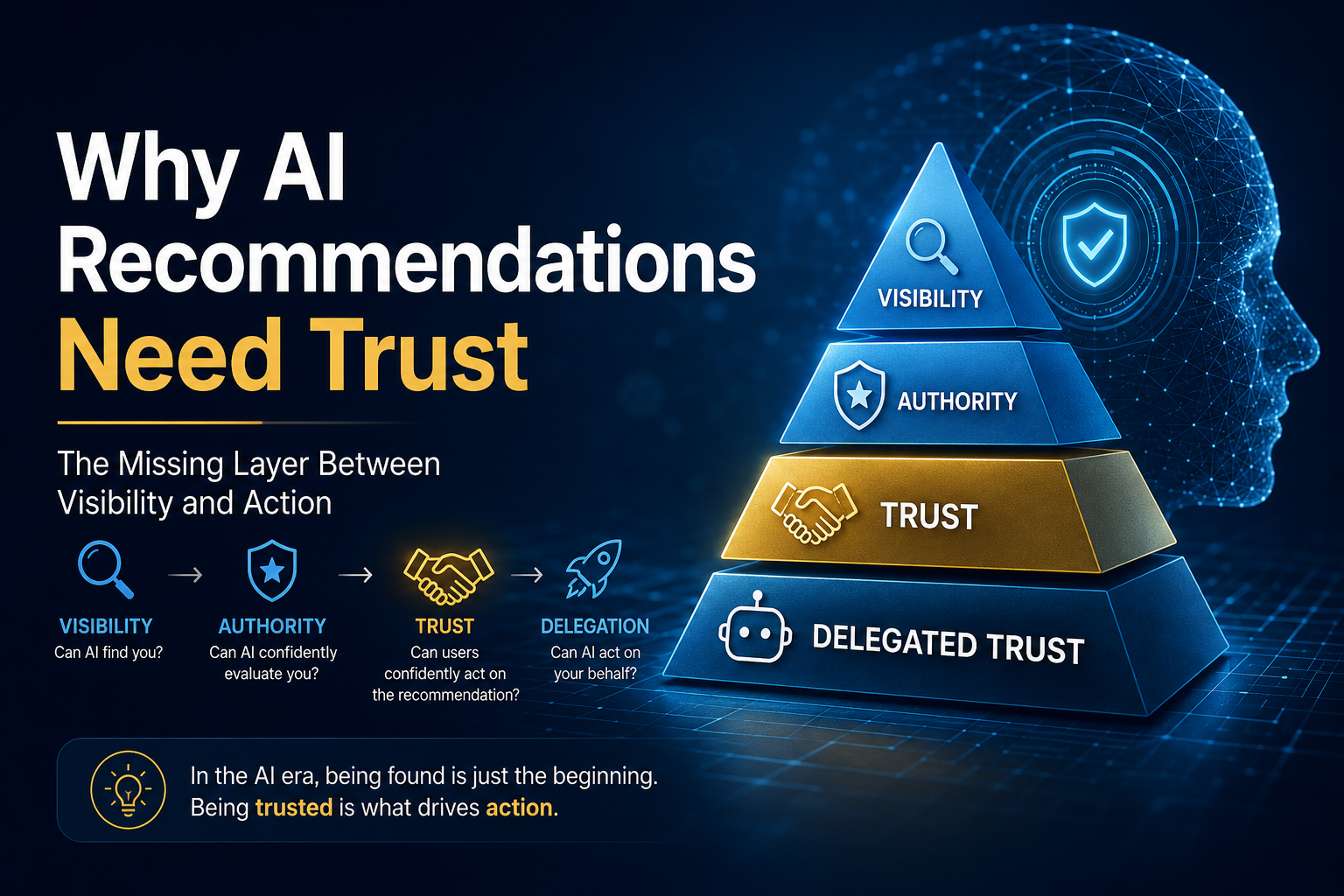
The Missing Layer Between Visibility And Action
For years, digital marketing has focused on visibility.
The objective was simple:
Be found.
Rank higher.
Generate more traffic.
Increase exposure.
This approach made sense in the era of traditional search because search engines primarily functioned as retrieval systems.
A user asked a question.
The search engine returned a list of possible answers.
The user decided what to trust.
But AI is changing that model.
Increasingly, AI systems are moving beyond retrieval and toward recommendation.
Instead of simply presenting information, they are helping users decide which information matters most.
And that shift introduces a new requirement:
Trust.
Because recommendation is fundamentally different from retrieval.
Retrieval helps users find answers.
Recommendation influences which answers they choose.
As AI becomes more involved in decision-making, trust becomes increasingly important.
The future of AI visibility is no longer just about being found.
It is about becoming trusted enough to be recommended.
The Emerging AI Decision Framework
As AI systems become more influential in discovery and decision-making, three layers are becoming increasingly important.
Visibility
Can AI find you?
Authority
Can AI confidently evaluate you?
Trust
Can users confidently act on the recommendation?
These layers build upon one another.
Without visibility, there is no discovery.
Without authority, there is no recommendation confidence.
Without trust, there is no action.
Many organizations continue focusing primarily on visibility.
But AI systems are increasingly operating across all three layers.
Understanding this progression may become one of the most important competitive advantages of the AI era.
Retrieval Requires Relevance
Traditional search systems were designed around relevance.
A user enters a query.
The search engine evaluates content.
The most relevant results are surfaced.
Success depends largely on signals such as:
- Keywords
- Semantic relevance
- Content quality
- Search intent alignment
- Technical accessibility
The system’s responsibility ends once information is presented.
The human decides what to trust.
In this environment, visibility is often enough.
If users can find you, they can evaluate you themselves.
This is why SEO became the dominant discipline of the search era.
Recommendations Require Confidence
AI recommendation systems operate differently.
When users ask:
- Which cybersecurity provider should I choose?
- Which CRM platform is best?
- Which consultant should I hire?
- Which solution is most reliable?
AI systems are increasingly expected to narrow the options.
The system is no longer simply retrieving information.
It is helping shape a decision.
That introduces risk.
A poor recommendation damages confidence.
A strong recommendation reinforces confidence.
This creates a new challenge for AI systems.
When multiple answers appear relevant, how does the system determine which answer deserves recommendation priority?
The answer increasingly comes down to confidence.
And confidence is built through trust signals.
Why AI Systems Need Trust Signals
AI systems operate in environments filled with uncertainty.
A search query may produce hundreds or thousands of acceptable answers.
Many pages may appear relevant.
Many brands may appear credible.
Many experts may appear qualified.
The challenge is determining which answer carries the lowest risk of disappointment.
This is where trust signals become valuable.
Trust signals help reduce uncertainty.
They provide evidence that an answer is more likely to be accurate, credible, and useful.
Examples include:
- Independent citations
- Expert references
- Consistent brand recognition
- Positive review signals
- Knowledge graph associations
- Third-party validation
- Demonstrated expertise
The more trust signals a source accumulates, the easier it becomes for AI systems to recommend it with confidence.
Trust is not simply a human concept.
Trust is increasingly becoming a decision-support mechanism.
Where AI Authority Fits
This is where AI Authority™ becomes important.
Many organizations still view AI visibility as a content problem.
Publish more articles.
Create more pages.
Produce more content.
But visibility alone does not create recommendation confidence.
AI systems need evidence.
They need signals.
They need reasons to believe one source is more credible than another.
AI Authority represents the accumulation of those signals.
It is not simply about being visible.
It is about becoming a recommendation candidate.
AI Authority develops when multiple signals reinforce one another:
- Consistent topical expertise
- Structured knowledge architecture
- Strong entity relationships
- Third-party citations
- Review and reputation signals
- Cross-platform validation
- Recognition within a trusted ecosystem
As these signals accumulate, recommendation confidence increases.
The organization becomes easier for AI systems to evaluate, understand, and recommend.
This is why authority increasingly matters more than exposure.
Visibility gets you considered.
Authority gets you shortlisted.
Trust gets you chosen.
Trust Reduces Decision Risk
At its core, trust functions as a risk-reduction mechanism.
Every recommendation carries uncertainty.
Every decision involves trade-offs.
The higher the stakes, the more important trust becomes.
This principle applies equally to humans and AI systems.
When uncertainty increases, trust becomes more valuable.
When consequences increase, trust becomes more valuable.
When decisions become more difficult, trust becomes more valuable.
Trust allows decisions to happen despite incomplete information.
This is why recommendation systems increasingly depend on trust signals.
Without trust, recommendations remain suggestions.
With trust, recommendations become actionable.
The Agentic AI Challenge
The importance of trust becomes even greater as AI evolves beyond recommendation.
The next stage is agentic AI.
Traditional AI systems assist decisions.
Agentic systems may increasingly participate in decisions.
Examples include:
- Booking services
- Purchasing products
- Selecting vendors
- Managing subscriptions
- Coordinating workflows
- Executing transactions
At this stage, AI is no longer simply recommending options.
It may be acting on behalf of users.
This changes the trust equation completely.
An AI system can retrieve information with minimal trust.
It can recommend information with moderate trust.
But it cannot safely act without significantly higher levels of trust.
The more autonomy an AI system receives, the more confidence it must have in the entities involved.
Trust becomes a prerequisite for delegation.
From Trust To Delegation
This is where the future may be heading.
The progression appears increasingly clear:
Visibility
AI can find you.
Authority
AI can evaluate you.
Trust
AI can recommend you.
Delegation
AI can act on your behalf.
Every stage increases the importance of trust.
Every stage increases the consequences of failure.
And every stage raises the standards required for recommendation confidence.
Organizations that understand this progression early may be better positioned for the next generation of AI-driven discovery.
Final Thought
The search era rewarded visibility.
The recommendation era rewards authority.
The agentic era may reward trust.
As AI systems become more influential in decision-making, recommendation confidence will become increasingly important.
Because the future of AI is not simply about what gets found.
It is about what gets recommended.
And ultimately, what becomes trusted enough for action.
TonyCWK Insight™
Visibility helps AI find you.
AI Authority helps AI recommend you.
Trust determines whether people act on the recommendation.
Delegated Trust determines whether AI can act on their behalf.
Frequently Asked Questions
Why do AI recommendations need trust?
AI recommendations influence decisions rather than simply presenting information. As AI systems move from retrieval to recommendation, trust helps reduce uncertainty and increases confidence that a recommendation is accurate, credible, and useful.
What is the difference between AI Visibility, AI Authority, and AI Trust?
AI Visibility determines whether AI systems can find your content. AI Authority determines whether AI systems view your brand or content as a credible recommendation candidate. AI Trust determines whether users are willing to act on the recommendation.
What are AI trust signals?
AI trust signals are indicators that help establish confidence in a source. Examples include third-party citations, expert references, customer reviews, entity recognition, knowledge graph associations, brand consistency, and demonstrated expertise.
Why is AI Authority important for recommendations?
AI Authority helps AI systems evaluate which sources are most credible when multiple relevant answers exist. The stronger the authority signals, the greater the likelihood that an organization becomes a recommendation candidate.
How does trust influence AI decision support?
Trust reduces decision risk. When AI systems recommend products, services, vendors, or experts, trust signals help increase confidence that the recommendation is likely to satisfy the user’s needs.
What is Delegated Trust?
Delegated Trust refers to the level of confidence required before AI systems can safely perform actions on behalf of users. It extends beyond recommendation and becomes increasingly important in agentic AI environments where systems may execute tasks or transactions autonomously.
How does agentic AI increase the importance of trust?
Agentic AI systems may perform actions such as purchasing products, booking services, selecting vendors, or managing workflows. Because these actions carry real-world consequences, trust becomes a prerequisite for delegation.
Is trust becoming more important than visibility?
Visibility remains essential because AI cannot recommend what it cannot find. However, as AI shifts toward recommendation and decision support, trust is becoming an increasingly important differentiator that influences whether recommendations lead to action.
What is the relationship between AI Authority and Delegated Trust?
AI Authority helps AI systems recommend an organization. Delegated Trust determines whether AI systems can confidently act on behalf of users based on those recommendations. Authority supports recommendation confidence, while Delegated Trust supports action confidence.
What is the future of AI-driven discovery?
The future of AI-driven discovery is likely to progress from Visibility to Authority, Trust, and Delegation. Organizations that build strong trust and authority signals may be better positioned as AI systems become more involved in decision-making and autonomous actions.
Written by Tony Chan (TonyCWK)
AI Authority & Digital Strategy Researcher
Leave a Reply