
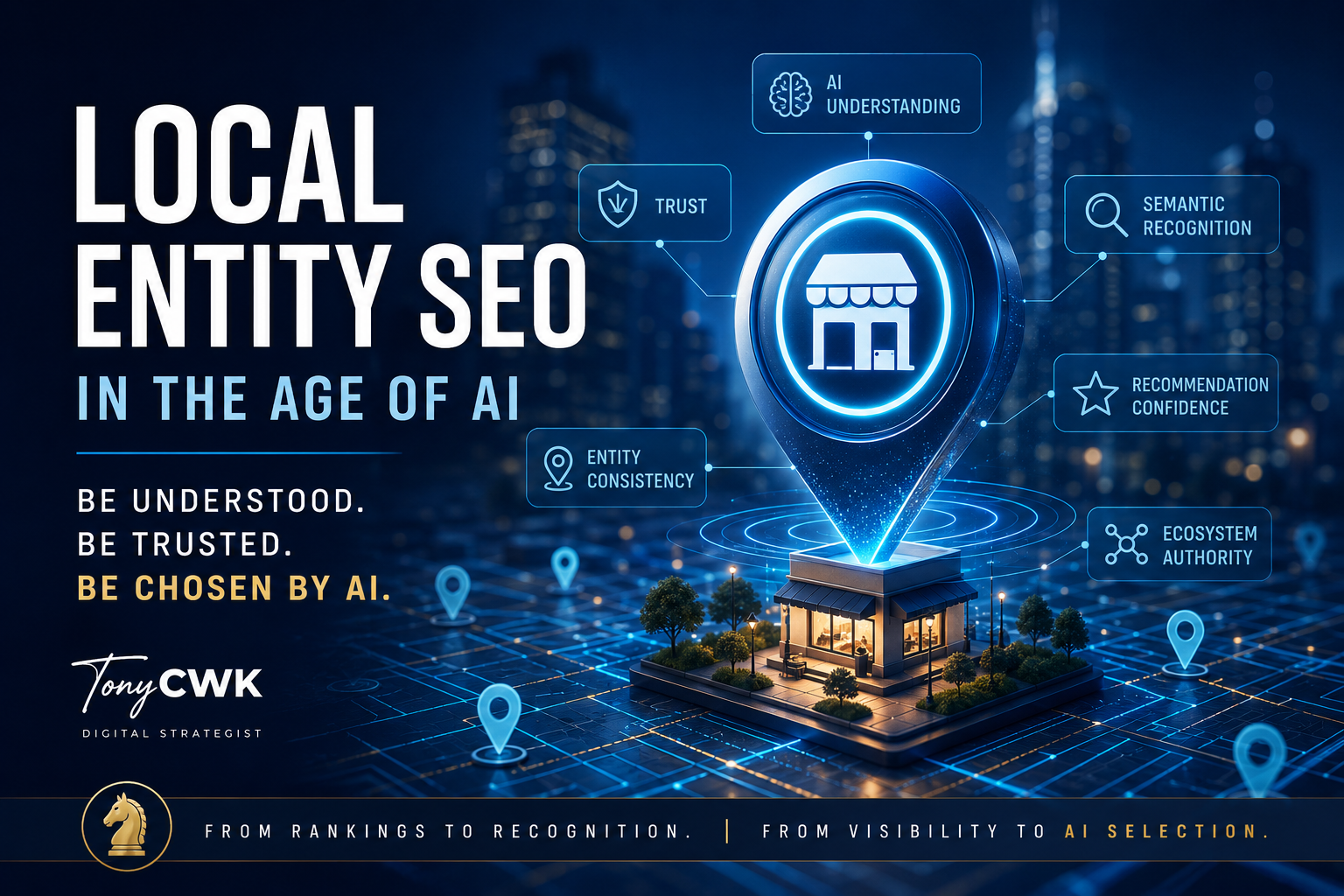
Why Local Businesses Must Optimize for AI Selection, Not Just Search Rankings
By Tony Chan (TonyCWK)
Executive Summary
Local SEO is no longer just about ranking on Google Maps or appearing in “near me” searches.
In the age of AI-powered discovery, local businesses are entering a new visibility economy — one where AI systems increasingly decide which businesses get recommended, cited, summarized, and surfaced inside conversational interfaces.
The future of local visibility is not merely:
- “Who ranks first?”
But:
- “Who gets selected by AI?”
This changes everything.
Traditional local SEO focused heavily on:
- Keywords
- Citations
- Reviews
- Directory listings
- Google Business Profile optimization
Those still matter.
But AI systems now evaluate something much deeper:
- Entity clarity
- Cross-platform consistency
- Structured knowledge architecture
- Reputation reinforcement
- Semantic trust
- Contextual authority
- Retrieval confidence
This is where Local Entity SEO becomes critical.
Businesses that fail to establish strong entity signals may remain technically searchable — yet become increasingly invisible inside AI-generated answers.
The brands that win in the next era will not simply optimize for clicks.
They will optimize for:
- AI retrieval
- AI understanding
- AI trust
- AI recommendation
- AI citation
And this creates a new competitive advantage for local businesses.
The Shift From Local SEO to Local Entity Authority
Traditional local SEO was built around location relevance.
AI discovery systems operate differently.
They attempt to understand:
- Who you are
- What you do
- Whether your business is trustworthy
- Whether your information is consistent
- Whether you are contextually associated with your industry
- Whether multiple sources validate your existence
This transforms local optimization from:
- “Location-based ranking”
Into:
- “Entity-based recognition.”
The implication is enormous.
A business can:
- Rank locally
- Have decent reviews
- Own a website
…yet still fail to become an AI-recognized entity.
Meanwhile, another smaller business with:
- Better semantic consistency
- Stronger structured data
- Better ecosystem validation
- Clearer expertise clustering
…may become the AI-preferred recommendation.
This is the beginning of AI-driven local selection systems.
What Is Local Entity SEO?
Local Entity SEO is the process of helping AI systems clearly understand:
- Your business identity
- Your location
- Your expertise
- Your services
- Your credibility
- Your relationships across the digital ecosystem
It goes beyond classic local optimization.
It focuses on making your business:
- Machine-readable
- AI-recognizable
- Contextually validated
- Semantically consistent
- Retrieval-friendly
In simpler terms:
Traditional Local SEO helps users find you.
Local Entity SEO helps AI systems understand and trust you.
Why AI Changes Local Search Forever
AI interfaces are changing how users discover local businesses.
Increasingly, users ask:
- “What’s the best chiropractor near me?”
- “Which accountant should I trust for SMEs?”
- “Recommend a reliable wedding photographer in Singapore.”
- “Which nearby café is good for remote work?”
The AI system may answer directly.
This means:
- Fewer clicks
- Fewer search result comparisons
- Fewer directory visits
The AI layer becomes the new gatekeeper.
And AI systems tend to prefer businesses with:
- Strong entity clarity
- Reliable ecosystem signals
- Consistent information
- Strong thematic relevance
- Reinforced trust markers
This means local visibility is becoming:
- An AI trust problem
—not merely— - A keyword optimization problem
The 5 Pillars of Local Entity SEO
1. Entity Consistency
AI systems compare information across:
- Website
- Google Business Profile
- Directories
- Reviews
- Citations
- Mentions
Inconsistency weakens confidence.
Critical consistency areas:
- Business name
- Address
- Phone number
- Website URL
- Service descriptions
- Categories
- Branding terminology
AI systems reward businesses with:
- Stable digital identities
- Consistent semantic references
- Reinforced entity associations
2. Structured Knowledge Architecture
AI systems rely heavily on structure.
This includes:
- Schema markup
- Service pages
- FAQ structure
- Internal linking
- Location pages
- Topical clustering
A local business website should function like:
Not merely:
- A digital brochure
Important schema types include:
- LocalBusiness
- Organization
- FAQPage
- Service
- Person
- Review
- GeoCoordinates
Structured architecture improves:
- Retrieval confidence
- AI parsing
- Citation probability
- Knowledge graph association
3. Thematic Local Authority
AI systems evaluate whether your business demonstrates:
- Repeated expertise
- Topical depth
- Industry association
For example:
A chiropractic clinic should not only have:
- A homepage
- A services page
It should also build:
- Educational articles
- Treatment explainers
- FAQs
- Condition-specific pages
- Local wellness content
- Expert commentary
AI systems interpret this as:
- Expertise reinforcement
This increases:
- Selection likelihood
- Citation trust
- Topical authority
4. Ecosystem Credibility Signals
AI systems do not trust websites in isolation.
They compare external validation signals such as:
- Reviews
- Directory mentions
- Media features
- Social profiles
- Industry associations
- Partnerships
- Citations
- Local news mentions
This creates:
The stronger the ecosystem validation:
- The higher the AI trust confidence
This is why Digital PR increasingly matters for local businesses.
5. AI Retrieval Optimization
Modern local visibility requires optimization for:
- Retrieval systems
- Vector search
- Semantic matching
- AI summarization
This means content should be:
- Clear
- Context-rich
- Structured
- Natural language oriented
- Question-answer optimized
Businesses should increasingly create:
Not merely:
- SEO landing pages
The Rise of AI-Selected Local Businesses
We are entering a world where:
- AI assistants recommend service providers
- AI summarizes local options
- AI filters choices before users even browse
This changes competitive dynamics dramatically.
The future winner may not be:
- The business with the biggest ad budget
But rather:
- The business with the strongest AI-understood authority footprint
This creates a major opportunity for SMEs.
Because AI systems often prioritize:
- clarity
- trust
- structure
- semantic relevance
Over:
- sheer brand size
Why Most Local Businesses Are Still Unprepared
Most local businesses still optimize primarily for:
- Keywords
- Basic listings
- Ads
- Star ratings
Few are preparing for:
- AI retrieval systems
- AI recommendation models
- Entity-based discovery
- Semantic trust evaluation
This creates a temporary competitive gap.
Businesses that build strong local entity authority now may gain:
- Early AI visibility advantages
- Higher recommendation likelihood
- Stronger AI citation probability
- Better long-term discoverability
Before the majority adapts.
The Future of Local Discovery
The future of local discovery will increasingly depend on:
- Entity clarity
- Knowledge architecture
- Trust reinforcement
- Ecosystem validation
- AI readability
Search engines are evolving into:
- recommendation engines
- answer systems
- AI-mediated discovery layers
This means local businesses must evolve from:
- SEO-first thinking
To:
- AI selection-first thinking
The future belongs to businesses that become:
- understandable
- trustworthy
- structured
- retrievable
- recommendable
By both humans and machines.
Final Thought
Local SEO is no longer only about visibility inside search engines.
It is increasingly about:
- visibility inside AI systems.
In the AI era:
- Rankings matter less without recognition.
- Traffic matters less without selection.
- Presence matters less without trust.
The next evolution of local marketing is not just local SEO.
It is:
Local Entity Authority.
And the businesses that master it early may dominate the next generation of AI-powered local discovery.
Key Insights
- AI systems increasingly select local businesses directly inside conversational interfaces.
- Local Entity SEO focuses on AI understanding, trust, and retrieval.
- Structured knowledge architecture is becoming critical for local discoverability.
- Entity consistency across platforms strengthens AI confidence.
- AI systems evaluate ecosystem credibility, not just websites alone.
- Local visibility is shifting from ranking optimization to AI selection optimization.
- SMEs can outperform larger competitors through stronger AI entity clarity.
Frequently Asked Questions (FAQ)
What is Local Entity SEO?
Local Entity SEO is the practice of optimizing a business for AI understanding, semantic recognition, and trust-based retrieval across search engines and AI systems.
How is Local Entity SEO different from traditional Local SEO?
Traditional Local SEO focuses on rankings and map visibility. Local Entity SEO focuses on AI recognition, entity consistency, structured knowledge, and retrieval confidence.
Why is AI changing local search?
AI systems increasingly answer local queries directly instead of showing lists of search results, making AI recommendation and selection more important.
What are entity signals?
Entity signals are consistent digital indicators that help AI systems understand a business identity, services, expertise, and credibility.
Does Google Business Profile still matter?
Yes. Google Business Profile remains a critical entity validation source for local businesses.
Why is structured data important for local businesses?
Structured data helps AI systems interpret business information accurately and increases machine readability.
Can small businesses compete with large brands in AI search?
Yes. AI systems often reward clarity, trust, relevance, and semantic consistency rather than just brand size.
What role do reviews play in AI visibility?
Reviews contribute to trust reinforcement signals that help AI systems evaluate credibility.
How does content affect Local Entity SEO?
Educational and expertise-driven content strengthens thematic authority and improves AI understanding.
What is AI retrieval optimization?
AI retrieval optimization focuses on structuring content so AI systems can easily retrieve, interpret, and summarize it.
Suggested Further Reading
- “The AI Authority Pyramid™”👉 https://tonycwk.com/ai-authority-pyramid/
- “Why AI Doesn’t Trust Content — It Trusts Systems”👉 https://tonycwk.com/why-ai-doesnt-trust-content-it-trusts-systems/
- “How AI Systems Build Trust”👉https://tonycwk.com/why-ai-doesnt-trust-content-it-trusts-systems/
- “Digital PR → AI Authority Mapping Framework”👉 https://tonycwk.com/digital-pr-ai-authority-mapping-framework/
- “Selection Rate vs Click-Through Rate”👉https://tonycwk.com/selection-rate-vs-click-through-rate/
- “Entity Persistence in the Age of LLMs”👉 https://tonycwk.com/entity-persistence-in-the-age-of-llms/
- “AI Discovery Flywheel™”👉 https://tonycwk.com/ai-discovery-flywheel/
- “AI Memory Architecture™”👉 https://tonycwk.com/ai-memory-architecture/
- “Authority Velocity Metrics👉https://tonycwk.com/authority-velocity-metrics/
Leave a Reply