
The AI Era Rewards Clarity, Speed, and Trust — Not Just Scale
In traditional digital marketing, large corporations had overwhelming advantages.
They had:
- Bigger advertising budgets
- Larger SEO teams
- Stronger domain authority
- More backlinks
- More content production capacity
- More distribution power
But AI discovery is changing the rules.
In AI-powered search and recommendation systems, visibility is no longer determined purely by size.
It is increasingly determined by selection probability.
And this creates one of the biggest strategic shifts of the AI era:
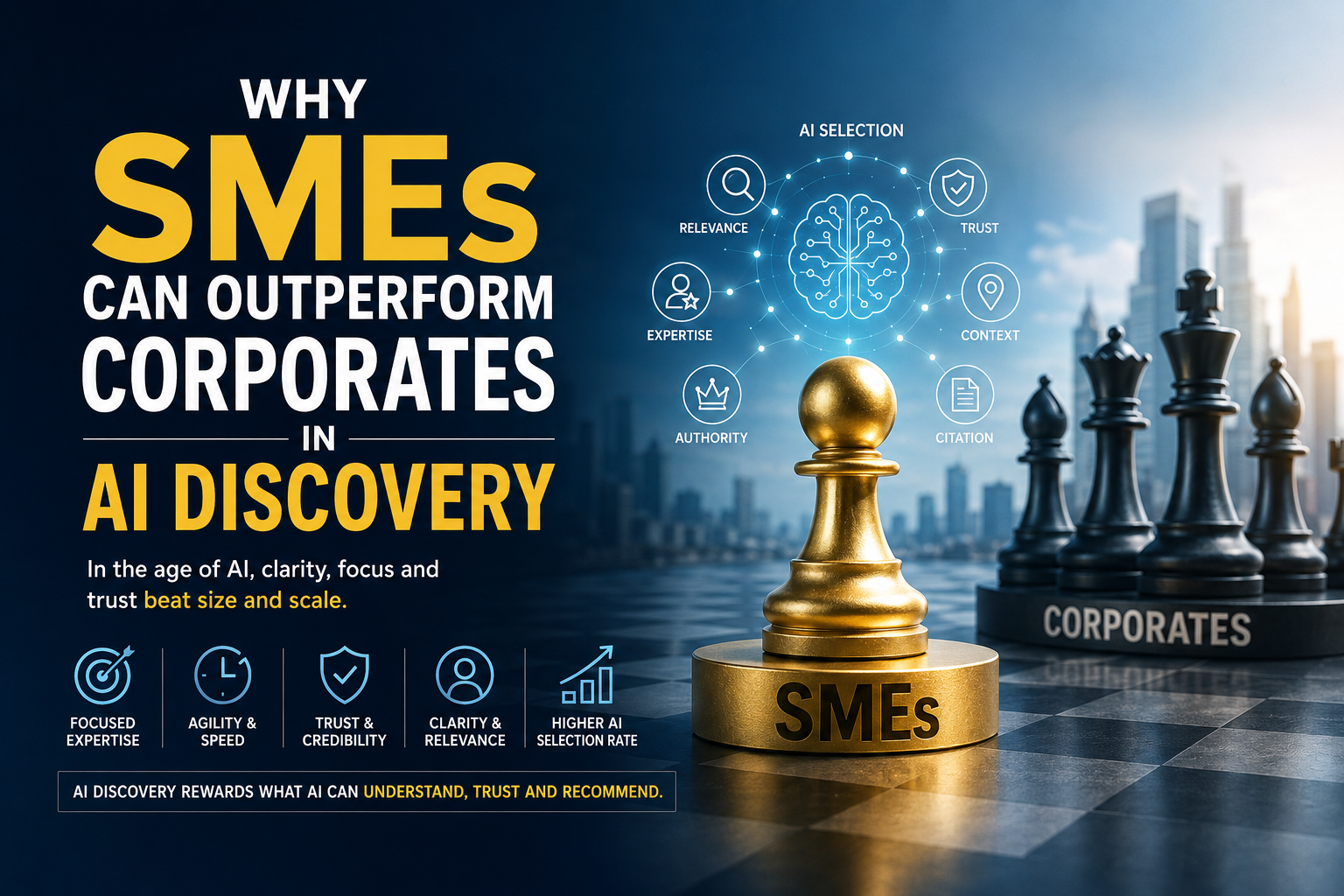
SMEs can now outperform corporates in AI discovery ecosystems.
Not because SMEs possess greater scale
But because they can often become:
- clearer,
- faster,
- more focused,
- more trusted,
- and more structurally understandable to AI systems.
The future does not automatically belong to the biggest brands.
It belongs to the most selectable brands.
The Shift From Search Ranking to AI Selection
Traditional SEO was largely a ranking competition.
The objective was:
- rank higher,
- dominate SERPs,
- acquire traffic,
- and win clicks.
But AI systems operate differently.
Modern AI discovery systems increasingly:
- summarize,
- synthesize,
- recommend,
- cite,
- rerank,
- and compress information into direct answers.
This means users often never see:
- 10 blue links,
- multiple competitors,
- or full search result pages.
Instead, AI systems select a smaller set of entities to surface.
This changes the competitive equation entirely.
The question is no longer:
“Who ranks highest?”
The new question becomes:
“Who does the AI trust enough to select?”
That distinction changes everything.
Why Scale Can Become a Weakness
Large corporations often assume AI discovery will favor them automatically.
But AI systems do not reward organizational size alone.
In many cases, scale introduces friction.
Large organizations frequently struggle with:
- fragmented messaging,
- inconsistent knowledge structures,
- departmental silos,
- slow content approval cycles,
- diluted expertise,
- generic positioning,
- excessive corporate language,
- and weak entity clarity.
Ironically, the very scale that helped corporations dominate traditional SEO can reduce AI selection efficiency.
AI systems prefer:
- semantic clarity,
- topical consistency,
- structured expertise,
- recognizable authority,
- and trust reinforcement.
Large organizations often produce massive amounts of content without maintaining strong thematic coherence.
This creates ambiguity.
And ambiguity reduces AI confidence.
SMEs Have Structural Advantages in AI Discovery
SMEs possess several natural advantages in AI ecosystems.
1. Faster Authority Specialization
SMEs can become deeply focused on a narrow expertise area much faster than corporates.
Instead of trying to serve everyone, SMEs can dominate a precise niche.
For example:
- a cybersecurity SME specializing in ransomware recovery,
- a local legal consultancy focused on SME compliance,
- a chiropractor serving desk-bound professionals,
- or a boutique AI consultancy focused on AI discoverability.
AI systems often reward:
- depth over breadth,
- specificity over generalization,
- and clarity over scale.
Focused topical authority is easier for AI systems to interpret and trust.
2. Stronger Entity Clarity
Corporates often have:
- multiple divisions,
- conflicting brand narratives,
- inconsistent messaging,
- and broad positioning.
SMEs can maintain a highly coherent entity identity.
AI systems understand entities through:
- repetition,
- semantic consistency,
- structured associations,
- and recurring expertise patterns.
The clearer the entity,
the easier it becomes for AI systems to:
- classify,
- contextualize,
- and recommend it.
This is a major advantage.
3. SMEs Can Move Faster
AI ecosystems evolve rapidly.
Large corporations often require:
- approvals,
- compliance reviews,
- multi-team coordination,
- legal vetting,
- and executive alignment.
SMEs can:
- publish faster,
- adapt faster,
- experiment faster,
- and reinforce authority faster.
In AI discovery systems, velocity matters.
Entities that continuously reinforce expertise signals can compound authority faster than slower-moving competitors.
This aligns strongly with the TonyCWK concept of Authority Velocity Metrics.
AI systems do not only evaluate authority statically.
They increasingly evaluate:
- momentum,
- reinforcement frequency,
- ecosystem consistency,
- and discovery acceleration.
AI Prefers Confidence Over Ambiguity
One of the most misunderstood realities of AI discovery is this:
AI systems are fundamentally probability engines.
They attempt to reduce uncertainty.
When AI selects a source, it is effectively making a confidence decision.
This means AI often prefers:
- specialized expertise,
- consistent signals,
- narrow authority domains,
- and reinforced credibility patterns.
SMEs can outperform corporates because they often communicate with:
- clearer positioning,
- stronger focus,
- and less ambiguity.
A smaller but highly coherent entity can become more AI-selectable than a larger but fragmented brand.
This is one reason why niche creators, boutique firms, and specialist consultancies increasingly appear in AI-generated answers.
The Real Competitive Advantage Is Not Budget — It Is Structured Trust
Many businesses still believe AI visibility will primarily be purchased.
But AI systems cannot simply be “ad-bought” the same way search clicks were.
AI systems increasingly evaluate:
- semantic trust,
- ecosystem reinforcement,
- citation consistency,
- structured expertise,
- and contextual relevance.
This means SMEs can compete asymmetrically.
A focused SME with:
- clear expertise,
- strong knowledge architecture,
- entity consistency,
- and ecosystem credibility
can outperform a massive organization producing generic content at scale.
The AI era rewards:
- trust density,
- not content volume.
Why Local SMEs May Become Extremely Powerful in AI Discovery
Local businesses are particularly well-positioned.
Why?
Because local intent naturally favors:
- precision,
- proximity,
- specialization,
- and contextual trust.
For example, an AI system answering:
“Who is the best chiropractor for office workers in Singapore?”
may prefer:
- a highly specialized local clinic
over - a massive generic healthcare brand.
Why?
Because:
- the entity specialization is clearer,
- the contextual match is stronger,
- and the expertise narrative is more focused.
This is why local entity authority may become one of the most important strategic opportunities for SMEs in the AI era.
The Future Belongs to Selectable SMEs
The AI era is not eliminating competition.
It is redistributing advantage.
Traditional digital systems rewarded:
- scale,
- budget,
- backlinks,
- and distribution dominance.
AI discovery increasingly rewards:
- clarity,
- trust,
- consistency,
- structure,
- specialization,
- and authority reinforcement.
This creates a historic opportunity for SMEs.
For the first time in digital history, smaller businesses can compete asymmetrically against much larger organizations — not by outspending them, but by becoming more AI-selectable.
The future will not belong solely to the largest brands.
It will belong to the brands AI systems understand, trust, and repeatedly select.
And in many cases, that advantage may favor SMEs.
The TonyCWK Perspective
The future of visibility is no longer purely about ranking.
It is about:
- selection,
- recommendation,
- citation,
- and trust probability.
This is why the next era of digital competition will not be dominated only by corporations with the largest budgets.
It will increasingly be shaped by entities with:
- the clearest authority,
- the strongest knowledge architecture,
- the most reinforced ecosystem trust,
- and the highest AI selection confidence.
In the AI era:
SMEs do not need to become bigger than corporates.
They need to become more selectable.
FAQ Section
1. Why can SMEs outperform corporates in AI discovery?
SMEs can outperform corporates because AI discovery rewards clarity, specialization, consistency, and trust signals. Smaller businesses often have sharper positioning and faster execution than large organizations with complex structures.
2. Does AI discovery favor large brands automatically?
No. Large brands may have more authority signals, but AI systems do not rely on size alone. They also evaluate relevance, clarity, expertise, trust, and contextual fit.
3. What is AI discovery?
AI discovery refers to how AI-powered systems find, evaluate, select, cite, and recommend brands, businesses, content, or experts in response to user intent.
4. Why are SMEs well-positioned for AI discovery?
SMEs are often more focused, agile, and easier for AI systems to understand. Their expertise can be more concentrated around a specific niche, location, audience, or problem.
5. How is AI discovery different from traditional SEO?
Traditional SEO focuses heavily on ranking and clicks. AI discovery focuses more on selection, recommendation, citation, and trust-based visibility inside AI-generated answers.
6. Can a small business beat a corporate brand in AI search?
Yes, especially when the small business has stronger niche relevance, clearer entity identity, better structured content, and stronger contextual authority for a specific query.
7. Why does entity clarity matter for SMEs?
Entity clarity helps AI systems understand who the business is, what it does, who it serves, and why it should be trusted. Without clear entity signals, AI systems may struggle to classify or recommend the brand.
8. What advantages do SMEs have over corporates?
SMEs often have advantages in speed, specialization, messaging consistency, local relevance, and authority concentration. These traits can improve AI selection probability.
9. What weaknesses do corporates have in AI discovery?
Corporates may suffer from fragmented messaging, slow approvals, generic content, complex brand structures, and diluted expertise signals. These can reduce AI confidence.
10. How can SMEs improve their AI discovery visibility?
SMEs should build clear topic clusters, use structured content, strengthen entity signals, create authoritative educational content, earn credible mentions, and maintain consistent messaging across platforms.
11. Is AI discovery only about content creation?
No. Content is important, but AI discovery also depends on knowledge architecture, credibility signals, structured data, external mentions, reviews, consistency, and ecosystem trust.
12. Why does specialization matter in AI discovery?
Specialization reduces ambiguity. AI systems are more likely to select an entity when its expertise is clearly associated with a specific topic, audience, location, or problem.
13. Can local SMEs benefit from AI discovery?
Yes. Local SMEs can benefit significantly because AI systems often need specific, contextual answers for location-based queries, such as trusted providers, local experts, or niche service businesses.
14. What is the biggest mistake SMEs make in AI discovery?
The biggest mistake is trying to sound too broad or generic. SMEs should not imitate large corporates. They should strengthen their specialist authority and make their expertise unmistakable.
15. How does this connect to the AI Authority Pyramid™?
The AI Authority Pyramid™ provides the structural foundation for AI discovery. SMEs can use it to build authority content, AI-readable knowledge architecture, thematic depth, credibility signals, and algorithmic recognition.
16. Will paid ads replace AI authority for SMEs?
No. Paid ads may still create visibility, but AI authority builds long-term trust and selection probability. SMEs should not rely only on paid visibility in AI-driven environments.
17. What is the future of SME visibility in AI?
The future of SME visibility will depend on becoming more understandable, trusted, and selectable by AI systems. SMEs that build clear authority ecosystems can compete strongly against larger brands.
Suggested Further Reading
- “The AI Authority Pyramid™”👉 https://tonycwk.com/ai-authority-pyramid/
- “Why AI Doesn’t Trust Content — It Trusts Systems” 👉 https://tonycwk.com/why-ai-doesnt-trust-content-it-trusts-systems/
- “How Small Brands Beat Large Brands in AI” 👉 https://tonycwk.com/how-small-brands-beat-large-brands-in-ai/
- “Local Entity SEO in the Age of AI” 👉 https://tonycwk.com/local-entity-seo-in-the-age-of-ai/
- “Selection Rate vs Click-Through Rate” 👉https://tonycwk.com/selection-rate-vs-click-through-rate/
- “Digital PR → AI Authority Mapping Framework” 👉 https://tonycwk.com/digital-pr-ai-authority-mapping-framework/
- “Entity Persistence in the Age of LLMs” 👉 https://tonycwk.com/entity-persistence-in-the-age-of-llms/
- “How AI Systems Build Trust” 👉 https://tonycwk.com/how-ai-systems-build-trust/
- “AI Selection Psychology™ 👉https://tonycwk.com/ai-selection-psychology/
Written by Tony Chan (TonyCWK)
AI Authority & Digital Strategy Researcher
Leave a Reply