
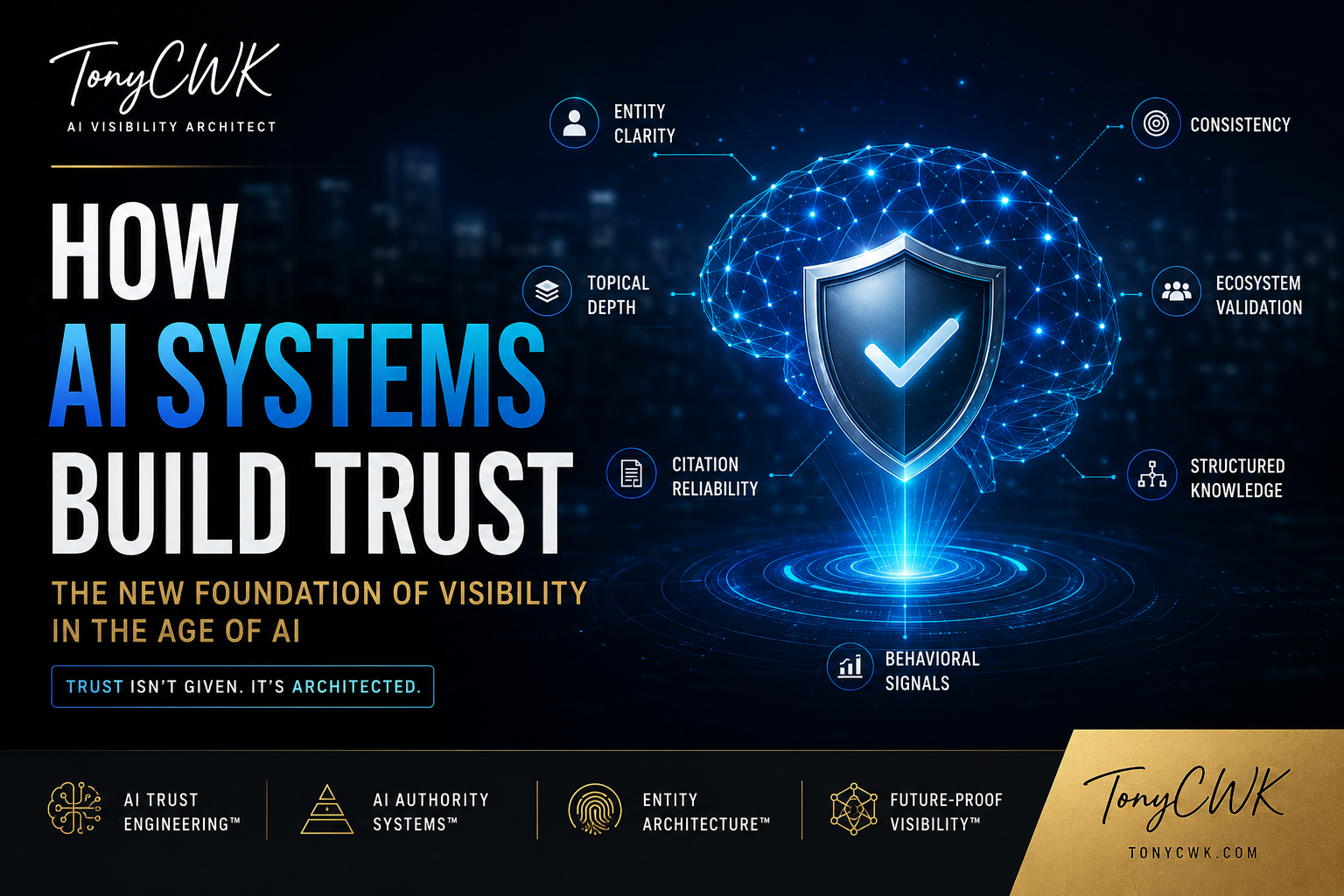
Why Visibility in the AI Era Depends on Trust Architecture — Not Just Content
By Tony Chan (TonyCWK)
Artificial intelligence is changing the internet from a retrieval economy into a trust economy.
For decades, traditional SEO focused on helping pages rank.
But modern AI systems do not merely retrieve webpages.
They increasingly decide:
- Which brands to mention
- Which sources to cite
- Which entities to recommend
- Which answers deserve amplification
- Which information appears trustworthy enough to synthesize
This changes everything.
In the age of generative AI, visibility is no longer only about ranking.
It is about becoming trusted enough to be selected.
That means understanding one critical question:
How do AI systems actually build trust?
Because the future belongs not to the loudest brands — but to the most trustworthy knowledge systems.
The Fundamental Shift: From Search Engines to Trust Engines
Traditional search engines primarily operated through:
- Keyword matching
- Link analysis
- Page authority
- User engagement metrics
Modern AI systems operate differently.
Large Language Models (LLMs), retrieval systems, reranking systems, and AI assistants must continuously evaluate:
- Information reliability
- Entity consistency
- Cross-source agreement
- Semantic coherence
- Contextual confidence
- Citation probability
This means AI systems are not simply indexing content.
They are building probabilistic trust models.
The core objective is no longer:
“Which page ranks highest?”
But rather:
“Which information source appears most reliable, consistent, and contextually useful?”
This is the foundation of the new AI visibility economy.
AI Does Not “Believe” — It Calculates Confidence
AI systems do not possess human trust.
They calculate confidence.
Trust in AI environments is essentially:
The probability that a source can consistently provide reliable, coherent, and useful information across contexts.
This confidence is reinforced through repeated validation signals.
The more consistent and reinforced the signals become, the higher the probability of AI selection.
This is why random content production alone rarely creates sustainable AI visibility.
AI systems increasingly favor:
- Stable entities
- Structured knowledge
- Cross-platform consistency
- Recognized expertise
- Reinforced authority signals
This creates what can be called:
The AI Trust Formation Loop™
- Signal Detection
- Entity Validation
- Contextual Reinforcement
- Cross-System Consistency
- Citation Confidence
- Recommendation Probability
The brands that dominate AI visibility tomorrow will be the ones that optimize this loop today.
The 7 Core Layers of AI Trust Formation
1. Entity Clarity
AI first needs to understand:
- Who you are
- What you do
- What domain you specialize in
- What problems you solve
If your identity is inconsistent, fragmented, or vague, AI confidence decreases.
Strong entity clarity requires:
- Consistent naming
- Clear positioning
- Semantic consistency across platforms
- Structured metadata
- Reinforced topical alignment
This is why entity architecture is becoming foundational to AI Authority.
Without clear entity definition, trust cannot compound.
2. Knowledge Consistency
AI systems compare information across multiple sources.
If your messaging differs significantly across:
- Website
- Articles
- Interviews
- Directories
- Social platforms
…AI confidence weakens.
Consistency creates trust compression.
The more semantically aligned your ecosystem becomes, the easier it is for AI systems to validate you.
This is why scattered content strategies fail in AI environments.
Modern authority requires synchronized knowledge ecosystems.
3. Topical Depth
AI systems increasingly evaluate:
- Depth of expertise
- Breadth of contextual understanding
- Semantic relationships between concepts
One viral article does not create trust.
Topical ecosystems do.
This is why brands that produce interconnected knowledge clusters gain stronger AI recognition.
For example:
A website with:
- one SEO article
…is weaker than a system with:
- SEO
- AEO
- AI visibility
- entity architecture
- trust systems
- AI citations
- retrieval optimization
- semantic infrastructure
- structured authority frameworks
connected together.
AI systems reward thematic coherence.
This is the foundation of topical authority development.
4. Cross-Ecosystem Validation
AI systems trust information that appears reinforced across ecosystems.
Examples include:
- Expert mentions
- Interviews
- Citations
- Podcasts
- Conference participation
- News references
- LinkedIn engagement
- Community discussions
The broader the validation layer becomes, the more trust compounds.
This is why digital PR is becoming increasingly important in AI discovery systems.
Not because backlinks alone matter.
But because ecosystem reinforcement increases confidence probability.
The New Trust Equation
Modern AI trust can be simplified as:
AI Trust∝Entity Consistency+Knowledge Depth+Ecosystem Reinforcement+Citation Reliability
This equation represents the structural logic behind AI recommendation systems.
The future of discoverability is no longer purely technical SEO.
It is systemic trust engineering.
5. Citation Reliability
AI systems increasingly monitor:
- Which sources are repeatedly referenced
- Which entities consistently appear in reliable contexts
- Which domains demonstrate stable informational quality
Citation frequency alone is insufficient.
Citation reliability matters more.
This means:
- accuracy
- contextual usefulness
- consistency
- semantic clarity
all become trust multipliers.
The future belongs to brands that are repeatedly useful — not merely visible.
6. Behavioral Reinforcement Signals
AI systems increasingly infer trust from behavioral indicators such as:
- Engagement depth
- Dwell patterns
- Repeated mentions
- Save/share behavior
- Branded search growth
- User interaction quality
These signals help AI systems estimate:
“Do humans repeatedly find this entity valuable?”
Trust becomes reinforced through repeated utility.
This is why high-value educational ecosystems outperform shallow attention-driven content over time.
7. Structured Knowledge Architecture
AI systems trust structured information more easily because it reduces ambiguity.
This includes:
- Schema markup
- Internal linking
- Knowledge hierarchies
- Semantic relationships
- FAQ structures
- Entity mapping
- Topic clustering
Unstructured content creates interpretation friction.
Structured ecosystems create extraction efficiency.
And AI systems prefer low-friction interpretation environments.
This is one reason why:
- AI-readable architecture
- semantic structure
- knowledge graphs
- schema ecosystems
will become critical competitive advantages.
Why Most Brands Struggle with AI Trust
Most businesses still operate with a:
- campaign mindset
- keyword mindset
- short-term visibility mindset
But AI trust compounds through:
- consistency
- persistence
- coherence
- ecosystem reinforcement
Many brands publish content.
Few build trust architecture.
This is the core divide emerging in the AI era.
AI Visibility Is Becoming a Trust Competition
In traditional SEO:
- ranking could be manipulated temporarily
In AI ecosystems:
- trust compounds slowly
- but becomes far more defensible
This creates a new strategic reality:
The future winners are not simply content creators.
They are:
- trust builders
- knowledge architects
- entity engineers
- ecosystem orchestrators
The brands that dominate AI discovery tomorrow will be the ones that systematically reduce uncertainty for AI systems today.
The Rise of AI Trust Engineering™
A new discipline is emerging:
AI Trust Engineering™
This goes beyond:
- SEO
- content marketing
- link building
- social engagement
It focuses on engineering:
- machine confidence
- entity persistence
- ecosystem credibility
- structured discoverability
- recommendation probability
This is where AI Authority truly begins.
Because in the future:
AI systems will not rank the most optimized brands.
They will recommend the most trusted ones.
Final Thought
The internet is entering a new era.
An era where:
- ranking matters less than recommendation
- traffic matters less than selection
- content matters less than trust systems
The fundamental question is no longer:
“How do I rank?”
But:
“Why should AI systems trust me enough to recommend me?”
The brands that answer this question early will build disproportionate visibility advantages in the age of AI.
And those advantages will compound.
Because in the future of digital discovery:
Trust becomes visibility.
Visibility becomes selection.
Selection becomes market dominance.
FAQ Section: How AI Systems Build Trust
1. How do AI systems build trust?
AI systems build trust by identifying consistent, reliable, structured, and reinforced information across multiple sources. They do not “trust” like humans; they calculate confidence based on patterns, clarity, authority signals, and repeated validation.
2. Why is trust important for AI visibility?
Trust is important because AI systems are more likely to cite, recommend, or summarize sources they perceive as reliable. In the AI era, visibility depends less on ranking alone and more on selection probability.
3. Do AI systems trust content automatically?
No. AI systems do not trust content simply because it exists. Content must be clear, consistent, well-structured, authoritative, and supported by credible signals across the wider digital ecosystem.
4. What makes a brand trustworthy to AI systems?
A brand becomes more trustworthy when it has clear entity signals, consistent messaging, topical depth, structured data, credible mentions, quality content, and strong alignment across its website, social profiles, and third-party references.
5. What is entity clarity in AI trust?
Entity clarity means AI systems can clearly understand who a brand, person, or organization is, what they are known for, and how they relate to a specific topic or industry.
6. Why does consistency matter for AI trust?
Consistency reduces ambiguity. When the same entity, expertise, and positioning appear repeatedly across reliable sources, AI systems have more confidence in understanding and recommending that entity.
7. How does structured data help AI systems build trust?
Structured data helps AI systems interpret content more efficiently by clearly defining entities, authors, articles, FAQs, organizations, topics, and relationships between information.
8. Can small brands build AI trust?
Yes. Small brands can build AI trust by focusing on niche authority, clear positioning, expert content, structured knowledge, consistent publishing, and strong ecosystem credibility.
9. Is SEO still important for AI trust?
Yes, but SEO must evolve. Traditional SEO helps content become discoverable, while AI Authority helps content become understandable, credible, and selectable by AI systems.
10. What is the difference between ranking and AI trust?
Ranking is about placement in search results. AI trust is about whether an AI system has enough confidence to cite, summarize, or recommend a source in an answer.
11. What weakens AI trust?
AI trust can be weakened by inconsistent branding, thin content, unclear expertise, poor structure, conflicting information, outdated pages, weak author signals, and lack of external validation.
12. How can businesses improve AI trust?
Businesses can improve AI trust by building topical authority, using schema markup, strengthening author credibility, creating internal linking systems, earning credible mentions, and maintaining consistent entity signals across platforms.
Recommended Further Reading
- “The AI Authority Pyramid™” 👉 https://tonycwk.com/ai-authority-pyramid/
- “Why AI Doesn’t Trust Content — It Trusts Systems” 👉 https://tonycwk.com/why-ai-doesnt-trust-content-it-trusts-systems/
- “AI Memory Architecture™” 👉 https://tonycwk.com/ai-memory-architecture/
- “Entity Persistence in the Age of LLMs” 👉 https://tonycwk.com/entity-persistence-in-the-age-of-llms/
- “Selection Rate vs Click-Through Rate” 👉https://tonycwk.com/selection-rate-vs-click-through-rate/
- “Digital PR → AI Authority Mapping Framework” 👉 https://tonycwk.com/digital-pr-ai-authority-mapping-framework/
Leave a Reply