
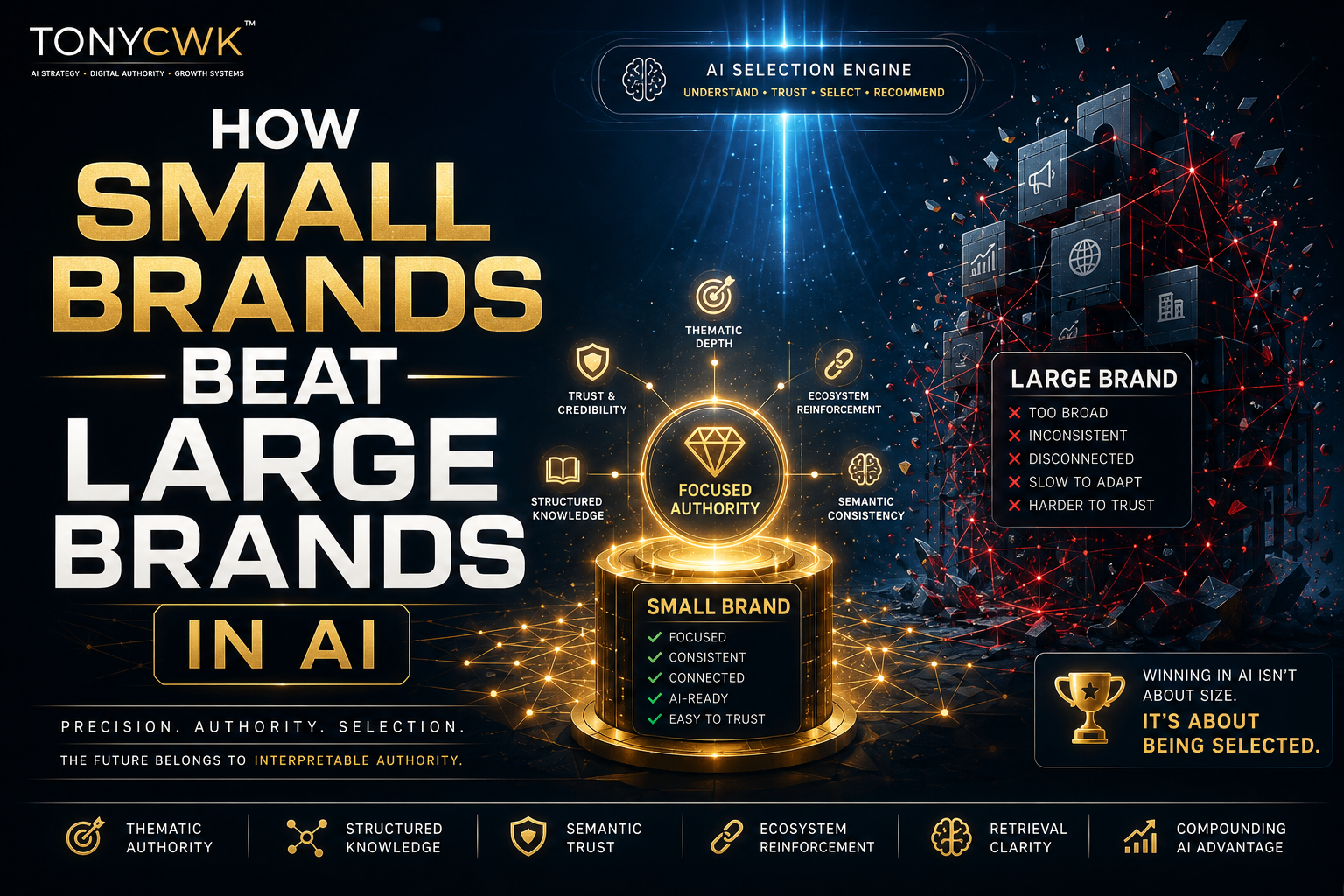
Why AI Selection Is Rewriting Competitive Advantage
The New Competitive Reality
For decades, large brands dominated digital visibility through scale.
They had:
- Bigger ad budgets
- Larger SEO teams
- More backlinks
- Higher domain authority
- Massive content production capacity
In traditional search environments, scale often won.
But AI changes the rules.
Large Language Models (LLMs), AI search systems, retrieval engines, and answer interfaces are not merely ranking pages anymore.
They are selecting answers.
And in selection systems, precision frequently beats scale.
This is why many smaller brands are beginning to outperform much larger competitors in AI-driven visibility environments.
Not because they publish more.
But because they are:
- More focused
- More structurally coherent
- More topically authoritative
- More semantically consistent
- Easier for AI systems to trust
The future of visibility may belong less to the largest brand…
…and more to the most interpretable authority.
The Shift From “Ranking Competition” to “Selection Competition”
Traditional SEO competition looked like this:
| Traditional Search Era | AI Discovery Era |
|---|---|
| Rank pages | Select answers |
| Optimize keywords | Build authority systems |
| Win clicks | Win recommendations |
| Traffic-focused | Trust-focused |
| Domain authority | Entity authority |
| Volume advantage | Clarity advantage |
In search engines, large brands benefited from scale economics.
In AI systems, scale alone is insufficient.
Because LLMs evaluate:
- Semantic consistency
- Retrieval confidence
- Topical depth
- Cross-platform reinforcement
- Knowledge structure
- Citation reliability
- Entity persistence
This creates a major opportunity for focused smaller brands.
Why Large Brands Often Struggle in AI
Ironically, many enterprise brands are poorly optimized for AI selection systems.
Not because they lack resources.
But because they often suffer from structural fragmentation.
Common enterprise weaknesses include:
1. Topic Dilution
Large brands publish across too many disconnected subjects.
AI systems struggle to determine:
“What are they truly authoritative in?”
Smaller brands can dominate by owning a narrow thematic territory deeply.
2. Organizational Inconsistency
Enterprise content often involves:
- Multiple departments
- Multiple agencies
- Multiple writers
- Multiple brand voices
This creates semantic inconsistency.
AI systems prefer coherent knowledge ecosystems.
3. SEO-Driven Content Inflation
Large brands frequently publish:
- High-volume
- Low-depth
- Keyword-oriented
- Redundant content
This weakens signal clarity.
More content does not always equal more authority.
Sometimes it creates noise.
4. Slow Knowledge Adaptation
Smaller brands can adapt quickly.
Large enterprises often move slowly because of:
- Approval layers
- Compliance processes
- Legacy systems
- Organizational inertia
AI environments evolve rapidly.
Agility becomes a strategic advantage.
Why Small Brands Can Win in AI
Small brands possess several structural advantages in AI ecosystems.
1. Focus Beats Breadth
AI systems heavily reward thematic concentration.
A small cybersecurity brand focused entirely on:
- Threat detection
- SOC operations
- AI-assisted defense
- Incident response
may outperform a massive generic IT company in AI retrieval for those topics.
Because AI increasingly asks:
“Who demonstrates the clearest specialized authority?”
Not:
“Who is the biggest company?”
2. Semantic Consistency Builds Trust
Smaller brands often maintain:
- More consistent messaging
- Stronger conceptual alignment
- Clearer positioning
- More coherent expertise narratives
This improves:
- Entity understanding
- Retrieval confidence
- Knowledge graph interpretation
- AI trust reinforcement
Consistency compounds.
3. Structured Knowledge Outperforms Content Volume
AI systems prefer:
- Clearly structured content
- Interconnected concepts
- Defined entities
- Hierarchical knowledge organization
A smaller brand with:
- 30 highly interconnected authoritative articles
can outperform a large brand with:
- 3,000 disconnected blog posts
because AI systems prioritize interpretability.
4. Niche Authority Is Easier to Validate
General authority is difficult.
Niche authority is achievable.
Small brands can dominate:
- One industry
- One methodology
- One framework
- One audience segment
- One problem category
This creates stronger retrieval precision.
AI systems prefer confidence over ambiguity.
AI Does Not Think Like Humans
Humans are influenced by:
- Brand recognition
- Advertising exposure
- Market dominance
- Familiarity bias
AI systems evaluate differently.
LLMs increasingly rely on:
- Pattern reinforcement
- Semantic alignment
- Knowledge confidence
- Citation probability
- Retrieval reliability
- Contextual relevance
This changes competitive dynamics dramatically.
A smaller but highly specialized source may become more selectable than a globally recognized brand.
The Rise of “Selection Readiness”
The future winners are not necessarily the biggest brands.
They are the most selection-ready brands.
Selection readiness includes:
| AI Selection Factor | Why It Matters |
|---|---|
| Thematic depth | Demonstrates expertise concentration |
| Semantic consistency | Improves AI confidence |
| Structured knowledge | Easier for retrieval systems |
| Ecosystem credibility | Reinforces trust signals |
| Cross-platform reinforcement | Strengthens entity persistence |
| Retrieval clarity | Improves answer extraction |
| Knowledge interconnectedness | Enhances AI comprehension |
This is why smaller brands can increasingly compete asymmetrically.
The New AI Competitive Advantage
In the AI era:
- Precision beats scale
- Clarity beats volume
- Systems beat campaigns
- Structure beats noise
- Authority beats visibility hacks
The winners are becoming the brands that are easiest for AI systems to:
- Understand
- Trust
- Retrieve
- Reinforce
- Recommend
This is fundamentally different from traditional digital competition.
Real-World Pattern Emerging
We are already seeing signs of this shift:
Smaller experts outperforming media giants in AI citations
Specialized creators becoming default references
Niche communities gaining disproportionate visibility
Independent analysts outranking enterprise publishers in AI summaries
Focused educational brands dominating answer retrieval
This trend is likely to accelerate.
The Strategic Playbook for Small Brands
Small brands should stop competing directly with large enterprises on:
- Ad spend
- Content volume
- Generic keywords
- Publishing frequency
Instead, they should optimize for:
1. Thematic Authority
Own a narrow territory deeply.
2. AI-Readable Knowledge Architecture
Create interconnected knowledge systems.
3. Structured Expertise
Use frameworks, definitions, models, and semantic consistency.
4. Ecosystem Reinforcement
Strengthen external mentions, citations, interviews, PR, podcasts, and references.
5. Entity Persistence
Ensure AI repeatedly encounters the same expertise associations.
6. Retrieval Optimization
Make information extractable, understandable, and reusable by AI systems.
The Biggest Misunderstanding About AI Visibility
Most brands still believe AI visibility works like SEO.
It does not.
SEO optimized for:
- Discoverability
AI authority optimizes for:
That distinction changes everything.
The Future Belongs to Interpretable Authority
Large brands still possess enormous advantages.
But AI is creating a historic window where smaller brands can compete asymmetrically.
For the first time in digital history:
A smaller company with:
- stronger expertise focus,
- clearer knowledge architecture,
- better semantic consistency, and
- stronger thematic reinforcement
can outperform enterprise giants in AI selection systems.
Not because they are louder.
But because they are easier for AI to trust.
Final Thought
The future of competition may no longer be:
“Who has the largest marketing budget?”
But rather:
“Who is most understandable, trustworthy, and retrievable to AI systems?”
That is the new battleground.
And small brands are far better positioned than most people realize.
FAQ Section
Can small brands really outperform large companies in AI search?
Yes. AI systems increasingly prioritize thematic authority, semantic consistency, and retrieval confidence rather than brand size alone.
Why do AI systems favor niche expertise?
Specialized expertise is easier for AI systems to validate, associate, and retrieve confidently compared to broad generalized authority.
Is SEO still important for small brands?
Yes. But SEO alone is no longer sufficient. Small brands also need AI-readable structure, entity consistency, and authority reinforcement systems.
What is the biggest advantage small brands have in AI?
Focus. Small brands can build deep thematic authority faster and more coherently than large fragmented enterprises.
What is AI selection?
AI selection refers to how AI systems choose which entities, sources, or answers to retrieve, summarize, cite, or recommend.
How can small brands improve AI visibility?
By improving:
- knowledge structure,
- topical depth,
- semantic consistency,
- ecosystem credibility,
- and retrieval clarity.
FAQ Section
Can small brands really outperform large companies in AI search?
Yes. AI systems increasingly prioritize thematic authority, semantic consistency, and retrieval confidence rather than brand size alone.
Why do AI systems favor niche expertise?
Specialized expertise is easier for AI systems to validate, associate, and retrieve confidently compared to broad generalized authority.
Is SEO still important for small brands?
Yes. But SEO alone is no longer sufficient. Small brands also need AI-readable structure, entity consistency, and authority reinforcement systems.
What is the biggest advantage small brands have in AI?
Focus. Small brands can build deep thematic authority faster and more coherently than large fragmented enterprises.
What is AI selection?
AI selection refers to how AI systems choose which entities, sources, or answers to retrieve, summarize, cite, or recommend.
How can small brands improve AI visibility?
By improving:
- knowledge structure,
- topical depth,
- semantic consistency,
- ecosystem credibility,
- and retrieval clarity.
Suggested Further Readings
- AI Authority Pyramid™ 👉 https://tonycwk.com/ai-authority-pyramid/
- AI Authority Flywheel™ 👉 https://tonycwk.com/ai-discovery-flywheel/
- Selection Rate vs Click-Through Rate 👉https://tonycwk.com/selection-rate-vs-click-through-rate/
- Why AI Doesn’t Trust Content — It Trusts Systems 👉 https://tonycwk.com/why-ai-doesnt-trust-content-it-trusts-systems/
- AI Memory Architecture™ 👉 https://tonycwk.com/ai-memory-architecture/
- How AI Systems Build Trust 👉https://tonycwk.com/ai-selection-psychology/
- Entity Persistence in the Age of LLMs 👉 https://tonycwk.com/entity-persistence-in-the-age-of-llms/
- Digital PR → AI Authority Mapping Framework 👉 https://tonycwk.com/digital-pr-ai-authority-mapping-framework/
Written by Tony Chan (TonyCWK)
AI Authority & Digital Strategy Researcher
Leave a Reply