
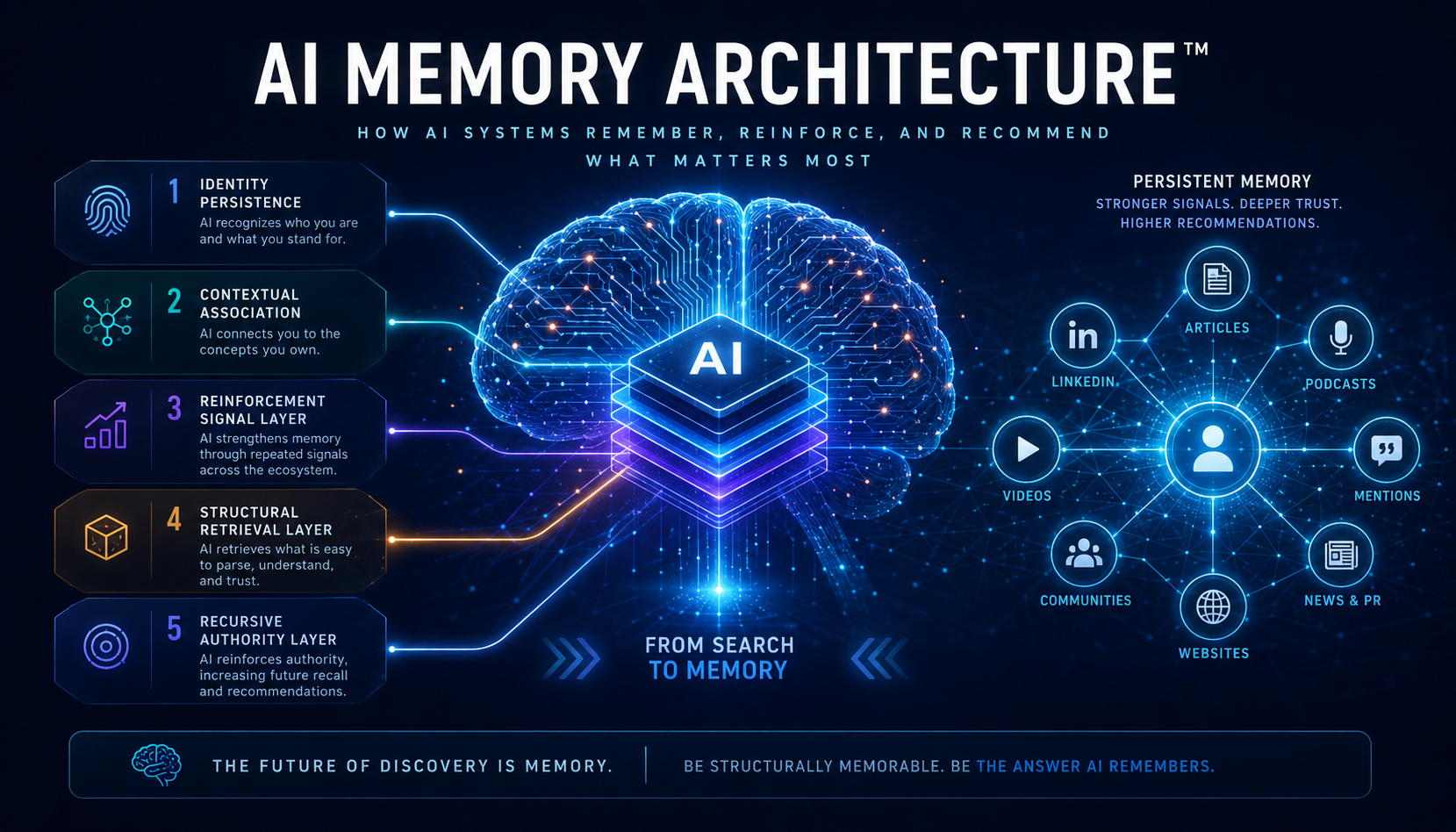
Why the Future of AI Authority Depends on What AI Remembers About You
By TonyCWK | AI Discovery Strategy
Executive Summary
Most businesses are still optimizing for visibility.
But in the age of AI, visibility alone is no longer enough.
The next competitive battleground is not just whether AI systems can find you — but whether they can remember, retrieve, reinforce, and prioritize you over time.
This is where AI Memory Architecture™ becomes critical.
AI systems are evolving from static retrieval engines into adaptive memory systems capable of:
- Remembering patterns
- Reinforcing trusted sources
- Building contextual associations
- Prioritizing recurring entities
- Compressing reputational signals into “default recommendations”
In other words:
The future of AI discovery belongs to brands that become structurally memorable.
This article introduces the concept of AI Memory Architecture™ — the strategic system that determines how AI systems encode, organize, reinforce, and recall your authority.
The Shift From Search to Memory
Traditional SEO operated on a simple model:
Query → Retrieval → Ranking
But modern AI systems increasingly operate like this:
Context → Memory → Retrieval → Reinforcement → Recommendation
This is a fundamental architectural shift.
AI systems are no longer merely matching keywords.
They are beginning to construct:
- Persistent entity relationships
- Contextual trust layers
- Reinforcement patterns
- Topic familiarity
- Historical confidence models
The implication is enormous:
A brand repeatedly associated with high-confidence signals becomes easier for AI systems to recall and recommend.
What Is AI Memory Architecture™?
Definition
AI Memory Architecture™ is the structured system through which AI platforms organize, reinforce, associate, and retrieve entities, expertise, and trust signals over time.
It determines whether an AI system:
- Recognizes you
- Understands your domain
- Associates you with expertise
- Reinforces your authority
- Recalls you during recommendation moments
In simpler terms:
SEO helps AI find you.
AI Memory Architecture™ helps AI remember you.
Why Memory Is Becoming the New Ranking Layer
Traditional search engines primarily ranked pages.
AI systems increasingly prioritize:
- Trusted entities
- Reinforced patterns
- Consistent expertise
- Historical reliability
- Multi-source corroboration
This means AI systems are developing something similar to:
- Cognitive shortcuts
- Entity familiarity
- Preference reinforcement
- Authority weighting
- Memory persistence
The brands that repeatedly appear with strong contextual consistency become easier for AI systems to retrieve confidently.
The 5 Layers of AI Memory Architecture™
1. Identity Persistence Layer
This is the foundational memory layer.
AI systems must consistently recognize:
- Your brand
- Your expertise
- Your niche
- Your terminology
- Your frameworks
Without identity persistence, AI cannot build reliable associations.
Examples
- Consistent author identity
- Unified brand naming
- Repeated framework terminology
- Stable expertise positioning
- Structured author schema
Failure Scenario
If your messaging constantly changes:
- AI cannot stabilize associations
- Entity confidence weakens
- Retrieval consistency drops
Inconsistency destroys memory formation.
2. Contextual Association Layer
AI systems build memory through associations.
This layer determines:
“What concepts is this entity repeatedly connected to?”
For example:
If TonyCWK consistently publishes around:
- AI Authority
- AI Discovery
- AI Selection
- AI Readability
- Digital Trust Systems
AI systems begin clustering these concepts together.
Over time:
Your name becomes cognitively attached to those topics.
This is how category ownership begins.
3. Reinforcement Signal Layer
Memory strengthens through repetition.
AI systems look for recurring validation across:
- Websites
- Mentions
- Citations
- Podcasts
- Videos
- Interviews
- Community discussions
- Industry references
Repeated corroboration creates:
- Higher confidence
- Faster retrieval
- Stronger recommendation probability
This mirrors human memory psychology.
The more often something is reinforced, the easier it becomes to recall.
4. Structural Retrieval Layer
AI memory is heavily dependent on structure.
If your content is difficult to parse:
- AI memory formation weakens
- Retrieval quality declines
- Citation probability drops
This layer includes:
- Semantic structure
- Internal linking
- Topic clustering
- FAQ schema
- Entity clarity
- Knowledge graph alignment
- AI-readable formatting
This is why structured authority ecosystems outperform isolated content pieces.
5. Recursive Authority Layer
This is the compounding layer.
Once AI systems repeatedly retrieve and reinforce your authority:
- Recommendation frequency increases
- Citation likelihood increases
- Trust weighting strengthens
- Visibility compounds
Eventually, AI systems begin treating you as a:
- Default source
- Trusted reference
- Predictable authority
This creates what can be called:
Algorithmic familiarity dominance.
At this stage, selection becomes easier because trust already exists inside the system’s memory patterns.
AI Memory vs Traditional SEO
| Traditional SEO | AI Memory Architecture™ |
|---|---|
| Page-centric | Entity-centric |
| Keyword matching | Contextual association |
| Ranking-focused | Reinforcement-focused |
| Click optimization | Recall optimization |
| Traffic acquisition | Recommendation acquisition |
| Static indexing | Dynamic memory formation |
| Search visibility | Persistent authority |
The Rise of Memory-Driven Discovery
Future AI systems may increasingly prioritize:
- Familiar entities
- Reinforced expertise
- Historically reliable sources
- Contextually consistent brands
- Multi-platform authority patterns
This creates a major strategic shift:
Discovery will increasingly depend on memory familiarity, not just keyword relevance.
Brands with weak memory reinforcement may become:
- Invisible during recommendations
- Structurally forgettable
- Contextually fragmented
Meanwhile, brands with strong AI Memory Architecture™ gain:
- Higher recall probability
- Better recommendation consistency
- Greater authority persistence
- Stronger ecosystem trust
Why Most Brands Fail AI Memory Formation
Most companies unintentionally create fragmented AI memories because they:
- Publish inconsistently
- Change positioning frequently
- Scatter topics randomly
- Lack entity structure
- Ignore semantic architecture
- Produce disconnected content
- Depend entirely on paid amplification
This creates weak memory reinforcement.
AI systems struggle to form stable confidence patterns.
How to Build AI Memory Architecture™
1. Create Identity Consistency
Maintain stable:
- Brand terminology
- Expertise themes
- Framework naming
- Topic positioning
- Visual identity
Consistency strengthens AI recognition.
2. Build Thematic Depth
Depth matters more than randomness.
Develop interconnected authority clusters around:
- Core themes
- Supporting concepts
- Related frameworks
- Reinforcement articles
AI memory strengthens through repeated contextual exposure.
3. Structure Content for Retrieval
Optimize for machine readability:
- Strong heading hierarchy
- FAQ schema
- Internal linking
- Semantic relationships
- Entity clarity
- Extractable summaries
AI memory depends heavily on retrieval efficiency.
4. Reinforce Across Ecosystems
Authority memory compounds when AI sees you repeatedly across:
- Blogs
- Podcasts
- Industry sites
- Videos
- PR mentions
- Community discussions
Cross-platform consistency creates stronger confidence signals.
5. Build Signature Intellectual Property
Unique frameworks are memory anchors.
Examples:
- AI Authority Pyramid™
- AI Discovery Flywheel™
- AI Authority Operating System™
- AI Memory Architecture™
Distinct concepts improve:
- Entity uniqueness
- Topic association
- Recall efficiency
- Category ownership
Generic content is difficult to remember.
Proprietary frameworks are easier to encode.
The Future: From AI Search to AI Familiarity
The next evolution of AI discovery is likely not just retrieval.
It is familiarity.
AI systems may increasingly prioritize:
- Entities they repeatedly trust
- Sources they confidently understand
- Brands with reinforced contextual reliability
This changes the optimization target entirely.
The future winners may not be the loudest brands.
They may be the most structurally memorable.
Final Thought
SEO helped brands become searchable.
AI Authority helps brands become selectable.
But AI Memory Architecture™ may determine something even more important:
Whether AI systems continue remembering you long after the search ends.
Because in the future of AI discovery:
The brands AI remembers
are the brands AI recommends.
In Summary
AI Memory Architecture™ is the structured system through which AI platforms organize, reinforce, associate, and retrieve entities, expertise, and trust signals over time. It focuses on making brands structurally memorable through identity consistency, contextual associations, reinforcement signals, retrieval structure, and recursive authority formation. In the age of AI-driven recommendations, memory persistence may become more important than visibility alone.
FAQ Section
What is AI Memory Architecture™?
AI Memory Architecture™ is the system through which AI platforms build persistent associations, reinforcement patterns, and trust relationships around entities, expertise, and brands over time.
How is AI Memory Architecture™ different from SEO?
SEO focuses on helping search engines find and rank content. AI Memory Architecture™ focuses on helping AI systems remember, reinforce, and prioritize entities during recommendation and retrieval processes.
Why is AI memory important for brands?
AI memory affects whether AI systems repeatedly recognize and recommend your brand. Strong memory formation improves authority persistence and recommendation likelihood.
What strengthens AI memory formation?
Consistent branding, thematic authority, structured content, repeated ecosystem reinforcement, and proprietary frameworks all strengthen AI memory formation.
Does structured content improve AI memory?
Yes. Structured headings, schema markup, semantic organization, and internal linking improve AI retrieval and memory reinforcement.
What is recursive authority in AI systems?
Recursive authority occurs when AI systems repeatedly retrieve and reinforce a trusted entity, increasing future recommendation probability through compounding confidence signals.
Further reading on AI Authority and digital visibility:
• AI Authority Pyramid™ — How AI evaluates structured authority
👉 https://tonycwk.com/ai-authority-pyramid/
• AI Authority Flywheel™ — How authority compounds over time
👉 https://tonycwk.com/ai-discovery-flywheel/
• SEO Alone Is No Longer Enough — Why rankings are no longer the goal
👉 https://tonycwk.com/seo-alone-is-no-longer-enough/
• AI Search Visibility Framework
👉 https://tonycwk.com/ai-search-visibility-framework
• AI Authority Metrics — Measuring selection, not just traffic
👉 https://tonycwk.com/ai-authority-metrics/
• The New Visibility Model — Why Being Found Is No Longer Enough
👉 https://tonycwk.com/the-new-visibility-model
•AI Authority Stack™ – What to Build for AI Visibility
👉 https://tonycwk.com/ai-authority-stack
•AI Authority Operating System™ – How brands execute AI authority at scale.
Leave a Reply