
✨ Executive Summary
Digital visibility is no longer defined by traffic alone.
In AI-driven environments, the key question is not “How many users visited?” but “Was your content selected?”
Traditional metrics—rankings, clicks, and impressions—measure exposure.
AI Authority requires a new class of metrics that measure selection, trust, and citation.
This article introduces the AI Authority Metrics Framework, a structured approach to evaluating visibility in the age of AI—where being seen is no longer enough, and being chosen is what matters.
📉 The Measurement Problem in Modern Search
For years, digital marketing performance has been measured using:
- Organic traffic
- Keyword rankings
- Click-through rates
These metrics were sufficient in a system where:
Users manually evaluated and selected search results.
However, AI-driven search introduces a fundamental shift:
AI systems now evaluate sources on behalf of users.
The Consequence
A growing portion of user journeys now ends without:
- A click
- A page visit
- A measurable session
Yet decisions are still being influenced.
👉 This creates a blind spot:
Influence without traffic
🔄 From Traffic Metrics to Selection Metrics
To understand performance in AI environments, we must distinguish between two types of visibility:
| Traditional Visibility | AI Visibility |
|---|---|
| Impressions | Inclusion in AI outputs |
| Clicks | Citations |
| Sessions | Influence |
| Rankings | Selection |
The New Measurement Question
Instead of asking:
“How much traffic did this generate?”
We must ask:
“How often is this source selected when answers are generated?”
🔺 The AI Authority Metrics Framework (TonyCWK Model)
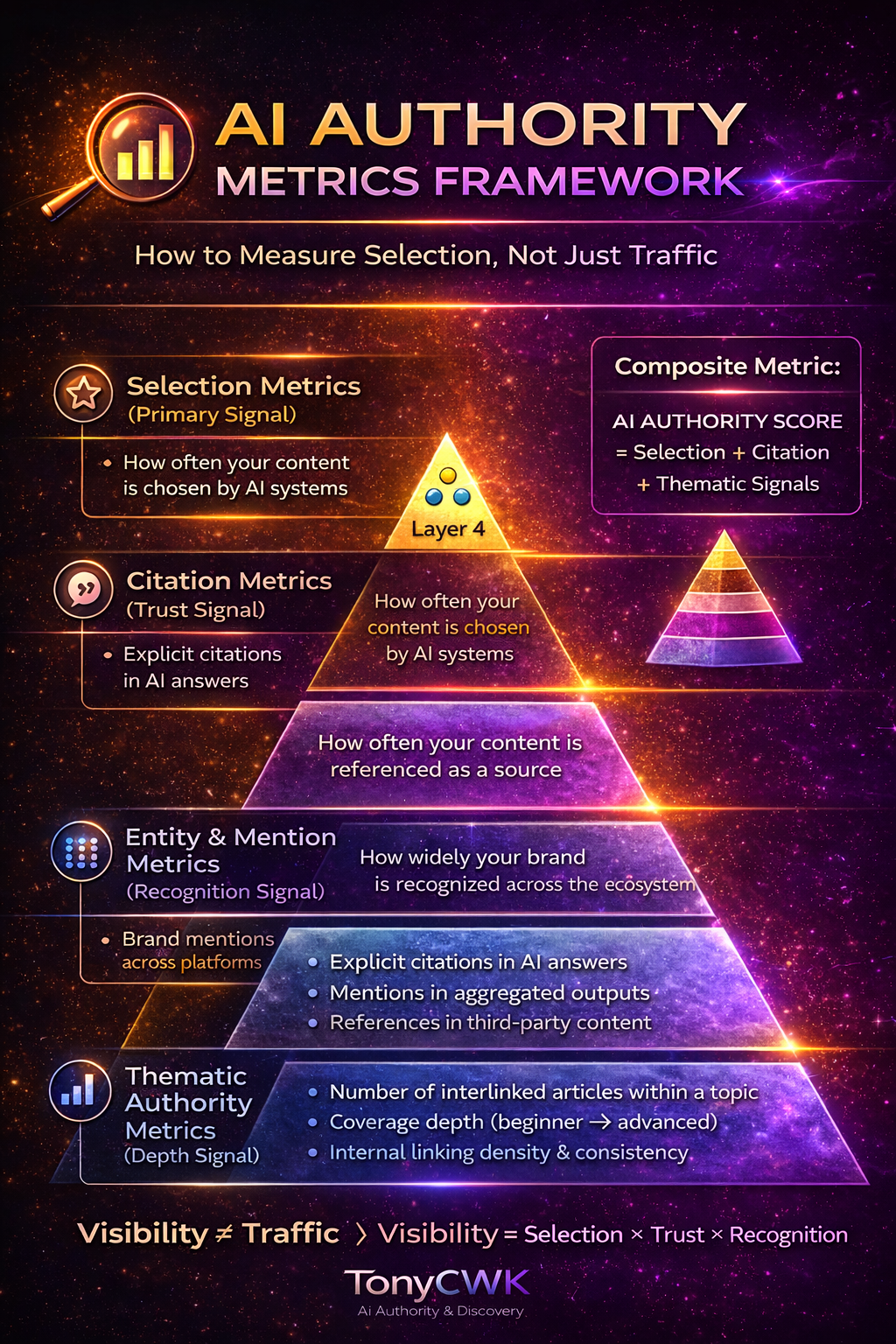
To measure AI Authority effectively, visibility must be evaluated across four metric layers.
1. Selection Metrics (Primary Signal)
What it measures:
How often your content is chosen by AI systems
Indicators:
- Frequency of appearance in AI-generated answers
- Inclusion in summaries and recommendations
- Presence in multi-source synthesis outputs
Why it matters:
This is the closest equivalent to:
“Ranking #1” in the AI era
But instead of position, it reflects:
Selection probability
2. Citation Metrics (Trust Signal)
What it measures:
How often your content is referenced as a source
Indicators:
- Explicit citations in AI answers
- Mentions in aggregated outputs
- References in third-party content
Why it matters:
Citation is not just visibility—it is:
Validation of authority
3. Entity & Mention Metrics (Recognition Signal)
What it measures:
How widely your brand or concept is recognised across the ecosystem
Indicators:
- Brand mentions across platforms
- Repetition of your frameworks (e.g. “AI Authority Pyramid”)
- Presence in discussions, articles, and communities
Why it matters:
AI systems rely on:
Consistent entity signals to determine trust
4. Thematic Authority Metrics (Depth Signal)
What it measures:
How comprehensively you cover a topic
Indicators:
- Number of interlinked articles within a topic
- Coverage depth (beginner → advanced)
- Internal linking density
- Content consistency
Why it matters:
Authority is not built by a single article, but by:
A coherent knowledge system
📊 The Composite Metric: AI Authority Score (Conceptual)
Individually, these metrics provide signals.
Combined, they form a more meaningful evaluation:
AI Authority Score = Selection + Citation + Entity + Thematic Signals
Interpretation
- High traffic, low selection → visible but not trusted
- Low traffic, high citation → influential but underexposed
- High across all → true authority
🧠 Practical Measurement (What You Can Track Today)
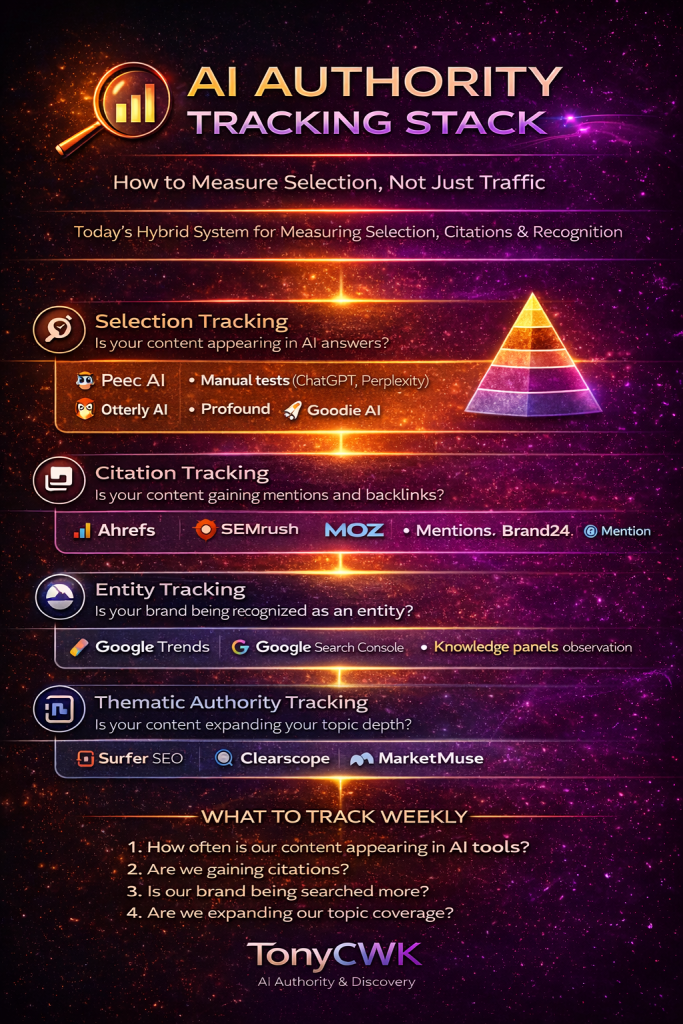
While AI metrics are still evolving, proxies can be used:
Selection Proxies
- Appearance in AI tools (manual checks)
- Inclusion in featured summaries
Citation Proxies
- Backlinks (quality > quantity)
- References from other creators
Entity Proxies
- Brand search volume
- Mentions across platforms (LinkedIn, forums, etc.)
Thematic Proxies
- Number of cluster articles
- Internal linking structure
- Topic coverage completeness
⚖️ Why Traditional Metrics Are No Longer Enough
The Illusion of Traffic Growth
A site may show:
- Increasing impressions
- Stable rankings
Yet:
- Declining click-through rates
- Reduced user visits
The Hidden Reality
AI systems may already be:
- Using your content
- Extracting your insights
- Presenting them without attribution
👉 Meaning:
You are influencing outcomes without visibility in traditional metrics
🔁 Metrics Within the AI Discovery Flywheel
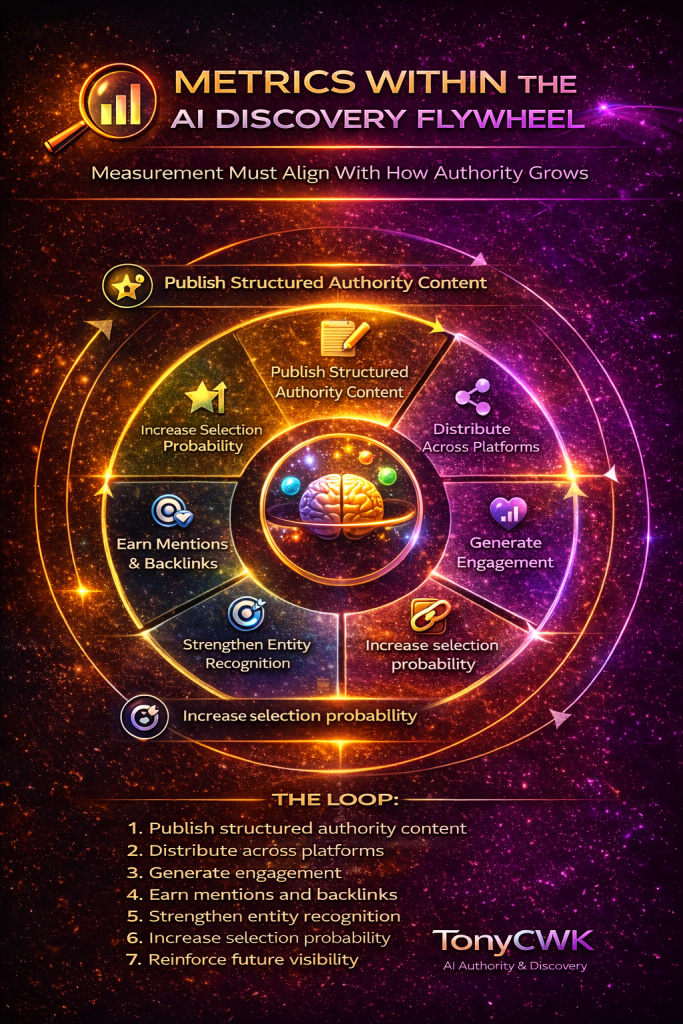
Measurement must align with how authority grows.
The Loop:
- Publish structured authority content
- Distribute across platforms
- Generate engagement
- Earn mentions and backlinks
- Strengthen entity recognition
- Increase selection probability
- Reinforce future visibility
Key Insight
Each metric layer feeds the next:
- Mentions → citations
- Citations → selection
- Selection → amplification
🚨 The Strategic Risk of Ignoring AI Metrics
Organisations that rely solely on:
- Traffic
- Rankings
- CTR
Will:
- Misinterpret performance
- Underestimate influence
- Miss emerging opportunities
The Result
They will optimise for:
What is easy to measure
Instead of:
What actually drives visibility in AI systems
🧭 How to Transition to AI Authority Measurement
1. Expand Your KPI Framework
Include:
- Citation tracking
- Brand mentions
- Topic coverage
2. Redefine Success Metrics
Move from:
- Traffic targets
To:
- Selection and influence targets
3. Build Measurement Systems
- Track mentions across platforms
- Monitor backlinks and references
- Evaluate topic cluster completeness
4. Align Teams Around New Metrics
- Content → authority
- SEO → structure
- Marketing → distribution
🎯 The New Measurement Equation
In the AI era:
Visibility ≠ Traffic
Visibility = Selection × Trust × Recognition
🔚 Final Insight
The evolution of search is not just about how content is created.
It is about how performance is measured.
Those who continue to measure only traffic will:
- Optimise for a declining system
Those who measure authority will:
- Compete in the system that is emerging
📌 Conclusion
AI Authority cannot be understood without redefining metrics.
The future of digital performance is not:
- How many users you attract
But:
- How often you are selected when it matters
❓FAQ
What are AI Authority Metrics?
They are metrics that measure selection, citation, trust, and recognition rather than just traffic and rankings.
Why is traffic no longer enough?
Because AI systems often answer queries directly, reducing clicks while still influencing decisions.
What is selection in AI search?
Selection refers to how often a source is chosen by AI systems to be included in generated answers.
What are citation metrics?
They measure how often your content is referenced or used as a source.
What are entity metrics?
They track how frequently your brand or concepts are mentioned across the digital ecosystem.
What is thematic authority?
It refers to how comprehensively a topic is covered through interconnected content.
How can AI Authority be measured today?
Using proxies such as backlinks, mentions, structured content, and manual AI visibility checks.
To deepen your understanding of AI Authority and digital visibility:
• AI Authority Pyramid™ — How AI evaluates structured authority
👉 https://tonycwk.com/ai-authority-pyramid/
• AI Authority Flywheel™ — How authority compounds over time
👉 https://tonycwk.com/ai-discovery-flywheel/
• SEO Alone Is No Longer Enough — Why rankings are no longer the goal
👉 https://tonycwk.com/seo-alone-is-no-longer-enough/
• The New Visibility Model — Why Being Found Is No Longer Enough
👉 https://tonycwk.com/the-new-visibility-model
• AI Search Visibility Framework
👉 https://tonycwk.com/ai-search-visibility-framework
Written by Tony Chan (TonyCWK)
AI Authority & Digital Strategy Researcher
Leave a Reply