
Building Strategic Authority in the Age of Generative Discovery
AI search visibility refers to how content is discovered, interpreted, and selected by AI-driven systems. Unlike traditional SEO, which focuses on rankings, AI visibility depends on structured knowledge, contextual relevance, and authority signals.
Long-term discovery influence emerges when strategic content capability and algorithmic trust reinforce one another over time.
What is AI Search Visibility Framework?
The AI Search Visibility Framework is a structured model that helps brands improve how they are discovered, interpreted, and selected by AI-driven systems. It integrates structured content, authority signals, and contextual relevance to increase visibility in generative search environments.
To understand this shift clearly, the framework can be summarised as follows:
Executive Summary
- AI search is shifting from rankings to selection
- Visibility now depends on structured, credible content
- The AI Search Visibility Framework combines:
- The Pyramid (foundation)
- The Flywheel (momentum)
- Brands must optimise for:
- Understanding
- Trust
- Retrieval
- Long-term visibility is built through repeated AI selection and reinforcement over time
To understand why this shift is critical, we must examine how search behaviour has fundamentally changed.
Why AI Search Visibility Matters
The shift from traditional search to AI-driven discovery is not a minor evolution — it is a fundamental transformation in how visibility is earned.
In the past, brands competed for position.
Today, they compete for selection.
This shift sets the foundation for the AI Search Visibility Framework, which we will explore next.
1. AI Reduces the Need for Clicks
Generative AI systems increasingly provide direct answers instead of lists of links.
This means:
- Users may never visit multiple websites
- Only a few sources are selected and cited
- Visibility is concentrated among trusted content
👉 If your content is not selected, it is effectively invisible.
2. Ranking No Longer Guarantees Visibility
A page can rank #1 and still not be chosen by AI systems.
Why?
Because AI evaluates more than keywords:
- Clarity of explanation
- Structure of content
- Contextual completeness
- Credibility signals
👉 Ranking = Availability
👉 Selection = Actual Visibility
3. AI Operates on Knowledge Systems, Not Pages
Traditional SEO optimises individual pages.
AI systems interpret:
- Relationships between topics
- Consistency across content
- Depth of expertise within a domain
👉 This shifts the focus from:
“optimising pages” → “building knowledge ecosystems”
4. Authority Is Algorithmically Interpreted
AI systems infer authority based on patterns such as:
- Repeated mentions and citations
- Thematic consistency
- Structured content hierarchy
- External validation signals
👉 Authority is no longer claimed — it is calculated
5. Visibility Becomes Compounded Over Time
In AI-driven environments:
- Selected content is more likely to be selected again
- Citations reinforce credibility
- Recognition builds momentum
👉 Visibility is no longer linear — it is compounding
Strategic Implication
To succeed in this new environment, brands must shift from:
| Old Model (SEO) | New Model (AI Visibility) |
|---|---|
| Optimise for keywords | Optimise for understanding |
| Focus on rankings | Focus on selection |
| Create isolated content | Build connected knowledge |
| Drive clicks | Earn citations |
| Short-term wins | Long-term authority systems |
Key Takeaway
AI Search Visibility is not about being found.
It is about being chosen, trusted, and repeatedly referenced.
Brands that understand this shift will build sustainable visibility.
Those that do not will struggle — even if they rank.
The Strategic Shift from SEO to AI Visibility
For decades, search visibility has been associated primarily with ranking positions. However, the rapid adoption of generative AI search experiences is redefining how information is surfaced, summarised, and trusted.
In this emerging environment, brands compete not only for traffic but for recognition within algorithmic knowledge layers. This transition marks the evolution from traditional Search Engine Optimisation (SEO) toward broader disciplines such as Answer Engine Optimisation (AEO) and Generative Engine Optimisation (GEO).
From TonyCWK’s perspective, sustainable AI visibility emerges not from isolated optimisation tactics, but from a systems-driven approach that integrates content clarity, thematic authority, and credibility signals into a coherent long-term strategy.
The AI Search Visibility Pyramid
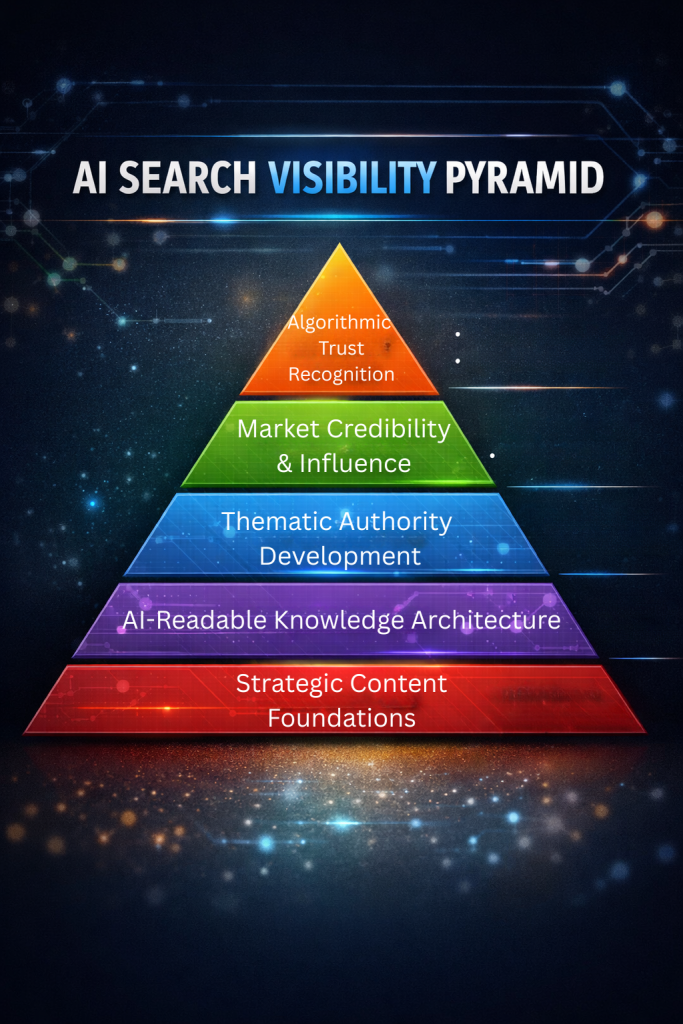
The AI Search Visibility Pyramid provides a structured model for understanding how visibility is built and reinforced within AI-driven search environments.
Unlike traditional SEO frameworks that focus on rankings, this model explains how discoverability, authority, and selection are progressively strengthened through layered capabilities.
Each level of the pyramid represents a critical component of AI visibility. Together, they form a system that enables content to be interpreted, trusted, and repeatedly selected.
1. Strategic Content Foundations
At the base of the pyramid lies the creation of high-quality, intent-aligned content.
This includes:
- Clear topic focus
- Strong alignment with user intent
- Depth and completeness of information
Without strong foundational content, higher levels of visibility cannot be sustained.
👉 This layer ensures content is relevant and worth retrieving
2. AI-Readable Knowledge Architecture
Content must be structured in a way that AI systems can easily interpret and extract.
This involves:
- Logical heading hierarchy (H1–H3)
- Clear semantic relationships between sections
- Consistent formatting and language
Well-structured content improves:
- Interpretability
- Retrieval accuracy
- Answer generation quality
👉 This layer ensures content is understandable by machines
3. Thematic Authority Development
Beyond individual pages, AI systems evaluate how deeply a brand covers a topic.
This requires:
- Interconnected content clusters
- Consistent focus on specific themes
- Progressive depth across related topics
As thematic coverage expands, the brand becomes recognised as a reliable source within a domain.
👉 This layer ensures content is contextually authoritative
4. Market Credibility & Influence
Authority is reinforced through external validation signals.
These include:
- Mentions and citations
- Backlinks from reputable sources
- Brand recognition across platforms
AI systems interpret these signals as indicators of trust and credibility.
👉 This layer ensures content is trusted beyond its own platform
5. Algorithmic Trust Recognition
At the top of the pyramid is the outcome of all preceding layers:
👉 Repeated selection by AI systems
When content consistently demonstrates:
- Clarity
- Structure
- Authority
- Credibility
It becomes more likely to be:
- Selected in AI-generated answers
- Referenced across queries
- Reinforced over time
👉 This layer represents true AI visibility
Key Insight
AI Search Visibility is not achieved through isolated optimisation.
It is built through a layered system, where each level reinforces the next.
The stronger the foundation, the more sustainable the visibility.
While the Pyramid explains how authority is built, visibility in AI systems is reinforced through continuous selection. This dynamic process is captured in the AI Discovery Flywheel.
From Capability to Momentum: The AI Search Flywheel
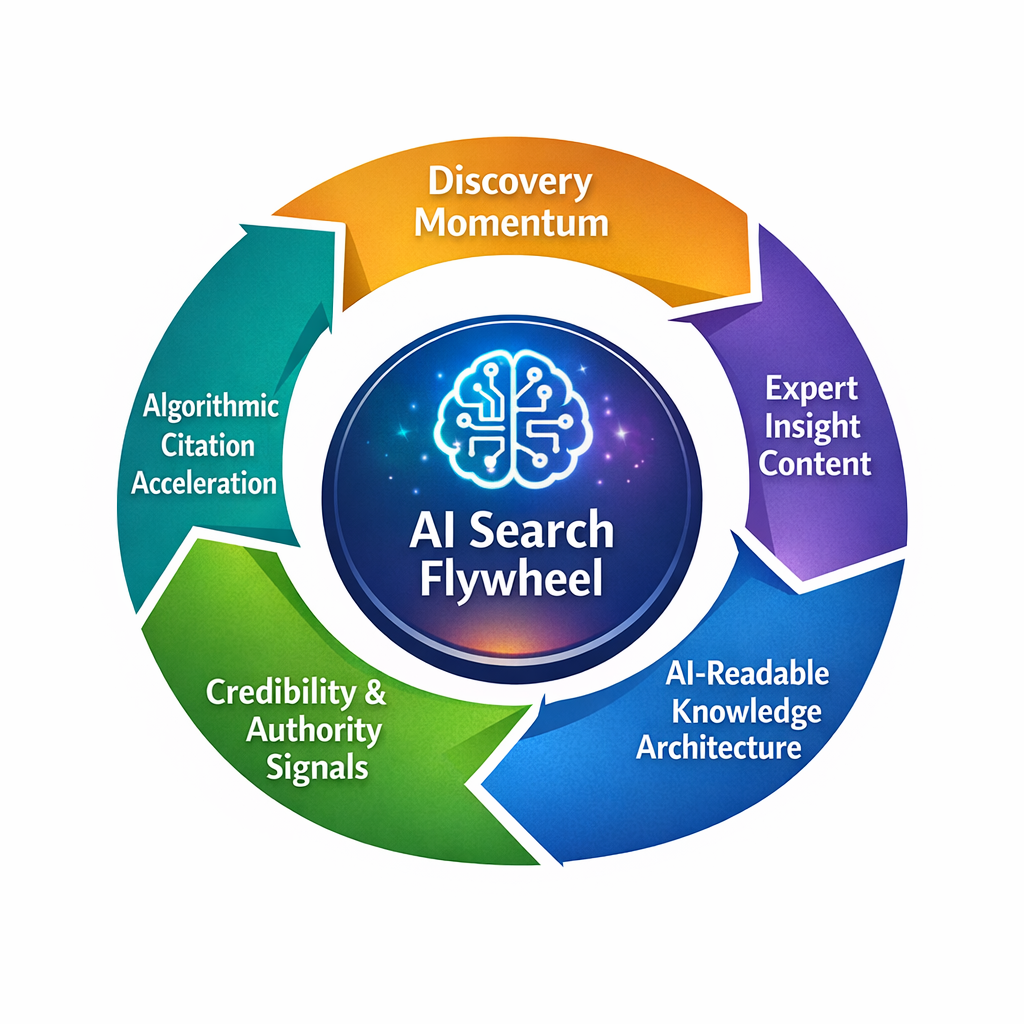
While the pyramid explains how strategic foundations are built, sustainable influence depends on how these capabilities interact dynamically. The AI Search Flywheel illustrates the reinforcing momentum created when structured expertise and authority signals continuously compound discovery influence.
The AI Search Flywheel operates as a continuous loop, where each stage reinforces the next, creating compounding visibility over time.
Expert Insight Leadership
Publishing original frameworks and forward-thinking insights positions a brand as a source of strategic knowledge.
Structured Knowledge Systems
Content is organised for machine interpretation, enabling accurate extraction and retrieval.
Credibility & Authority Signals
External validation strengthens algorithmic trust and reinforces perceived expertise.
Algorithmic Citation Acceleration
Consistent inclusion in AI summaries increases exposure and reinforces authority recognition.
Discovery Momentum
Over time, repeated citations and engagement generate reinforcing cycles of visibility growth.
Together, these dynamics transform visibility from a static achievement into a self-sustaining growth mechanism.
Over time, this flywheel transforms visibility from a one-time outcome into a self-reinforcing system of continuous discovery.
Translating Insight into Action: The AI Search Strategy Matrix
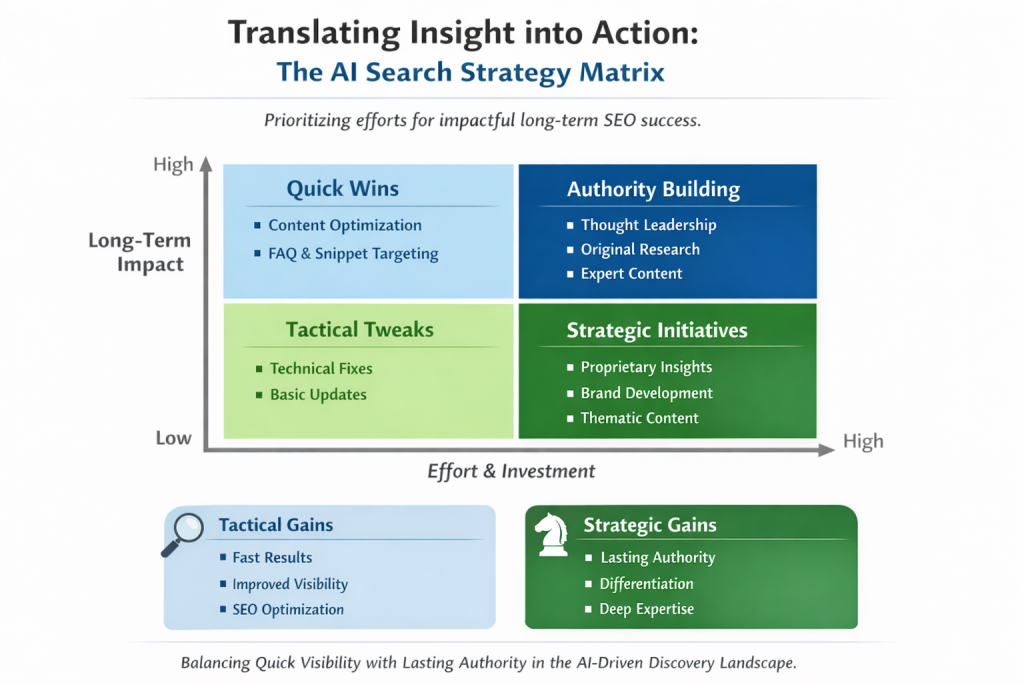
Understanding strategic models alone is insufficient without practical execution prioritisation. The AI Search Strategy Matrix provides a decision framework for allocating effort toward initiatives that deliver meaningful long-term impact.
Quick visibility gains may be achieved through structured content optimisation and answer-focused formatting. However, enduring authority typically requires deeper investments in thematic leadership, proprietary insights, and credibility development.
By distinguishing between tactical improvements and strategic capability building, organisations can deploy resources more effectively in an increasingly AI-driven discovery landscape.
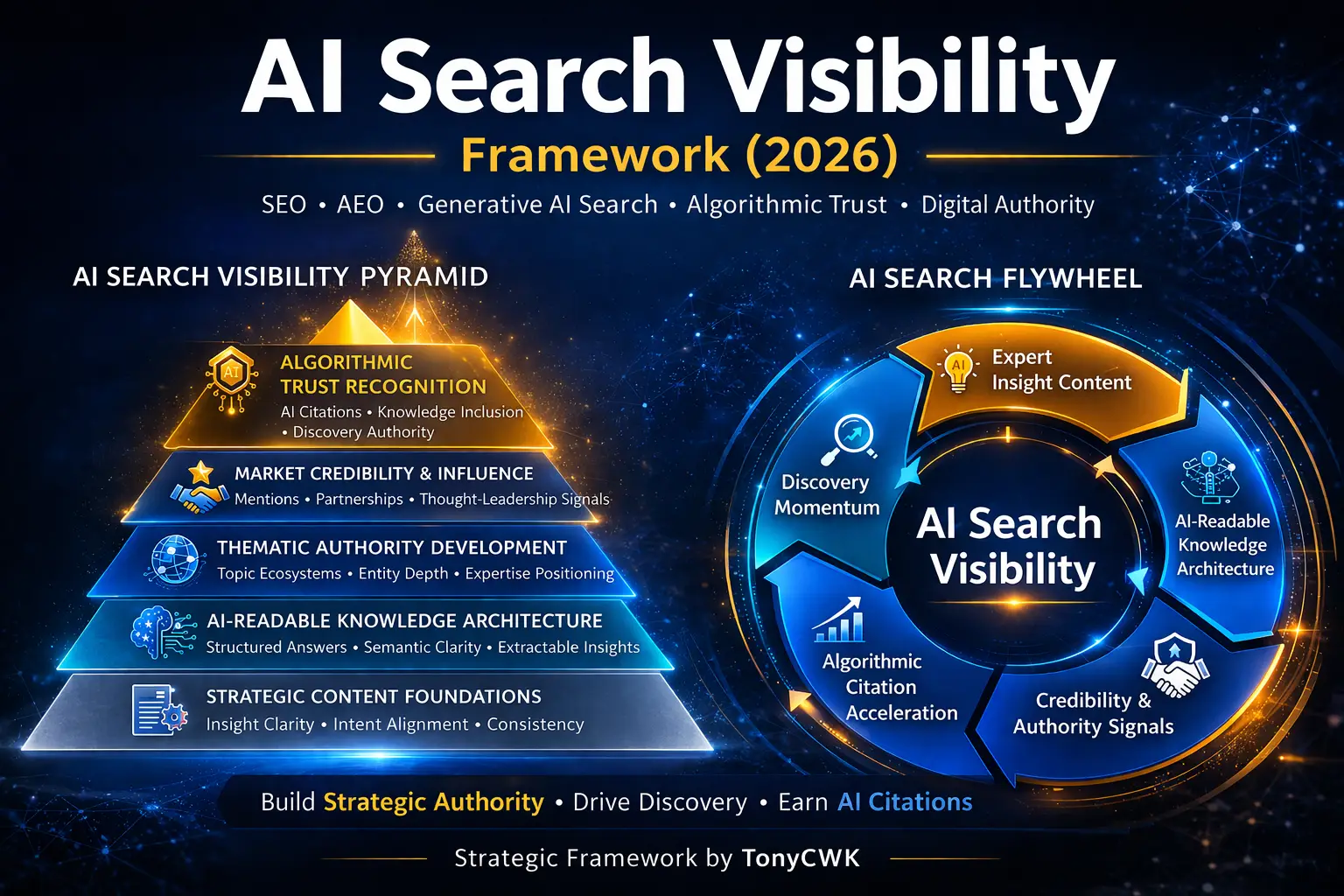
The AI Search Visibility Framework combines two strategic perspectives: a structural foundation model and a growth momentum engine. The AI Search Visibility Pyramid illustrates the progressive capability layers organisations must strengthen — from content foundations and AI-readable knowledge architecture to authority building and ultimately algorithmic citation visibility. Complementing this, the AI Search Flywheel represents the continuous momentum cycle that amplifies visibility over time, where discovery momentum, expert insight content, structured knowledge systems, credibility signals and citation acceleration reinforce one another. Together, these visuals demonstrate that sustainable AI search visibility is not achieved through isolated tactics, but through the integration of foundational strength and strategic compounding motion.
Looking Ahead: The AI Search Visibility Timeline
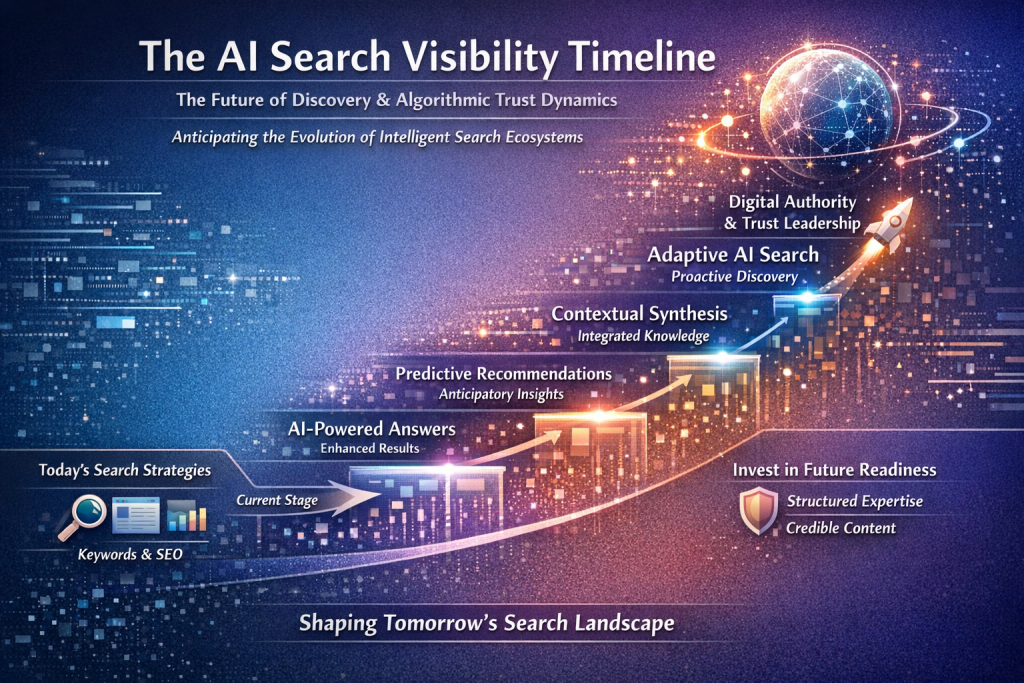
Beyond current strategies, marketers must anticipate how intelligent search ecosystems will continue to evolve. The AI Search Visibility Timeline offers a forward-looking perspective on the progression of discovery behaviours and algorithmic trust dynamics.
As search experiences move toward predictive recommendations and context-aware knowledge synthesis, brands that invest early in structured expertise and credibility systems are more likely to shape future standards of digital authority.
Conclusion: Designing Visibility Systems for the Next Generation of Search
In an era where intelligent platforms increasingly influence how information is surfaced and trusted, search visibility is no longer defined by isolated optimisation tactics. It is the outcome of deliberately cultivated strategic capabilities, reinforced authority signals, and a deep understanding of how knowledge flows within evolving digital ecosystems.
Collectively, the models presented in this article represent TonyCWK’s structured lens for interpreting the emerging architecture of AI-driven digital visibility. Organisations that embrace this systems-oriented perspective will be better positioned not only to adapt to generative search — but to influence how authority is recognised in the next generation of discovery environments.
⭐ AI Search Visibility Framework (2026) — Strategic Q&A
To further clarify how AI search visibility works in practice, the following questions address key concepts, challenges, and strategic considerations.
1. What is AI Search Visibility?
AI Search Visibility refers to a brand’s ability to be discovered, interpreted and cited by AI-driven search systems such as generative answer engines, AI assistants and knowledge synthesis platforms.
2. Why is AI search visibility important in 2026 and beyond?
As users increasingly rely on AI-generated answers rather than traditional search results, brands must optimise not only for rankings but also for inclusion within AI summaries, recommendations and citations.
3. How is AI Search Visibility different from traditional SEO?
Traditional SEO focuses on improving search engine rankings, while AI Search Visibility emphasises structured knowledge, semantic clarity, authority signals and extractable insights that AI systems can easily interpret and reference.
4. What is the AI Search Visibility Pyramid?
The AI Search Visibility Pyramid is a strategic capability model that illustrates progressive layers brands must strengthen — from strategic content foundations to algorithmic trust recognition — to achieve sustainable AI discoverability.
5. Must all pyramid layers be fully achieved before AI visibility is possible?
No. The pyramid represents capability maturity rather than rigid stages. Brands can gain partial visibility early, but stronger foundational layers significantly increase long-term citation potential.
6. What is the AI Search Flywheel?
The AI Search Flywheel is a continuous growth engine that demonstrates how discovery momentum, expert insight content, structured knowledge systems, credibility signals and citation acceleration reinforce each other over time.
7. How do the pyramid and flywheel models work together?
The pyramid provides structural strength and strategic capability, while the flywheel represents momentum and compounding growth. Together they form an integrated system for sustainable AI visibility.
8. What role does structured knowledge play in AI search optimisation?
Structured knowledge enables AI systems to understand context, relationships and intent, making content more extractable, referenceable and likely to be cited in AI-generated responses.
9. What is Answer Engine Optimisation (AEO)?
Answer Engine Optimisation focuses on structuring content to directly address user questions in clear, concise formats that AI systems can easily extract and present as authoritative answers.
10. What is Generative Engine Optimisation (GEO)?
Generative Engine Optimisation involves designing content ecosystems that influence how generative AI models interpret topics, form summaries and recommend sources across conversational search environments.
11. How can brands improve their authority signals for AI visibility?
Brands can strengthen authority signals through consistent thought leadership content, credible mentions, expert collaborations, data-driven insights and strong thematic positioning within their industry.
12. What type of content performs best for AI discoverability?
Expert-level insight content that provides original analysis, structured explanations, practical frameworks and clear definitions tends to perform best in AI-driven search environments.
13. Can small businesses also benefit from AI search optimisation strategies?
Yes. By focusing on niche expertise, structured content clarity and consistent credibility building, smaller brands can achieve strong visibility within specific knowledge domains.
14. How long does it take to achieve meaningful AI search visibility?
AI visibility is typically built over time through compounding efforts in content quality, authority development and structured optimisation, rather than through short-term tactical adjustments.
15. What are AI citations and why do they matter?
AI citations occur when generative systems reference a brand, framework or source while producing answers. These citations enhance perceived authority and can significantly influence user trust and discovery.
16. How should businesses measure AI search visibility performance?
Metrics may include AI citation frequency, branded search growth, topical authority signals, engagement depth and inclusion in AI summaries across different platforms.
17. Will traditional SEO become less important in the AI search era?
Traditional SEO remains foundational, but its role is evolving. It must now integrate with semantic optimisation, structured knowledge design and authority-driven content strategies.
18. What is the long-term strategic goal of AI search visibility frameworks?
The long-term goal is to position brands as trusted knowledge entities within digital ecosystems, enabling sustained discoverability, influence and relevance as search behaviour continues to evolve.
19. How should brands position themselves to be selected by AI systems?
Brands should position themselves as structured knowledge sources rather than content publishers. This requires clear topical focus, consistent expertise, strong internal linking, and credibility signals that reinforce trust. The goal is not just to rank, but to become a reliable entity that AI systems can confidently reference and recommend.
20. What will AI search visibility look like in the next 3–5 years?
AI search visibility will increasingly favour entities that demonstrate structured knowledge, consistent authority signals, and cross-platform credibility. Selection will become more predictive and context-aware, making long-term authority building more important than short-term optimisation tactics.
Together, these questions highlight a fundamental shift: visibility is no longer about being found, but about being selected, trusted, and continuously reinforced by AI systems.
What is AI Search Visibility?
AI Search Visibility refers to a brand’s ability to be discovered, interpreted and cited by AI-driven search systems such as generative answer engines, AI assistants and knowledge synthesis platforms.
Why is AI search visibility important in 2026 and beyond?
As users increasingly rely on AI-generated answers rather than traditional search results, brands must optimise not only for rankings but also for inclusion within AI summaries, recommendations and citations.
How is AI Search Visibility different from traditional SEO?
Traditional SEO focuses on improving search engine rankings, while AI Search Visibility emphasises structured knowledge, semantic clarity, authority signals and extractable insights that AI systems can easily interpret and reference.
What is the AI Search Visibility Pyramid?
The AI Search Visibility Pyramid is a strategic capability model that illustrates progressive layers brands must strengthen — from strategic content foundations to algorithmic trust recognition — to achieve sustainable AI discoverability.
What is the AI Search Flywheel?
The AI Search Flywheel is a continuous growth engine that demonstrates how discovery momentum, expert insight content, structured knowledge systems, credibility signals and citation acceleration reinforce each other over time.
How should businesses measure AI search visibility performance?
Metrics may include AI citation frequency, branded search growth, topical authority signals, engagement depth and inclusion in AI summaries across different platforms.
Will traditional SEO become less important in the AI search era?
Traditional SEO remains foundational, but its role is evolving. It must now integrate with semantic optimisation, structured knowledge design and authority-driven content strategies.
Framework Evolution Note (June 2026):
This article presents the original AI Search Visibility Framework introduced in March 2026. Since publication, the framework has evolved into several specialized models, including the AI Search Visibility Pyramid™, AI Authority Pyramid™, and AI Discovery Flywheel™, each addressing a distinct aspect of AI-driven discovery, authority, and recommendation.
Leave a Reply