
Introduction: The Strategy Gap No One Is Talking About
Most digital marketing advice today still sounds logical.
- Find your niche
- Create helpful content
- Improve your website
- Run ads
- Build funnels
None of this is wrong.
But here’s the problem:
It was designed for a world where users search, click, and compare.
That world is disappearing.
Today, users increasingly:
- Ask AI instead of searching
- Receive answers instead of browsing
- Trust recommendations instead of evaluating options
This creates a fundamental shift:
Visibility is no longer about being found.
It is about being selected.
The Old Model: Traffic-Based Visibility
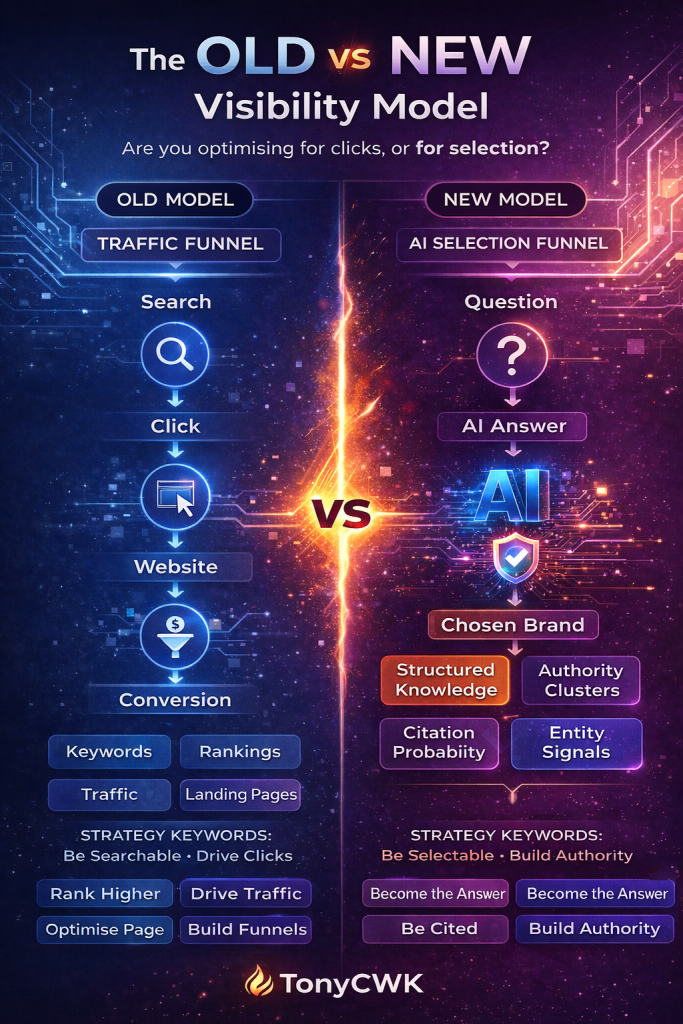
Traditional digital marketing operates on a simple flow:
Search → Click → Website → Conversion
This model assumes:
- Users explore multiple options
- Rankings drive visibility
- Traffic equals opportunity
What Marketers Optimised For:
- Keywords
- Rankings
- Click-through rates
- Landing page conversions
This worked well in the SEO era.
But it has a critical limitation today.
The New Reality: AI-Mediated Discovery
The flow has changed.
Question → AI Answer → Selected Brand
Users no longer:
- Browse 10 websites
- Compare multiple providers
- Spend time evaluating options
Instead:
AI does the filtering, selection, and recommendation.
This creates a new bottleneck:
If AI does not select you, you do not exist in the decision process.
Why Traditional Strategies Are No Longer Enough
Many businesses are still doing everything “right”:
- Publishing content
- Running ads
- Improving UX
- Building funnels
Yet they struggle with:
- Declining traffic
- Lower engagement
- Reduced differentiation
Because:
They are optimising for clicks — in a world that is shifting toward answers.
The Strategic Shift: From Visibility to Selection
To win today, businesses must evolve from:
| Old Thinking | New Thinking |
|---|---|
| Be searchable | Be selectable |
| Rank higher | Be recommended |
| Drive traffic | Become the answer |
| Optimise pages | Build knowledge systems |
The AI Authority Framework (2026)
To be selected in an AI-driven environment, your digital presence must evolve into a structured authority system.
1. Structured Knowledge (Not Just Content)
AI does not “read” like humans.
It extracts.
Your content must be:
- Clearly defined
- Logically structured
- Easy to interpret
Examples:
- Direct answers
- Defined concepts
- Clean formatting
- Q&A sections
If AI cannot extract your content, it cannot select you.
2. Topical Authority (Depth Over Volume)
One good article is not enough.
AI looks for:
- Consistency
- Depth
- Coverage
This means:
- Content clusters
- Interlinked topics
- Clear thematic focus
Authority is built through coverage, not isolated content.
3. Citation Probability (Will AI Reference You?)
Ask a critical question:
“Is this content quotable?”
High-probability content:
- Answers clearly
- Explains simply
- Provides structured insights
Low-probability content:
- Fluffy
- Generic
- Hard to extract
AI prefers clarity over creativity.
4. AI-Readable Content Design
Your content must shift from:
- Blog writing
→ To - Answer architecture
This includes:
- Bullet structures
- Frameworks
- Step-by-step logic
- Executive summaries
Content is no longer written only for humans.
It must also be understood by machines.
5. Entity & Brand Recognition
AI does not just evaluate content.
It evaluates who is saying it.
Signals that matter:
- Consistent expertise
- Mentions across platforms
- Clear positioning
- Recognisable authority
You are not just building content.
You are building a recognisable knowledge entity.
Where Traditional Tactics Still Matter
To be clear — the fundamentals are not obsolete.
They are simply no longer sufficient on their own.
Still Important:
- Niche positioning
- Problem-solving content
- User experience
- Conversion optimisation
- Retention strategies
But these now operate at a different level:
They convert demand.
They do not create visibility.
The New Visibility Stack
To compete effectively today, your strategy should look like this:
Layer 1 — AI Authority (Top)
- Structured knowledge
- Authority clusters
- Citation optimisation
Layer 2 — Content System
- SEO + AI-readable content
- Topic depth
- Internal linking
Layer 3 — Experience
- Website UX
- Conversion flow
- Speed
Layer 4 — Growth Channels
- Ads
- Social
A Simple Strategic Test
Ask yourself:
If a customer asks AI about your category — will your brand appear in the answer?
If the answer is no:
You don’t have a traffic problem.
You have a selection problem.
Conclusion: The Future Belongs to the Selected
Digital marketing is not disappearing.
But it is evolving.
The winners will not be:
- The loudest
- The most visible
- The most optimised
They will be:
The most trusted, structured, and selectable.
Final Thought
In the past:
You competed for attention.
Today:
You compete for selection.
And in the near future:
If AI does not choose you, your market may never see you.
FAQ
1. What is the old visibility model in digital marketing?
The old visibility model is traffic-driven, where businesses rely on search rankings, clicks, and website visits to generate conversions.
2. What is the new visibility model?
The new visibility model is AI-driven, where visibility comes from being selected and recommended by AI systems rather than just being found in search results.
3. What is a traffic funnel?
A traffic funnel is a traditional marketing process where users move from search to click, then to a website, and finally to conversion.
4. What is an AI selection funnel?
An AI selection funnel is a model where users ask a question, AI generates an answer, and selects specific brands to recommend.
5. Why is the traffic funnel becoming less effective?
Because users increasingly rely on AI-generated answers instead of clicking through multiple websites to compare options.
6. What does “being selectable” mean?
Being selectable means your content is structured, clear, and authoritative enough for AI systems to choose and recommend it as the answer.
7. How does AI decide which brand to recommend?
AI evaluates clarity, authority, structure, relevance, and trust signals before selecting a brand as part of its answer.
8. What is AI Authority?
AI Authority is the ability of a brand to be consistently recognised, trusted, and selected by AI systems as a reliable source of information.
9. What is structured knowledge?
Structured knowledge refers to content that is clearly organised, logically presented, and easy for AI systems to interpret and extract.
10. What are authority clusters?
Authority clusters are groups of interlinked content that comprehensively cover a topic, signalling expertise and depth to AI systems.
11. What is citation probability?
Citation probability is the likelihood that AI systems will extract, reference, or quote your content when generating answers.
12. How can content increase citation probability?
Content can increase citation probability by being concise, well-structured, directly answering questions, and providing clear frameworks.
13. What are entity signals?
Entity signals are indicators that define who you are, what you specialise in, and how consistently your expertise appears across platforms.
14. Is SEO still relevant in the AI era?
Yes, SEO remains relevant, but it must evolve to include AI-readable content, structured knowledge, and authority-building strategies.
15. What is the difference between ranking and selection?
Ranking determines where you appear in search results, while selection determines whether AI chooses you as the answer.
16. Why is traffic no longer the main goal?
Because users may never click if AI provides the answer directly, making selection more important than traffic.
17. What type of content works best for AI visibility?
Content that is clear, structured, concise, and directly answers specific questions performs best for AI visibility.
18. How should businesses adapt their content strategy?
Businesses should focus on building topic authority, structuring knowledge, and creating content that AI systems can easily extract and trust.
19. What role does user experience play now?
User experience remains important for conversion, but it does not influence whether AI selects your content initially.
20. What is the biggest shift in digital marketing today?
The biggest shift is moving from optimising for visibility (being found) to optimising for selection (being chosen by AI).
To deepen your understanding of AI Authority and digital visibility:
• AI Authority Pyramid™ — How AI evaluates structured authority
👉 https://tonycwk.com/ai-authority-pyramid/
• AI Authority Flywheel™ — How authority compounds over time
👉 https://tonycwk.com/ai-discovery-flywheel/
• SEO Alone Is No Longer Enough — Why rankings are no longer the goal
👉 https://tonycwk.com/seo-alone-is-no-longer-enough/
• AI Search Visibility Framework
👉 https://tonycwk.com/ai-search-visibility-framework
• AI Authority Metrics — Measuring selection, not just traffic
👉 https://tonycwk.com/ai-authority-metrics/
Written by Tony Chan (TonyCWK)
AI Authority & Digital Strategy Researcher
Leave a Reply