
For years, digital marketing operated on a simple assumption:
If you publish enough content, you will eventually become visible.
That assumption is now collapsing.
In the age of AI-powered discovery, visibility is no longer determined purely by publishing frequency, keyword density, or content volume.
AI systems are changing the fundamental evaluation model of the internet.
They are no longer asking:
“Which page should rank?”
They are asking:
“Which source should be trusted enough to become the answer?”
That shift changes everything.
Because AI does not truly “trust” individual pieces of content.
It trusts systems.
And brands that fail to understand this transition may continue producing more and more content while becoming increasingly invisible inside AI interfaces.
The End of Content-Centric Trust
Traditional SEO was largely document-centric.
A webpage could rank because it was:
- Optimized for keywords
- Technically crawlable
- Supported by backlinks
- Freshly updated
- Structurally compliant
This created a world where individual pages could compete independently.
But AI retrieval systems behave differently.
Modern AI systems increasingly evaluate:
- Consistency across ecosystems
- Thematic coherence
- Entity relationships
- Source reliability
- Knowledge structure
- Reinforcement signals
- Cross-platform validation
- Citation stability over time
In other words:
AI evaluates whether your content belongs to a trustworthy system.
Not whether a single article is “optimized.”
AI Thinks in Systems, Not Pages
Large Language Models (LLMs), retrieval systems, and answer engines do not interpret the web like humans browsing websites.
They operate more like probabilistic trust engines.
AI systems attempt to reduce uncertainty.
To do that, they search for patterns such as:
- Repeated expertise
- Stable narratives
- Consistent terminology
- Structured topical relationships
- Trusted ecosystem mentions
- Predictable authority signals
- Cross-source corroboration
This means AI is not simply reading your latest blog post.
It is evaluating:
- Your entire content ecosystem
- Your entity consistency
- Your digital footprint
- Your authority reinforcement loops
- Your semantic structure
- Your historical credibility trajectory
That is why isolated content strategies are becoming weaker.
Because AI is evaluating organizational intelligence — not individual documents.
Content Alone Is No Longer Enough
Many brands still operate using a “content quantity” mindset.
They believe:
- More blogs = more traffic
- More keywords = more rankings
- More publishing = more visibility
But AI interfaces compress discovery.
Users increasingly receive:
- AI-generated summaries
- Recommended answers
- Synthesized responses
- Citation clusters
- Suggested brands
- Default authorities
This creates a major consequence:
The number of visible positions shrinks dramatically.
AI systems now act as gatekeepers.
And gatekeepers require trust models.
That means:
Content is no longer the end product.
Content is now merely a signal inside a larger authority system.
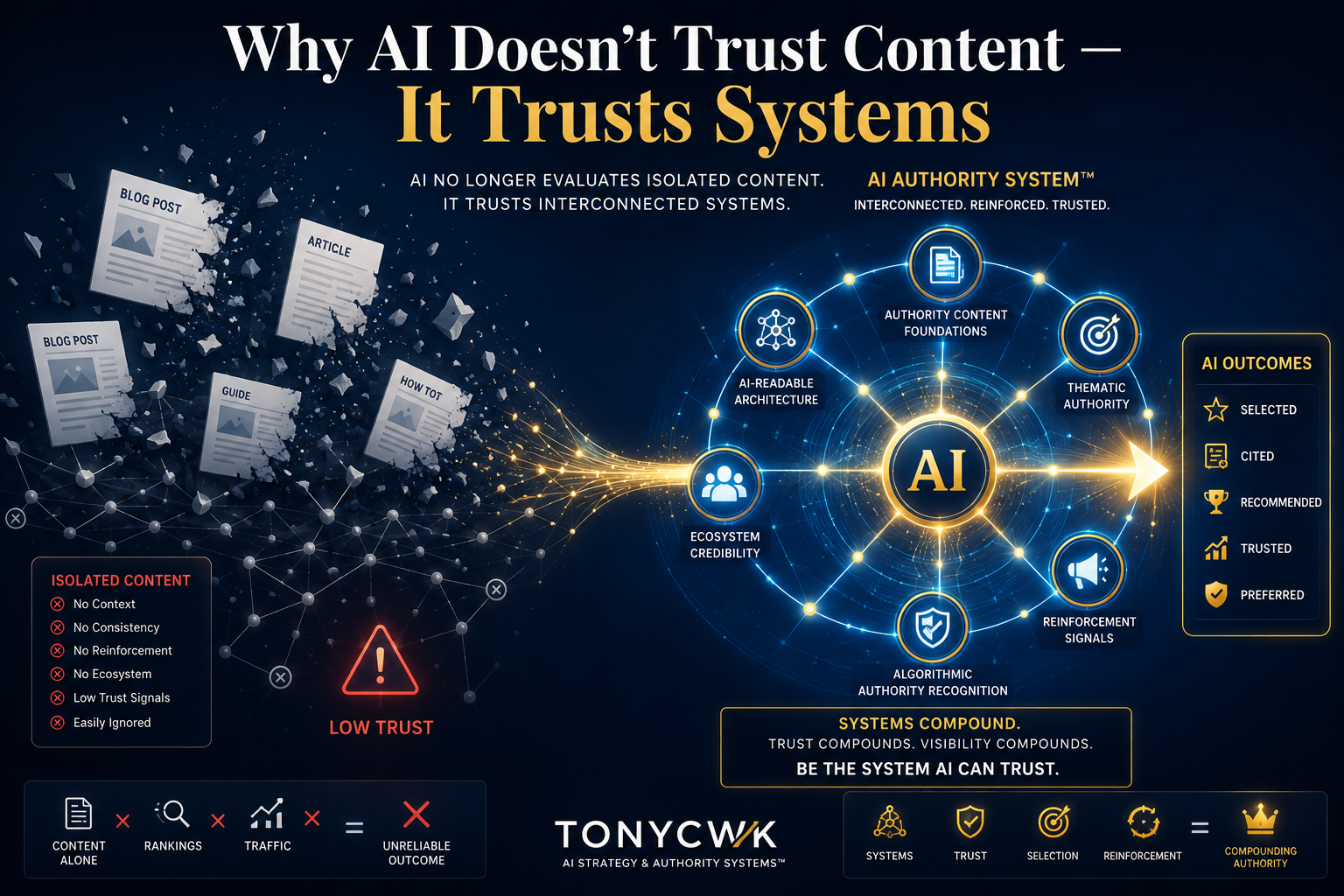
The Rise of the AI Authority System™
Traditional SEO optimized pages.
AI visibility requires optimizing systems.
This is where the concept of the AI Authority System™ becomes critical.
An AI Authority System™ is the interconnected infrastructure that allows AI systems to consistently identify, validate, retrieve, and reinforce your expertise.
It is not a single tactic.
It is a compounding ecosystem.
The system typically includes:
1. Authority Content Foundations
High-quality expertise-driven content remains essential.
But content now serves as foundational evidence rather than the final objective.
AI looks for:
- Depth
- Originality
- Clarity
- Expertise consistency
- Semantic richness
Thin, repetitive, AI-generated content without intellectual structure becomes increasingly weak over time.
2. AI-Readable Knowledge Architecture
AI systems prefer information that is:
- Structured
- Interconnected
- Categorized
- Machine-readable
- Contextually reinforced
This includes:
- Internal linking systems
- Topic clusters
- Schema markup
- Entity relationships
- Hierarchical content organization
- Canonical terminology
AI trust increases when knowledge is easy to interpret.
3. Thematic Authority Development
Generalist visibility is weakening.
AI increasingly rewards topical concentration.
Brands that repeatedly demonstrate expertise in a tightly connected domain become easier for AI to classify and trust.
This creates:
- Higher retrieval confidence
- Better contextual matching
- Stronger recommendation probability
Authority is built through thematic repetition with strategic depth.
4. Ecosystem Credibility Signals
AI systems do not trust self-claims alone.
They look for external validation.
This includes:
- Brand mentions
- Digital PR
- Expert citations
- Interviews
- Podcast appearances
- Community references
- Industry recognition
- Cross-platform consistency
The broader your credibility ecosystem, the easier it becomes for AI systems to validate your authority.
5. Algorithmic Authority Recognition
Eventually, systems begin reinforcing themselves.
AI starts recognizing patterns such as:
- Frequent citation
- Consistent retrieval
- Stable entity association
- High answer utility
- Reinforced expertise clusters
At this stage, visibility compounds.
You stop competing only for rankings.
You begin competing for default selection.
Why AI Distrusts Isolated Content
AI systems are inherently skeptical.
Why?
Because the internet is full of:
- Low-quality content
- Manipulated SEO pages
- Synthetic AI spam
- Contradictory information
- Shallow expertise
- Content farms
As a result, AI systems increasingly prioritize:
- Signal consistency
- Reinforcement patterns
- Historical reliability
- Ecosystem alignment
A single article cannot easily establish trust anymore.
AI wants repeated evidence across systems.
That means:
One viral post is not authority.
One ranking page is not authority.
One backlink is not authority.
Authority emerges from systemic reinforcement.
The Future Belongs to System Builders
The brands winning in AI discovery are no longer merely publishers.
They are system builders.
They create ecosystems where:
- Knowledge compounds
- Signals reinforce each other
- Trust becomes machine-recognizable
- Expertise becomes structurally visible
This is a major strategic shift.
The future of visibility will belong less to:
- Content factories
- Keyword farms
- Publishing velocity alone
And more to:
- Structured intelligence
- Knowledge architecture
- Entity authority
- Retrieval optimization
- Trust reinforcement systems
The internet is transitioning from a content economy to a trust economy.
SEO Is Evolving Into Selection Intelligence
Traditional search optimized for ranking.
AI discovery optimizes for selection.
That distinction matters.
Because ranking measures visibility.
But selection determines whether AI chooses you as the answer.
This creates a new strategic layer beyond SEO:
- Selection readiness
- Retrieval trust
- Answer utility
- Authority reinforcement
- Entity confidence
- AI interpretability
The future winners will not simply produce more content.
They will build systems that AI can reliably trust.
The New Visibility Equation
The old equation was:
Content → Rankings → Traffic
The new equation is becoming:
Systems → Trust → Selection → Reinforcement
That is a fundamentally different internet.
And it explains why many brands are quietly becoming invisible despite publishing more than ever before.
Because AI doesn’t trust content.
It trusts systems.
Final Thoughts
The AI era is not eliminating content.
It is changing how content is evaluated.
Content remains important.
But isolated content without structural authority is becoming increasingly weak inside AI-driven discovery environments.
The future belongs to brands that understand:
- AI-readable systems
- Structured expertise
- Ecosystem credibility
- Reinforcement loops
- Authority architecture
Visibility is no longer about being present.
It is about being trusted enough to be selected.
And in the AI era:
Trust is systemic.
Frequently Asked Questions (FAQ)
What does “AI trusts systems, not content” mean?
It means AI systems evaluate broader patterns of authority, consistency, credibility, and knowledge structure rather than relying on individual articles alone.
Is content still important in the AI era?
Yes. Content remains foundational. However, content alone is no longer sufficient without supporting authority systems and ecosystem credibility.
What is an AI Authority System™?
An AI Authority System™ is the interconnected infrastructure of content, structure, credibility signals, thematic authority, and reinforcement mechanisms that increase AI trust and selection probability.
Why are some brands becoming invisible despite publishing frequently?
Because AI systems prioritize trusted authority ecosystems rather than sheer publishing volume or keyword frequency.
What is the difference between ranking and selection?
Ranking measures where content appears in search results. Selection refers to whether AI systems choose your brand as the recommended or cited answer.
How can brands improve AI trust?
Brands can improve AI trust by building:
- Strong topic clusters
- Consistent expertise
- Structured knowledge architecture
- Cross-platform credibility
- Digital PR signals
- Reinforcement loops
Suggested Further Reading
- “The New Visibility Model: Why Being Found Is No Longer Enough” 👉https://tonycwk.com/the-new-visibility-model
- “SEO vs AI Authority: The Future of Digital Visibility” 👉https://tonycwk.com/seo-alone-is-no-longer-enough/
- “How Search Has Evolved in the Age of AI” 👉https://tonycwk.com/ai-search-visibility-framework
- “AI Selection Psychology™” 👉https://tonycwk.com/ai-selection-psychology/
Written by Tony Chan (TonyCWK)
AI Authority & Digital Strategy Researcher
Leave a Reply