
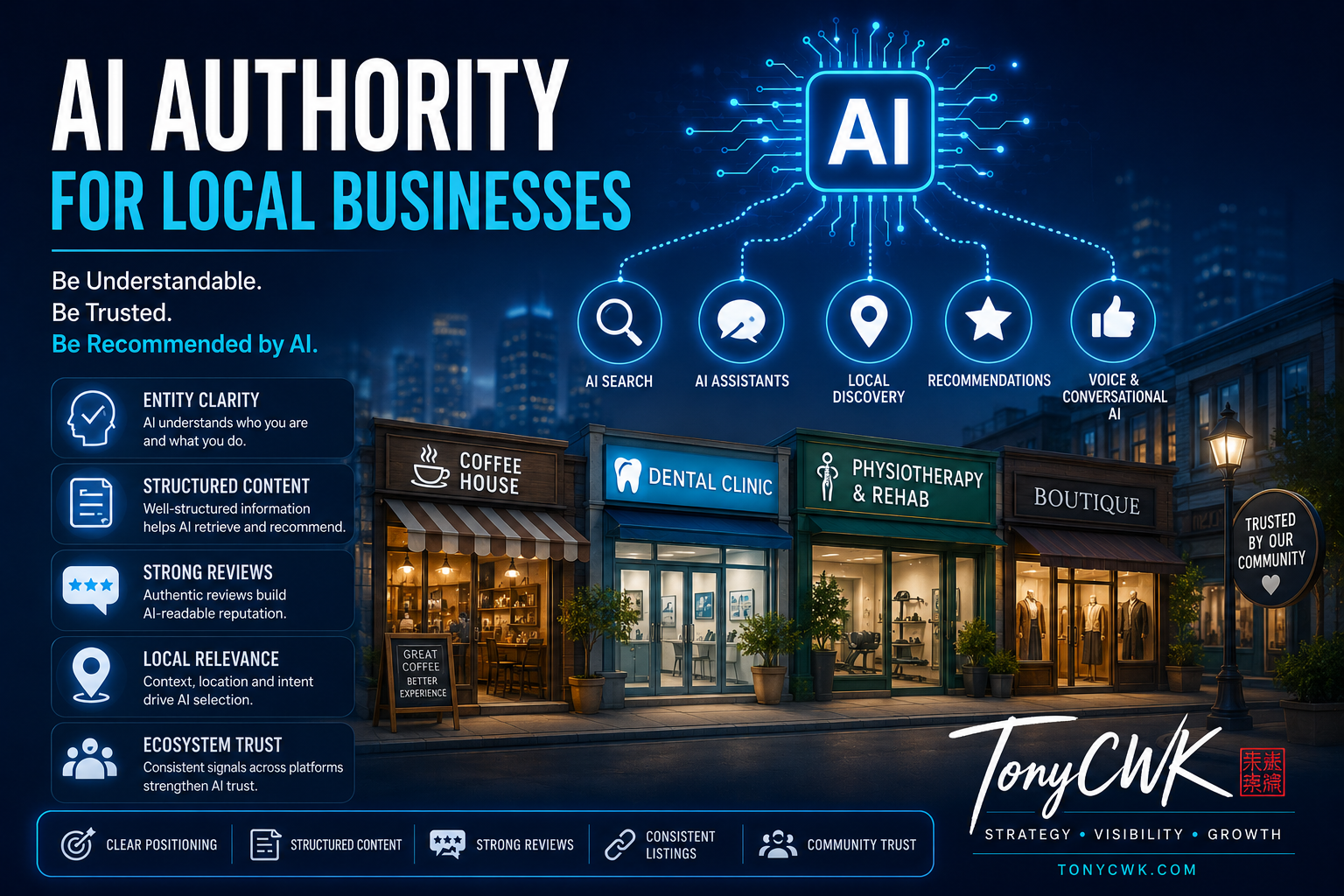
Why Small Local Brands Must Become AI-Selectable
For years, local business visibility depended heavily on three things:
- Google rankings
- Paid ads
- Word-of-mouth referrals
But the rise of AI-powered discovery is fundamentally changing how customers find and choose local businesses.
Today, people increasingly ask AI systems questions like:
- “What’s the best chiropractor near me for office workers?”
- “Which café in Singapore is good for remote work?”
- “Recommend a trusted renovation contractor in Tampines.”
- “Which tuition center is best for PSLE Math?”
The future of local discovery is no longer just about ranking.
It is about being selected, cited, and recommended by AI systems.
This is where AI Authority becomes critical for local businesses.
The Shift From Local SEO → Local AI Authority
Traditional Local SEO focused on:
- Google Business Profile optimization
- Keywords + location pages
- Reviews
- Citations/directories
- Backlinks
These still matter.
But AI systems now evaluate businesses differently.
Modern AI discovery systems assess:
- Entity clarity
- Reputation consistency
- Contextual trust
- Thematic specialization
- Review sentiment patterns
- Structured business information
- Cross-platform credibility
- Recommendation-worthiness
This means:
Visibility is no longer purely algorithmic.
It is increasingly probabilistic and trust-driven.
Local businesses must evolve from merely being searchable…
…to becoming AI-selectable entities.
What Is AI Authority for Local Businesses?
AI Authority for local businesses refers to:
The probability that AI systems recognize, trust, retrieve, and recommend a local business within relevant customer contexts.
This includes:
- AI search engines
- LLM-powered assistants
- AI recommendation systems
- AI-enhanced local search
- Voice assistants
- Generative answer engines
In the AI era:
- Google Maps matters
- Reviews matter
- Website SEO matters
But increasingly…
- Structured knowledge matters more
- Entity consistency matters more
- Thematic authority matters more
- Ecosystem trust matters more
Why Local Businesses Are Especially Vulnerable in the AI Era
Many local businesses still rely on outdated visibility models:
- Directory stuffing
- Generic SEO pages
- Thin location content
- Short-term ads
- Inconsistent branding
- Minimal knowledge structure
This creates a dangerous problem:
AI systems struggle to understand them clearly.
If AI cannot confidently understand a business, it becomes less likely to recommend it.
This creates what can be called:
The Local AI Visibility Gap
Two businesses may offer similar services.
But the business with:
- Better structured knowledge
- Stronger entity signals
- Higher thematic clarity
- More ecosystem trust
…becomes significantly more selectable by AI systems.
Over time:
The most AI-understandable local businesses gain disproportionate visibility advantages.
The 5 Pillars of Local AI Authority
1. Entity Clarity
AI systems need to clearly understand:
- Who you are
- What you do
- Where you operate
- What you specialize in
Many local businesses confuse AI systems with:
- inconsistent naming
- conflicting contact details
- vague service descriptions
- mixed positioning
Example:
Instead of:
“We provide quality wellness solutions.”
AI-readable clarity would be:
“Chiropractic clinic in Singapore specializing in posture correction and neck pain treatment for office professionals.”
Specificity improves AI understanding.
2. Structured Knowledge Architecture
AI systems prefer structured information over fragmented information.
Local businesses should structure:
- Services
- FAQs
- Pricing categories
- Service areas
- Business hours
- Practitioner profiles
- Customer outcomes
- Case studies
This improves AI retrieval and recommendation potential.
3. Thematic Authority
AI systems increasingly reward specialization.
Generalist businesses become harder to categorize.
Example:
Instead of:
“Digital marketing agency.”
AI-selectable positioning becomes:
“Singapore B2B LinkedIn marketing agency specializing in AI discovery visibility for SMEs.”
The narrower and clearer the expertise:
…the stronger the AI association becomes.
4. Ecosystem Credibility Signals
AI systems evaluate trust through ecosystem reinforcement.
This includes:
- Reviews
- Mentions
- Local citations
- Media coverage
- Social proof
- Cross-platform consistency
- Industry references
- Community engagement
The business that appears trustworthy across multiple platforms gains stronger authority reinforcement.
5. AI-Readable Reputation
Reviews are no longer only for humans.
AI systems increasingly analyze:
- review language
- sentiment consistency
- recurring expertise themes
- service quality patterns
- customer outcome patterns
Example:
A clinic consistently receiving reviews mentioning:
- “neck pain relief”
- “office posture issues”
- “long working hours”
…helps AI systems associate the clinic with those use cases.
This strengthens recommendation probability.
Why Reviews Become More Powerful in AI Discovery
In traditional SEO:
Reviews influenced rankings.
In AI discovery:
Reviews influence semantic trust.
AI systems increasingly interpret reviews as:
- proof of expertise
- proof of outcomes
- proof of specialization
- proof of customer satisfaction
This means local businesses should encourage reviews that mention:
- specific services
- customer situations
- outcomes achieved
- specialist strengths
Not fake reviews.
Not keyword stuffing.
But authentic contextual signals.
The Rise of Conversational Local Search
The future of local discovery will increasingly sound like conversations.
Instead of typing:
“best dentist Singapore”
Users may ask:
“Which dentist in Singapore is good for anxious patients?”
Or:
“Recommend a family café near Tanjong Pagar suitable for remote work.”
This changes optimization dramatically.
Businesses must now optimize for:
- contextual relevance
- customer scenarios
- expertise mapping
- conversational retrieval
- AI recommendation trust
Local Businesses Must Build AI-Readable Trust Systems
The future winners will not simply have:
- the largest budgets
- the most ads
- the highest traffic
Instead, the winners will build:
- clearer knowledge systems
- stronger entity consistency
- more trustworthy ecosystems
- deeper thematic authority
- AI-readable credibility
This is the transition from:
“Being Found”
to
“Being Recommended”
Practical AI Authority Strategy for Local Businesses
Step 1 — Clarify Positioning
Define:
- Exact specialization
- Ideal customer profile
- Geographic focus
- Primary outcomes delivered
Avoid generic positioning.
Step 2 — Build Structured Content
Create:
- Service pages
- Local FAQs
- Customer scenario pages
- Problem-solution articles
- Practitioner bios
- Local guides
AI systems need structured context.
Step 3 — Strengthen Review Semantics
Encourage reviews describing:
- customer problems
- experiences
- outcomes
- specialties
Semantic specificity matters.
Step 4 — Improve Ecosystem Consistency
Ensure consistent:
- business name
- phone number
- descriptions
- categories
- service positioning
Across:
- Google Business Profile
- Website
- Directories
- Local listings
Step 5 — Develop Thematic Authority
Own a niche.
Example:
Instead of:
“fitness trainer”
Become:
“Singapore posture correction fitness coach for desk-bound professionals.”
AI systems reward thematic clarity.
The Future Belongs to AI-Selectable Local Brands
Many local businesses still believe visibility is mainly about:
- ads
- keywords
- rankings
But AI is changing discovery itself.
The future belongs to businesses that are:
- understandable
- structured
- trusted
- contextually relevant
- semantically reinforced
Because in the AI era:
The best local business may not always be the one that ranks first.
Increasingly…
It will be the one AI systems trust enough to recommend.
Final Thought
Local businesses are entering a new discovery economy.
One where:
- trust compounds
- structure matters
- clarity wins
- specialization dominates
- AI recommendation becomes the new visibility layer
The future of local marketing is no longer just Local SEO.
It is:
Local AI Authority
Because in the age of AI:
Searchable businesses survive.
Selectable businesses dominate.
FAQs: AI Authority for Local Businesses
1. What is AI Authority for local businesses?
AI Authority for local businesses is the ability of a local brand to be understood, trusted, retrieved, cited, and recommended by AI systems when users ask location-based or service-based questions.
2. How is AI Authority different from Local SEO?
Local SEO focuses on rankings, maps visibility, keywords, reviews, and citations. AI Authority goes further by building entity clarity, structured knowledge, thematic expertise, ecosystem trust, and AI-readable reputation signals.
3. Is Local SEO still important in the AI era?
Yes. Local SEO remains important because search engines, maps, reviews, and local listings still provide foundational visibility signals. However, Local SEO should now support AI Authority, not operate separately from it.
4. Why does AI Authority matter for small local businesses?
AI Authority matters because customers increasingly use AI assistants and AI-powered search tools to ask for recommendations. Local businesses that are clearer, more trusted, and better structured are more likely to be selected.
5. What makes a local business AI-selectable?
A local business becomes AI-selectable when AI systems can clearly understand what it does, where it operates, who it serves, why it is trusted, and what customer problems it solves.
6. Do customer reviews affect AI Authority?
Yes. Reviews help AI systems understand reputation, service quality, customer sentiment, recurring strengths, and specific use cases. Reviews with authentic detail are more useful than generic reviews.
7. What kind of reviews help AI Authority?
Helpful reviews mention the specific service, customer problem, location, experience, and outcome. For example, “helped with neck pain from long office hours” is more useful than simply “good service.”
8. Does Google Business Profile still matter?
Yes. Google Business Profile remains one of the most important local entity sources. It supports visibility, trust, reviews, business details, service categories, and local discovery signals.
9. Should local businesses create FAQ content?
Yes. FAQ content helps AI systems understand customer questions, service context, local intent, and business expertise. It also improves content structure and answer-readiness.
10. What is entity clarity?
Entity clarity means AI systems can clearly identify a business as a distinct entity, including its name, services, location, audience, specialization, and credibility signals.
11. Why is structured content important for AI Authority?
Structured content helps AI systems extract and interpret information more easily. Service pages, FAQs, schema markup, practitioner profiles, and location pages all improve AI readability.
12. Can a small local business compete with larger brands in AI discovery?
Yes. AI discovery rewards clarity, specialization, trust, and relevance. A small local business with strong niche positioning can become more selectable than a larger but more generic competitor.
13. What are ecosystem credibility signals?
Ecosystem credibility signals are external trust indicators such as reviews, directory listings, local citations, media mentions, social profiles, backlinks, testimonials, and consistent brand references.
14. What is thematic authority for local businesses?
Thematic authority means a business is strongly associated with a specific topic, service category, customer problem, or local niche. This helps AI systems understand when to recommend it.
15. How can local businesses improve AI Authority?
Local businesses can improve AI Authority by clarifying positioning, optimizing Google Business Profile, creating structured service content, encouraging detailed reviews, adding schema, and maintaining consistent listings.
16. Is schema markup necessary for local AI Authority?
Schema markup is not the only factor, but it helps search engines and AI systems understand business details, services, FAQs, reviews, locations, and organization information more clearly.
17. What schema types are useful for local businesses?
Useful schema types include LocalBusiness, Organization, Service, FAQPage, Review, WebPage, BreadcrumbList, and Person schema where relevant.
18. How does AI Authority affect customer acquisition?
AI Authority can improve customer acquisition by increasing the chance that a business appears in AI-generated answers, recommendation lists, local comparisons, and conversational search results.
19. What is the future of local business visibility?
The future of local visibility will move from being found through rankings alone to being selected through AI trust, structured knowledge, reputation signals, and contextual relevance.
20. What is the main principle of AI Authority for local businesses?
The main principle is simple: local businesses must become easy for AI to understand, trust, and recommend.
Suggested Further Readings
The AI Authority Pyramid™
Explains the core framework behind AI-selectable brands and structured authority development. 👉 https://tonycwk.com/ai-authority-pyramid/
Why AI Doesn’t Trust Content — It Trusts Systems
Expands on why local businesses must build structured ecosystems instead of relying on isolated content. 👉 https://tonycwk.com/why-ai-doesnt-trust-content-it-trusts-systems/
How AI Systems Build Trust
Explores how AI evaluates credibility, consistency, and recommendation-worthiness. 👉https://tonycwk.com/ai-selection-psychology/
AI Discovery Flywheel™
Shows how authority compounds over time through reinforcement signals and discovery momentum. 👉 https://tonycwk.com/ai-discovery-flywheel/
AI Authority Operating System™
Introduces the orchestration layer behind AI visibility, structure, and selection.👉 https://tonycwk.com/ai-authority-operating-system
Written by Tony Chan (TonyCWK)
AI Authority & Digital Strategy Researcher
Leave a Reply