
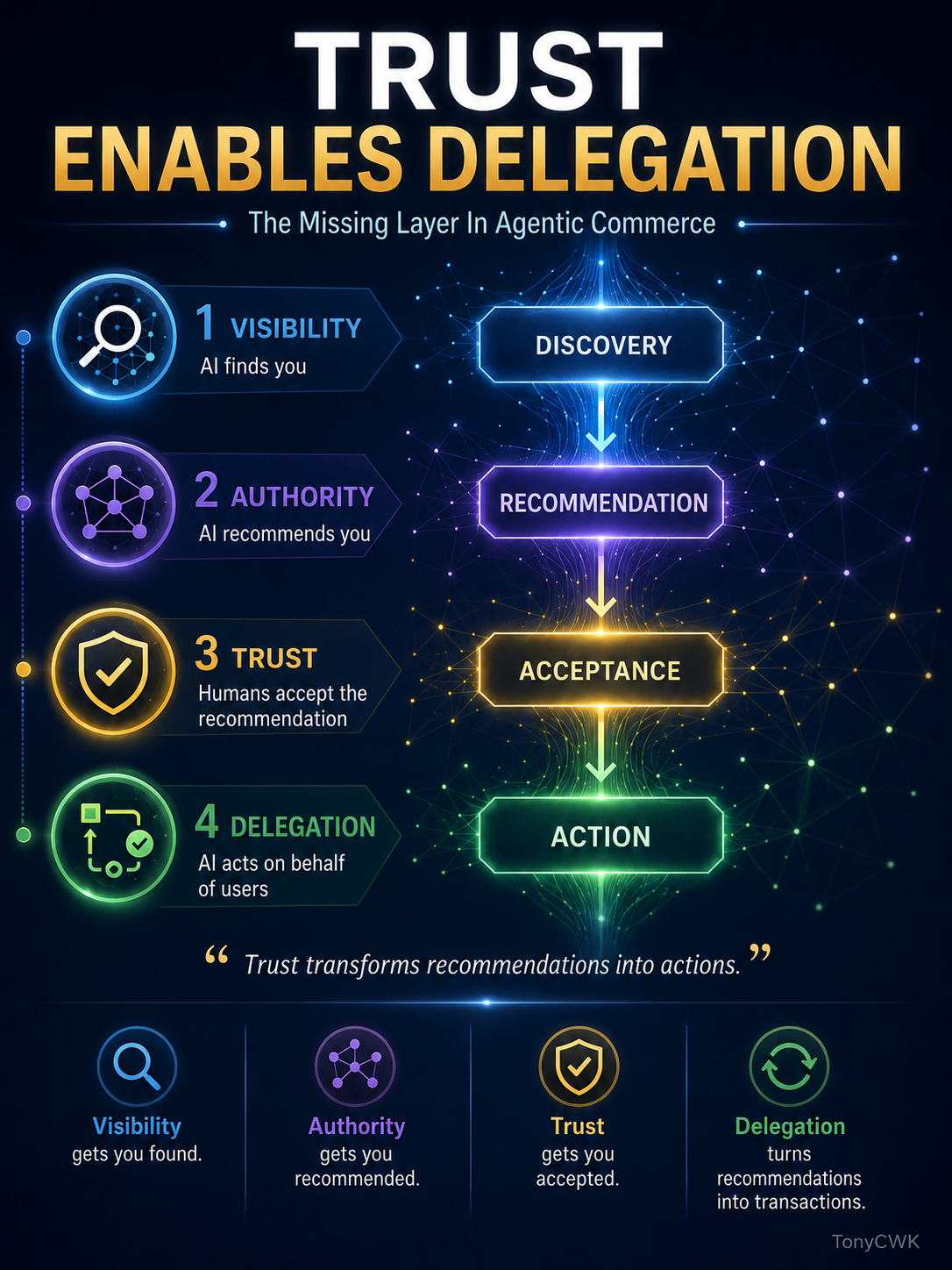
The conversation around AI visibility has largely focused on discovery, rankings, citations, and recommendations.
These are important.
But they are no longer the end of the journey.
As AI systems evolve from information retrieval tools into decision-support systems and autonomous agents, a new question emerges:
What happens after a recommendation is accepted?
The answer is delegation.
The future of AI commerce may not be defined by what gets found.
It may be defined by what gets trusted enough for decisions to be delegated.
This is the missing layer in many discussions about AI search, AI visibility, and agentic commerce.
Visibility helps AI find you.
Authority helps AI recommend you.
Trust helps humans believe the recommendation.
Delegation determines whether action actually happens.
The Evolution Of AI Influence
Traditional digital marketing was built around attention.
The objective was simple:
Traffic → Clicks → Conversions
AI changes this equation.
Modern AI systems increasingly act as intermediaries between businesses and consumers.
Instead of evaluating hundreds of options themselves, users increasingly rely on AI systems to:
• Filter information
• Compare alternatives
• Recommend options
• Explain choices
• Automate decisions
This creates a new influence progression:
Visibility → Authority → Trust → Delegation
Each stage represents a deeper level of influence.
Being visible means you can be discovered.
Being authoritative means you can be recommended.
Being trusted means your recommendation is accepted.
Being delegated means action is taken.
Why Trust Matters More Than Ever
Many organizations assume trust is simply another marketing metric.
In reality, trust is becoming a prerequisite for delegation.
Consider the difference between these two situations:
Scenario 1:
An AI assistant recommends a hotel.
The user reviews multiple options before making a decision.
Scenario 2:
An AI travel agent books the hotel automatically according to predefined preferences.
The second scenario requires something fundamentally different.
The user is no longer evaluating the recommendation.
The user is allowing the AI to act.
That transition requires trust.
Without trust, recommendations remain suggestions.
With trust, recommendations become decisions.
Delegation Is The Real Endgame
The Emerging Agentic Commerce Model
Traditional Commerce
Consumer → Search → Evaluate → Purchase
AI-Assisted Commerce
Consumer → AI Recommendation → Evaluate → Purchase
Agentic Commerce
Consumer → AI Agent → Decision → Transaction
As AI agents become more capable, the human evaluation stage gradually shrinks.
The critical question becomes:
Will users trust the AI enough to let it act?
The Delegation Threshold™
The point at which a user becomes sufficiently confident in an AI system to allow autonomous decision-making within predefined boundaries.
Examples:
Low Delegation
- Calendar scheduling
- Email prioritization
- Travel suggestions
Medium Delegation
- Subscription renewals
- Vendor shortlisting
- Inventory recommendations
High Delegation
- Financial transactions
- Healthcare decisions
- Contract approvals
- Procurement purchases
The higher the consequence, the higher the trust requirement.
Why AI Authority Alone Is Not Enough
AI Authority explains why a business gets recommended.
Trust explains why the recommendation gets accepted.
Delegation explains why action occurs.
This distinction is crucial.
Many organizations focus only on visibility.
Some focus on authority.
Very few focus on what happens after trust is established.
Yet delegation may become the most commercially important layer of all.
The Future Of Agentic Commerce
Over the next few years, businesses will increasingly compete across four layers:
Layer 1 — Visibility
Layer 2 — Authority
Will AI systems recommend you?
Layer 3 — Trust
Will humans accept the recommendation?
Layer 4 — Delegation
Will humans allow AI to act on the recommendation?
Organizations that reach Layer 4 will possess a significant competitive advantage.
Because delegated decisions happen faster than manually evaluated decisions.
The Strategic Implication
A future AI agent choosing a supplier, software platform, hotel, insurer, consultant, or logistics provider may never review hundreds of options.
Instead, it may choose from a trusted shortlist.
The winners will not necessarily be the most visible.
They may not even be the most cited.
They will be the organizations that consistently earn sufficient trust for decisions to be delegated.
Conclusion
The future of AI visibility is not simply about being found.
It is not even just about being recommended.
The next frontier is delegation.
Visibility creates discovery.
Authority creates recommendation.
Trust creates acceptance.
Delegation creates action.
In the age of agentic commerce, trust does more than influence decisions.
Trust enables delegation.
FAQ
1. What does “Trust Enables Delegation” mean?
It means users will only allow AI agents to act on their behalf when they trust the recommendation, the system, and the expected outcome.
2. Why is trust important in agentic commerce?
Because agentic commerce moves beyond suggestions. AI agents may compare, choose, book, renew, purchase, or execute tasks. Without trust, users will keep control. With trust, users may delegate.
3. How is agentic commerce different from AI search?
AI search helps users find answers or options. Agentic commerce allows AI systems to take action, such as making a purchase, booking a service, or completing a transaction.
4. What is the Delegation Threshold™?
The Delegation Threshold™ is the point where a user becomes confident enough to allow an AI system to act within defined boundaries.
5. Is AI Authority™ the same as trust?
No. AI Authority™ helps a brand become discoverable, credible, and recommendable to AI systems. Trust determines whether humans accept the recommendation and allow action.
6. What comes after AI recommendation?
After recommendation comes acceptance. After acceptance comes delegation. This is where AI shifts from influencing decisions to acting on decisions.
7. Will humans still be involved in agentic commerce?
Yes. Human involvement will remain important, especially for high-risk, high-value, or emotionally significant decisions. The more serious the decision, the stronger the trust requirement.
8. What should businesses do to prepare for agentic commerce?
Businesses should build clear information architecture, verifiable credibility signals, transparent policies, consistent customer experience, and strong trust signals that both AI systems and humans can evaluate.
Leave a Reply