
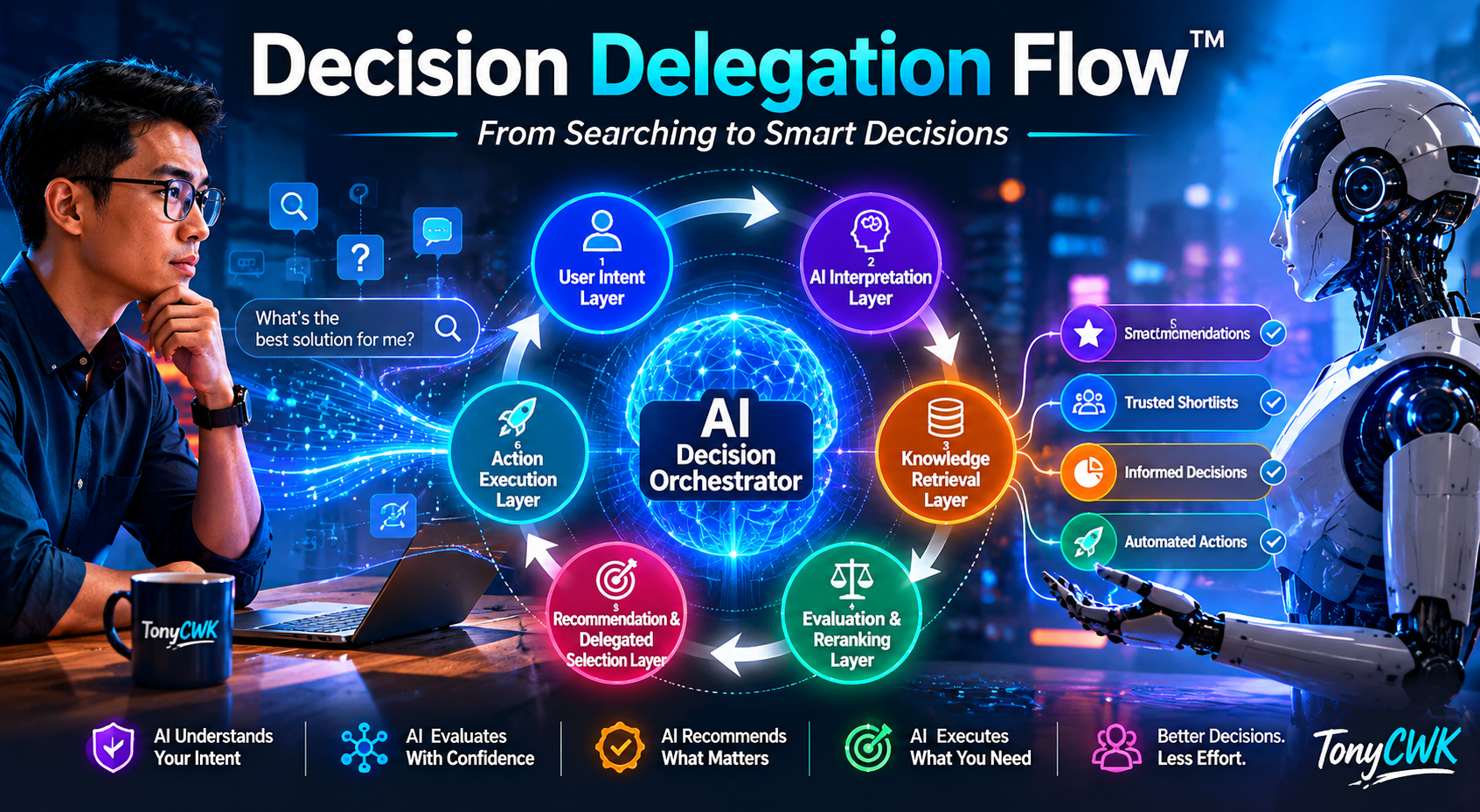
How Agentic AI Is Replacing Traditional Browsing With Intelligent Recommendation Systems
For over two decades, digital marketing operated around a relatively stable behavioral assumption:
Users searched.
Users browsed.
Users compared.
Users clicked.
Users decided.
The internet functioned primarily as an information retrieval environment.
Search engines helped users locate information.
Websites competed for attention.
And marketers optimized for discoverability within human browsing behavior.
But the AI era is fundamentally changing that model.
We are now entering the age of:
Decision Delegation.
Increasingly, users are no longer manually navigating digital ecosystems themselves.
Instead, they are outsourcing evaluation, filtering, recommendation, comparison, and even action execution to AI systems.
This emerging behavioral transition may become one of the most significant shifts in the history of digital marketing.
Because the future competitive landscape may no longer revolve around:
“Can users find your website?”
But increasingly around:
“Will AI systems choose your brand during delegated decision-making?”
This is the foundation of:
Decision Delegation Flow™.
The Shift From Information Retrieval to Decision Orchestration
Traditional search behavior was fundamentally exploratory.
Users manually performed:
- keyword searches
- comparison browsing
- website evaluation
- review analysis
- feature comparison
- trust assessment
- decision selection
The user remained the primary decision processor.
Search engines merely assisted navigation.
But AI systems are changing the architecture of interaction itself.
Today, users increasingly ask AI systems to:
- recommend products
- summarize research
- shortlist providers
- compare options
- filter information
- evaluate credibility
- generate purchasing suggestions
- automate workflows
- execute tasks directly
This transforms AI from:
an information gateway
into
a decision intermediary.
And eventually:
a decision orchestrator.
The Emergence of Decision Delegation
Decision Delegation occurs when users increasingly transfer cognitive evaluation responsibilities to AI systems.
Instead of manually analyzing dozens of sources, users now increasingly ask:
- “What is the best CRM for SMEs?”
- “Recommend the most trustworthy cybersecurity certification pathway.”
- “Which chiropractor is best for office workers?”
- “What’s the best value AI marketing platform?”
- “Which vendor should I choose?”
The user no longer wants infinite information.
The user wants:
trusted resolution.
This changes the role of digital visibility entirely.
In the traditional web:
visibility created optionality.
In the AI era:
visibility increasingly influences selection.
The Decision Delegation Flow™ Framework
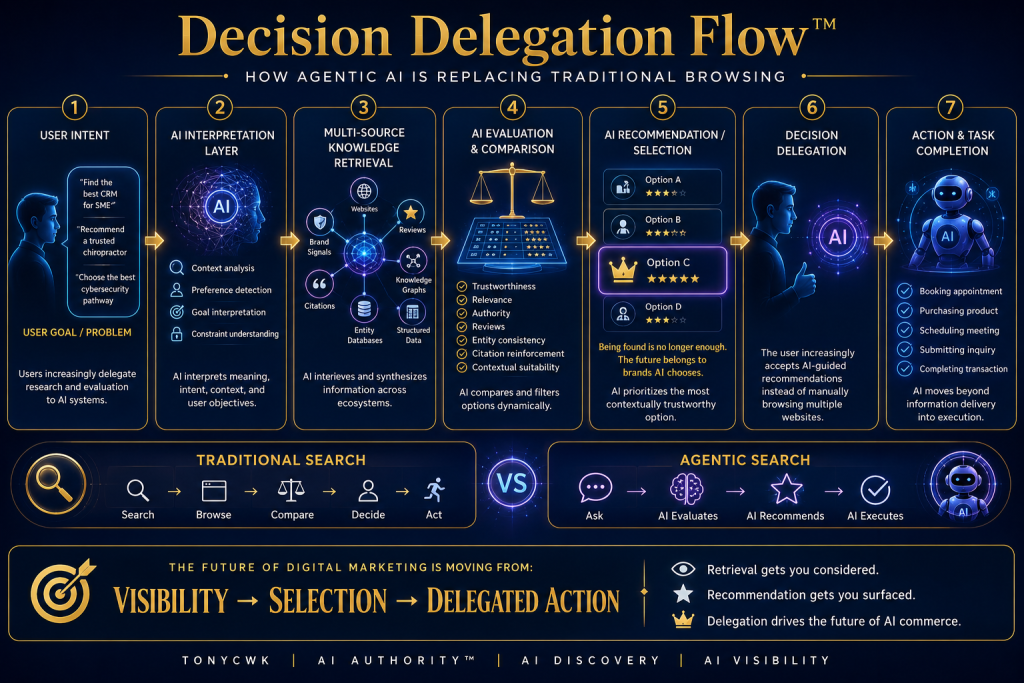
The Decision Delegation Flow™ model explains how modern AI systems increasingly mediate digital decision-making.
The flow typically operates across six interconnected stages.
Stage 1 — User Intent Layer
The process begins with a user objective.
The user expresses:
- a problem
- a need
- a goal
- a preference
- a desired outcome
Unlike traditional keyword search, modern AI systems increasingly interpret:
- semantic meaning
- contextual goals
- behavioral intent
- situational constraints
- preference patterns
The interaction becomes conversational rather than navigational.
This represents a major shift from:
query matching
to
intent interpretation.
Stage 2 — AI Interpretation Layer
The AI system then performs intent analysis.
This includes:
- contextual understanding
- semantic interpretation
- user objective modeling
- constraint analysis
- prioritization weighting
AI systems increasingly attempt to infer:
- urgency
- budget sensitivity
- trust requirements
- expertise level
- regional relevance
- historical patterns
- personalization factors
This means AI systems are no longer simply indexing information.
They are interpreting decision context.
And context increasingly shapes recommendation outcomes.
Stage 3 — Knowledge Retrieval Layer
The AI system then retrieves information from multiple ecosystems simultaneously.
These may include:
- websites
- structured databases
- knowledge graphs
- reviews
- forums
- citations
- business profiles
- product ecosystems
- schema layers
- APIs
- historical behavioral signals
Importantly, retrieval itself is becoming multi-dimensional.
AI systems increasingly evaluate:
- authority
- consistency
- semantic coherence
- trust reinforcement
- entity clarity
- citation frequency
- ecosystem alignment
- contextual relevance
This creates a major competitive shift.
The future winners may not simply be:
the most searchable brands.
But the most interpretable and reinforceable brands.
Stage 4 — Evaluation & Reranking Layer
This may become the most strategically important layer in AI-mediated discovery.
Because retrieval alone is no longer enough.
AI systems increasingly rerank information based on:
- trustworthiness
- confidence
- consistency
- recommendation safety
- contextual alignment
- authority reinforcement
- ecosystem validation
This means visibility itself is becoming probabilistic.
Being retrievable does not guarantee being recommended.
This creates the emerging importance of:
- AI Authority™
- AI Selection Systems™
- Citation Engineering™
- Ecosystem Trust Signals
- Retention Architecture
- Governance Layers
The future battle may increasingly revolve around:
algorithmic preference formation.
Stage 5 — Recommendation & Delegated Selection Layer
At this stage, AI systems increasingly compress complexity into simplified recommendations.
Instead of presenting:
- 50 search results
- 20 comparison pages
- 15 websites
AI systems increasingly provide:
- ranked recommendations
- summarized evaluations
- curated shortlists
- direct answers
- preferred options
This fundamentally changes digital competition.
In traditional SEO:
visibility was distributed.
In AI systems:
recommendation concentration may intensify.
The competitive environment shifts from:
discoverability competition
to
selection competition.
Stage 6 — Action Execution Layer
The final stage is where agentic AI becomes transformational.
AI systems increasingly move beyond:
recommendation.
Toward:
execution.
Emerging AI systems may:
- schedule appointments
- complete purchases
- book services
- fill forms
- automate workflows
- initiate transactions
- manage subscriptions
- coordinate vendors
This means AI systems may eventually become:
decision execution infrastructure.
And brands may increasingly compete not only for human attention —
but for AI action eligibility.
Why Decision Delegation Changes Digital Marketing
This shift fundamentally alters the architecture of digital competition.
Traditional marketing optimized for:
- clicks
- traffic
- impressions
- rankings
- sessions
But AI-mediated ecosystems increasingly optimize for:
- recommendation probability
- trust persistence
- retrieval confidence
- contextual authority
- ecosystem coherence
- reinforcement consistency
- selection preference
This means future digital marketing may become increasingly centered around:
delegation readiness.
The Rise of Delegation-Optimized Brands
In the AI era, the strongest brands may increasingly become those that are:
- machine-readable
- semantically structured
- contextually trustworthy
- citation-rich
- ecosystem-consistent
- entity-coherent
- reinforcement-stable
- recommendation-safe
Because AI systems cannot confidently recommend what they cannot confidently interpret.
This is why AI Authority™ becomes increasingly important.
AI systems reward:
confidence.
And confidence is increasingly built through:
reinforced digital ecosystems.
The Hidden Risk of AI-Mediated Selection
One of the least discussed implications of Decision Delegation is recommendation concentration risk.
As AI systems increasingly compress decisions:
- fewer brands may receive visibility
- recommendation concentration may increase
- dominant entities may reinforce recursively
- trust loops may compound asymmetrically
This could create:
- winner-amplification dynamics
- authority compounding effects
- recommendation monopolization risks
- reduced discovery diversity
Which means the future competitive landscape may increasingly reward:
Not merely discoverability.
Decision Delegation and the Future of SEO
SEO itself is not disappearing.
But its role is evolving.
Traditional SEO optimized for:
human navigation.
AI-era visibility increasingly optimizes for:
machine confidence.
This means future SEO may increasingly merge with:
- AI Authority
- entity architecture
- structured trust systems
- retrieval optimization
- citation ecosystems
- semantic reinforcement
- machine-readable governance
Search is evolving from:
“finding pages”
toward:
“selecting trusted entities.”
The Future of Digital Competition
The internet may be entering a new operational phase.
The first era was:
Information Retrieval.
The second era became:
Attention Optimization.
The emerging era may become:
Delegated Decision Infrastructure.
In this environment:
users increasingly outsource cognition.
AI systems increasingly mediate trust.
And brands increasingly compete for algorithmic preference.
This changes everything.
Because in the future:
the most successful brands may not be the brands users browse most.
But the brands AI systems recommend most confidently.
Final Thoughts
Decision Delegation Flow™ represents more than a search trend.
It represents a structural transformation in how digital decisions are made.
The future of digital marketing may no longer revolve purely around:
attention acquisition.
But increasingly around:
delegation eligibility.
Because in the AI era:
visibility gets you considered.
Authority gets you trusted.
But delegation gets you chosen.
FAQ: Decision Delegation Flow™
1. What is Decision Delegation Flow™?
Decision Delegation Flow™ is a TonyCWK framework that explains how users increasingly delegate research, evaluation, comparison, recommendation, and action-taking to AI systems instead of manually browsing websites.
2. Why is Decision Delegation important in digital marketing?
It matters because AI systems are becoming decision intermediaries. Brands now need to be not only discoverable by humans, but also interpretable, trustworthy, and recommendable by AI systems.
3. How is Decision Delegation different from traditional search?
Traditional search gives users a list of results to evaluate manually. Decision Delegation allows AI systems to interpret intent, retrieve information, evaluate options, and recommend or execute actions on behalf of the user.
4. What are the main stages of Decision Delegation Flow™?
The main stages are User Intent, AI Interpretation, Knowledge Retrieval, Evaluation and Reranking, Recommendation and Delegated Selection, and Action Execution.
5. How does AI interpret user intent?
AI systems analyze context, goals, constraints, preferences, urgency, and semantic meaning to understand what the user is really trying to achieve.
6. Why is being found no longer enough?
Because AI systems may retrieve many brands but recommend only a few. Being discoverable does not guarantee being selected.
7. What is the Evaluation and Reranking Layer?
The Evaluation and Reranking Layer is where AI systems assess retrieved information based on relevance, trust, authority, consistency, and contextual fit before deciding what to recommend.
8. How does Decision Delegation affect SEO?
SEO remains important, but it increasingly needs to evolve beyond rankings and traffic toward AI readability, entity clarity, structured data, citation signals, and recommendation confidence.
9. What does “delegation readiness” mean?
Delegation readiness refers to how prepared a brand is to be understood, trusted, recommended, and acted upon by AI systems during delegated decision-making.
10. Why does AI Authority™ matter in Decision Delegation?
AI Authority™ helps brands build the structured trust, semantic clarity, and ecosystem consistency needed for AI systems to recommend them confidently.
11. Can small brands benefit from Decision Delegation?
Yes. Small brands can benefit if they build strong topical clarity, structured content, consistent entity signals, reviews, citations, and trustworthy digital ecosystems.
12. What is the risk of Decision Delegation for brands?
The main risk is invisibility inside AI-mediated recommendations. A brand may rank, publish, or advertise, but still be excluded from AI-generated shortlists.
13. How does Decision Delegation change customer journeys?
Customer journeys may become shorter, more compressed, and more AI-mediated. Instead of visiting many websites, users may rely on AI to narrow choices quickly.
14. What is the Action Execution Layer?
The Action Execution Layer is where AI systems move from recommending options to completing tasks, such as booking, purchasing, scheduling, filling forms, or initiating workflows.
15. How can brands prepare for Decision Delegation?
Brands should strengthen machine-readable content, structured data, clear service pages, authoritative topical clusters, credible citations, reviews, consistent business information, and trust signals across platforms.
16. Is Decision Delegation the same as agentic AI?
They are related but not identical. Agentic AI refers to systems that can take actions or complete tasks. Decision Delegation describes the broader behavioral shift where users transfer decision responsibilities to AI systems.
17. What metrics may become important in Decision Delegation?
Future metrics may include recommendation frequency, AI citation presence, selection rate, retrieval confidence, entity consistency, answer inclusion, and comparison visibility.
18. Does paid advertising still matter in Decision Delegation?
Yes, but paid visibility may need to evolve. Ads may increasingly become conversational, recommendation-aware, and integrated into AI-mediated decision environments.
19. Why is ecosystem consistency important?
AI systems build confidence from repeated, consistent signals across websites, profiles, reviews, articles, citations, schema, and third-party references.
20. What is the future of digital marketing in the age of Decision Delegation?
Digital marketing may increasingly shift from attention acquisition to trust reinforcement, recommendation eligibility, and AI-mediated selection.
Suggested Further Reading
- Ads vs AI Authority: Why Paid Visibility Alone Is No Longer Enough
- Why SMEs Can Outperform Corporates in AI Discovery
- How Small Brands Beat Large Brands in AI
- The AI Discovery Flywheel™
- The AI Authority Pyramid™
- How Search Has Evolved in the Age of AI — From Rankings to Recommendations
- SEO Alone Is No Longer Enough
- Entity Persistence in the Age of LLMs
- Local Entity SEO in the Age of AI
Written by Tony Chan (TonyCWK)
AI Authority & Digital Strategy Researcher
Leave a Reply