
Why the Future of Digital Visibility Is About Being Chosen by AI
The digital visibility era is entering a profound transformation.
For decades, businesses competed to be found.
They optimized websites for rankings, clicks, impressions, and traffic.
But in the age of AI systems, recommendation engines, delegated commerce, and conversational interfaces, visibility alone is no longer enough.
The new competitive advantage is becoming selectable.
Not just discoverable.
Not merely searchable.
But algorithmically preferred, trusted, retrievable, and recommended by AI systems.
This is the rise of Selectability™.
What Is Selectability™?
Selectability™ refers to the probability that an AI system chooses a brand, company, product, service, or source during recommendation, retrieval, ranking, delegation, or transaction execution.
In traditional SEO:
- Success meant being indexed.
- Then ranking.
- Then generating clicks.
In AI-native ecosystems:
- AI systems increasingly make pre-selection decisions before users even visit websites.
- Recommendation layers increasingly filter the digital ecosystem.
- Delegated AI agents increasingly determine what users see, compare, and purchase.
This means businesses are no longer competing solely for visibility.
They are competing for algorithmic selection.
The Shift From Discoverability to Selectability™
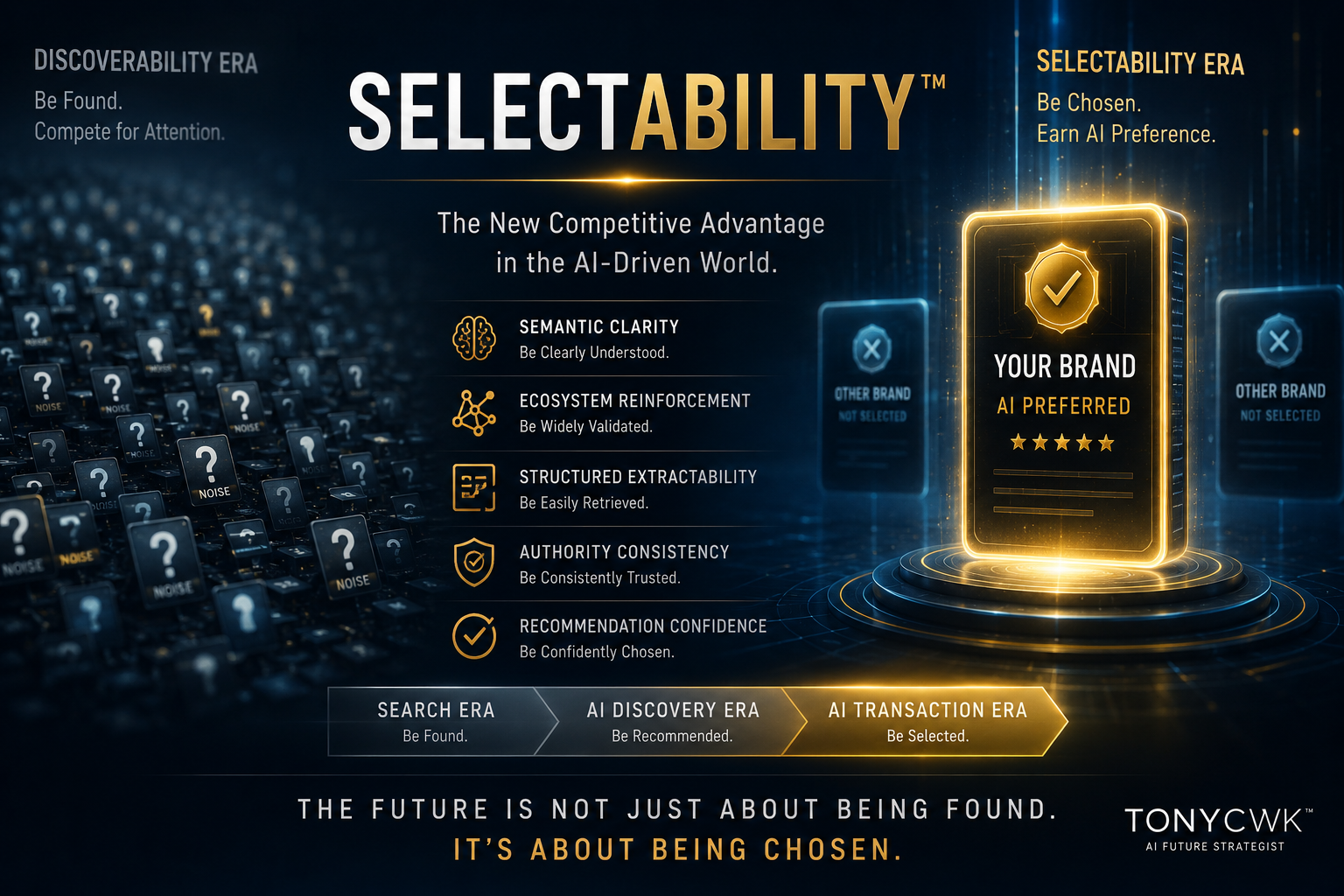
The internet is transitioning through three major eras:
| Era | Primary Goal | Core Metric |
|---|---|---|
| Search Era | Be Found | Rankings & Clicks |
| AI Discovery Era | Be Recommended | Citations & Retrieval |
| AI Transaction Era | Be Selected | Delegated AI Preference |
In the Search Era:
- Users searched manually.
- Businesses competed for SERP visibility.
- Traffic generation was the objective.
In the AI Discovery Era:
- AI systems summarize information.
- Recommendation engines influence visibility.
- Structured knowledge becomes critical.
In the AI Transaction Era:
- AI agents may transact on behalf of users.
- Universal carts aggregate decisions.
- AI systems increasingly choose between brands autonomously.
This fundamentally changes digital competition.
Why Selectability™ Matters
AI systems cannot evaluate the entire internet equally in real time.
They rely on:
- retrieval prioritization,
- trust signals,
- semantic consistency,
- historical reinforcement,
- ecosystem validation,
- authority patterns,
- and recommendation confidence.
This means AI systems naturally become selective.
The future winners online may not necessarily be:
- the loudest,
- the largest,
- or the highest spending advertisers.
Instead, they may be the most:
- structurally understandable,
- semantically coherent,
- consistently reinforced,
- and algorithmically trustworthy.
This is the foundation of Selectability™.
The Core Components of Selectability™
1. Semantic Clarity
AI systems favor entities they can clearly understand.
This includes:
- clear positioning,
- consistent terminology,
- thematic specialization,
- structured content architecture,
- and unambiguous expertise signals.
Confused brands reduce AI confidence.
Clear brands increase AI retrieval confidence.
2. Ecosystem Reinforcement
AI systems validate entities across ecosystems.
This includes:
- citations,
- mentions,
- backlinks,
- social discussions,
- third-party references,
- reviews,
- and platform consistency.
Repeated reinforcement strengthens algorithmic trust.
3. Structured Extractability
AI systems prefer content that is easy to:
- parse,
- retrieve,
- summarize,
- cite,
- and compare.
This includes:
- schema,
- Q&A structures,
- semantic headings,
- modular insights,
- concise explanations,
- and machine-readable architecture.
Content that AI cannot easily extract becomes less selectable.
4. Authority Consistency
AI systems evaluate:
- whether messaging remains stable,
- whether expertise themes remain coherent,
- and whether authority compounds over time.
Brands with fragmented positioning weaken recommendation confidence.
Consistent thematic authority strengthens selection probability.
5. Recommendation Confidence
AI systems increasingly optimize for:
- answer reliability,
- recommendation safety,
- user trust,
- and low-risk outputs.
The higher the confidence an AI system has in an entity, the higher the likelihood of selection.
This becomes critical in:
- AI assistants,
- delegated commerce,
- AI procurement,
- AI search,
- and autonomous recommendation systems.
Selectability™ vs Traditional SEO
| Traditional SEO | Selectability™ |
|---|---|
| Optimize for rankings | Optimize for AI preference |
| Compete for clicks | Compete for recommendation |
| Traffic-centric | Trust-centric |
| Keyword optimization | Entity reinforcement |
| Page-level optimization | Ecosystem-wide authority |
| User chooses manually | AI increasingly pre-selects |
SEO remains important.
But SEO alone may no longer guarantee visibility in AI-mediated environments.
The future layer above discoverability is selectability.
Why AI Systems Become Selective
AI systems operate under computational and trust constraints.
They must:
- reduce uncertainty,
- minimize hallucinations,
- optimize recommendation quality,
- and improve user satisfaction.
This naturally pushes AI systems toward:
- authoritative entities,
- coherent knowledge ecosystems,
- and reinforced recommendation patterns.
In other words:
AI systems optimize for confidence.
And confidence creates selectivity.
Universal Cart and the Rise of AI Selectability™
The emergence of:
- AI shopping agents,
- delegated purchasing,
- conversational commerce,
- and universal carts
accelerates the importance of Selectability™.
In delegated commerce:
- users may not manually compare dozens of brands,
- AI agents may filter choices automatically,
- and recommendation layers may determine transaction flow before websites are visited.
This creates a future where:
The battle is no longer merely for traffic.
It is for AI preference.
The Economic Impact of Selectability™
As AI systems mediate more digital decisions:
- recommendation concentration may increase,
- authority compounding may accelerate,
- and visibility inequality may widen.
Businesses with strong AI selectability may gain:
- disproportionate recommendation exposure,
- recurring AI citations,
- stronger delegated commerce inclusion,
- and compounding algorithmic trust.
Meanwhile:
- low-coherence brands,
- fragmented ecosystems,
- and weak authority structures
may increasingly disappear from AI recommendation layers.
The Future of Digital Competition
The future internet may increasingly reward:
- structured intelligence,
- semantic consistency,
- retrieval confidence,
- authority ecosystems,
- and recommendation reliability.
This means the future competitive advantage is no longer merely visibility.
It is Selectability™.
Final Thoughts
The digital economy is shifting from:
- search → recommendation,
- retrieval → delegation,
- traffic → trust,
- and discoverability → selectability.
In the AI era, the question is no longer:
“Can users find your brand?”
The more important question becomes:
“Will AI systems choose your brand?”
That is the future of digital competition.
And that future is Selectability™.
FAQ
What is Selectability™?
Selectability™ refers to the likelihood that AI systems choose, recommend, retrieve, or prioritize a brand, entity, product, or source within AI-driven environments.
Why is Selectability™ important?
As AI systems increasingly mediate digital discovery and transactions, businesses must compete not only for visibility but also for AI recommendation preference.
Is Selectability™ replacing SEO?
No. SEO remains foundational. However, Selectability™ expands beyond rankings into AI trust, recommendation confidence, semantic clarity, and ecosystem authority.
How does AI determine selectability?
AI systems evaluate:
- semantic consistency,
- ecosystem reinforcement,
- structured extractability,
- authority signals,
- recommendation safety,
- and retrieval confidence.
What is the difference between discoverability and selectability?
Discoverability means being found.
Selectability means being algorithmically preferred and recommended.
Does Selectability™ matter for small businesses?
Yes. In fact, AI systems may reward highly specialized and semantically coherent SMEs more efficiently than large but fragmented enterprises.
How does structured content improve Selectability™?
Structured content improves machine readability, extractability, summarization accuracy, and retrieval confidence for AI systems.
What role does authority play in Selectability™?
Authority strengthens AI trust and recommendation confidence, increasing the probability that AI systems select an entity during retrieval or delegation.
How is Selectability™ related to AI Authority?
AI Authority strengthens the signals that contribute to Selectability™, including trust, consistency, semantic reinforcement, and ecosystem credibility.
Will delegated commerce increase the importance of Selectability™?
Yes. As AI agents increasingly assist or transact on behalf of users, algorithmic selection becomes a core competitive battleground.
Suggested Further Reading
- The Future of Search Is Recommendation, Not Retrieval 👉 https://tonycwk.com/the-future-of-search-is-recommendation-not-retrieval/
- AI Selection Systems™ 👉 https://tonycwk.com/ai-selection-systems/
- Selection Intelligence™ 👉 https://tonycwk.com/selection-intelligence/
- Retrieval Confidence™ 👉 https://tonycwk.com/retrieval-confidence/
- Algorithmic Authority Recognition 👉 https://tonycwk.com/algorithmic-authority-recognition/
- AI Authority Systems 👉 https://tonycwk.com/ai-authority-systems/
- The Rise of AI Selectivity™ in Delegated Commerce 👉 https://tonycwk.com/the-rise-of-ai-selectivity-in-delegated-commerce/
- AI Discovery Flywheel™ 👉 https://tonycwk.com/ai-discovery-flywheel/
- Entity Persistence in the Age of LLMs 👉 https://tonycwk.com/entity-persistence-in-the-age-of-llms/
- Why AI Doesn’t Trust Content — It Trusts Systems 👉 https://tonycwk.com/why-ai-doesnt-trust-content-it-trusts-systems/
Written by Tony Chan (TonyCWK)
AI Authority & Digital Strategy Researcher
Leave a Reply