
Why Future Digital Visibility Will Be Governed by Systems — Not Just Content
The digital visibility model is undergoing a structural transformation.
For more than two decades, businesses competed primarily through:
- rankings,
- keywords,
- backlinks,
- ad spend,
- and content volume.
But in the age of generative AI, recommendation engines, and conversational interfaces, the rules are changing.
Modern AI systems no longer simply retrieve pages.
They evaluate:
- interpretability,
- trust structure,
- entity consistency,
- semantic coherence,
- authority reinforcement,
- and recommendation confidence.
This means the future of digital visibility will increasingly belong not to businesses with the “most content,” but to businesses with the strongest AI Authority Systems™.
At TonyCWK, this emerging shift can be understood through a new strategic lens:
SEO optimized discoverability.
AI Authority Systems™ optimize recommendability.
What Are AI Authority Systems™?
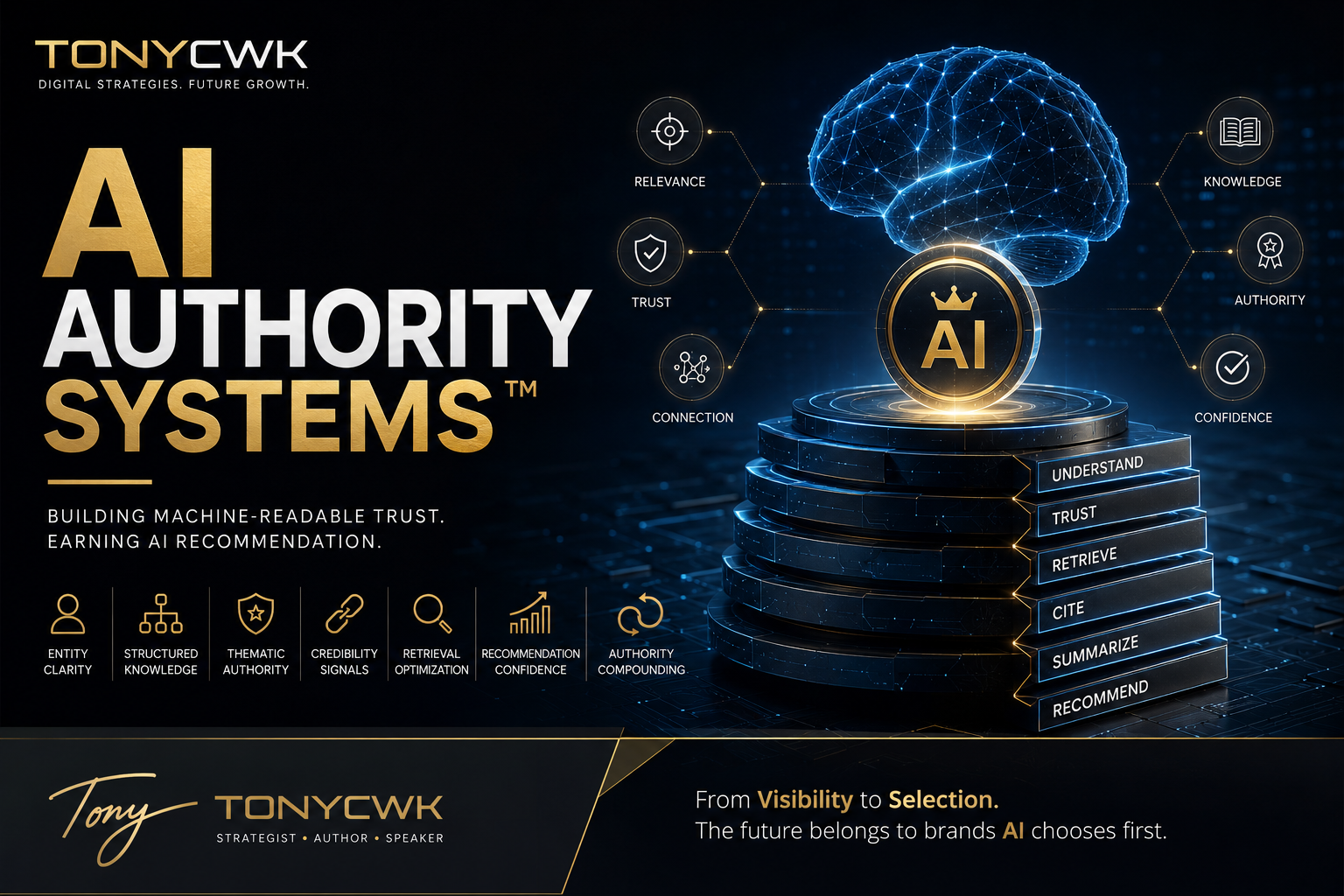
AI Authority Systems™ are integrated digital infrastructures designed to help AI systems:
- understand,
- trust,
- retrieve,
- cite,
- summarize,
- and recommend a brand consistently.
Unlike traditional SEO campaigns that often focus on isolated ranking tactics, AI Authority Systems™ operate as interconnected ecosystems.
They combine:
- structured knowledge architecture,
- thematic authority,
- entity consistency,
- credibility reinforcement,
- semantic clarity,
- retrieval optimization,
- and trust signals across platforms.
In other words:
AI Authority Systems™ are not “content strategies.”
They are machine-readable trust ecosystems.
Why Traditional SEO Alone Is No Longer Enough
Traditional search engines primarily ranked pages.
AI systems increasingly synthesize answers.
That distinction changes everything.
Instead of presenting users with:
“Here are 10 links.”
AI systems increasingly provide:
“Here is the answer.”
This means AI systems must internally decide:
- which sources are trustworthy,
- which entities are authoritative,
- which information is semantically stable,
- and which brands deserve recommendation confidence.
This transition from:
ranking → recommendation
fundamentally changes digital marketing itself.
The Core Shift: From Visibility to Selection
In traditional SEO:
visibility was often enough.
In AI-mediated environments:
visibility without trust may become meaningless.
A website may still:
- rank,
- generate impressions,
- or appear in search results,
yet still fail to become:
- cited,
- summarized,
- reused,
- or recommended by AI systems.
This is where AI Authority Systems™ become critical.
Because future AI ecosystems increasingly operate on:
- confidence scoring,
- source prioritization,
- authority reinforcement,
- and retrieval trust layers.
Research surrounding AI authority evaluation increasingly points toward structured trust hierarchies, authority signals, and source credibility as central factors in AI-mediated recommendation systems.
The 7 Pillars of AI Authority Systems™
1. Entity Clarity
AI systems must clearly understand:
- who you are,
- what you do,
- what category you belong to,
- and how your expertise is positioned.
Brands with fragmented identity signals create interpretive ambiguity.
AI systems avoid ambiguity.
This is why:
- consistent naming,
- semantic categorization,
- author entities,
- organization schema,
- and topical clarity
become foundational.
2. Structured Knowledge Architecture
Most websites were built for humans.
Future authority systems must also be built for machines.
This includes:
- semantic hierarchy,
- extractable answers,
- definitional clarity,
- contextual relationships,
- and AI-readable structure.
AI systems increasingly favor content that is:
- compressible,
- interpretable,
- structurally coherent,
- and semantically organized.
3. Thematic Authority Depth
Future AI visibility will likely reward:
depth over breadth.
Instead of publishing disconnected articles, brands will need:
- interconnected topic clusters,
- authority ecosystems,
- layered semantic reinforcement,
- and sustained expertise development.
This creates stronger:
- retrieval confidence,
- citation-worthiness,
- and recommendation eligibility.
4. Cross-Platform Credibility Signals
AI systems do not evaluate websites in isolation.
They increasingly assess:
- external mentions,
- reputation consistency,
- citations,
- authorship,
- business profiles,
- and ecosystem validation.
Authority becomes reinforced when:
multiple independent signals converge coherently.
This mirrors emerging AI authority methodologies emphasizing:
- trust verification,
- entity reinforcement,
- and cross-platform consistency.
5. Retrieval Optimization
In the AI era, content must not only exist.
It must be retrievable.
AI systems increasingly prefer:
- concise clarity,
- definitional precision,
- modular knowledge,
- structured Q&A,
- and semantically stable explanations.
This is why:
- AEO (Answer Engine Optimization),
- GEO (Generative Engine Optimization),
- and AI extraction optimization
are rapidly becoming essential.
6. Recommendation Confidence
Future AI systems will increasingly behave like:
confidence engines.
They attempt to minimize:
- hallucination risk,
- misinformation risk,
- ambiguity risk,
- and trust uncertainty.
Brands that provide:
- coherent systems,
- consistent expertise,
- strong semantic stability,
- and verifiable trust layers
will likely gain stronger recommendation confidence.
7. Authority Compounding
One of the most powerful characteristics of AI Authority Systems™ is compounding.
Traditional traffic often behaves linearly.
Authority behaves exponentially.
Once AI systems repeatedly:
- retrieve,
- cite,
- summarize,
- and recommend a brand,
future recommendation probability may increase further through:
- reinforcement loops,
- citation familiarity,
- semantic association,
- and trust persistence.
This creates what TonyCWK defines as:
The AI Discovery Flywheel™
Where:
- authority improves visibility,
- visibility improves citations,
- citations improve trust,
- trust improves recommendation probability,
- and recommendations further strengthen authority.
Why SMEs May Benefit More Than Large Corporations
One of the most overlooked implications of AI Authority Systems™ is this:
Large brands are not automatically guaranteed AI dominance.
In fact, SMEs may possess structural advantages.
Smaller organizations can often:
- specialize faster,
- create clearer thematic positioning,
- maintain stronger semantic consistency,
- and build more focused authority ecosystems.
AI systems increasingly reward:
clarity over size.
This means highly focused SMEs may outperform larger but semantically fragmented enterprises.
The Future of Marketing Is Systemic
The AI era is transforming marketing from:
campaign-based visibility
into:
system-based authority engineering.
Future competitive advantage will increasingly come from:
- authority infrastructure,
- semantic ecosystems,
- machine-readable trust,
- and recommendation architecture.
This changes the role of marketers entirely.
The future marketer is no longer only:
- a content creator,
- advertiser,
- or SEO specialist.
The future marketer becomes:
an authority systems architect.
The New Visibility Equation
The future may increasingly look like this:
Traditional SEO:
Traffic → Clicks → Conversions
AI Authority Systems™:
Trust → Recommendation → Selection → Conversions
And that distinction may redefine the next decade of digital competition.
Final Thoughts
The rise of AI-mediated discovery systems represents one of the most significant visibility shifts since the birth of search engines.
Businesses that continue optimizing only for:
- rankings,
- impressions,
- and clicks
may slowly lose strategic relevance in AI-driven ecosystems.
Because future AI systems are increasingly designed not merely to retrieve information —
—but to decide what deserves recommendation.
And in that environment:
The businesses with the strongest AI Authority Systems™ may become the businesses that AI chooses first.
FAQ for “AI Authority Systems™”
1. What are AI Authority Systems™?
AI Authority Systems™ are structured digital ecosystems designed to help AI systems understand, trust, retrieve, cite, and recommend a brand more confidently.
2. How are AI Authority Systems™ different from SEO?
SEO focuses on search visibility and rankings. AI Authority Systems™ focus on machine-readable trust, retrieval confidence, and recommendation eligibility.
3. Why do AI Authority Systems™ matter?
They matter because AI systems increasingly decide which brands, sources, and answers deserve to be summarized, cited, or recommended.
4. Are AI Authority Systems™ only for large companies?
No. SMEs may benefit strongly because focused businesses can build clearer topical authority and more consistent trust signals than larger, fragmented brands.
5. What are the main components of an AI Authority System™?
Key components include entity clarity, structured knowledge architecture, thematic authority, credibility signals, retrieval optimization, recommendation confidence, and authority compounding.
6. What is entity clarity?
Entity clarity means AI systems can clearly understand who the brand is, what it does, who it serves, and what expertise it is associated with.
7. What is structured knowledge architecture?
Structured knowledge architecture organizes content so both humans and AI systems can easily interpret, extract, connect, and reuse information.
8. Why is thematic authority important?
Thematic authority helps AI systems associate a brand with a specific area of expertise through repeated, consistent, and interconnected content signals.
9. What are credibility signals?
Credibility signals include external mentions, citations, reviews, author profiles, business profiles, backlinks, media references, and consistent brand presence across platforms.
10. What is retrieval optimization?
Retrieval optimization means making content easier for AI systems to find, extract, summarize, and reuse in AI-generated answers.
11. What is recommendation confidence?
Recommendation confidence is the level of trust an AI system may have when deciding whether to suggest a brand, source, or answer to a user.
12. Can AI Authority Systems™ improve AI visibility?
Yes. A strong system can improve the likelihood that a brand is understood, retrieved, cited, and recommended across AI-driven discovery environments.
13. Is AI Authority Systems™ the same as AEO or GEO?
No. AEO and GEO are important parts of the wider system, but AI Authority Systems™ are broader because they include trust, entity, authority, and ecosystem signals.
14. How does content quality fit into AI Authority Systems™?
Content quality is important, but it must be supported by structure, consistency, credibility, and authority reinforcement to become AI-selectable.
15. Why is cross-platform consistency important?
AI systems may evaluate signals across multiple sources. Consistent brand identity, messaging, expertise, and citations reduce ambiguity and improve trust interpretation.
16. How can SMEs build AI Authority Systems™?
SMEs can start by defining a clear niche, publishing structured authority content, building topic clusters, improving schema, strengthening business profiles, and earning external mentions.
17. What role does schema play?
Schema helps search engines and AI systems interpret entities, authorship, organization details, article structure, FAQs, and topical relationships more clearly.
18. Will AI Authority Systems™ replace SEO?
No. They extend SEO. SEO helps brands become findable, while AI Authority Systems™ help brands become understandable, trusted, and recommendable.
19. How long does it take to build an AI Authority System™?
It is a compounding process. Results may not appear immediately, but consistent authority building can strengthen AI visibility over time.
20. What is the future of AI Authority Systems™?
The future of AI Authority Systems™ is likely to involve stronger emphasis on trust architecture, structured knowledge, entity persistence, citation-worthiness, and AI recommendation readiness.
Recommended Further Readings
- What Is AI Authority™?
The foundational concept behind machine-readable trust and AI recommendation readiness.👉 https://tonycwk.com/what-is-ai-authority/ - The AI Authority Pyramid™
Understanding the 5 structural layers of future AI visibility.👉 https://tonycwk.com/ai-authority-pyramid/ - The AI Discovery Flywheel™
How authority compounds through citations, retrieval, and recommendation loops.👉 https://tonycwk.com/ai-discovery-flywheel/ - AI Selection Systems™ Explained
Why future AI ecosystems prioritize selection over rankings. - Why SEO Alone Is No Longer Enough in the Age of AI
How digital visibility is evolving beyond traditional search optimization.👉 https://tonycwk.com/seo-alone-is-no-longer-enough/ - Selection Rate vs Click-Through Rate (CTR)
The new visibility metrics emerging in AI-mediated environments.👉https://tonycwk.com/selection-rate-vs-click-through-rate/ - Retrieval Confidence™
How AI systems evaluate trustworthiness before surfacing information. - Citation-Worthiness in the Age of AI
Why being referenced by AI systems may become more valuable than traffic itself. - How AI Systems Build Trust
Understanding semantic consistency, authority reinforcement, and recommendation confidence.👉 https://tonycwk.com/how-ai-systems-build-trust/ - Entity Persistence in the Age of LLMs
Why consistent entity signals matter for long-term AI visibility.👉 https://tonycwk.com/entity-persistence-in-the-age-of-llms/ - Why AI Doesn’t Trust Content — It Trusts Systems
The shift from content-centric marketing to systemic authority architecture.👉 https://tonycwk.com/why-ai-doesnt-trust-content-it-trusts-systems/ - How SMEs Can Outperform Large Brands in AI Discovery
Why focused authority ecosystems may outperform scale.👉 https://tonycwk.com/why-smes-can-outperform-corporates-in-ai-discovery/
Written by Tony Chan (TonyCWK)
AI Authority & Digital Strategy Researcher
Leave a Reply