
The Strategic System Behind AI-Era Visibility, Recommendation, and Trust
By TonyCWK
Introduction
For more than two decades, digital visibility was largely governed by search rankings.
Brands competed for:
- higher keyword positions,
- more backlinks,
- stronger click-through rates,
- and larger volumes of traffic.
But the rise of AI systems is fundamentally changing how visibility works.
Modern AI interfaces no longer simply retrieve information.
They:
- interpret,
- summarize,
- compare,
- validate,
- and increasingly recommend.
This changes everything.
Because in the age of AI:
Visibility is no longer just about being found.
It is about being selected.
This is where the AI Authority Framework™ becomes critical.
The AI Authority Framework™ is a strategic model that explains:
- how AI systems evaluate brands,
- how recommendation trust is formed,
- why some organizations become repeatedly surfaced by AI,
- and how businesses can build sustainable AI-era discoverability.
It is not merely an SEO framework.
It is a visibility operating model for the AI era.
What Is the AI Authority Framework™?
The AI Authority Framework™ is a structured system that helps brands become:
- AI-readable,
- AI-trusted,
- AI-citable,
- AI-retrievable,
- and AI-recommendable.
It explains how modern AI systems increasingly prioritize:
| Traditional Search Era | AI Authority Era |
|---|---|
| Ranking pages | Selecting entities |
| Traffic acquisition | Recommendation eligibility |
| Keyword optimization | Trust architecture |
| Content quantity | Knowledge coherence |
| Search visibility | AI discoverability |
| Click-through rate | Selection probability |
| Backlinks | Multi-signal credibility |
| SERP competition | AI recommendation competition |
This represents a structural shift in digital marketing.
The future belongs not to the loudest brands.
It belongs to the most structurally trusted systems.
Why Traditional SEO Alone Is No Longer Enough
Traditional SEO was designed primarily for:
- indexing,
- retrieval,
- and ranking.
But AI systems now operate differently.
Large Language Models (LLMs) and AI recommendation systems evaluate:
- semantic consistency,
- entity relationships,
- thematic authority,
- citation confidence,
- ecosystem validation,
- structured extractability,
- and retrieval reliability.
This means:
A website can rank highly in search engines yet still fail to become a trusted AI recommendation source.
Conversely:
A smaller brand with stronger thematic clarity and knowledge architecture may become disproportionately visible in AI-generated responses.
This is the emergence of:
AI Recommendation Economics.
The Core Principle of AI Authority™
AI systems do not merely rank content.
They evaluate confidence in knowledge systems.
This distinction is extremely important.
AI models increasingly favor:
- coherent information ecosystems,
- predictable topical consistency,
- reinforced entity signals,
- cross-platform validation,
- and structured trust indicators.
In other words:
AI systems are not evaluating isolated pages.
They are evaluating:
organizational intelligence consistency.
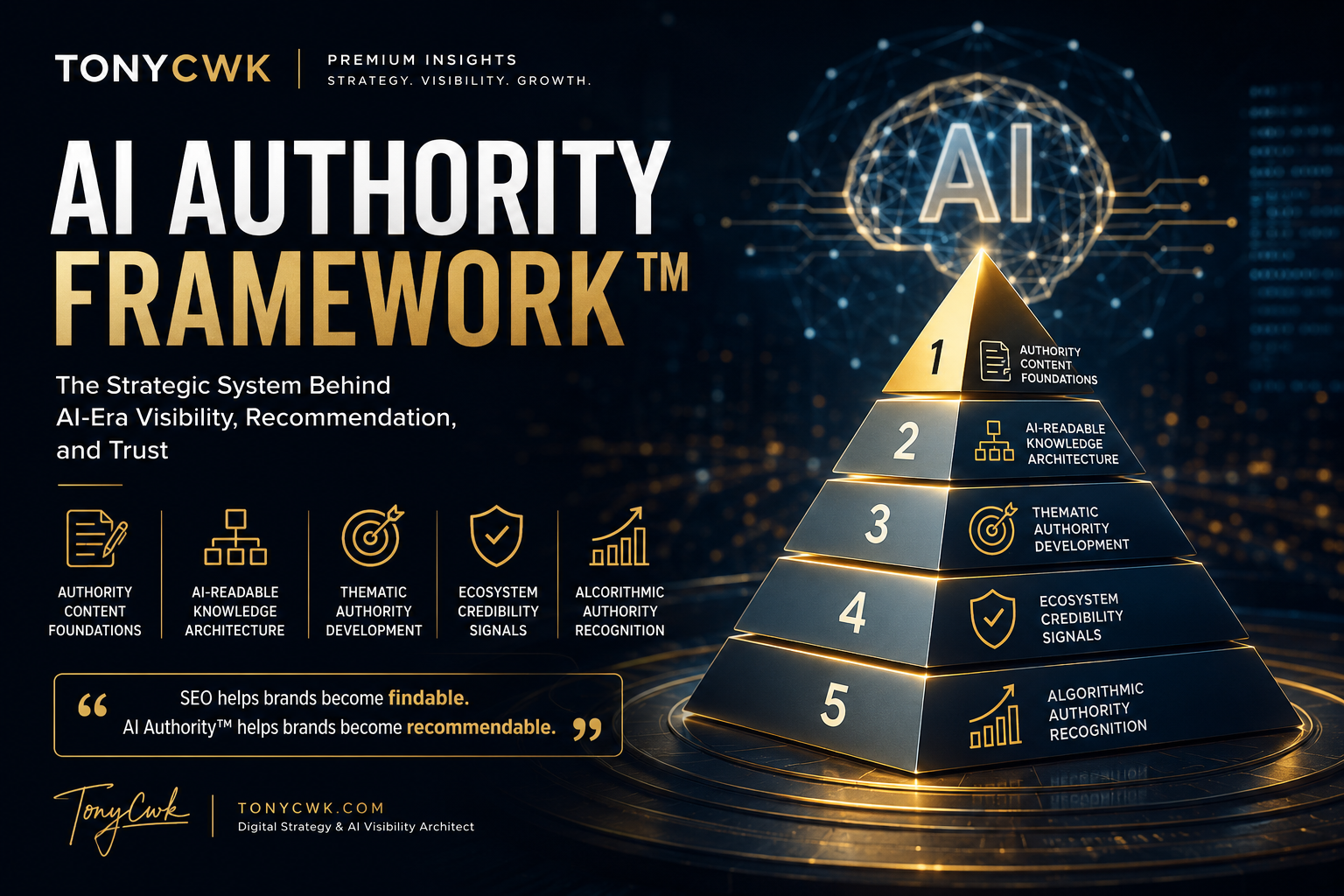
The 5 Layers of the AI Authority Framework™
The AI Authority Framework™ can be understood through five interconnected layers.
1. Authority Content Foundations
This is the foundational layer.
Without strong foundational content, AI systems struggle to:
- understand expertise,
- map thematic relationships,
- or establish retrieval confidence.
This layer focuses on:
- evergreen expertise,
- semantic depth,
- educational clarity,
- structured explanations,
- and consistent topical publishing.
High-authority content is:
- highly extractable,
- citation-friendly,
- semantically coherent,
- and contextually useful.
In the AI era:
Content quality is no longer enough.
Content must also be:
machine-comprehensible.
2. AI-Readable Knowledge Architecture
AI systems prefer structured knowledge.
This layer focuses on:
- schema markup,
- entity structuring,
- semantic hierarchy,
- internal linking systems,
- content clustering,
- and contextual organization.
AI systems increasingly rely on:
- entity relationships,
- topical mapping,
- structured metadata,
- and retrieval pathways.
This transforms websites from:
“collections of pages”
into:
structured knowledge ecosystems.
3. Thematic Authority Development
AI systems reward consistency.
Brands that publish across interconnected themes develop stronger:
- retrieval confidence,
- semantic authority,
- and recommendation probability.
This means:
One viral article is insufficient.
AI authority compounds through:
- sustained topical reinforcement,
- interconnected expertise,
- and thematic depth.
This is why:
Topical ecosystems outperform isolated content campaigns.
4. Ecosystem Credibility Signals
AI systems validate trust externally.
This layer includes:
- citations,
- mentions,
- backlinks,
- author reputation,
- business legitimacy,
- reviews,
- platform consistency,
- and cross-channel recognition.
AI systems increasingly compare information across:
- websites,
- LinkedIn,
- business profiles,
- media mentions,
- directories,
- and social ecosystems.
Consistency across ecosystems increases:
algorithmic trust confidence.
5. Algorithmic Authority Recognition
This is the compounding layer.
Once AI systems repeatedly observe:
- semantic consistency,
- successful retrieval,
- external validation,
- and high recommendation utility,
they begin developing:
persistent recommendation confidence.
This creates:
- recurring visibility,
- repeated citations,
- stronger AI surfacing,
- and long-term discoverability advantages.
At this stage:
Authority becomes self-reinforcing.
The Shift From Search Rankings to AI Recommendations
The AI era changes the visibility model entirely.
Previously:
Users searched manually.
Today:
AI increasingly interprets intent on behalf of users.
This means visibility is moving from:
retrieval
to
delegation.
Users increasingly ask AI:
- what to buy,
- which company to trust,
- which tools to use,
- which experts to follow,
- and which solutions are most reliable.
This creates a new competitive battleground:
recommendation eligibility.
Why SMEs May Have an Advantage in the AI Era
Ironically, AI systems may reduce certain advantages previously held by large corporations.
Large brands often suffer from:
- fragmented messaging,
- inconsistent expertise,
- diluted positioning,
- and organizational complexity.
Smaller businesses can sometimes outperform larger organizations because they can build:
- tighter thematic clarity,
- stronger semantic consistency,
- faster content adaptation,
- and more coherent expertise ecosystems.
In AI recommendation environments:
clarity often beats scale.
The Rise of AI Discoverability
The future of marketing increasingly revolves around:
discoverability architecture.
This includes:
- whether AI can understand your business,
- whether your expertise is extractable,
- whether your knowledge is trusted,
- and whether your brand is recommendation-worthy.
This is why the future of digital visibility is increasingly tied to:
- AI Authority™,
- AEO (Answer Engine Optimization),
- GEO (Generative Engine Optimization),
- entity optimization,
- and retrieval confidence systems.
AI Authority Is a Long-Term Strategic Asset
Paid ads create temporary visibility.
AI authority compounds.
Once AI systems consistently associate a brand with:
- expertise,
- trust,
- semantic clarity,
- and recommendation utility,
that visibility can become self-reinforcing.
This creates a compounding advantage similar to:
- brand equity,
- reputation,
- and market trust.
Except now:
the compounding occurs inside AI ecosystems.
The Future of Digital Marketing
The future of digital marketing will increasingly revolve around:
- recommendation systems,
- AI trust evaluation,
- structured knowledge ecosystems,
- semantic authority,
- and machine-readable credibility.
This does not mean SEO disappears.
Rather:
SEO evolves into something much larger.
The future belongs to businesses that understand:
SEO helps brands become findable.
AI Authority™ helps brands become recommendable.
And in the age of AI:
recommendation is becoming the new visibility currency.
Final Thoughts
The AI Authority Framework™ is not simply a marketing tactic.
It is a strategic operating model for the next era of digital visibility.
As AI systems increasingly shape:
- discovery,
- comparison,
- validation,
- and recommendations,
brands must evolve from:
“content publishers”
into:
trusted knowledge systems.
Because the future of visibility will not be determined solely by:
who ranks first.
It will increasingly be determined by:
who AI trusts enough to recommend repeatedly.
FAQ — AI Authority Framework™
1. What is the AI Authority Framework™?
The AI Authority Framework™ is a strategic model that explains how businesses can become more discoverable, trusted, and recommendable within AI-driven ecosystems. It focuses on building structured authority signals that AI systems can understand and validate.
2. Why is AI Authority becoming important?
As AI systems increasingly shape search, recommendations, and decision-making, businesses need more than traditional SEO. AI systems now evaluate semantic consistency, trust signals, thematic expertise, and knowledge reliability before surfacing brands.
3. Is AI Authority™ the same as SEO?
No. SEO primarily focuses on search visibility and rankings, while AI Authority™ focuses on recommendation eligibility, AI trust, entity understanding, and long-term discoverability within AI systems.
4. What is the difference between ranking and recommendation?
Ranking determines where a page appears in search results. Recommendation determines whether AI systems trust and select a brand, entity, or source when generating answers or suggestions.
5. How do AI systems evaluate authority?
AI systems increasingly evaluate:
- semantic consistency,
- thematic expertise,
- structured data,
- citation confidence,
- entity relationships,
- ecosystem credibility,
- and retrieval reliability.
6. What are the five layers of the AI Authority Framework™?
The five layers are:
- Authority Content Foundations
- AI-Readable Knowledge Architecture
- Thematic Authority Development
- Ecosystem Credibility Signals
- Algorithmic Authority Recognition
7. What is AI-readable knowledge architecture?
AI-readable knowledge architecture refers to how content, entities, metadata, schema, and internal linking are structured so AI systems can better understand and retrieve information.
8. Why is thematic consistency important for AI systems?
AI systems prefer predictable and coherent expertise patterns. Strong thematic consistency helps reinforce retrieval confidence and recommendation trust.
9. Can smaller businesses compete with large brands in AI discovery?
Yes. Smaller businesses can often build stronger semantic clarity, focused expertise, and more coherent authority ecosystems, making them highly competitive in AI recommendation environments.
10. What role does structured data play in AI Authority™?
Structured data helps AI systems interpret relationships, entities, topics, and contextual meaning more effectively, improving machine readability and retrieval confidence.
11. Does AI Authority™ affect Google AI Overviews and AI search?
Yes. AI Authority principles can influence how brands are surfaced in AI-generated summaries, conversational search experiences, and recommendation systems.
12. What is retrieval confidence?
Retrieval confidence refers to the likelihood that AI systems trust and consistently retrieve a brand or source for relevant queries and contextual recommendations.
13. How does AI Authority™ relate to AEO and GEO?
AI Authority™ complements:
- AEO (Answer Engine Optimization),
- GEO (Generative Engine Optimization),
- entity SEO,
- and semantic search optimization.
It acts as a broader strategic framework behind sustainable AI discoverability.
14. Why are ecosystem credibility signals important?
AI systems validate trust across multiple external sources, including:
- business profiles,
- LinkedIn,
- citations,
- reviews,
- media mentions,
- and cross-platform consistency.
15. Can AI Authority™ compound over time?
Yes. Once AI systems repeatedly associate a brand with trusted expertise and successful retrieval, recommendation confidence can strengthen over time.
16. Is publishing more content enough to build AI Authority™?
No. Volume alone is insufficient. AI systems increasingly prioritize:
- knowledge coherence,
- topical depth,
- semantic consistency,
- and structured expertise ecosystems.
17. How can businesses improve AI discoverability?
Businesses can improve AI discoverability by:
- building structured topical clusters,
- improving semantic consistency,
- strengthening entity signals,
- implementing schema markup,
- and reinforcing ecosystem credibility.
18. What industries benefit from AI Authority™?
Virtually all industries that rely on digital visibility, trust, expertise, and discoverability can benefit, including:
- consulting,
- healthcare,
- finance,
- SaaS,
- education,
- e-commerce,
- and professional services.
19. Is AI Authority™ a short-term trend?
No. AI Authority™ reflects a structural evolution in how digital visibility and recommendation systems operate in the age of AI.
20. What is the future of AI-driven visibility?
The future of visibility is shifting from:
- search rankings,
to: - recommendation systems,
- AI trust evaluation,
- semantic authority,
- and discoverability ecosystems.
Businesses that become recommendation-worthy will gain long-term competitive advantages.
Suggested Further Readings
You may also enjoy:
- The AI Authority Pyramid™ 👉 https://tonycwk.com/ai-authority-pyramid/
- AI Selection Systems™ 👉 https://tonycwk.com/ai-selection-systems/
- The AI Discovery Flywheel™ 👉 https://tonycwk.com/ai-discovery-flywheel/
- Why SEO Alone Is No Longer Enough 👉 https://tonycwk.com/seo-alone-is-no-longer-enough/
- Selection Rate vs Click-Through Rate 👉https://tonycwk.com/selection-rate-vs-click-through-rate/
- Why AI Doesn’t Trust Content — It Trusts Systems 👉 https://tonycwk.com/why-ai-doesnt-trust-content-it-trusts-systems/
- Entity Persistence in the Age of LLMs 👉 https://tonycwk.com/entity-persistence-in-the-age-of-llms/
Leave a Reply