
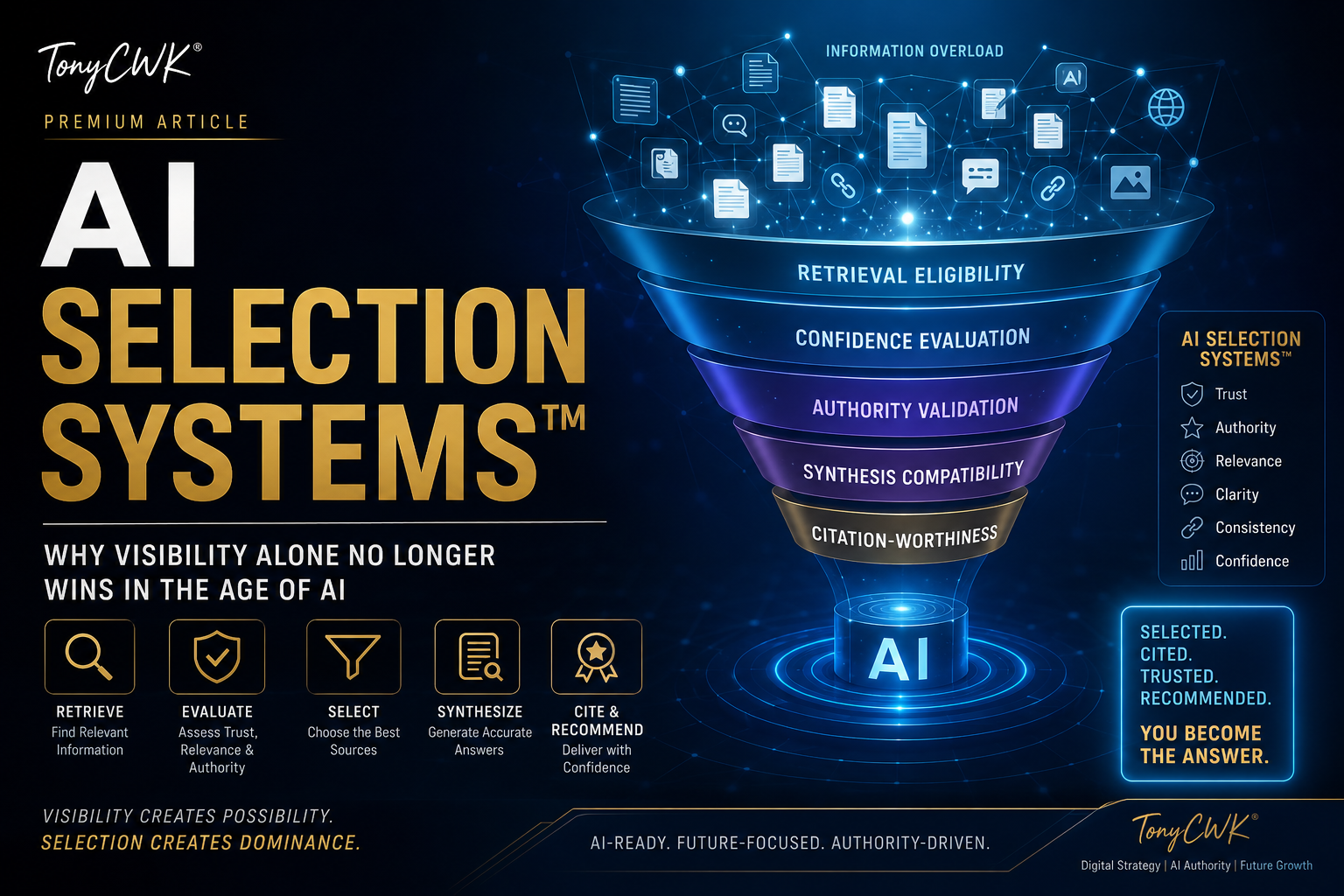
Why Visibility Alone No Longer Wins in the Age of AI
By Tony Chan(TonyCWK)
Executive Summary
For decades, digital marketing revolved around one primary objective:
Get discovered.
SEO optimized for rankings.
Advertising optimized for impressions.
Social media optimized for reach.
But AI-driven discovery changes the equation entirely.
Modern AI systems do not merely retrieve information.
They evaluate, interpret, compare, prioritize, compress, and ultimately:
Select.
This is the emergence of AI Selection Systems™ — the invisible decision-making architectures that determine which brands, entities, sources, and ideas become surfaced, cited, recommended, and trusted inside AI-generated answers.
In the AI era, the competitive advantage is no longer just visibility.
It is:
- Selection probability
- Citation likelihood
- Retrieval confidence
- Semantic trustworthiness
- Ecosystem consistency
- Authority persistence
The brands that understand AI Selection Systems™ will dominate the next generation of digital discovery.
The rest may remain technically visible — but practically ignored.
The Shift From Search Engines to Selection Engines
Traditional search engines primarily ranked pages.
AI systems operate differently.
Instead of presenting ten blue links, AI systems increasingly synthesize answers directly.
This fundamentally changes how digital visibility works.
Traditional SEO Model
Search → Ranking → Click → Website
Success depended on:
- Keywords
- Backlinks
- CTR
- SERP position
- Traffic acquisition
AI Discovery Model
Query → Retrieval → Evaluation → Selection → Synthesis
Success now depends on:
- Semantic clarity
- Entity recognition
- Knowledge structure
- Trust reinforcement
- Citation-worthiness
- Cross-platform consistency
- Confidence signals
AI systems are not simply asking:
“Can this page rank?”
They are asking:
“Can this source be trusted enough to represent the answer?”
That is a completely different optimization challenge.
What Are AI Selection Systems™?
Definition
AI Selection Systems™ are the algorithmic frameworks and evaluation mechanisms used by AI systems to determine which entities, sources, brands, and information should be retrieved, trusted, synthesized, cited, and recommended in AI-generated outputs.
These systems combine:
- Retrieval logic
- Semantic understanding
- Authority scoring
- Contextual relevance
- Confidence modeling
- Ecosystem validation
- Knowledge consistency
Unlike traditional ranking systems, AI Selection Systems™ optimize for:
- Reliability
- Clarity
- Predictability
- Consensus
- Structured understanding
- Risk reduction
AI Does Not “See” Brands Like Humans Do
Humans recognize brands emotionally.
AI systems recognize brands structurally.
This means AI systems evaluate:
- Entity consistency
- Topic relationships
- Semantic reinforcement
- Knowledge graph associations
- Mention patterns
- Cross-platform corroboration
- Citation recurrence
- Context stability
The stronger the structural consistency, the higher the probability of AI selection.
This is why many brands with large ad budgets still fail in AI visibility.
Because AI systems are not buying familiarity.
They are evaluating confidence.
The Five Core Layers of AI Selection Systems™
1. Retrieval Eligibility
Before a brand can be selected, it must first be retrievable.
This depends on:
- Crawlability
- Structured content
- Semantic clarity
- Entity extraction readiness
- Technical accessibility
- Machine-readable architecture
If AI systems cannot clearly interpret the content, selection probability collapses immediately.
This is why:
- weak site structure,
- fragmented messaging,
- inconsistent entities,
- and poor semantic organization
become major liabilities in AI environments.
2. Confidence Evaluation
AI systems continuously estimate:
“How confident are we that this information is accurate?”
Confidence is influenced by:
- Consistency across sources
- Stable topic positioning
- Entity reinforcement
- Citation frequency
- Contextual alignment
- Historical reliability
AI systems prefer low-ambiguity entities.
Brands that constantly shift positioning, messaging, or topical focus often weaken their own AI trust signals.
3. Authority Validation
AI systems increasingly evaluate:
- topical authority,
- ecosystem credibility,
- expert reinforcement,
- and knowledge depth.
This is where:
- Digital PR,
- structured expertise,
- high-quality educational content,
- and authoritative mentions
become critical.
Authority is no longer isolated to backlinks alone.
It is becoming an ecosystem-level trust architecture.
4. Synthesis Compatibility
AI systems prefer sources that are easy to synthesize into generated answers.
This means content must be:
- clear,
- structured,
- extractable,
- logically organized,
- semantically coherent,
- and contextually stable.
Content written purely for emotional engagement or algorithmic clickbait often performs poorly in AI synthesis environments.
AI systems prefer compressible clarity.
5. Citation-Worthiness
Not all visible sources become cited sources.
AI systems increasingly favor sources that:
- explain concepts clearly,
- maintain thematic consistency,
- demonstrate expertise,
- and reduce hallucination risk.
This creates a new competitive advantage:
Citation-worthiness.
The future winners are not merely searchable brands.
They are selectable and citeable brands.
The Rise of Selection-Based Competition
Traditional competition focused on:
- ad spend,
- rankings,
- and visibility share.
AI changes competition into:
Selection Competition
Brands now compete for:
- AI trust,
- retrieval confidence,
- citation inclusion,
- recommendation probability,
- and semantic authority.
This creates a major strategic shift.
In the past:
- visibility could be purchased.
In the future:
Why Many SEO Strategies Will Fail
Many SEO strategies were designed for:
- clicks,
- traffic,
- and rankings.
But AI systems optimize for:
- answer quality,
- synthesis reliability,
- and confidence stability.
This creates a growing disconnect between:
- traffic optimization
and - selection optimization.
A page can still rank highly while rarely being cited by AI systems.
Why?
Because ranking visibility does not automatically equal:
- trustworthiness,
- extraction readiness,
- or synthesis suitability.
AI Selection Systems™ Favor Structured Authority
AI systems increasingly reward brands that behave like:
- knowledge entities,
- trusted ecosystems,
- and semantically reinforced authorities.
This is why the future belongs to brands that build:
- structured expertise,
- entity clarity,
- thematic consistency,
- ecosystem reinforcement,
- and long-term authority persistence.
This aligns closely with the philosophy behind the:
- AI Authority Pyramid™
- AI Discovery Flywheel™
- AI Authority Operating System™
- AI Authority Stack™
- AI Selection System™
Together, these frameworks form a compounding visibility architecture for the AI era.
The New KPI: Selection Probability
The next generation of digital marketing metrics may include:
- AI citation frequency
- AI retrieval frequency
- selection probability
- synthesis inclusion rate
- entity confidence score
- thematic authority strength
- ecosystem consistency index
Traffic alone becomes insufficient.
Because:
If AI systems never select you, users may never reach you.
The Future of Digital Visibility
The internet is evolving from:
- a search-first environment
into:
- a selection-first ecosystem.
This changes everything:
- SEO
- branding
- PR
- authority building
- content strategy
- digital trust
- online visibility
The brands that survive will not simply optimize for algorithms.
They will optimize for:
- AI interpretability,
- semantic trust,
- structured authority,
- and selection confidence.
Final Thought
The future of digital visibility is no longer about being found.
It is about being chosen.
In the AI era:
Visibility creates possibility.
Selection creates dominance.
And the brands that understand AI Selection Systems™ earliest may become the foundational authorities of the next digital economy.
FAQ Section: AI Selection Systems™
1. What are AI Selection Systems™?
AI Selection Systems™ refer to the algorithmic processes AI platforms use to decide which brands, sources, entities, and information should be retrieved, trusted, cited, and recommended in AI-generated answers.
2. How are AI Selection Systems different from traditional search engines?
Traditional search engines rank pages. AI Selection Systems evaluate, synthesize, and select information based on relevance, clarity, authority, trust, and confidence.
3. Why does AI selection matter for brands?
AI selection matters because users may increasingly receive answers directly from AI systems instead of clicking through multiple search results. If a brand is not selected, it may become invisible in AI-driven discovery.
4. Is AI selection the same as SEO ranking?
No. SEO ranking focuses on visibility in search results. AI selection focuses on whether AI systems trust a source enough to include, cite, or recommend it in generated answers.
5. What makes a brand more selectable by AI systems?
A brand becomes more selectable when it has clear entity identity, structured content, thematic consistency, credible external signals, and strong authority around specific topics.
6. Why is structured content important for AI selection?
Structured content helps AI systems understand, extract, summarize, and reuse information accurately. Clear headings, definitions, FAQs, schema, and semantic organization improve machine readability.
7. What is retrieval eligibility?
Retrieval eligibility means a brand or source is technically and semantically accessible enough for AI systems to discover, interpret, and consider it for an answer.
8. What is citation-worthiness?
Citation-worthiness is the quality that makes a source reliable, clear, authoritative, and useful enough to be cited or referenced by AI systems in response to user queries.
9. Can a page rank well in Google but still fail in AI selection?
Yes. A page can rank well but still be weak for AI selection if it lacks clarity, structured knowledge, authority signals, or synthesis-friendly explanations.
10. How does digital PR support AI Selection Systems™?
Digital PR supports AI selection by creating third-party credibility signals, authoritative mentions, contextual references, and ecosystem validation around a brand or entity.
11. Do backlinks still matter in AI selection?
Backlinks may still matter, but they are no longer the only signal. AI systems also evaluate entity consistency, topical authority, structured information, credibility signals, and contextual reliability.
12. What is synthesis compatibility?
Synthesis compatibility means content is easy for AI systems to summarize, interpret, compare, and include in generated answers without confusion or loss of meaning.
13. Why do AI systems prefer clarity over complexity?
AI systems prefer clarity because clear information reduces ambiguity and improves answer reliability. Confusing, fragmented, or inconsistent content increases selection risk.
14. How can small brands improve AI selection probability?
Small brands can improve selection probability by focusing on niche authority, consistent messaging, structured content, local or industry-specific expertise, and credible external validation.
15. What is the role of entity consistency in AI selection?
Entity consistency helps AI systems understand who a brand is, what it does, where it operates, and what topics it should be associated with.
16. How should marketers measure AI selection?
Marketers can measure AI selection through AI citation frequency, brand mention presence in AI answers, topical visibility across AI platforms, selection rate, and entity recognition consistency.
17. Is AI selection only relevant for large companies?
No. AI selection can benefit SMEs and smaller brands because AI systems often reward clarity, specificity, and expertise rather than brand size alone.
18. What is the future of AI Selection Systems™?
The future of AI Selection Systems™ will likely involve stronger evaluation of trust, entity recognition, source reliability, structured knowledge, and cross-platform credibility.
Further Reading
Recommended related articles:
- “The AI Authority Pyramid™” 👉 https://tonycwk.com/ai-authority-pyramid/
- “Why AI Doesn’t Trust Content — It Trusts Systems” 👉 https://tonycwk.com/why-ai-doesnt-trust-content-it-trusts-systems/
- “How AI Systems Build Trust” 👉 https://tonycwk.com/how-ai-systems-build-trust/
- “Entity Persistence in the Age of LLMs” 👉 https://tonycwk.com/entity-persistence-in-the-age-of-llms/
- “Digital PR → AI Authority Mapping Framework” 👉 https://tonycwk.com/digital-pr-ai-authority-mapping-framework/
- “How Small Brands Beat Large Brands in AI” 👉 https://tonycwk.com/how-small-brands-beat-large-brands-in-ai/
- “Selection Rate vs Click-Through Rate” 👉https://tonycwk.com/selection-rate-vs-click-through-rate/
- “AI Authority for Local Businesses” 👉 https://tonycwk.com/ai-authority-for-local-businesses/
- “Hero-Hub-Hygiene in AI” 👉 https://tonycwk.com/hero-hub-hygiene-in-ai/
Leave a Reply