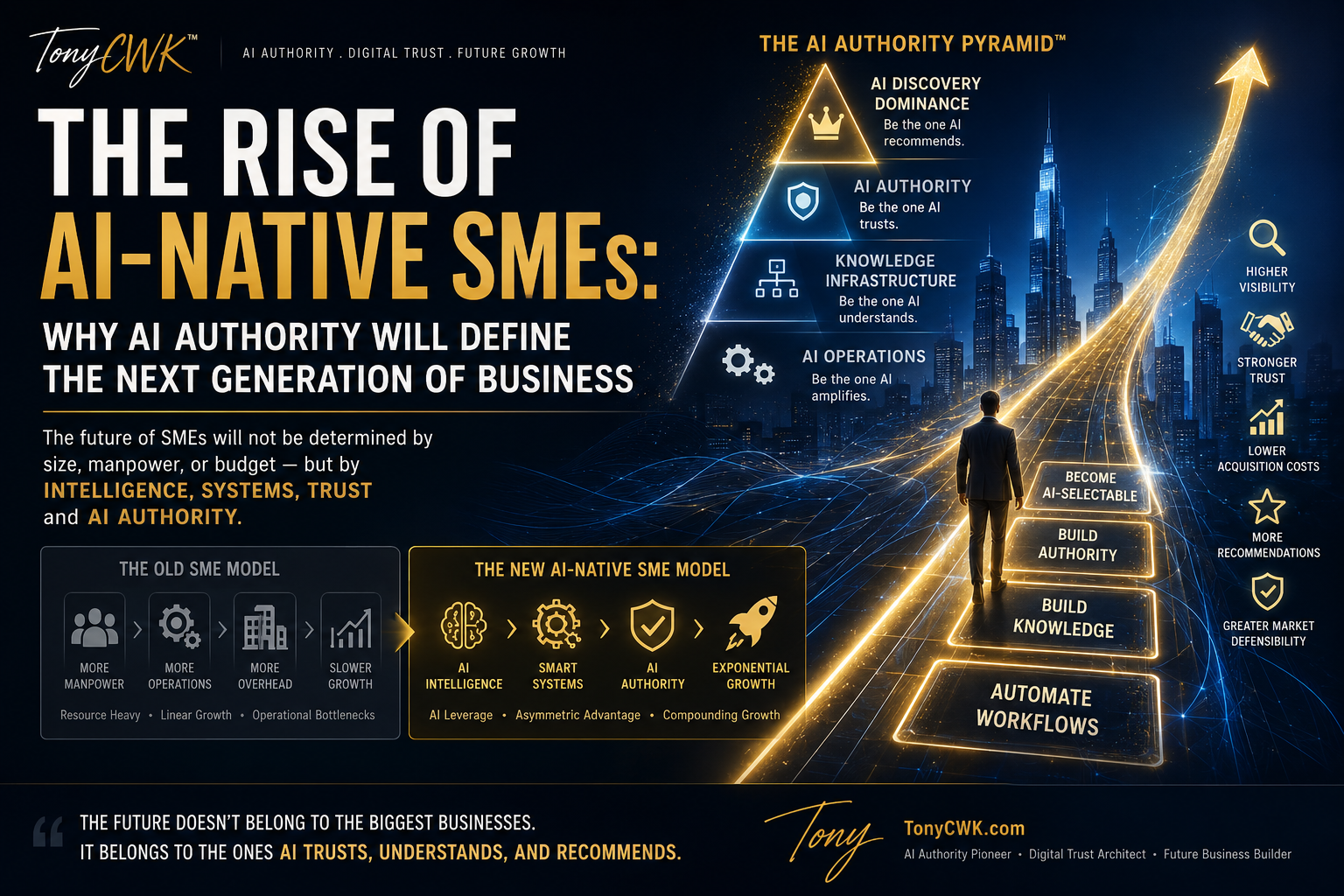
The SME Landscape Is About to Change Forever
For decades, SMEs competed through:
- manpower
- operational efficiency
- physical expansion
- sales execution
- advertising budgets
- outsourcing scale
The formula was simple:
More resources → more output → more growth.
But AI is now dismantling that equation.
A single founder with AI can now:
- create content at scale
- automate workflows
- conduct research
- generate designs
- manage customer support
- analyze data
- build websites
- execute marketing campaigns
- streamline operations
The barrier to execution is collapsing.
And that changes the future of SMEs completely.
We Are Entering the Era of AI-Native SMEs
The next generation of SMEs will not resemble traditional small businesses.
They will resemble:
- intelligence-amplified organizations
- lean operating systems
- AI-augmented expertise networks
- highly automated digital entities
In many cases:
a 5-person AI-native SME may outperform a traditional 50-person business.
Not because they work harder.
But because they operate differently.
AI Is Creating a New Class of SMEs
Historically:
- large companies won through scale
- SMEs struggled with resource limitations
- operational capacity determined growth
But AI compresses operational asymmetry.
Now:
- execution becomes faster
- coordination becomes cheaper
- content becomes scalable
- research becomes instant
- workflows become automated
This creates:
asymmetric leverage.
The future advantage no longer comes from:
- having the largest workforce
- producing the most content
- spending the most on ads
Instead, advantage increasingly comes from:
- intelligence
- systems
- trust
- discoverability
- algorithmic recommendation
And this is where AI Authority becomes critical.
AI Alone Is NOT the Competitive Advantage
This is the mistake many businesses are making in 2026.
They believe:
using AI tools automatically creates differentiation.
It doesn’t.
Because AI tools are rapidly becoming:
- accessible
- standardized
- commoditized
Soon:
everyone will have access to similar AI capabilities.
Which means:
operational efficiency alone stops being a moat.
The real differentiator becomes:
Who AI Systems Trust Enough to Recommend
That is the new battlefield.
The AI Era Is Shifting From Ranking to Selection
Traditional digital marketing was built around:
- rankings
- traffic
- impressions
- clicks
- reach
But AI systems behave differently.
AI does not simply “rank pages.”
AI systems increasingly:
- retrieve
- synthesize
- evaluate
- compare
- compress
- recommend
This creates a fundamentally different visibility model.
The question is no longer:
“Can your business be found?”
The new question becomes:
“Will AI systems select your business?”
That changes the entire competitive landscape for SMEs.
Future SMEs Will Compete on AI Authority
In the AI era, the strongest SME may not be:
- the largest
- the most funded
- the most established
Instead, the strongest SME may become:
- the most trusted
- the most structurally consistent
- the most semantically clear
- the most ecosystem-reinforced
- the most citation-worthy
Because AI systems optimize for:
- confidence
- clarity
- consistency
- reinforcement
- retrieval reliability
Not merely popularity.
This is the rise of:
Algorithmic Trust Economies
Why AI Authority Becomes a Compounding Asset
As AI interfaces increasingly mediate discovery:
- search engines
- AI assistants
- recommendation systems
- retrieval systems
- enterprise copilots
Businesses that AI repeatedly selects gain:
- higher visibility
- stronger trust
- lower acquisition costs
- more recommendation frequency
- greater market defensibility
This creates a compounding effect.
Much like:
- brand equity
- intellectual property
- reputation capital
- distribution dominance
AI Authority becomes:
a long-term strategic business asset.
The Future SME Stack
The next generation of successful SMEs may operate through four interconnected layers.
1. AI Operations Layer
Using AI to improve:
- automation
- workflows
- productivity
- customer support
- operational speed
This creates execution efficiency.
2. Knowledge Infrastructure Layer
Building:
- AI-readable content
- semantic clarity
- structured information architecture
- retrieval-ready ecosystems
This creates machine interpretability.
3. AI Authority Layer
Developing:
- ecosystem credibility
- thematic consistency
- digital trust signals
- citation-worthiness
- cross-platform reinforcement
This creates algorithmic trust.
4. AI Discovery Layer
Achieving:
- AI recommendation frequency
- persistent discoverability
- retrieval preference
- selection dominance
This creates compounding visibility.
Why Most SMEs Are Still Unprepared
Most businesses are still optimizing for:
- clicks
- impressions
- keyword rankings
- short-term ad performance
But AI is quietly changing how discovery works underneath the surface.
The future internet may increasingly reward:
- structured expertise
- trusted entities
- ecosystem consistency
- machine-readable authority
- reinforced knowledge graphs
Not just content volume.
This is why many SMEs risk becoming:
operationally efficient yet algorithmically invisible.
The Biggest Misunderstanding About AI Marketing
Many businesses think AI marketing means:
- generating more content
- automating social posts
- using ChatGPT for copywriting
But that is only the surface layer.
The deeper transformation is this:
AI is restructuring how trust, discovery, and recommendation work online.
And the businesses that understand this early will gain disproportionate advantages.
The Future Belongs to Selectable SMEs
The old internet rewarded:
who could publish.
The search era rewarded:
who could rank.
The AI era increasingly rewards:
who AI systems trust enough to select.
This is why the future of SMEs will not merely depend on:
- adoption of AI tools
But on:
- AI Authority
- structured trust
- semantic consistency
- ecosystem reinforcement
- retrieval confidence
- algorithmic credibility
The next generation of SMEs will not simply be:
AI-powered.
They will be:
AI-selectable.
And that may become the defining competitive advantage of the next decade.
FAQ Section
1. What is an AI-native SME?
An AI-native SME is a small or medium-sized business that uses AI as a core operating layer, not just as a productivity tool. It uses AI to support research, content, workflows, customer service, marketing, and decision-making.
2. How will AI change the future of SMEs?
AI will allow SMEs to operate with greater speed, lower overhead, and stronger execution capacity. Smaller teams will be able to perform functions that previously required larger teams, agencies, or expensive infrastructure.
3. Will AI make SMEs more competitive against large companies?
Yes. AI reduces the advantage of scale by giving smaller businesses access to automation, intelligence, content production, and operational systems that were once available mainly to larger organizations.
4. Why is AI Authority important for SMEs?
AI Authority helps SMEs become trusted, understood, and recommended by AI systems. As customers increasingly use AI tools for discovery and decision-making, businesses with stronger AI Authority may gain more visibility and trust.
5. Is using AI tools enough to build a competitive advantage?
No. AI tools will become widely available. The real advantage comes from building structured knowledge, credibility signals, semantic consistency, and authority that AI systems can recognize.
6. What does it mean for an SME to become AI-selectable?
An AI-selectable SME is a business that AI systems can confidently retrieve, interpret, trust, and recommend when users ask relevant questions.
7. How does AI Authority differ from traditional SEO?
Traditional SEO focuses mainly on ranking in search results. AI Authority focuses on being selected, cited, and recommended by AI systems through trust, structure, expertise, and credibility.
8. What are the key layers of the future SME stack?
The future SME stack includes AI operations, knowledge infrastructure, AI Authority, and AI discovery. Together, these layers help SMEs move from simple automation to trusted AI recommendation.
9. Can small businesses build AI Authority without a large budget?
Yes. SMEs can build AI Authority through consistent expert content, structured pages, clear entity signals, digital PR, customer proof, and cross-platform credibility reinforcement.
10. Why will AI Authority become a business asset?
AI Authority can compound over time. When AI systems repeatedly associate a business with trust, expertise, and relevance, that business may gain stronger visibility, lower acquisition costs, and more recommendation opportunities.
11. What risks do SMEs face if they ignore AI Authority?
SMEs may become operationally efficient but algorithmically invisible. They may use AI internally but fail to appear in AI-generated answers, recommendations, and discovery pathways.
12. How can SMEs start building AI Authority?
SMEs should start by clarifying their expertise, structuring their website content, publishing authoritative articles, building internal links, earning credibility signals, and ensuring their brand information is consistent across platforms.
13. Will AI replace traditional marketing for SMEs?
AI will not fully replace traditional marketing, but it will change how marketing works. Future marketing will need to combine content, trust signals, structured data, authority building, and AI-readable knowledge architecture.
14. What role does trust play in AI discovery?
Trust is central to AI discovery. AI systems are more likely to surface businesses that show consistent expertise, credible references, clear information, and strong ecosystem reinforcement.
15. What is the biggest opportunity for SMEs in the AI era?
The biggest opportunity is asymmetric leverage. SMEs can use AI to operate more efficiently while building authority systems that help them become discoverable, trusted, and recommended at scale.
Suggested Further Reading Topics
What Is AI Authority™?
Understanding how AI systems evaluate trust, credibility, and recommendation-worthiness.
👉 https://tonycwk.com/what-is-ai-authority/
The AI Authority Pyramid™
The 5-layer framework for building sustainable AI discoverability.
👉 https://tonycwk.com/ai-authority-pyramid/
The AI Discovery Flywheel™
How authority compounds through reinforcement, citations, and ecosystem momentum.
👉 https://tonycwk.com/ai-discovery-flywheel/
AI Selection Systems™
Why future visibility depends on being selected — not merely ranked.
👉 https://tonycwk.com/ai-selection-systems/
Digital PR in the Era of AI Authority
Transforming mentions and citations into algorithmic trust signals.
👉 https://tonycwk.com/digital-pr-ai-authority-mapping-framework/
Local Entity SEO in the Age of AI
Why local businesses must optimize for AI understanding, not just local rankings.
👉 https://tonycwk.com/local-entity-seo-in-the-age-of-ai/
Why SMEs Can Outperform Corporates in AI Discovery
How agility and semantic clarity may outperform organizational scale.
👉 https://tonycwk.com/why-smes-can-outperform-corporates-in-ai-discovery/
AI Doesn’t Trust Content. It Trusts Systems.
Why future business visibility depends on structured authority ecosystems.
👉 https://tonycwk.com/why-ai-doesnt-trust-content-it-trusts-systems/
Written by Tony Chan (TonyCWK)
AI Authority & Digital Strategy Researcher
Leave a Reply