
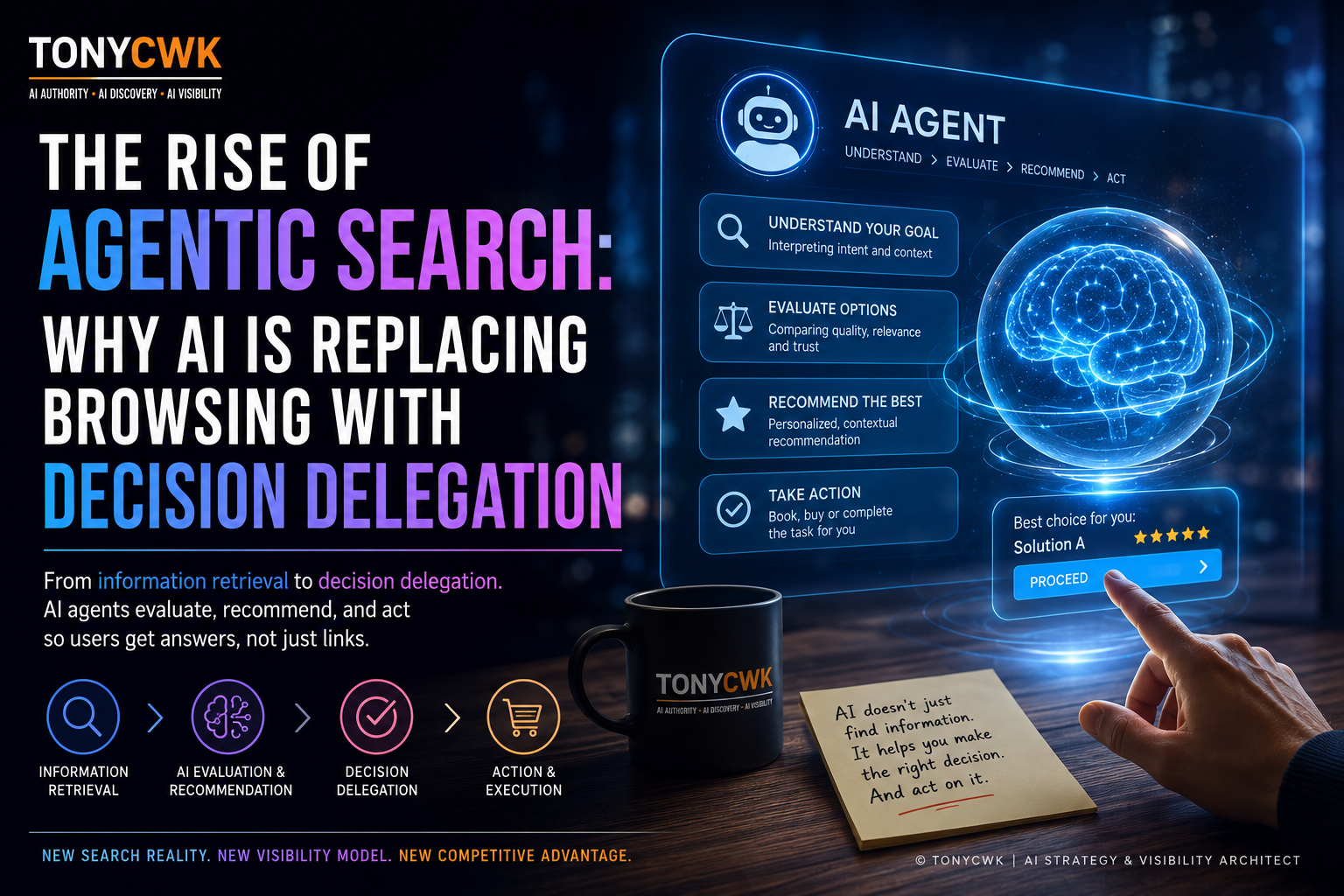
The End of the Browsing Era
For more than two decades, the internet operated on a relatively stable behavioral model.
Users searched.
Browsers displayed results.
Websites competed for clicks.
Consumers compared options manually.
Digital marketing evolved around this ecosystem.
SEO optimized discoverability.
Advertising optimized visibility.
Websites optimized conversion.
But artificial intelligence is beginning to fundamentally reshape this behavioral architecture.
We are now entering the era of:
Agentic Search
An environment where AI systems do not merely retrieve information.
They increasingly:
- evaluate options
- compare alternatives
- summarize decisions
- recommend actions
- complete tasks
- transact on behalf of users
This marks one of the most important shifts in the history of digital marketing.
The web is slowly transitioning from:
Information Retrieval
to
Decision Delegation
And that changes everything.
What Is Agentic Search?
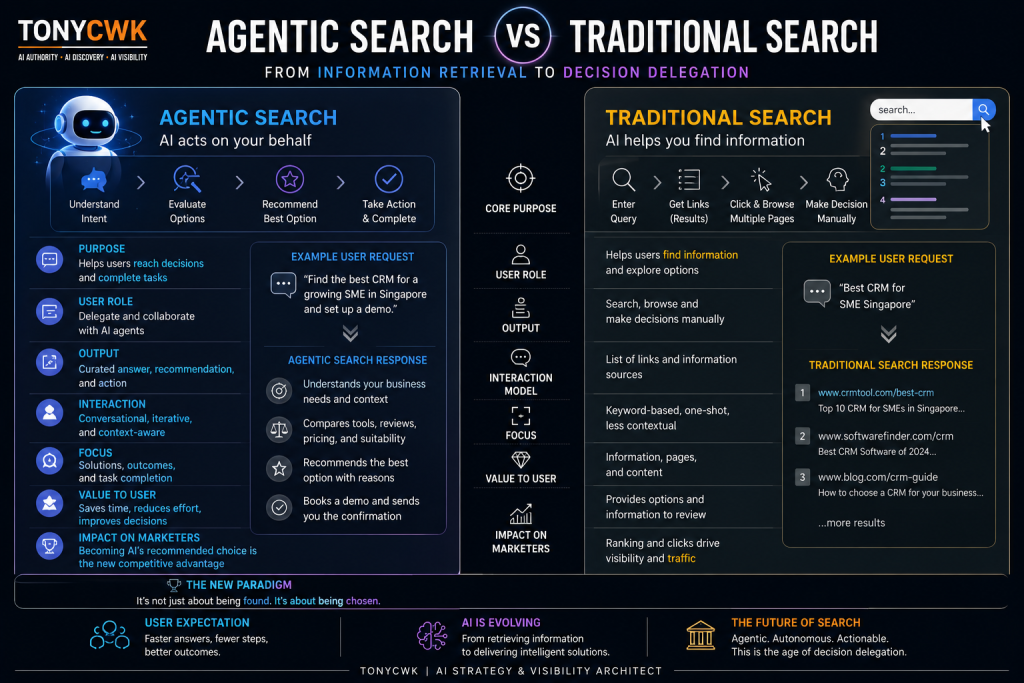
Traditional search engines function primarily as retrieval systems.
Users:
- search for information
- browse links
- compare websites
- synthesize decisions manually
Agentic search changes this model entirely.
In agentic environments, AI systems become:
- interpreters
- evaluators
- recommendation engines
- autonomous assistants
- task execution layers
Instead of:
“Here are 10 links.”
The future increasingly becomes:
“Here is the best option based on your context, goals, preferences, and constraints.”
This transforms search from:
- navigation
into - delegation.
The AI no longer simply helps users find information.
It increasingly helps users decide.
And eventually:
- act.
Why This Shift Matters
The implications are enormous because digital marketing has historically depended on one core assumption:
Users browse before they decide.
But AI agents compress:
- research
- comparison
- evaluation
- filtering
- recommendation
- conversion
into a single conversational interaction.
The traditional funnel begins collapsing.
The Collapse of the Traditional Customer Journey
For years, marketers optimized around this structure:
Awareness → Interest → Research → Comparison → Decision → Purchase
Entire industries emerged around influencing each stage.
But agentic systems increasingly compress these stages into one AI-mediated workflow.
A user may simply ask:
“Find me the best cybersecurity certification pathway for career transition.”
Or:
“Recommend the most trustworthy chiropractor near me for office workers.”
Or:
“Choose the best CRM platform for a growing SME in Singapore.”
The AI system may:
- retrieve options
- compare reviews
- evaluate reputation
- analyze relevance
- filter competitors
- recommend one solution
- complete the transaction
without the user manually browsing dozens of websites.
This changes the economics of digital visibility itself.
The Shift From Search Engine to Decision Engine
Historically, Google functioned primarily as:
- an indexing engine
- a retrieval layer
- a ranking system
But modern AI ecosystems are evolving toward:
- conversational interfaces
- multimodal reasoning systems
- contextual recommendation engines
- autonomous agent frameworks
Search is becoming:
- predictive
- personalized
- action-oriented
- recommendation-driven
The future search engine may no longer behave like a search engine at all.
It may function more like:
- a strategic assistant
- a recommendation advisor
- a digital operating layer
This is why the rise of AI agents may become more disruptive than the rise of mobile search.
Why Browsing Is Becoming Less Important
In the traditional web:
- more clicks meant more opportunities
- more traffic meant more visibility
- more rankings meant more influence
But in agentic systems:
- the AI performs much of the browsing itself
This creates a major behavioral shift.
Users increasingly want:
- reduced friction
- fewer decisions
- simplified evaluation
- trusted recommendations
- delegated execution
The modern user is experiencing:
- information overload
- content fatigue
- decision exhaustion
AI agents solve this by reducing cognitive burden.
Instead of manually reviewing 20 websites, users increasingly prefer:
“Tell me the best option.”
This changes how authority works online.
The Rise of AI Selection Systems™
In the traditional SEO era, the key question was:
“Can users find you?”
In the agentic era, the more important question becomes:
“Will AI systems choose you?”
This is a fundamentally different competitive model.
Because visibility alone no longer guarantees influence.
A brand may be:
- indexed
- retrievable
- searchable
- AI-readable
yet still not become:
This creates the rise of:
AI Selection Systems™
Where competitive advantage increasingly depends on:
- recommendation probability
- contextual preference
- retrieval confidence
- citation reinforcement
- trust consistency
- ecosystem coherence
The future winners may not be the brands with the most content.
But the brands most consistently selected by AI systems.
Why SEO Alone Is No Longer Enough
Traditional SEO remains important.
But it is no longer sufficient on its own.
Because rankings do not necessarily translate into AI recommendation dominance.
AI systems evaluate far more than keywords.
They increasingly evaluate:
- semantic consistency
- entity clarity
- structured knowledge
- citation stability
- ecosystem trust
- contextual authority
- machine readability
- cross-platform coherence
This is why the future competitive layer extends beyond SEO into:
- AI Authority™
- AI Discovery
- Citation Engineering™
- Entity Persistence
- AI Governance Systems
- Retrieval Confidence™
The optimization target is no longer merely:
- search visibility
But:
- recommendation trust.
The Emergence of the Zero-Browse Economy
For years, analysts discussed the rise of the “zero-click economy.”
But agentic search may accelerate something even larger:
The Zero-Browse Economy
Where users:
- do not compare manually
- do not navigate extensively
- do not consume multiple sources directly
Instead:
AI systems increasingly mediate the entire decision layer.
This creates massive implications for:
- publishers
- advertisers
- marketers
- SEO professionals
- e-commerce businesses
- local businesses
- service providers
Because traffic itself may decline even while influence shifts toward AI recommendation ecosystems.
Why Trust Becomes the Most Important Digital Asset
AI systems operate differently from humans.
Humans tolerate:
- ambiguity
- inconsistency
- emotional persuasion
AI systems prioritize:
- confidence
- coherence
- verification
- consistency
- interpretability
This means future digital authority increasingly depends on:
- structured ecosystems
- stable entity relationships
- machine-readable trust
- reinforced citations
- semantic alignment
In other words:
AI systems trust systems more than isolated content.
This changes the future of branding entirely.
The Rise of Recommendation Economics
The internet historically operated on:
- attention economics
The AI era increasingly shifts toward:
- recommendation economics
Meaning:
- influence compounds through repeated AI preference
Not merely:
- exposure frequency.
This creates powerful winner-take-most dynamics.
Because once AI systems repeatedly identify certain entities as:
- trustworthy
- authoritative
- contextually reliable
they may continue reinforcing those entities across interactions.
This creates:
- recommendation loops
- citation loops
- reinforcement cycles
- authority compounding systems
The future competitive advantage may increasingly belong to:
- structurally trustworthy brands.
The Future Role of Websites
Websites are not disappearing.
But their role is evolving.
Historically, websites were:
- browsing destinations
Increasingly, they become:
- machine-readable authority repositories
Their future role includes:
- entity validation
- structured knowledge delivery
- semantic consistency
- trust reinforcement
- retrieval optimization
- citation support
- ecosystem coherence
This means:
- schema architecture
- content relationships
- entity mapping
- structured metadata
- knowledge graph alignment
become strategically important.
The future website is no longer merely a visual experience.
It becomes:
Why This Changes Digital Marketing Forever
Agentic search fundamentally changes:
- discoverability
- attribution
- branding
- advertising
- SEO
- conversion pathways
- customer journeys
- authority formation
The future internet may no longer reward brands that simply:
- publish the most
- advertise the most
- rank the most
Instead, it may reward brands that become:
- consistently interpretable
- contextually trustworthy
- structurally coherent
- repeatedly recommended
The future battle is not only for:
- visibility
But increasingly for:
- recommendation dominance.
The Future Belongs to AI-Preferred Brands
As AI agents become embedded into:
- search
- commerce
- productivity
- decision-making
- enterprise workflows
the most important digital question may become:
“Does AI trust your ecosystem enough to recommend you repeatedly?”
Because in the age of agentic search:
- retrieval gets you considered
- recommendation gets you surfaced
- reinforcement makes you dominant
And that may become the defining competitive framework of the AI era.
Final Thoughts
The rise of agentic search is not simply another SEO trend.
It represents a structural transformation in how humans interact with information, decisions, and digital systems.
The web is evolving from:
- browsing ecosystems
into - delegated intelligence ecosystems.
This is the transition from:
- search engines
to - decision engines.
And in this new environment, the future winners may not be the brands that generate the most attention.
But the brands AI systems trust enough to choose.
FAQ: The Rise of Agentic Search
1. What is agentic search?
Agentic search refers to AI-powered search systems that do more than retrieve information. They can interpret intent, compare options, recommend actions, and increasingly help users complete tasks.
2. How is agentic search different from traditional search?
Traditional search gives users a list of links. Agentic search helps users move closer to a decision by summarizing, evaluating, recommending, and sometimes acting on their behalf.
3. Why is agentic search important for digital marketing?
Agentic search changes the goal of digital marketing from being found to being selected. Brands must now think about whether AI systems trust them enough to recommend them.
4. What does “decision delegation” mean?
Decision delegation means users increasingly rely on AI systems to evaluate information, compare options, and recommend the best course of action instead of browsing manually.
5. Will agentic search reduce website traffic?
It may reduce some browsing behavior because users can receive answers, comparisons, and recommendations directly from AI interfaces. This makes AI visibility and recommendation trust more important.
6. Does SEO still matter in the agentic search era?
Yes. SEO still matters because search engines and AI systems need to discover and understand content. However, SEO alone may not be enough to earn AI recommendations.
7. What replaces traditional SEO in agentic search?
SEO is not replaced, but expanded. Brands need AI Authority™, structured knowledge, entity clarity, citation reinforcement, and machine-readable trust signals.
8. What is the difference between ranking and recommendation?
Ranking means appearing in search results. Recommendation means being selected by an AI system as a suitable, trusted, or preferred answer.
9. Why is AI selection more important than visibility?
Visibility means AI can find a brand. Selection means AI considers the brand trustworthy and relevant enough to recommend. In agentic search, selection may become more valuable than exposure.
10. What types of brands benefit most from agentic search?
Brands with clear expertise, consistent digital ecosystems, strong credibility signals, structured content, and trustworthy entity presence are more likely to benefit.
11. How can businesses prepare for agentic search?
Businesses should improve their structured data, content architecture, topical authority, brand consistency, citations, reviews, and entity signals across the web.
12. What role do websites play in agentic search?
Websites become machine-readable trust repositories. They help AI systems verify who the brand is, what it offers, why it is credible, and when it should be recommended.
13. What is the zero-browse economy?
The zero-browse economy describes a future where users increasingly rely on AI-generated answers and recommendations instead of visiting multiple websites manually.
14. How does agentic search affect paid advertising?
Paid advertising may become more conversational, recommendation-based, and embedded inside AI-assisted decision flows rather than only appearing as traditional search ads.
15. What is AI Authority™?
AI Authority™ refers to a brand’s ability to become understood, trusted, cited, and recommended by AI systems across search, answer engines, and agentic interfaces.
16. What is an AI Selection System™?
An AI Selection System™ is the set of signals, structures, and trust factors that influence whether AI systems choose one brand, answer, product, or service over another.
17. Why does entity clarity matter in agentic search?
AI systems need to understand entities clearly. If a brand’s identity, expertise, services, and credibility are inconsistent, AI may be less confident in recommending it.
18. What are trust signals for agentic search?
Trust signals include authoritative content, structured data, expert authorship, citations, reviews, consistent profiles, credible mentions, and transparent business information.
19. How should marketers measure agentic search performance?
Marketers should look beyond traffic and rankings. New metrics may include AI mentions, citation frequency, recommendation presence, selection rate, and contextual visibility.
20. What is the main takeaway from agentic search?
The future of digital marketing is moving from search visibility to AI recommendation trust. Brands must not only be findable; they must become selectable.
Further Reading
- The AI Authority Pyramid™
- The AI Discovery Flywheel™
- Why SEO Alone Is No Longer Enough
- The AI Citation Layer™
- Citation Engineering™
- AI Selection Systems™
- The Governance Layer of AI Authority™
- Entity Persistence in the Age of LLMs
- How Search Has Evolved in the Age of AI — From Rankings to Recommendations
- The New Visibility Model: Why Being Found Is No Longer Enough in the Age of AI
Written by Tony Chan (TonyCWK)
AI Authority & Digital Strategy Researcher
Leave a Reply