
The Next Evolution Of AI Influence
The discussion around AI visibility has evolved rapidly over the past two years.
Initially, the challenge was visibility.
Organizations wanted to understand how AI systems discovered content, retrieved information, and surfaced answers.
The question was simple:
How do we get AI systems to find us?
As AI search matured, a second challenge emerged.
Recommendation.
AI systems increasingly moved beyond retrieval.
They began summarizing information, comparing alternatives, evaluating sources, and recommending answers.
This shift led to a new question:
How do we become the entities AI systems choose to cite, surface, and recommend?
This is the challenge that led to the development of concepts such as AI Authority, recommendation confidence, and the AI Authority Pyramid™.
Visibility helps AI find you.
Authority helps AI recommend you.
But a third challenge is beginning to emerge.
Trust.
Why Recommendation Alone Is No Longer Enough
For many organizations, being recommended by AI may seem like the end goal.
However, recommendation is not the same as trust.
A recommendation only has value if people believe it.
This distinction is becoming increasingly important as AI systems become more influential in decision-making.
Consider the growing concerns surrounding:
- AI hallucinations
- Inaccurate search findings
- Agent hijacking and agentjacking
- Autonomous decision-making errors
- Misinformation risks
- Regulatory oversight
These challenges are forcing organizations to confront a new reality.
The question is no longer simply:
“Can AI recommend us?”
The question is increasingly becoming:
“Why should anyone trust the recommendation?”
The Difference Between Authority And Trust
Authority and trust are related, but they are not the same thing.
Authority explains why an entity is selected.
Trust explains why that selection is believed.
Authority answers:
Why was this recommended?
Trust answers:
Why should this recommendation be trusted?
An organization can have visibility.
An organization can build authority.
An organization can even become frequently recommended.
Yet if users question the accuracy, reliability, or credibility of the recommendation, its influence diminishes.
Authority may create recommendation confidence.
Trust creates decision confidence.
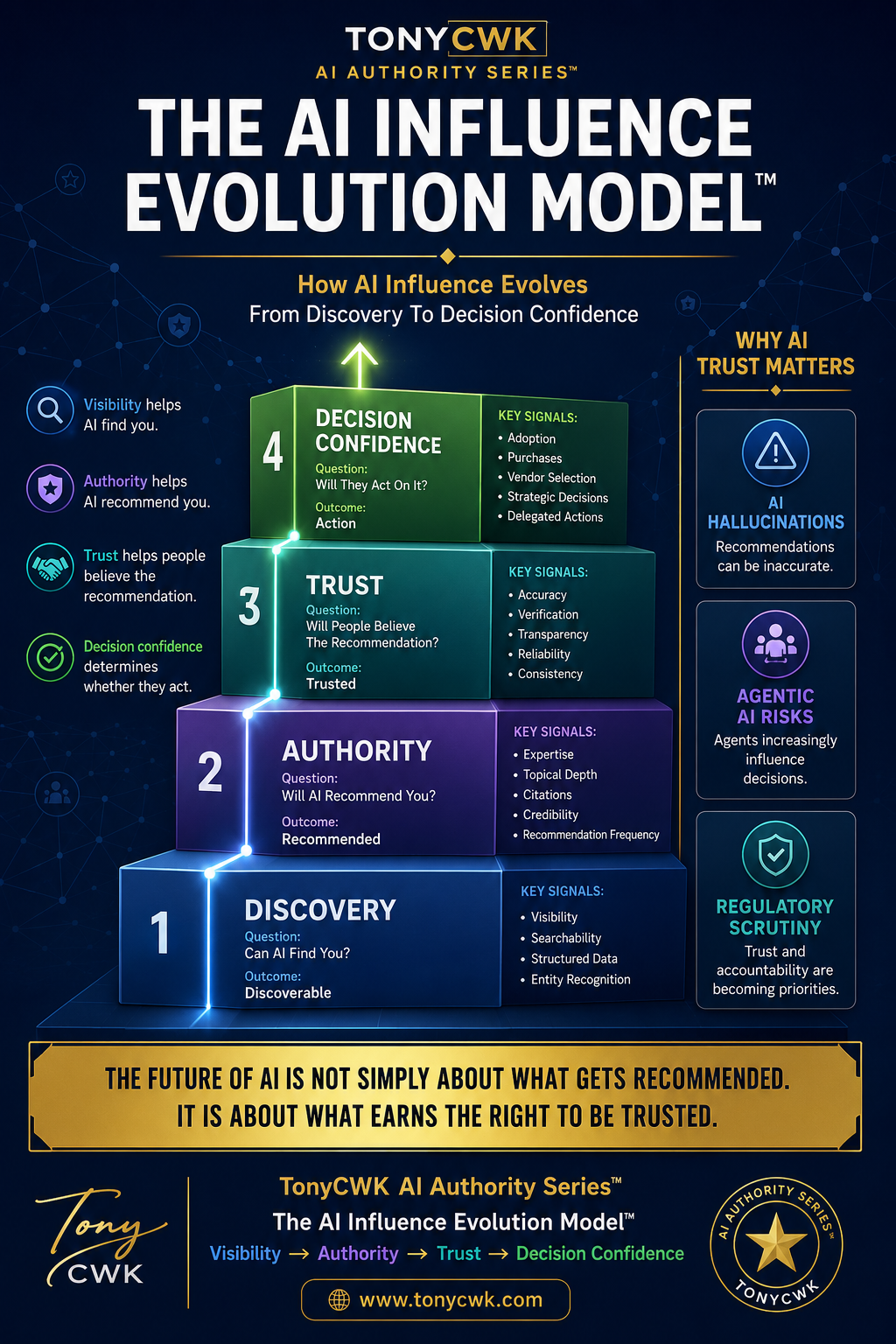
The Emerging AI Influence Model
As AI systems become more capable, influence may evolve through four stages.
Stage 1: Visibility
Can AI find you?
This includes:
- Searchability
- Discoverability
- Structured information
- Entity recognition
Visibility makes an organization discoverable.
Stage 2: Authority
Will AI recommend you?
This includes:
- Expertise
- Topical depth
- Credibility signals
- Citation frequency
- Ecosystem validation
Authority increases the likelihood of recommendation.
Stage 3: Trust
Will people believe the recommendation?
This includes:
- Accuracy
- Verification
- Transparency
- Reliability
- Consistency
Trust determines whether recommendations survive scrutiny.
Stage 4: Decision Confidence
Will people act on the recommendation?
This includes:
- Purchasing decisions
- Business decisions
- Vendor selection
- Delegated AI actions
- Strategic adoption
Decision confidence transforms influence into action.
Why Agentic AI Changes The Conversation
The rise of agentic AI may accelerate the importance of trust.
Traditional search systems primarily retrieved information.
Agentic systems increasingly evaluate information, compare alternatives, and make recommendations autonomously.
As agents become more capable, the consequences of poor recommendations increase.
A recommendation error may influence:
- Purchases
- Investments
- Business decisions
- Vendor selection
- Operational actions
The question therefore shifts from:
“What did the AI recommend?”
to:
“Can the recommendation be trusted?”
This distinction may become one of the defining challenges of the agentic era.
The Role Of AI Trust In The Future
AI Trust should not be viewed as a replacement for AI Authority.
Rather, it represents the next stage in the evolution of AI influence.
AI Authority explains how recommendation confidence develops.
AI Trust explains why recommendations deserve confidence.
AI Decision Confidence explains when people are willing to act.
Together they create a progression:
Visibility → Authority → Trust → Decision Confidence
Organizations that focus exclusively on visibility may struggle.
Organizations that focus exclusively on authority may also struggle.
The future advantage may belong to organizations capable of building all four.
Because recommendation alone is not enough.
Trust determines whether the recommendation survives scrutiny.
Decision confidence determines whether action happens.
Final Thoughts
The future of AI is not simply about what gets recommended.
It is about what earns the right to be trusted.
As AI systems become increasingly involved in discovery, evaluation, and decision support, organizations will need to think beyond visibility and recommendation.
The next challenge is trust.
And the organizations that successfully earn trust may become the organizations that shape decisions in the age of AI.
Visibility helps AI find you.
Authority helps AI recommend you.
Trust helps people believe the recommendation.
Decision confidence determines whether they act.
Frequently Asked Questions
What is AI Authority?
AI Authority refers to the credibility, relevance, and trust signals that help AI systems decide which entities, brands, or sources to cite, surface, or recommend.
What is AI Trust?
AI Trust refers to the confidence users, organizations, and decision-makers place in an AI recommendation after it has been generated. It asks whether the recommendation is accurate, reliable, verifiable, and worthy of action.
How is AI Authority different from AI Trust?
AI Authority explains why AI systems may choose or recommend an entity. AI Trust explains why that recommendation should be believed. Authority helps AI recommend you. Trust helps people believe the recommendation.
Why is AI Trust becoming more important?
AI Trust is becoming more important because AI systems are increasingly involved in search, recommendations, decision support, and autonomous actions. As risks such as hallucinations, inaccurate findings, agent hijacking, and misinformation increase, people need stronger reasons to trust AI-generated recommendations.
What is decision confidence in AI?
Decision confidence refers to the level of trust required for a person, organization, or AI agent to act on a recommendation. It connects AI recommendations to real-world outcomes such as purchases, vendor selection, business decisions, and delegated actions.
Why is recommendation alone no longer enough?
Recommendation alone is no longer enough because being recommended does not guarantee belief or action. A recommendation must survive scrutiny before users, customers, or organizations are willing to act on it.
How does agentic AI affect AI Trust?
Agentic AI increases the importance of AI Trust because autonomous systems may evaluate information, compare options, and take actions with less direct human involvement. This makes accuracy, verification, transparency, and reliability more important.
What is the future of AI Authority?
The future of AI Authority may evolve beyond visibility and recommendation into trust and decision confidence. Organizations will need to become discoverable, recommendable, trustworthy, and actionable within AI-influenced decision systems.
Leave a Reply