
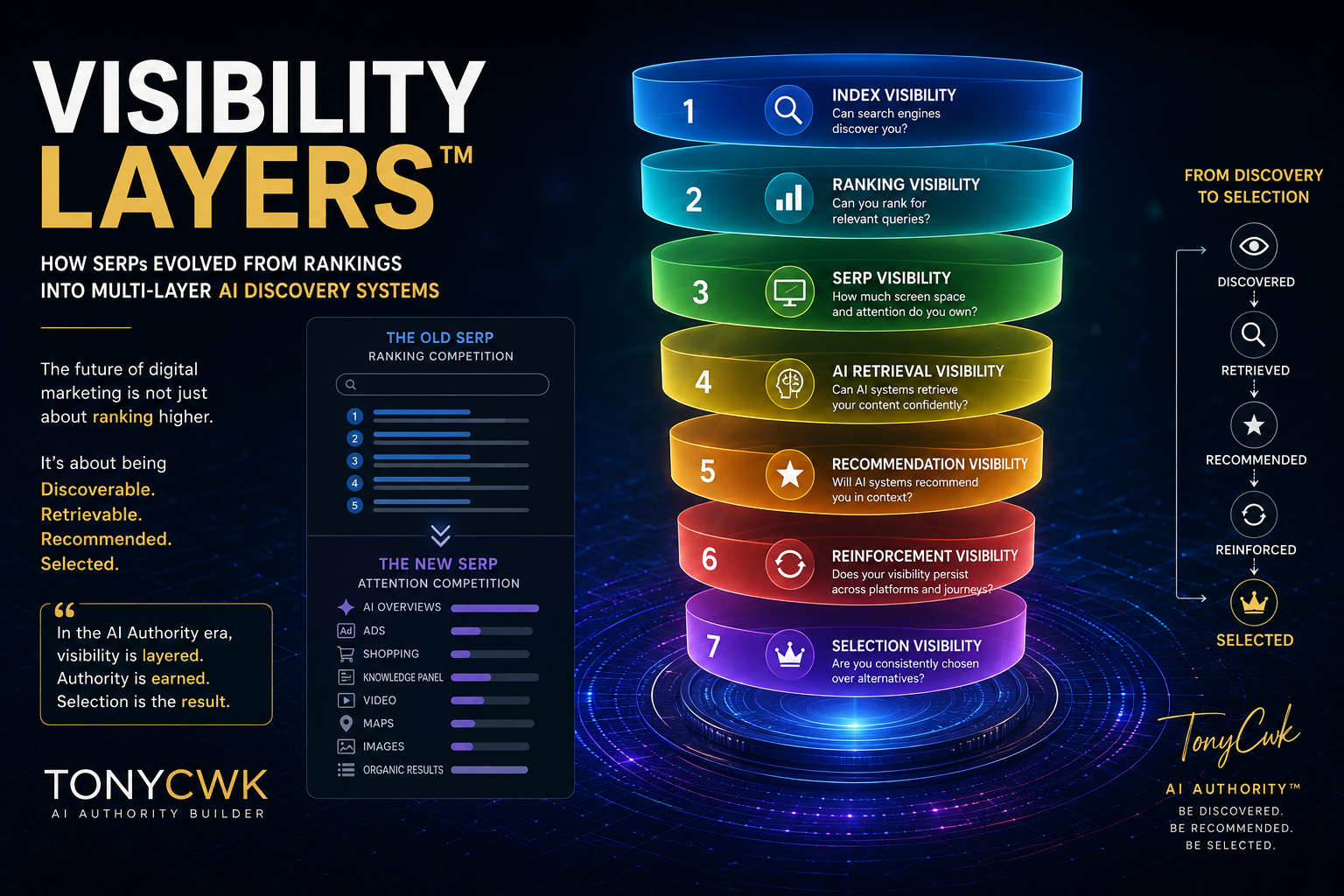
How SERPs Evolved From Rankings Into Multi-Layer AI Discovery Systems
For over two decades, digital marketing largely revolved around a relatively simple objective:
Rank higher.
The search engine results page (SERP) was once dominated by a familiar structure:
• 10 blue links
• organic rankings
• keyword positioning
• click-through optimization
Visibility was primarily determined by position.
If you ranked first, you won attention.
If you ranked lower, visibility declined rapidly.
But the digital discovery ecosystem is no longer operating under that model.
Today’s search environments increasingly include:
• AI Overviews
• conversational answers
• shopping integrations
• local packs
• knowledge panels
• featured snippets
• video carousels
• recommendation engines
• AI-generated summaries
• agentic assistants
This evolution is quietly transforming one of the foundational assumptions of digital marketing:
Visibility is no longer a single ranking position.
Visibility is becoming layered.
And that changes everything.
The Evolution Of SERPs
Traditional SERPs were largely hierarchical.
The higher your ranking:
• the more clicks you received
• the more traffic you earned
• the more visible your brand became
SEO success was primarily measured through:
• keyword rankings
• organic traffic
• click-through rate
• search impressions
But modern SERPs no longer function as pure ranking environments.
They are becoming:
multi-layer discovery ecosystems.
Today, a user may encounter:
• AI-generated answers before organic results
• shopping recommendations before editorial content
• video snippets before websites
• map packs before traditional listings
• brand panels before blog articles
• conversational summaries before clickable links
In many cases, the traditional organic result is no longer the first thing users see.
Sometimes it is not even the primary thing users interact with.
This means:
ranking alone no longer guarantees visibility.
The Shift From Ranking Competition To Attention Competition
The old SEO battlefield looked like this:
SEO → Rankings → Traffic
But the emerging AI discovery environment looks increasingly like this:
Discovery → Visibility → Retrieval → Recommendation → Reinforcement → Selection
This is a major structural shift.
Because the competitive layer is no longer only about:
“Can I rank?”
The more important question is becoming:
“How many visibility layers can my brand occupy simultaneously?”
Introducing Visibility Layers™
Visibility Layers™ is a strategic framework describing how digital visibility is evolving from single-position search rankings into interconnected multi-layer discovery systems across both human and AI-driven environments.
Instead of visibility existing in only one place, modern authority increasingly compounds across multiple visibility surfaces simultaneously.
The stronger the ecosystem reinforcement across layers, the greater the probability of:
• retrieval
• recommendation
• memorability
• authority persistence
• repeated selection
In the AI Authority era, visibility is becoming systemic rather than positional.
The Visibility Layers™ Framework
Layer 1 — Index Visibility
The foundational layer.
Can search engines and AI systems discover your existence?
Without discoverability:
• no retrieval occurs
• no indexing occurs
• no recommendation occurs
This layer includes:
• crawlability
• technical SEO
• site structure
• schema markup
• accessibility
• structured content architecture
SEO remains critically important here.
AI visibility does not eliminate the importance of technical discoverability.
It expands upon it.
Layer 2 — Ranking Visibility
Can your pages rank for relevant queries?
This includes:
• keyword relevance
• topical authority
• backlinks
• internal linking
• content quality
• search intent alignment
This layer still matters significantly because rankings continue to influence:
• traffic
• retrieval probability
• content exposure
• brand familiarity
However, ranking visibility is no longer the final destination.
It is increasingly becoming only one layer inside a much larger ecosystem.
Layer 3 — SERP Visibility
This is where modern search behavior begins to diverge from traditional SEO assumptions.
SERP visibility refers to:
• visual screen presence
• pixel occupancy
• SERP feature dominance
• attention positioning
A brand may appear through:
• featured snippets
• AI Overviews
• video results
• local packs
• shopping modules
• image carousels
• knowledge panels
This means a brand can dominate visibility even without holding the #1 traditional organic ranking.
Conversely, a #1 ranking may receive limited attention if pushed below:
• ads
• AI-generated answers
• rich SERP features
The battlefield is shifting from:
ranking position
to:
attention allocation.
The Pixel Economy Of Attention
Modern SERPs increasingly function as visual attention economies.
The question is no longer simply:
“What rank am I?”
But increasingly:
“How much cognitive screen space do I occupy?”
Brands that occupy larger portions of the discovery environment may gain:
• stronger memorability
• higher familiarity
• increased trust reinforcement
• better retrieval probability
• improved recommendation likelihood
This is one reason why:
• rich media
• branded search demand
• multi-format content
• omnichannel visibility
are becoming increasingly important.
Layer 4 — AI Retrieval Visibility
As AI systems become integrated into search and recommendation workflows, another competitive layer emerges:
Can AI systems confidently retrieve your information when answering user prompts?
This depends on factors such as:
• semantic clarity
• entity consistency
• contextual relevance
• topical reinforcement
• structured knowledge architecture
• ecosystem trust signals
This is where traditional SEO begins intersecting with:
• AI search optimization
• generative engine optimization (GEO)
• answer engine optimization (AEO)
• retrieval architecture
Visibility increasingly depends not only on being indexed —
but on being understandable.
Layer 5 — Recommendation Visibility
This layer represents one of the most important transitions in digital marketing.
Can AI systems recommend your brand contextually?
Not merely mention it.
Not merely retrieve it.
But actively prefer it.
This may depend on:
• authority consistency
• ecosystem reinforcement
• brand familiarity
• digital credibility
• cross-platform validation
• user trust signals
• contextual alignment
This is where AI Authority™ becomes increasingly important.
Because recommendation systems may gradually become:
• trust compressors
• decision filters
• preference engines
The future competitive layer may no longer be:
visibility alone
but:
Layer 6 — Reinforcement Visibility
Visibility compounds when it repeatedly appears across:
• platforms
• channels
• ecosystems
• contexts
• user journeys
This creates reinforcement.
The more consistently a brand appears across:
• search
• LinkedIn
• YouTube
• citations
• PR mentions
• AI summaries
• community discussions
the stronger its perceived authority may become.
This creates what may be described as:
Repeated exposure reinforces:
• familiarity
• trust
• memorability
• retrieval confidence
In many ways, authority itself may increasingly become a reinforcement system.
Layer 7 — Selection Visibility
The highest layer.
This is where visibility converts into repeated preference.
Selection Visibility refers to the probability that:
• users
• AI systems
• recommendation engines
• conversational assistants
consistently choose your brand over alternatives.
This may eventually become the defining competitive layer of the AI era.
Because future discovery systems may optimize less for:
information abundance
and more for:
decision efficiency.
The brands most consistently selected may gain:
• compounding visibility
• recommendation persistence
• ecosystem authority
• trust reinforcement
• accelerated discoverability
This creates a powerful flywheel:
Visibility → Trust → Recommendation → Selection → More Visibility
Why Visibility Layers™ Matters For Businesses
Many businesses still optimize primarily for:
• rankings
• clicks
• impressions
• traffic volume
But the future discovery environment is becoming far more complex.
Businesses increasingly need visibility across:
• search ecosystems
• AI systems
• recommendation layers
• knowledge environments
• conversational interfaces
• multi-platform discovery systems
The brands that dominate only one layer may struggle.
The brands that compound across layers may increasingly control:
• attention
• recommendation
• trust
• memorability
• selection
The Future Of Digital Marketing
The future of digital marketing may not belong solely to:
the best advertisers
or:
the best SEO practitioners.
It may increasingly belong to the brands that architect the strongest visibility ecosystems across both human and AI discovery systems.
Because in the AI Authority era:
Visibility is no longer linear.
It is layered.
It is reinforced.
It is systemic.
And increasingly:
it is selected.
Final Thoughts
The evolution of SERPs is not simply a UI change.
It represents a structural transformation in how visibility itself operates.
Search is evolving from:
a ranking system
into:
a multi-layer recommendation environment.
That means digital marketing itself is evolving from:
position optimization
into:
visibility architecture.
The future winners may not be the brands that rank highest once.
But the brands that consistently occupy the greatest number of visibility layers across the modern discovery ecosystem.
Because in the AI Authority era:
Being found is valuable.
Being retrieved is powerful.
But being repeatedly recommended and selected may become the ultimate competitive advantage.
FAQ: Visibility Layers™
1. What are Visibility Layers™?
Visibility Layers™ is a TonyCWK framework that explains how digital visibility has evolved from simple search rankings into a multi-layer discovery system across SERPs, AI search, recommendations, citations, and selection environments.
Instead of asking only whether a brand ranks on Google, the framework asks whether the brand can be discovered, retrieved, recommended, reinforced, and selected across both human and AI-driven discovery systems.
2. Why are Visibility Layers™ important in digital marketing?
Visibility Layers™ are important because modern digital marketing is no longer driven by rankings alone. Brands now compete across many surfaces, including organic results, AI Overviews, featured snippets, local packs, video results, shopping modules, social platforms, and AI recommendation systems.
The more layers a brand occupies, the stronger its discovery presence becomes.
3. Is SERP ranking still important in the AI Authority era?
Yes. SERP ranking still matters because search visibility remains a major foundation for discovery, traffic, brand awareness, and AI retrieval. However, ranking is no longer the only visibility factor.
In the AI Authority era, marketers must also consider SERP features, AI citations, recommendation visibility, brand trust signals, and cross-platform authority.
4. How has the SERP changed over time?
The SERP has evolved from a simple list of organic links into a complex visibility environment. Today, search results may include AI Overviews, paid ads, featured snippets, videos, maps, product results, knowledge panels, image carousels, and other rich elements.
This means brands now compete for screen space, attention, and recommendation presence — not just ranking position.
5. What is the difference between ranking visibility and SERP visibility?
Ranking visibility refers to where a page appears in traditional organic search results.
SERP visibility refers to how much visual presence and attention a brand receives on the full search results page, including organic listings, snippets, AI answers, local packs, videos, ads, and other features.
A brand can rank well but still receive limited attention if it is pushed below larger SERP features.
6. What is AI retrieval visibility?
AI retrieval visibility refers to whether AI systems can understand, retrieve, and use a brand’s content when generating answers or recommendations.
This depends on factors such as structured content, semantic clarity, topical authority, entity consistency, credibility signals, and strong knowledge architecture.
7. What is recommendation visibility?
Recommendation visibility refers to whether AI systems, search engines, and discovery platforms are likely to recommend a brand as a trusted option in context.
This is different from being merely visible. A brand may be mentioned, but recommendation visibility means the brand is actively positioned as a relevant or preferred choice.
8. How do Visibility Layers™ relate to AI Authority™?
Visibility Layers™ support AI Authority™ by showing how authority is built across multiple discovery surfaces. AI Authority™ is strengthened when a brand is consistently discoverable, understandable, credible, retrievable, recommended, and selected across digital ecosystems.
The more visibility layers a brand occupies, the stronger its authority signals may become.
9. Can small businesses benefit from Visibility Layers™?
Yes. Small businesses can benefit from Visibility Layers™ because they do not need to dominate every platform immediately. They can start by improving local SEO, structured content, Google Business Profile visibility, helpful articles, LinkedIn presence, reviews, and consistent brand signals.
For SMEs, the goal is to build layered visibility gradually and consistently.
10. What should marketers measure beyond keyword rankings?
Marketers should measure visibility across multiple layers, including organic rankings, SERP feature presence, branded search growth, AI mentions, citation visibility, local visibility, referral visibility, content engagement, recommendation presence, and conversion quality.
The future of digital marketing measurement will likely focus less on rankings alone and more on total discovery presence.
11. What is the highest level of Visibility Layers™?
The highest level is Selection Visibility. This is where users, AI systems, recommendation engines, or assistants repeatedly choose one brand over alternatives.
In the AI Authority era, being found is useful, being retrieved is powerful, but being repeatedly selected may become the strongest competitive advantage.
12. How can a brand improve its Visibility Layers™?
A brand can improve its Visibility Layers™ by building technically sound SEO, publishing structured and helpful content, strengthening topical authority, improving brand consistency, earning credible mentions, optimizing for SERP features, maintaining active social proof, and creating content that AI systems can understand and retrieve confidently.
Suggested Reading
1. The Evolution of SEO in the Age of AI Authority
Explore how traditional SEO is evolving beyond rankings into AI-driven retrieval, recommendation, and authority systems.
2. AI-Readable Knowledge Architecture
Understand why structured, semantically understandable content is becoming critical for AI retrieval and visibility.
3. The AI Citation Layer™
Learn how AI systems increasingly rely on citation confidence, contextual reinforcement, and ecosystem trust signals.
4. Why AI Doesn’t Trust Content — It Trusts Systems
A deeper exploration into why modern AI visibility depends less on isolated content pieces and more on interconnected authority ecosystems.
5. The Future of Search Is Recommendation, Not Retrieval
Explore how AI systems are transforming search engines from retrieval environments into recommendation ecosystems.
6. Decision Delegation Flow™
Explore how agentic AI systems may increasingly influence decision-making, recommendation pathways, and digital discovery.
7. AI Discovery Flywheel™
Discover how authority, reinforcement, citations, and recommendation loops compound digital visibility over time.
8. Digital PR → AI Authority Mapping Framework
Understand how PR, mentions, citations, and ecosystem trust signals increasingly contribute to AI Authority and recommendation visibility.
Written by Tony Chan (TonyCWK)
AI Authority & Digital Strategy Researcher
Leave a Reply