
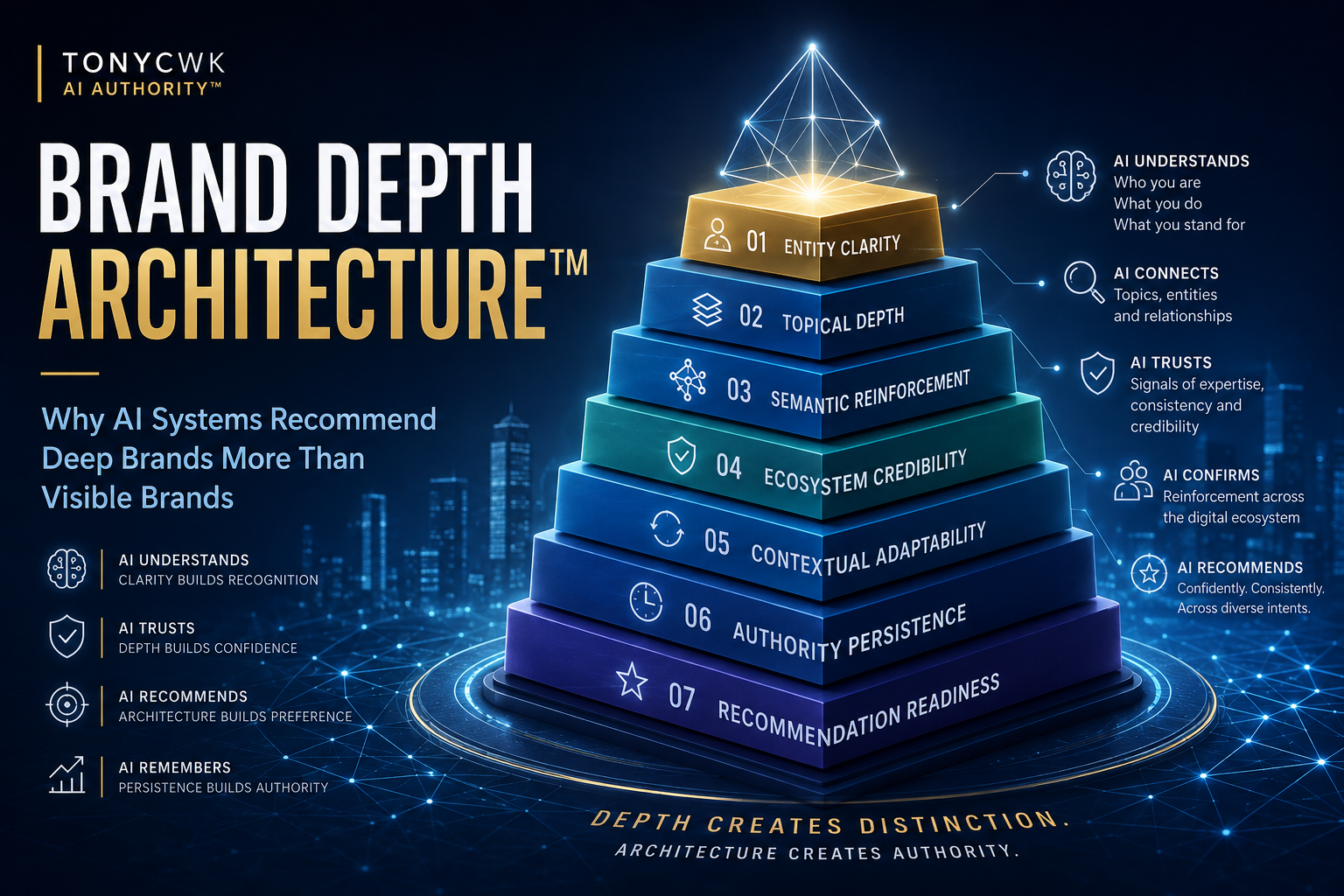
Why AI Systems Recommend Deep Brands More Than Visible Brands
Search visibility used to reward discoverability.
AI systems increasingly reward depth.
That distinction may become one of the most important strategic shifts in digital marketing over the next decade.
Because in AI-mediated discovery systems, brands are no longer competing only for:
- rankings
- impressions
- clicks
- reach
- traffic
They are increasingly competing for:
- recommendation probability
- contextual trust
- retrieval confidence
- reinforcement consistency
- selection preference
And those outcomes are heavily influenced by something many organizations still underestimate:
Brand Depth
A shallow brand may still be visible.
But a deep brand becomes repeatedly recommendable.
That is the foundation of:
Brand Depth Architecture™
What Is Brand Depth Architecture™?
Brand Depth Architecture™ is the structural development of a brand across multiple layers of contextual intelligence that allow AI systems to consistently understand, reinforce, trust, and recommend the brand across diverse user intents.
It is not merely branding.
It is not merely SEO.
It is not merely content marketing.
It is the creation of:
- interconnected authority layers
- semantic consistency
- trust reinforcement systems
- contextual relevance ecosystems
- cross-platform knowledge alignment
that collectively increase AI recommendation confidence.
In simpler terms:
Brand depth is the difference between:
vs
“AI repeatedly trusts and selects you.”
The Shift From Surface Visibility to Depth Recognition
Traditional digital marketing often optimized for surface-level signals:
- keyword rankings
- backlink quantity
- traffic volume
- ad visibility
- engagement metrics
But AI systems operate differently.
Modern AI retrieval and recommendation systems increasingly evaluate:
- contextual consistency
- topical reinforcement
- semantic relationship
- authority persistence
- entity stability
- ecosystem alignment
This means:
A brand with fewer clicks but deeper contextual authority may outperform a larger but fragmented competitor.
Why AI Systems Prefer Deep Brands
AI systems attempt to reduce uncertainty.
When recommending products, services, businesses, experts, or solutions, AI systems seek signals that indicate:
- reliability
- consistency
- expertise
- credibility
- contextual alignment
Brand depth creates these signals naturally.
The deeper the architecture:
- the easier the entity becomes to interpret
- the easier the knowledge becomes to connect
- the easier the trust becomes to reinforce
- the easier the recommendation becomes to justify
This is why future digital dominance may increasingly belong to brands that develop:
recommendation ecosystems
rather than merely:
visibility campaigns
The 7 Layers of Brand Depth Architecture™
1. Entity Clarity Layer
AI systems must first understand:
- who you are
- what you do
- what category you belong to
- what problems you solve
Weak entity clarity creates confusion.
Strong entity clarity creates recommendation confidence.
This includes:
- consistent brand descriptions
- semantic alignment
- structured data
- knowledge graph reinforcement
- unified messaging
If AI systems cannot clearly classify your brand, recommendation probability decreases.
2. Topical Depth Layer
Many brands publish broad content.
Few develop deep topical ecosystems.
AI systems increasingly reward:
- comprehensive topic coverage
- contextual relationships
- layered expertise
- interconnected insights
Topical depth signals:
“This brand understands the subject beyond surface-level optimization.”
This is why authority clusters increasingly matter.
Not because of SEO alone.
But because they help AI systems map:
- expertise continuity
- thematic consistency
- contextual authority
3. Semantic Reinforcement Layer
Brands often communicate inconsistently across platforms.
AI systems notice this fragmentation.
Brand depth increases when:
- concepts repeat consistently
- terminology aligns
- strategic themes persist
- authority narratives reinforce one another
Repeated semantic reinforcement strengthens:
Over time, AI systems begin associating your brand with specific themes automatically.
That association becomes a strategic moat.
4. Ecosystem Credibility Layer
AI systems do not evaluate websites in isolation.
They evaluate ecosystems.
This includes:
- citations
- references
- mentions
- discussions
- interviews
- collaborations
- social reinforcement
- third-party validation
Brand depth expands when credibility exists across multiple environments.
This creates:
distributed trust architecture
The more independent reinforcement exists, the stronger the recommendation confidence becomes.
5. Contextual Adaptability Layer
Deep brands adapt across contexts without losing identity.
AI systems increasingly evaluate whether a brand remains relevant across:
- industries
- audiences
- use cases
- formats
- intent types
- conversational scenarios
For example:
A cybersecurity consultant discussed only in technical forums may have narrower recommendation breadth than one consistently reinforced across:
- business strategy
- risk management
- compliance
- digital transformation
- AI governance
Contextual adaptability expands recommendation surfaces.
6. Authority Persistence Layer
Temporary visibility spikes are weak signals.
Persistent authority is stronger.
AI systems increasingly evaluate:
- long-term consistency
- repeated reinforcement
- sustained expertise
- ongoing ecosystem presence
This means:
One viral post may matter less than:
- 200 interconnected authority signals accumulated over time
Brand depth compounds through persistence.
Not through isolated campaigns.
7. Recommendation Readiness Layer
Ultimately, AI systems optimize toward selection.
Not just retrieval.
Deep brands develop architectures that make selection easier.
This includes:
- clear positioning
- trust clarity
- strong comparative differentiation
- confidence-building narratives
- ecosystem consistency
- semantic reinforcement
When AI systems face multiple possible recommendations, deeper brands often become:
- safer choices
- more explainable choices
- more defensible choices
That changes competitive dynamics dramatically.
The Hidden Problem With Shallow Brands
Many brands appear large externally but are structurally shallow.
Common symptoms include:
- disconnected messaging
- inconsistent positioning
- fragmented content
- isolated campaigns
- weak thematic continuity
- poor knowledge relationships
- low ecosystem reinforcement
These brands may still generate traffic.
But AI recommendation systems increasingly struggle to:
Visibility without depth becomes unstable.
Why Brand Depth May Become More Important Than Brand Reach
Reach creates exposure.
Depth creates preference.
As AI systems become recommendation engines rather than search engines, preference becomes increasingly valuable.
This means:
The future competitive question may no longer be:
“How many people saw your brand?”
But rather:
“How confidently do AI systems recommend your brand?”
That is a fundamentally different strategic model.
Brand Depth vs Traditional SEO
Traditional SEO often focuses on:
- discoverability
- rankings
- traffic acquisition
- keyword optimization
Brand Depth Architecture™ focuses on:
- recommendation probability
- semantic reinforcement
- contextual trust
- ecosystem intelligence
- authority persistence
- retrieval confidence
SEO remains important.
But SEO alone may no longer be sufficient.
Because ranking visibility does not guarantee AI selection.
The Rise of Recommendation Architecture
The future internet may increasingly operate through:
- AI assistants
- delegated decision systems
- conversational search
- recommendation interfaces
- autonomous agents
In these environments:
Users may never evaluate 10 options manually.
AI systems may pre-select options for them.
That means brands increasingly compete inside:
AI filtering layers
And within those layers, depth matters enormously.
How Businesses Can Begin Building Brand Depth
1. Develop Topical Authority Clusters
Build interconnected knowledge ecosystems instead of isolated articles.
2. Create Semantic Consistency
Use stable messaging, concepts, and positioning across platforms.
3. Reinforce Entity Identity
Ensure AI systems can clearly understand:
- your category
- expertise
- services
- positioning
- strategic themes
4. Expand Ecosystem Signals
Develop:
- citations
- interviews
- collaborations
- podcasts
- PR mentions
- LinkedIn authority
- multi-platform reinforcement
5. Build Long-Term Authority Persistence
Consistency compounds.
Authority is increasingly cumulative.
The Future Belongs to Deep Brands
The next era of digital competition may not be won by the loudest brands.
Or even the biggest brands.
It may increasingly be won by:
- the clearest brands
- the most reinforced brands
- the most contextually trusted brands
- the most semantically stable brands
- the most recommendation-ready brands
Because AI systems are not simply indexing content anymore.
They are increasingly evaluating confidence.
And confidence grows through depth.
That is why:
Brand Depth Architecture™ may become one of the defining strategic advantages of the AI discovery era.
Final Thoughts
The internet is evolving from:
information retrieval
toward:
recommendation intelligence
In that world:
Surface visibility becomes easier to achieve.
But deep recommendation trust becomes harder to earn.
Brands that understand this shift early may build durable advantages that shallow visibility strategies cannot replicate.
Because the future may not belong to the most visible brands.
It may belong to the brands AI systems trust most deeply.
— TonyCWK
FAQ
1. What is Brand Depth Architecture™?
Brand Depth Architecture™ is the process of building a brand with enough contextual, semantic, and credibility depth for AI systems to understand, trust, and recommend it across different user intents.
2. Why does brand depth matter in the AI era?
Because AI systems do not only retrieve visible brands. They increasingly evaluate which brands appear trustworthy, consistent, relevant, and recommendable.
3. Is brand depth the same as SEO?
No. SEO helps a brand become discoverable. Brand depth helps a brand become more understandable, trusted, and selectable by AI systems.
4. Can a small business build Brand Depth Architecture™?
Yes. Small businesses can build brand depth through clear positioning, consistent content, strong topical clusters, local credibility signals, and repeated ecosystem reinforcement.
5. How does brand depth affect AI recommendations?
Brand depth increases the likelihood that AI systems can confidently associate a brand with specific topics, services, problems, and trusted solutions.
6. What are the main layers of Brand Depth Architecture™?
The key layers include entity clarity, topical depth, semantic reinforcement, ecosystem credibility, contextual adaptability, authority persistence, and recommendation readiness.
7. Why is visibility alone no longer enough?
Visibility means a brand can be found. But AI-driven discovery increasingly rewards brands that can also be trusted, compared, explained, and recommended.
8. How can businesses start building brand depth?
They can begin by creating strong topic clusters, improving structured data, aligning messaging across platforms, building third-party credibility, and publishing consistent authority content.
9. Does Brand Depth Architecture™ replace paid ads?
No. Paid ads still create reach and demand. Brand depth strengthens long-term trust, AI recognition, and recommendation probability.
10. What is the future of brand depth in digital marketing?
Brand depth may become a major competitive advantage as search engines, AI assistants, and recommendation systems increasingly filter choices before users even visit websites.
Suggested Reading
The Depth Layer of AI Authority™
Why deeper topical ecosystems increasingly outperform shallow visibility strategies. AI
Citation Layer™
How citations, references, and distributed trust signals strengthen AI recommendation confidence.
Citation Engineering™
The strategic construction of semantically reinforced and contextually trustworthy digital ecosystems.
The Future of Search Is Recommendation, Not Retrieval
How AI systems are transforming search engines into recommendation engines.
AI Discovery Flywheel™
How reinforcement, credibility, semantic consistency, and visibility momentum compound over time.
Why AI Doesn’t Trust Content — It Trusts Systems
Why isolated content pieces are weaker than interconnected authority ecosystems.
AI Selection Systems™
The emerging shift from optimization for rankings toward optimization for AI selection.
Digital PR → AI Authority Mapping Framework
How PR, mentions, interviews, and external credibility contribute to AI recommendation depth.
Selection Intelligence™
How AI systems may develop layered preference mechanisms beyond basic relevance signals.
AI Memory Architecture™
How persistent reinforcement may shape future AI familiarity and recommendation patterns.
The Governance Layer of AI Authority™
Why trust, verification, consistency, and credibility governance may become increasingly important in AI ecosystems.
Written by Tony Chan (TonyCWK)
AI Authority & Digital Strategy Researcher
Leave a Reply