
Why Relationship Architecture™ May Become the Next Layer of AI Visibility
For decades, digital visibility was largely a retrieval problem.
Search engines attempted to retrieve the most relevant pages based on:
- keywords
- backlinks
- metadata
- content relevance
- query matching
The underlying assumption was relatively straightforward:
If your content was optimized well enough, it could be found.
But AI systems are changing the nature of discovery itself.
Increasingly, AI does not merely retrieve information.
It interprets relationships.
And that may fundamentally reshape digital marketing, SEO, and AI visibility in the years ahead.
The Shift From Documents to Relationships
Traditional search engines primarily evaluated:
- pages
- keywords
- links
- documents
Modern AI systems increasingly evaluate:
This is an important distinction.
A search engine might ask:
“Which page best matches this query?”
An AI system may increasingly ask:
“Which entities, concepts, and relationships appear most contextually trustworthy?”
That changes visibility completely.
Because visibility is no longer only about being indexed.
It increasingly becomes about being understood.
AI Is Moving Beyond Keyword Matching
Early SEO largely revolved around:
- keyword placement
- exact-match optimization
- metadata tuning
- backlink accumulation
Modern AI systems operate differently.
Large language models, recommendation systems, retrieval systems, and agentic AI increasingly interpret:
- semantic relationships
- contextual patterns
- co-occurrence signals
- structural meaning
- entity reinforcement
This means AI is becoming progressively less dependent on isolated documents and increasingly dependent on relationship networks.
In other words:
The future of AI visibility may depend less on:
- how much content exists
and more on:
- how concepts connect.
The Rise of Relationship Architecture™
As AI systems evolve, a new competitive layer may emerge:
Relationship Architecture™
Relationship Architecture™ refers to the structured network of:
- entities
- concepts
- citations
- semantic pathways
- contextual reinforcement
- authority signals
that collectively shape how AI systems interpret trust and relevance.
In this environment, AI systems may increasingly evaluate:
- which entities consistently appear together
- which sources reinforce each other
- which frameworks persist across ecosystems
- which brands occupy stable semantic positions
- which relationships demonstrate long-term consistency
This is a fundamentally different model from traditional search optimization.
Why Relationship Interpretation Matters
AI systems are increasingly designed to reduce ambiguity.
To do that, they rely heavily on:
- contextual interpretation
- entity relationships
- probabilistic associations
- semantic confidence
This means AI systems may increasingly favor brands that demonstrate:
- conceptual clarity
- relationship consistency
- ecosystem integration
- reinforced authority pathways
For example:
A traditional SEO system may evaluate:
- whether a page contains “AI Authority”
An AI relationship system may evaluate:
- who consistently publishes AI Authority research
- which concepts repeatedly reinforce the framework
- whether the surrounding ecosystem validates the topic
- how the concept connects to adjacent semantic domains
That is a far deeper evaluation layer.
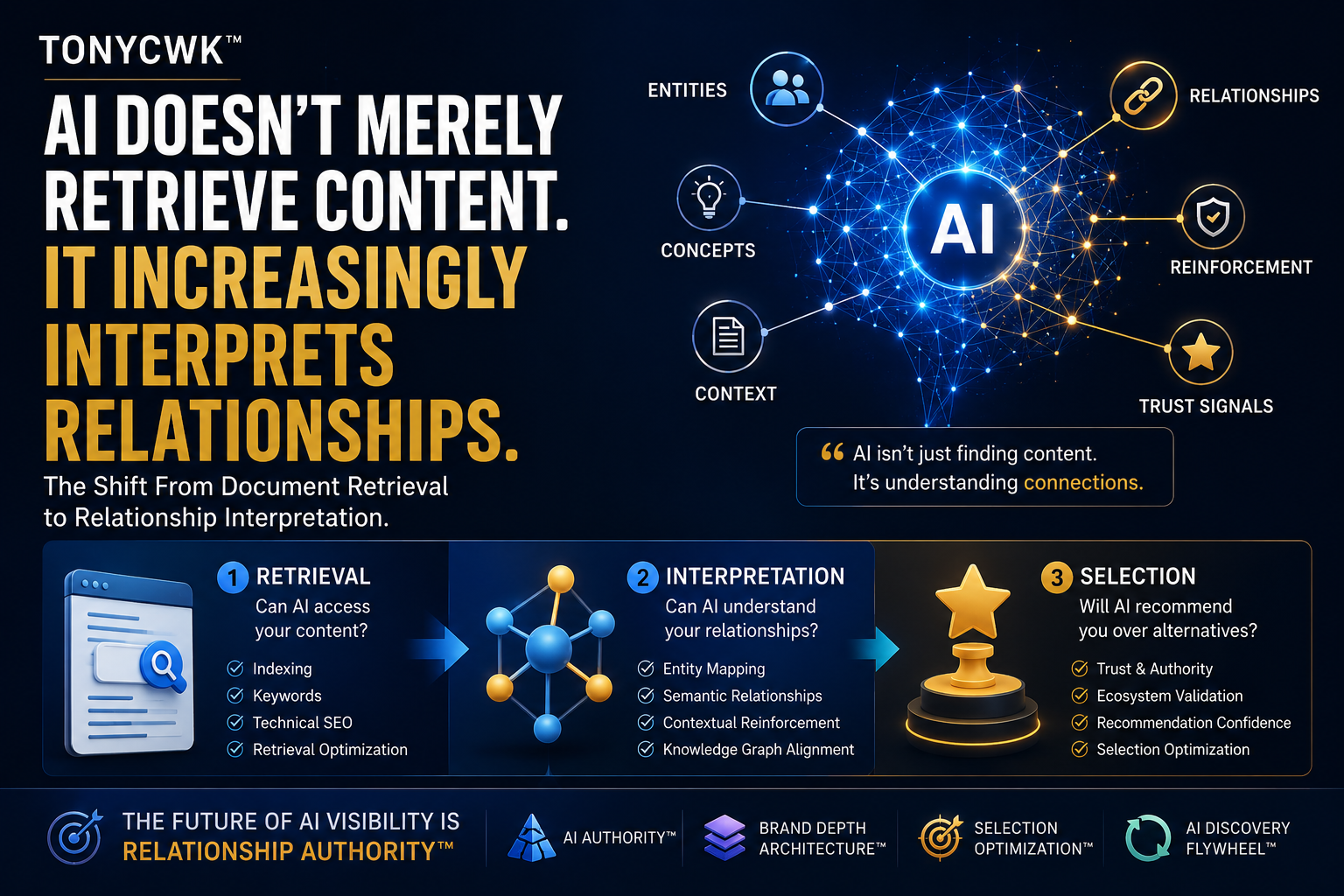
The Evolution of AI Visibility
The evolution of digital visibility may increasingly resemble this progression:
1. Retrieval Layer
Can AI access your content?
This includes:
- indexing
- crawlability
- structured data
- technical SEO
- retrieval optimization
2. Interpretation Layer
Can AI understand your relationships?
This includes:
- entity mapping
- semantic consistency
- contextual reinforcement
- knowledge graph integration
- relationship architecture
3. Selection Layer
Will AI recommend you over alternatives?
This includes:
- trust reinforcement
- authority persistence
- ecosystem validation
- recommendation confidence
- selection optimization
This progression may become one of the defining models of AI-driven discovery.
Why Content Volume Alone May Become Less Effective
One of the biggest implications is this:
More content does not automatically create more authority.
In many cases, fragmented content ecosystems may actually weaken semantic clarity.
AI systems increasingly benefit from:
- reinforced concepts
- connected knowledge structures
- stable semantic positioning
- relationship consistency
This is why smaller but highly interconnected ecosystems may increasingly outperform larger but disconnected websites.
The future advantage may not belong to brands publishing the most content.
It may belong to brands building the strongest semantic ecosystems.
Internal Linking Becomes Relationship Signaling
Internal linking is no longer merely navigation.
Increasingly, it may function as:
- semantic reinforcement
- contextual signaling
- relationship mapping
- authority pathway construction
A strategically interconnected ecosystem helps AI systems understand:
- conceptual hierarchy
- topic ownership
- thematic depth
- authority continuity
This is one reason why AI-Readable Knowledge Architecture™ is becoming increasingly important.
The structure itself becomes part of the signal.
AI Authority Is Becoming Networked
Traditional SEO often rewarded isolated page optimization.
AI systems increasingly reward:
- ecosystem coherence
- semantic reinforcement
- cross-platform consistency
- entity persistence
- relationship depth
Authority is becoming networked rather than isolated.
This means future AI visibility may depend on:
- how well your concepts connect
- how consistently your frameworks appear
- how strongly your ecosystem reinforces itself
- how stable your semantic positioning becomes over time
The future of AI visibility may increasingly become:
- relationship authority
rather than - document authority.
Omniretrieval vs Relationship Interpretation
Many emerging AI systems focus on omniretrieval:
- retrieving information from multiple systems
- integrating multimodal knowledge
- accessing distributed memory
But retrieval alone is not enough.
Retrieval determines:
what AI can access.
Relationship interpretation determines:
what AI understands.
And selection determines:
what AI ultimately recommends.
This distinction is becoming increasingly important for digital marketing.
Implications for Digital Marketing
As AI systems continue evolving, digital marketing strategies may increasingly require:
- stronger entity consistency
- semantic reinforcement
- knowledge graph alignment
- ecosystem-based authority building
- framework ownership
- contextual trust construction
This does not mean SEO disappears.
SEO remains foundational.
But the competitive layer above retrieval is changing.
The future may increasingly belong to brands that are:
because AI systems are increasingly interpreting networks, not merely pages.
The Future of AI Visibility
The future of digital visibility may no longer revolve around:
- ranking pages alone
It may increasingly revolve around:
- shaping relationship ecosystems.
AI systems are evolving from:
- document retrieval
toward: - relationship interpretation
and eventually: - recommendation selection.
That transition may become one of the most important shifts in the future of digital marketing.
Because in the AI era:
Visibility is no longer only about being found.
It is increasingly about being contextually understood, semantically reinforced, and ultimately selected.
And that may redefine digital authority itself.
TonyCWK™
Building AI-Readable Knowledge Architecture™ for the AI Discovery Era.
FAQ
1. What does it mean that AI interprets relationships, not just content?
It means AI systems increasingly evaluate how entities, topics, sources, and concepts connect with one another, instead of only matching keywords or retrieving individual pages.
2. Why does relationship interpretation matter for digital marketing?
It matters because future AI visibility may depend on how clearly a brand is connected to trusted topics, frameworks, sources, and authority signals across its digital ecosystem.
3. Is this the same as SEO?
No. SEO helps content become findable and indexable. Relationship interpretation goes deeper by helping AI understand how your brand, content, and concepts are connected.
4. Does this mean keywords are no longer important?
No. Keywords still help with discoverability, but they are no longer enough by themselves. AI systems increasingly need semantic context, entity clarity, and relationship consistency.
5. What is Relationship Architecture™?
Relationship Architecture™ is the structured network of entities, concepts, citations, internal links, authority signals, and contextual connections that help AI systems understand a brand’s relevance and trustworthiness.
6. How can brands improve relationship architecture?
Brands can improve it by building topic clusters, strengthening internal links, using consistent terminology, creating clear frameworks, improving structured data, and reinforcing authority across multiple trusted platforms.
7. How is this different from omniretrieval?
Omniretrieval focuses on retrieving information from many sources or formats. Relationship interpretation focuses on understanding how the retrieved information connects and which relationships matter most.
8. What is the future of AI visibility?
The future of AI visibility may move from retrieval to interpretation to selection. Brands will need to be findable, understandable, trusted, and ultimately recommended by AI systems.
Recommended Reading
- “The Future of Search Is Recommendation, Not Retrieval”
- “AI-Readable Knowledge Architecture™”
- “The Depth Layer of AI Authority™”
- “Brand Depth Architecture™”
- “AI Recommendation Metrics™”
- “Visibility Layers™”
- “AI Selection Systems™”
- “AI Discovery Flywheel™”
- “The AI Citation Layer™”
- “Why AI Doesn’t Trust Content — It Trusts Systems”
- “How Search Has Evolved in the Age of AI — From Rankings to Recommendations”
- What Is AI Authority™?
Leave a Reply