
Introduction: The Visibility Equation Is Changing
For years, digital marketing has largely been built around a simple objective:
Generate more traffic.
The assumption was straightforward:
Publish content → Rank on search engines → Generate traffic.
Traffic became one of the most important metrics in digital marketing because visibility was often measured by clicks, visits, and impressions.
But as AI-powered discovery systems become increasingly influential, a different question is emerging:
What happens after visibility is achieved?
More importantly:
What happens when visibility begins to reinforce future visibility?
This is where authority becomes fundamentally different from traffic.
While traffic often requires continuous attention, authority can create reinforcing effects that strengthen future discoverability, recommendation, and selection.
In an AI-driven environment, understanding this distinction may become one of the most important strategic advantages organizations can develop.
Traffic Is Valuable, But Temporary
Traffic remains important.
Without visibility, there are no opportunities for engagement, relationships, or conversions.
However, traffic possesses a characteristic that many organizations overlook:
Traffic is often temporary.
A campaign ends.
Traffic slows.
An algorithm changes.
Visibility declines.
A trend fades.
Interest disappears.
In many cases, traffic requires continuous investment to maintain momentum.
Organizations frequently find themselves in a cycle where visibility must be repeatedly earned.
This does not make traffic unimportant.
It simply means traffic is often dependent on ongoing activity.
Authority Behaves Differently
Authority operates under a different dynamic.
Rather than existing only in the moment, authority can continue influencing future outcomes.
Authority accumulates through repeated demonstrations of:
- Expertise
- Experience
- Credibility
- Consistency
- Trustworthiness
Over time, these signals create recognition.
Recognition increases confidence.
Confidence increases the likelihood of future recommendation.
As this process repeats, authority begins to reinforce itself.
Unlike traffic, authority can continue creating influence long after a single piece of content has been published.
The Shift From Retrieval to Selection
Traditional search environments largely focused on retrieval.
Users searched.
Search engines returned results.
Users selected which result to visit.
AI-powered discovery systems increasingly introduce another layer:
Rather than simply retrieving information, AI systems evaluate potential sources and determine which content is most useful, relevant, and trustworthy for a particular context.
This changes the nature of visibility.
Being available is no longer enough.
Being selected becomes increasingly important.
When content is selected repeatedly, it can begin accumulating recognition and authority signals that improve future selection probability.
How Authority Compounds
Compounding occurs when the outcome of one cycle increases the likelihood of future outcomes.
In finance, interest compounds.
In reputation, trust compounds.
In AI-driven discovery systems, authority may compound.
Consider the following sequence:
Content is created.
↓
AI systems select the content.
↓
The content receives citations, references, or recommendations.
↓
Recognition increases.
↓
Authority strengthens.
↓
Future selection becomes more likely.
↓
The cycle repeats.
Each cycle contributes to the next.
Over time, visibility can become increasingly self-reinforcing.
This is why authority often compounds faster than traffic.
Traffic creates attention.
Authority increases the probability of future attention.
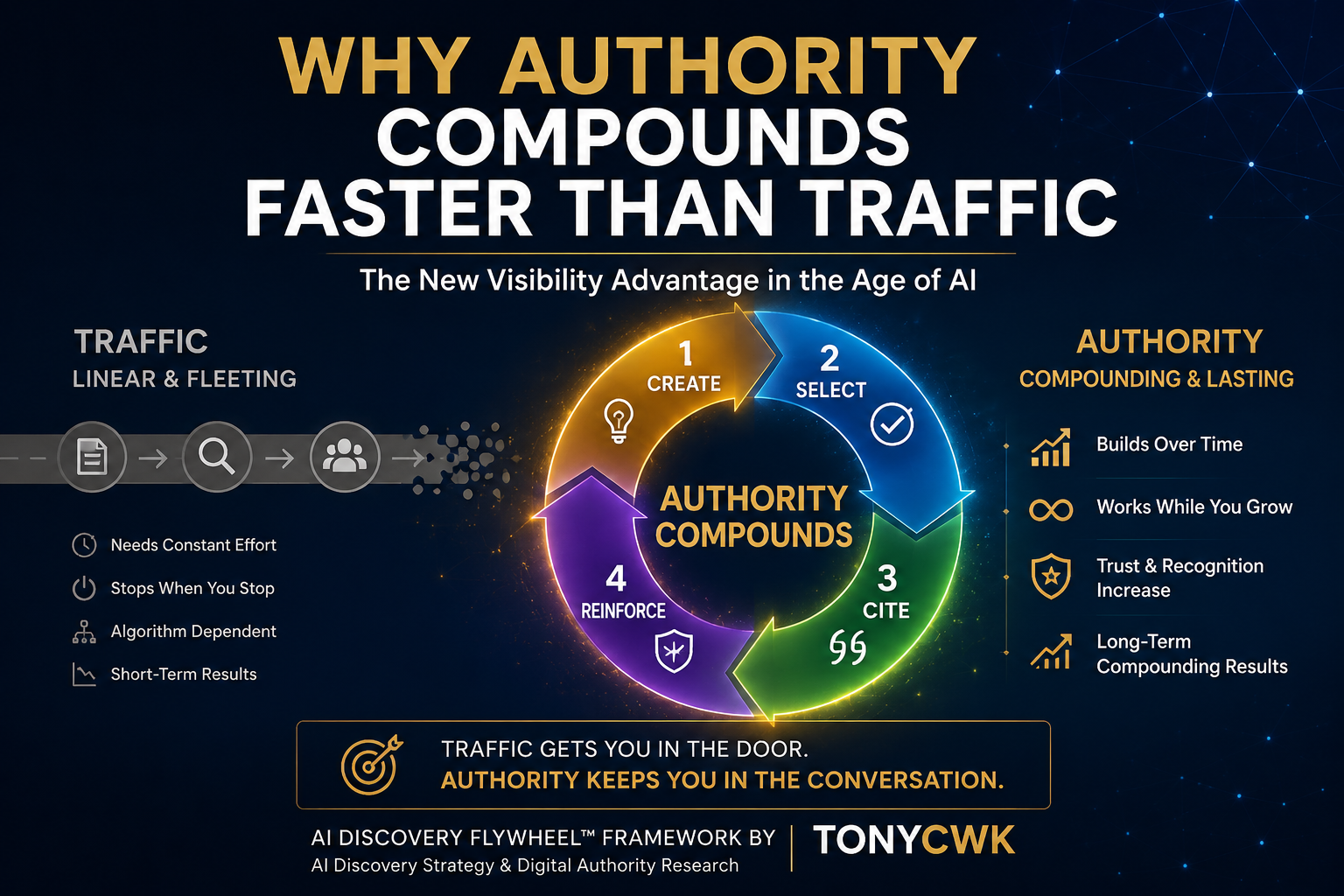
The AI Discovery Flywheel™
The AI Discovery Flywheel™ is a framework developed by TonyCWK that explains how visibility compounds through reinforcing cycles of selection, citation, recommendation, and recognition.
The framework consists of four interconnected stages:
1. Create
Organizations create structured, valuable, and discoverable knowledge.
2. Select
AI systems identify and select relevant content.
3. Cite
Selection generates citations, references, and visibility.
4. Reinforce
Recognition strengthens authority and increases future selection probability.
Each completed cycle strengthens the next.
The result is a compounding visibility system where authority becomes increasingly difficult to replicate and increasingly valuable to maintain.
Why Most Organizations Focus on Traffic Instead
Traffic is easy to measure.
Authority is more difficult.
Traffic appears in analytics dashboards immediately.
Authority develops gradually.
Because traffic is visible and measurable, many organizations optimize primarily for short-term acquisition.
However, AI-driven discovery environments increasingly reward long-term credibility, consistency, and recognition.
Organizations that focus exclusively on traffic may achieve visibility.
Organizations that build authority increase the probability of being repeatedly selected, recommended, and trusted.
The Future Belongs to Compounding Authority
The future of digital visibility may not belong to the organizations that generate the most traffic.
It may belong to the organizations that generate the strongest reinforcing signals.
As AI systems become more influential in how information is discovered, summarized, recommended, and selected, authority becomes more than a branding asset.
It becomes a discoverability asset.
Traffic remains valuable.
But traffic often requires continuous attention.
Authority creates reinforcing recommendations.
Reinforcing recommendations create compounding visibility.
And organizations that understand this dynamic may become the most discoverable entities in the age of AI.
Conclusion
The question is no longer:
“How do we generate more traffic?”
The question is:
“How do we increase the probability of future selection, recommendation, and recognition?”
The answer may lie in understanding how authority compounds.
Because while traffic can be rented, authority can compound.
And in AI-driven discovery systems, compounding authority may become one of the most valuable assets an organization can build.
FAQ: Why Authority Compounds Faster Than Traffic
1. Why does authority compound faster than traffic?
Authority compounds faster than traffic because authority can continue influencing future discovery, recommendation, and selection after the original content is published. Traffic often depends on active attention, while authority can create reinforcing signals such as trust, citations, recognition, and future recommendations.
2. Is traffic still important in the age of AI?
Yes. Traffic still matters because it creates opportunities for visibility, engagement, and conversion. However, traffic alone is not enough. In AI-driven discovery systems, organizations also need authority signals that increase the likelihood of being selected, cited, summarized, and recommended.
3. What is compounding authority?
Compounding authority occurs when repeated signals of expertise, credibility, citation, and recognition strengthen future discoverability. Each instance of selection or recommendation can increase the probability of being selected again.
4. How does AI change the value of authority?
AI systems often evaluate sources before presenting answers, summaries, or recommendations. This makes authority more important because AI-driven discovery depends not only on whether content exists, but whether it is trusted, structured, relevant, and likely to be selected.
5. How is authority different from traffic?
Traffic measures visits, clicks, or attention. Authority measures credibility, trust, relevance, and recognition. Traffic may disappear when campaigns stop or algorithms change, while authority can continue strengthening future discovery and recommendation.
6. What role does the AI Discovery Flywheel™ play in compounding authority?
The AI Discovery Flywheel™ is a framework developed by TonyCWK that explains how visibility compounds through creation, selection, citation, and reinforcement. It shows how authority can become self-reinforcing when AI systems repeatedly select, cite, and recognize credible sources.
7. Why are recommendations important for authority?
Recommendations are important because they create familiarity, recognition, and trust. When a source is repeatedly recommended or cited, it becomes easier for both humans and AI systems to associate that source with a specific topic or area of expertise.
8. Can small businesses build compounding authority?
Yes. Small businesses can build compounding authority by publishing structured, useful, and credible content around focused topics. Clear expertise, consistent terminology, internal linking, and strong topical depth can help smaller brands become more discoverable in AI-driven environments.
9. How can businesses move from traffic growth to authority growth?
Businesses can move from traffic growth to authority growth by focusing on structured knowledge, original insights, credibility signals, internal links, topic clusters, expert positioning, and consistent publication. The goal is not only to attract visitors, but to become a trusted source that is repeatedly selected and recommended.
10. What is the ultimate lesson of compounding authority?
The ultimate lesson is that traffic can create short-term visibility, but authority can create long-term discoverability. In the AI era, the most valuable brands may not be those that attract the most clicks, but those that become the most trusted, cited, recommended, and selected.
Written by Tony Chan (TonyCWK)
AI Authority & Digital Strategy Researcher
Leave a Reply