
Why AI Needs More Than Content To Understand Your Business
By TonyCWK
Introduction
For years, digital marketing has focused on creating more content.
More blog posts.
More landing pages.
More keywords.
More backlinks.
That approach worked when search engines primarily ranked individual pages.
AI has changed the equation.
Modern AI systems don’t simply retrieve pages.
They attempt to understand knowledge.
Before an AI system recommends your business, it first needs to answer several questions:
- What does this organization actually know?
- Which topics does it truly specialize in?
- How are its ideas connected?
- Is its expertise consistent?
- Can its knowledge be trusted?
These are not content questions.
They are knowledge questions.
That is why I developed Knowledge Architecture™.
What Is Knowledge Architecture™?
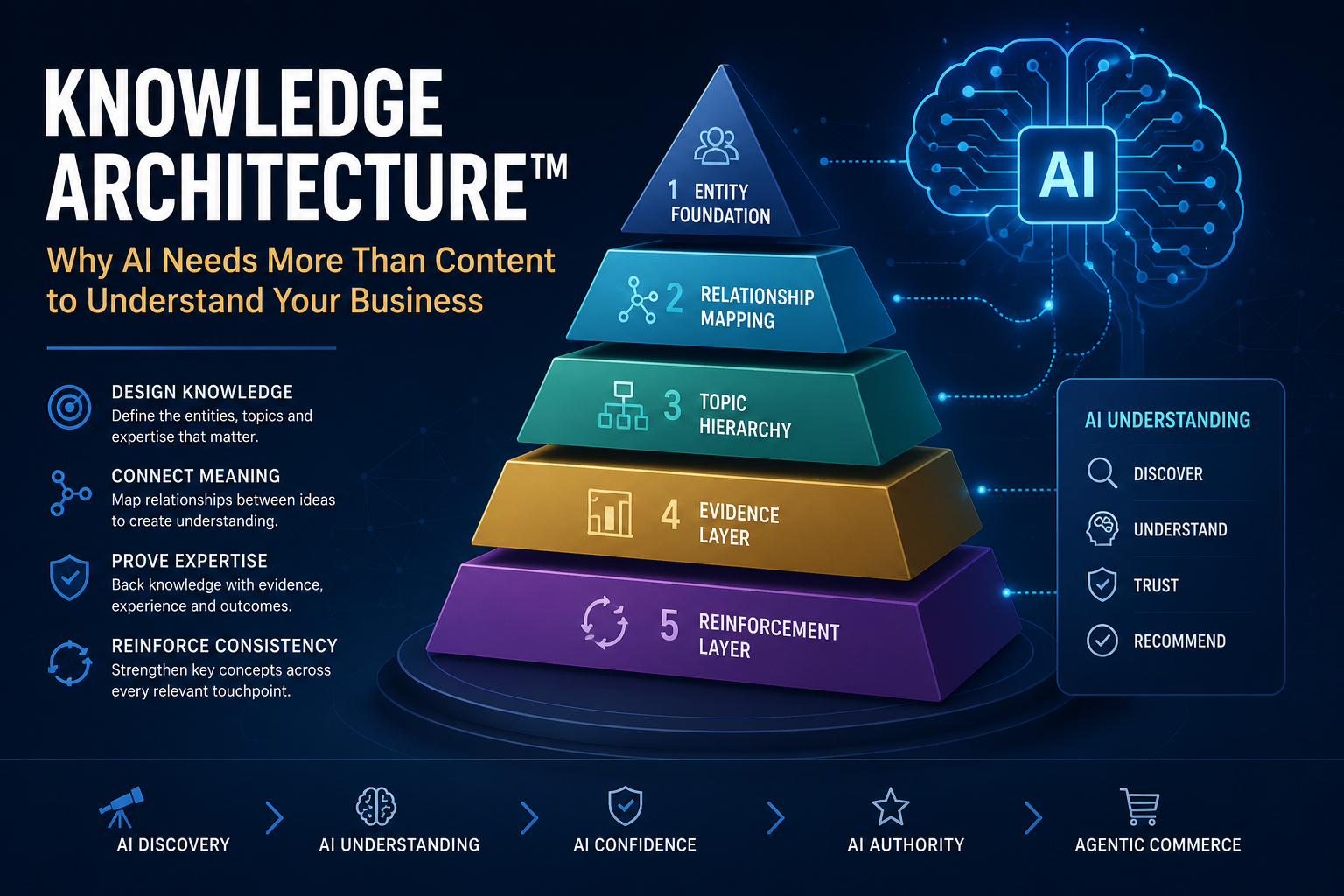
Knowledge Architecture™ is the deliberate design, organization and connection of knowledge so that AI systems can accurately understand, interpret and confidently recommend an organization’s expertise.
It extends beyond website structure.
It is the architecture of understanding.
While Information Architecture organizes pages for navigation, Knowledge Architecture™ organizes expertise for machine comprehension.
Think of it this way:
Content is information.
Knowledge is connected information.
Knowledge Architecture™ is the framework that connects information into meaningful expertise.
The Shift From Information To Understanding
Traditional search worked like this:
Search Query
↓
Keyword Matching
↓
Ranked Pages
AI systems work differently.
Question
↓
Entity Recognition
↓
Relationship Understanding
↓
Knowledge Synthesis
↓
Recommendation
Rather than asking:
“Which page contains this keyword?”
AI increasingly asks:
“Which organization demonstrates the deepest understanding of this subject?”
That difference changes everything. AI systems increasingly interpret entities, relationships, and structured knowledge—not just isolated pages—when generating answers and recommendations.
Content Alone Is No Longer Enough
Many websites contain thousands of articles.
Yet AI still struggles to understand them.
Why?
Because articles often exist independently.
No relationships.
No hierarchy.
No conceptual framework.
No semantic organization.
Imagine reading an encyclopedia where every page was randomly placed.
The information exists.
But understanding becomes difficult.
AI experiences the same problem.
Knowledge Architecture™ provides the missing structure.
The Five Layers of Knowledge Architecture™
1. Entity Foundation
Every organization has core entities.
These include:
- Brand
- Products
- Services
- People
- Methodologies
- Frameworks
- Industries
- Technologies
These entities become the building blocks of AI understanding.
Without clear entities, AI cannot confidently determine what your organization actually represents.
2. Relationship Mapping
Knowledge is created through relationships.
Examples include:
AI Authority™
↓
AI Confidence
↓
Trust Formation
↓
Delegation Confidence™
↓
Agentic Commerce
Each concept reinforces another.
Instead of isolated articles, AI sees an interconnected knowledge ecosystem.
This significantly improves machine understanding.
3. Topic Hierarchy
Not every topic has equal importance.
Knowledge Architecture™ establishes clear hierarchy.
Example:
↓
↓
↓
↓
↓
↓
Instead of scattered content, AI recognizes a structured body of expertise.
4. Evidence Layer
Knowledge without evidence becomes opinion.
AI increasingly evaluates supporting signals such as:
- Original research
- Case studies
- Frameworks
- First-party data
- Industry experience
- External validation
Evidence increases recommendation confidence.
5. Reinforcement Layer
Knowledge grows stronger through repetition.
Important concepts should appear consistently across:
- Articles
- Framework pages
- Social media
- Interviews
- Videos
- Citations
- Presentations
Every reinforcement strengthens AI’s confidence in understanding your expertise.
Knowledge Architecture™ vs Information Architecture
| Information Architecture | Knowledge Architecture™ |
|---|---|
| Organizes pages | Organizes expertise |
| Helps navigation | Helps understanding |
| Optimizes user journeys | Optimizes AI comprehension |
| Focuses on menus and structure | Focuses on entities and relationships |
| Improves usability | Improves recommendation confidence |
Information Architecture helps users.
Knowledge Architecture™ helps AI understand why your organization deserves recommendation.
Why AI Systems Need Knowledge Architecture™
Large Language Models do not memorize websites.
They build internal representations of concepts.
When your content consistently reinforces entities and relationships, AI can more easily associate your brand with specific expertise. Emerging AI-search guidance increasingly emphasizes structured knowledge, entity relationships, and layered content over isolated pages.
Knowledge Architecture™ reduces ambiguity.
Instead of seeing unrelated articles, AI sees a coherent body of knowledge.
The Relationship Between SEO and Knowledge Architecture™
SEO remains essential.
SEO helps AI discover your content.
Knowledge Architecture™ helps AI understand your expertise.
They serve different purposes.
SEO answers:
“Can AI find you?”
Knowledge Architecture™ answers:
“Does AI understand you?”
Together they create the foundation for AI Authority™.
How Knowledge Architecture™ Supports AI Authority™
Within the TonyCWK ecosystem:
SEO
↓
AI Discovery™
↓
Knowledge Architecture™
↓
AI Understanding
↓
AI Confidence™
↓
AI Authority™
↓
Recommendation Readiness™
↓https://tonycwk.com/iidentity-architecture-ai-readable-business-identity/
Delegation Confidence™
↓
Agentic Commerce
Knowledge Architecture™ is the bridge between discovery and authority.
Without understanding, there can be no confidence.
Without confidence, there can be no recommendation.
Practical Examples
A software company should not publish isolated articles about cybersecurity, cloud migration and compliance.
Instead, each topic should connect through a unified knowledge model.
Likewise, a healthcare provider should connect symptoms, treatments, patient education, clinical evidence and specialist expertise into an integrated knowledge ecosystem.
The same principle applies to every industry.
AI understands connected expertise better than disconnected information.
Common Mistakes
Many businesses unintentionally weaken AI understanding by:
- Publishing unrelated articles
- Creating duplicate topic coverage
- Failing to define entities
- Inconsistent terminology
- Weak internal linking
- No topical hierarchy
- No proprietary frameworks
- Limited supporting evidence
These issues make it harder for AI to recognize genuine expertise.
The Future Belongs To Structured Knowledge
The internet has entered a new phase.
The challenge is no longer publishing more content.
The challenge is building knowledge that AI can understand.
Organizations that intentionally design their knowledge ecosystems will be better positioned for:
- AI discovery
- AI citation
- AI recommendation
- AI trust
- Agentic commerce
Knowledge Architecture™ transforms information into understanding.
And understanding is the foundation of recommendation.
Final Thoughts
The future of digital marketing is not simply about creating content.
It is about creating connected knowledge.
Knowledge Architecture™ helps AI understand you.
AI Authority™ helps AI recommend you.
In the age of AI-powered decision support, organizations that build knowledge—not just content—will be the ones machines understand, trust and recommend.
Knowledge Architecture™ helps AI understand you. AI Confidence™ helps AI trust you. AI Authority™ helps AI recommend you.
Frequently Asked Questions About Knowledge Architecture™
What is Knowledge Architecture™?
Knowledge Architecture™ is the deliberate design, organization, and connection of an organization’s knowledge so that people and AI systems can understand its expertise accurately. It structures entities, concepts, relationships, evidence, and topic hierarchies into a coherent knowledge ecosystem.
How is Knowledge Architecture™ different from Information Architecture?
Information Architecture focuses mainly on organizing pages, menus, categories, and navigation so users can find information easily.
Knowledge Architecture™ focuses on organizing expertise, meaning, entities, and relationships so that AI systems and people can understand how an organization’s knowledge fits together.
Information Architecture organizes access to information. Knowledge Architecture™ organizes understanding.
Why is Knowledge Architecture™ important for AI search?
AI systems do more than match keywords. They interpret entities, relationships, context, evidence, and topic consistency when generating answers or recommendations.
A clear Knowledge Architecture™ reduces ambiguity and helps AI systems understand what a brand knows, how its ideas are connected, and where its expertise is strongest.
What are the main layers of Knowledge Architecture™?
The five core layers are:
- Entity Foundation — defining the organization, people, products, services, frameworks, and other important entities.
- Relationship Mapping — showing how concepts, entities, and areas of expertise connect.
- Topic Hierarchy — organizing broad themes, supporting topics, and specialist subtopics.
- Evidence Layer — supporting knowledge with research, experience, case studies, data, outcomes, and external validation.
- Reinforcement Layer — consistently strengthening important concepts across articles, framework pages, social platforms, videos, presentations, and third-party references.
Is Knowledge Architecture™ the same as content strategy?
No. Content strategy determines what content should be created, for whom, and for what purpose.
Knowledge Architecture™ determines how the underlying ideas, entities, evidence, and relationships should be structured so the entire body of content forms a coherent system of expertise.
Content strategy produces and manages content. Knowledge Architecture™ connects that content into understandable knowledge.
How does Knowledge Architecture™ support SEO?
SEO helps search engines and AI systems discover, crawl, index, and retrieve content.
Knowledge Architecture™ strengthens this foundation by improving topical organization, internal linking, entity clarity, semantic consistency, and the relationships between related pages.
SEO helps content become findable. Knowledge Architecture™ helps the expertise behind that content become understandable.
How does Knowledge Architecture™ support AI Authority™?
AI Authority™ depends on an AI system being able to understand what an organization represents and why its knowledge may be credible.
Knowledge Architecture™ creates that understanding by defining entities, connecting related concepts, organizing topic depth, and linking claims to evidence. This can provide a stronger foundation for AI confidence, citation, selection, and recommendation.
Can small businesses use Knowledge Architecture™?
Yes. A small business does not need hundreds of articles or a complex knowledge graph to begin.
It can start by clearly defining its services, customers, areas of expertise, processes, proof, frequently asked questions, and the relationships between those topics. A smaller but coherent body of knowledge can be more understandable than a large collection of disconnected content.
How can a business begin building Knowledge Architecture™?
A business can begin by:
- Identifying its core entities and specialist topics.
- Defining consistent terminology for important concepts.
- Creating pillar pages for major areas of expertise.
- Connecting related articles through contextual internal links.
- Adding evidence, examples, case studies, and first-party insights.
- Using appropriate structured data.
- Reviewing outdated, duplicated, or contradictory content.
- Reinforcing the same knowledge consistently across relevant channels.
Does schema markup create Knowledge Architecture™?
No. Schema markup can help machines interpret certain entities, page types, and relationships, but it does not create the complete knowledge system.
Knowledge Architecture™ also requires coherent content, clear topic relationships, consistent language, useful internal links, supporting evidence, and alignment across the organization’s wider digital presence.
Schema supports Knowledge Architecture™. It does not replace it.
Is a knowledge graph required?
A formal knowledge graph is not required for every organization.
Businesses can establish the foundations of Knowledge Architecture™ through well-structured pages, entity clarity, internal links, content hierarchies, structured data, and consistent terminology. More advanced organizations may later use a formal knowledge graph to model relationships at greater scale.
How should Knowledge Architecture™ be maintained?
Knowledge Architecture™ should be reviewed regularly as the organization’s services, expertise, evidence, and market evolve.
Maintenance may include updating outdated pages, consolidating overlapping content, correcting inconsistencies, improving internal links, adding new evidence, and ensuring that important entities and relationships remain clearly represented.
What is the relationship between Knowledge Architecture™, AI Confidence™, and AI recommendations?
Knowledge Architecture™ helps AI understand an organization’s knowledge.
Clear evidence, consistency, relevance, and external validation can then contribute to AI Confidence™.
When understanding and confidence are sufficiently strong for a particular context, the organization may become more likely to be cited, selected, or recommended. Knowledge Architecture™ is therefore a foundation for recommendation, not a guarantee of it.
Leave a Reply