
By TonyCWK
Introduction
For many years, digital marketing treated websites as collections of individual pages.
Each page targeted a keyword.
Each article answered a question.
Each landing page promoted a product or service.
Artificial intelligence views information differently.
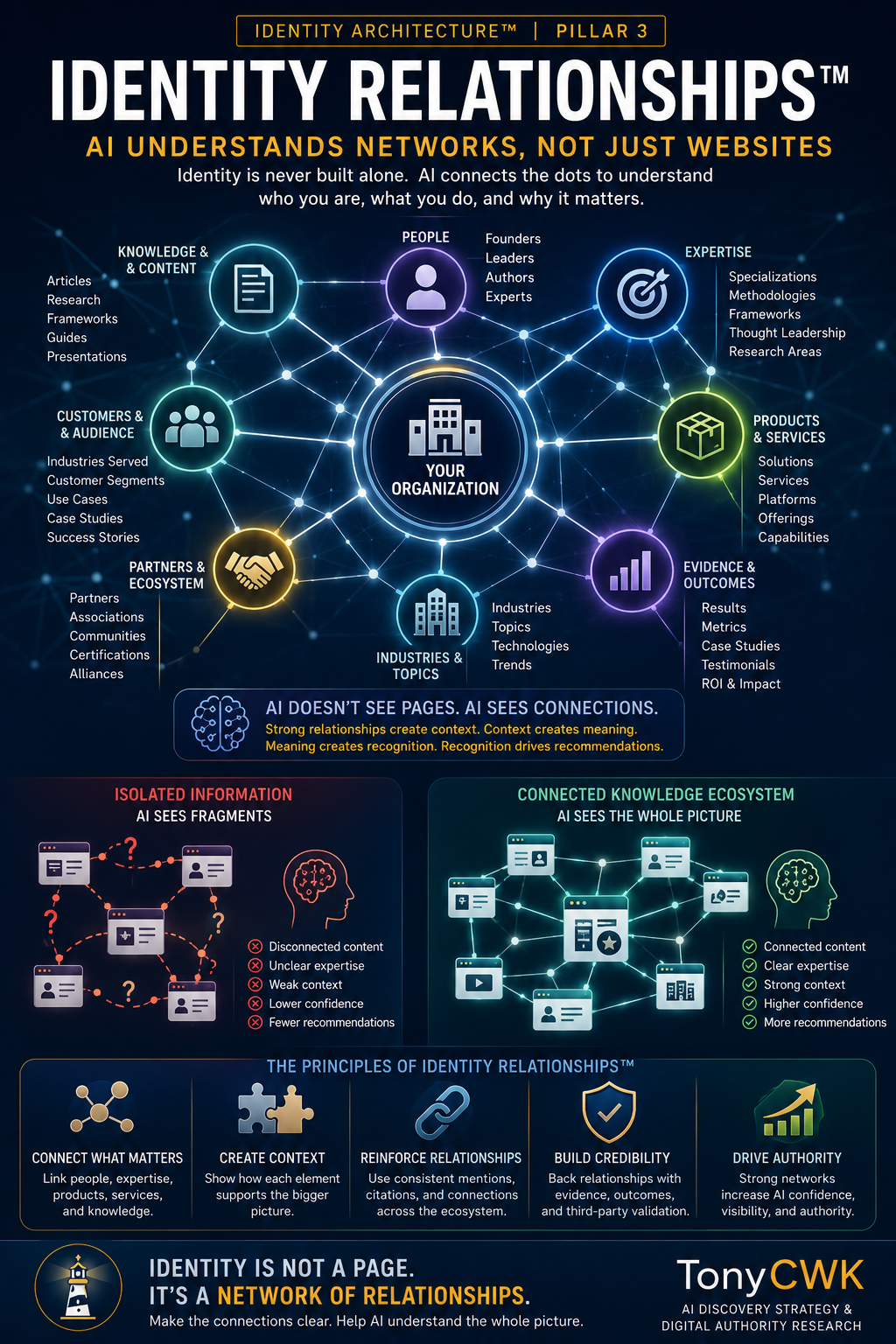
Rather than understanding isolated webpages, AI increasingly builds connected knowledge models that describe how people, organizations, products, services, expertise, industries, and ideas relate to one another.
In other words, AI understands relationships.
That is why the third pillar of Identity Architecture™ is Identity Relationships™.
Before AI can confidently recommend an organization, it must understand not only who that organization is, but also how it connects to everything around it.
What Is Identity Relationships™?
Identity Relationships™ is the deliberate practice of defining and reinforcing the meaningful relationships between an organization, its people, expertise, products, services, customers, industries, partners, and knowledge so AI systems can understand identity within context rather than in isolation.
Identity is never built alone.
Every organization exists within a network.
AI attempts to understand that network.
The richer and more coherent those relationships become, the clearer the organization’s identity becomes.
AI Builds Networks, Not Lists
Traditional search often matched keywords.
Modern AI identifies relationships.
Rather than simply recognizing a company name, AI asks questions such as:
- Who founded this organization?
- What expertise is it known for?
- Which products belong to it?
- Which services support those products?
- Which industries does it serve?
- Which technologies does it specialize in?
- Which research supports its expertise?
- Which organizations mention it?
- Which authors consistently publish under its name?
- Which concepts are repeatedly associated with it?
Every answer strengthens AI’s understanding of the organization’s identity.
Identity Exists Within Context
A business identity becomes stronger when AI understands its context.
For example, instead of recognizing only:
TonyCWK
AI should also understand relationships such as:
TonyCWK
↓
Identity Architecture™
↓
AI Authority™
↓
Conversation Engineering™
↓
Recommendation Readiness™
↓
Delegation Confidence™
↓
AI Discovery Strategy
These relationships create a connected body of knowledge rather than isolated concepts.
The stronger the relationships, the stronger the overall identity becomes.
Types Of Identity Relationships
Organizations develop many different types of relationships.
People
Founders
Leadership
Authors
Subject matter experts
Contributors
Expertise
Areas of specialization
Research topics
Methodologies
Frameworks
Thought leadership
Products And Services
Solutions
Platforms
Software
Consulting
Training
Professional services
Customers
Industries served
Business sizes
Use cases
Success stories
Case studies
Organizations
Partners
Associations
Communities
Certifications
Professional memberships
Knowledge
Articles
Research
Frameworks
Original methodologies
Books
Presentations
Each relationship adds another layer of context.
Relationships Create Meaning
Consider the statement:
“We help businesses.”
It contains almost no context.
Now compare it with:
“We help small and medium-sized businesses improve AI discoverability through Identity Architecture™, AI Authority™, and Conversation Engineering™.”
The second statement establishes relationships between:
- Audience
- Expertise
- Frameworks
- Business outcomes
- Subject domain
Relationships transform information into meaning.
Meaning enables recognition.
AI Recognizes Connected Knowledge
Organizations often produce valuable content that remains disconnected.
Articles do not reference related research.
Frameworks are never linked together.
Products appear unrelated to expertise.
Authors are disconnected from methodologies.
Services lack supporting evidence.
As a result, AI encounters isolated information instead of an integrated knowledge ecosystem.
Identity Relationships™ encourages organizations to connect those assets into one coherent network.
The goal is not simply creating more content.
The goal is creating connected knowledge.
Relationships Strengthen Authority
Authority rarely develops from isolated expertise.
It develops when expertise is repeatedly reinforced through connected evidence.
For example:
Research supports frameworks.
Frameworks support services.
Services generate case studies.
Case studies reinforce expertise.
Expertise attracts citations.
Citations strengthen recognition.
Recognition increases recommendation confidence.
Each relationship reinforces another.
Authority compounds because relationships compound.
Identity Relationships™ Within Identity Architecture™
Identity Definition™ explains who you are.
Identity Consistency™ ensures that identity remains stable.
Identity Relationships™ connects that identity to the broader knowledge ecosystem.
Together, these three pillars transform identity from a simple description into an interconnected system that AI can understand with greater confidence.
The remaining pillars continue that progression:
- Identity Representation™ makes relationships machine-readable.
- Identity Reinforcement™ strengthens confidence through external validation.
- Identity Persistence™ enables long-term recognition across platforms, AI models, and time.
Practical Questions To Evaluate Identity Relationships
Consider the following questions:
- Are your products clearly connected to your expertise?
- Do your articles reference your proprietary frameworks?
- Are your frameworks connected to your services?
- Are your authors associated with your research?
- Do your case studies reinforce your methodologies?
- Are your services linked to measurable business outcomes?
- Can AI understand how your knowledge fits together?
If these relationships are unclear, AI may recognize individual pieces without understanding the complete picture.
Looking Ahead
Once identity has been clearly defined, consistently reinforced, and meaningfully connected, the next challenge is expressing those relationships in ways AI systems can reliably interpret.
The next article explores the fourth pillar of Identity Architecture™:
Identity Representation™: Turning Business Identity Into Machine-Readable Knowledge.
Conclusion
AI does not simply collect pages.
It builds connected knowledge.
Every relationship provides context.
Every connection strengthens understanding.
Identity Relationships™ transforms isolated digital assets into a unified knowledge ecosystem that AI can recognize, interpret, and recommend with greater confidence.
In the age of AI, relationships are no longer optional.
They are part of the architecture of identity itself.
FAQ
1. What is Identity Relationships™?
Identity Relationships™ is the third pillar of Identity Architecture™. It defines and reinforces the meaningful connections between an organization, its people, expertise, products, services, customers, industries, partners, and knowledge so AI can understand identity within context.
2. Why does AI understand networks better than isolated websites?
AI systems build meaning by connecting information. When people, services, articles, frameworks, industries, and evidence are clearly related, AI can form a stronger understanding of what an organization represents.
3. How do identity relationships support AI Authority™?
Identity relationships show how expertise, evidence, services, outcomes, and citations connect. These connections help AI associate an organization with specific areas of authority more confidently.
4. What are examples of identity relationships?
Examples include founder-to-company relationships, author-to-article relationships, service-to-problem relationships, product-to-use-case relationships, framework-to-methodology relationships, and case-study-to-outcome relationships.
5. Why are disconnected articles or pages a problem?
Disconnected content may be visible individually, but AI may struggle to understand how those pieces fit together. This weakens the organization’s overall identity and reduces recommendation confidence.
6. How can businesses strengthen Identity Relationships™?
Businesses can strengthen identity relationships by connecting related articles, frameworks, services, case studies, author profiles, customer outcomes, industries served, and external references into one coherent knowledge ecosystem.
7. Is Identity Relationships™ the same as internal linking?
No. Internal linking can support identity relationships, but the concept is broader. It includes semantic, organizational, topical, author, product, service, industry, and credibility relationships across the entire digital ecosystem.
8. How does Identity Relationships™ connect to knowledge graphs?
Identity Relationships™ defines the connections that knowledge graphs can later represent. It explains what should be connected before technical structures are used to make those relationships machine-readable.
9. What is the goal of Identity Relationships™?
The goal is to help AI understand an organization as a connected identity system rather than a collection of disconnected webpages, profiles, services, or content assets.
10. How does Identity Relationships™ fit within Identity Architecture™?
Identity Definition™ explains who the organization is. Identity Consistency™ keeps that identity stable. Identity Relationships™ connects the organization to its people, expertise, offerings, evidence, and ecosystem context.
Leave a Reply