
By TonyCWK
Introduction
A clearly defined identity is valuable.
A consistent identity is stronger.
A connected identity provides context.
However, none of these guarantee that artificial intelligence can fully understand your business.
AI systems do not interpret digital information the same way humans do.
People naturally understand language, context, and relationships.
Machines require those relationships to be represented in ways they can reliably interpret.
That is where Identity Representation™ becomes essential.
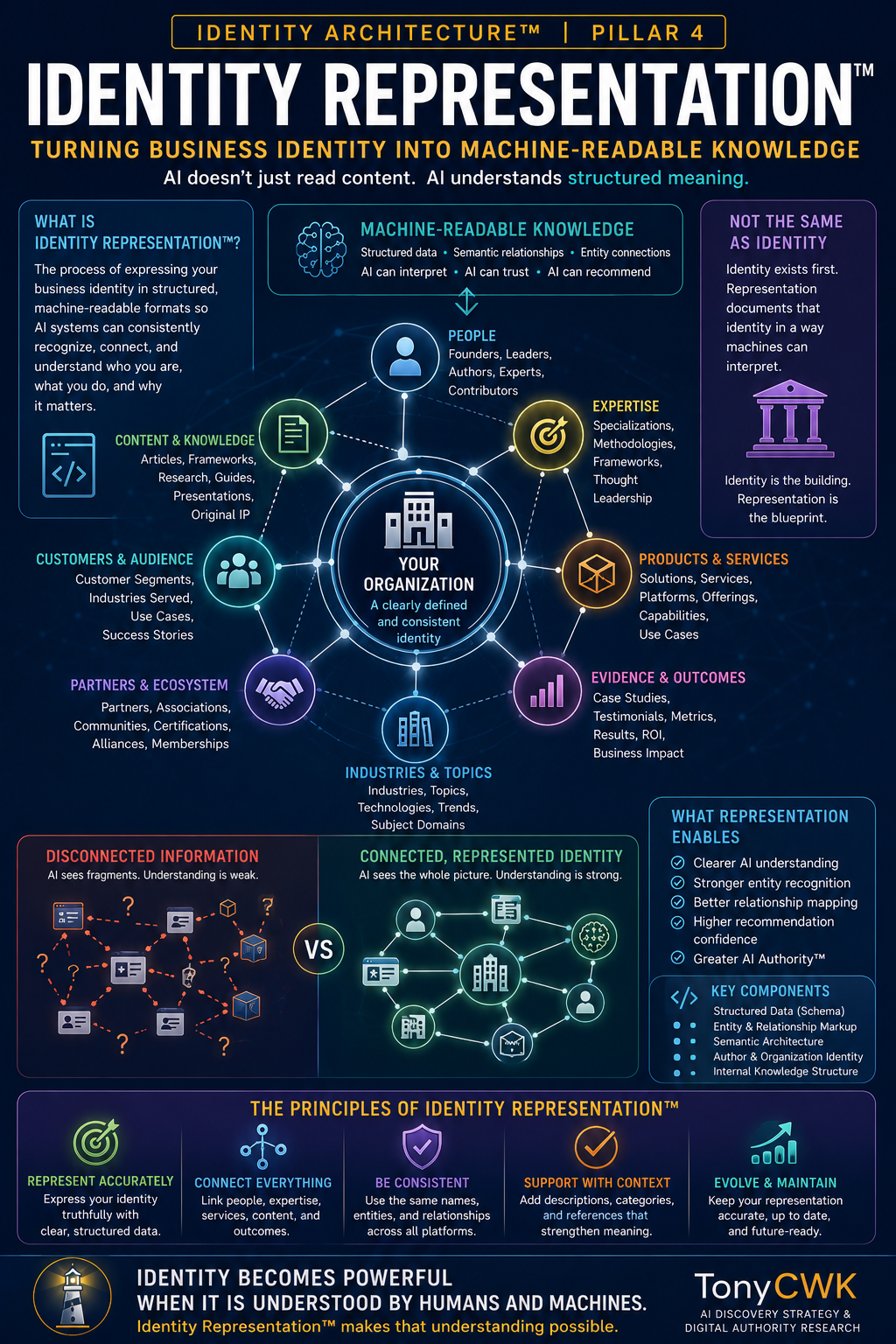
As the fourth pillar of Identity Architecture™, Identity Representation™ transforms business identity into structured, machine-readable knowledge that enables AI systems to consistently recognize, interpret, and connect the people, expertise, products, services, and relationships that define an organization.
What Is Identity Representation™?
Identity Representation™ is the process of expressing a business’s identity in structured, machine-readable formats that enable AI systems to consistently understand its people, expertise, products, services, relationships, and context.
It does not create identity.
It represents identity.
This distinction is important.
Many organizations invest in structured data before clearly defining their identity.
If the identity itself is ambiguous, no amount of technical markup can fully resolve that ambiguity.
Identity must exist before it can be represented.
AI Understands Structure
AI increasingly relies on structured relationships rather than isolated text.
Instead of simply reading paragraphs, AI identifies:
- Organizations
- People
- Authors
- Products
- Services
- Topics
- Industries
- Locations
- Events
- Publications
- Relationships between entities
Every structured connection strengthens machine understanding.
Identity Representation™ provides those connections.
Representation Is Not The Same As Identity
A useful analogy is architectural design.
The building exists.
The blueprint describes it.
The blueprint is not the building.
Similarly:
Identity Definition™ establishes who you are.
Identity Representation™ documents that identity in ways AI systems can interpret consistently.
Many businesses confuse representation with identity itself.
Publishing schema alone does not establish authority.
Creating an entity does not automatically build expertise.
Technical implementation should always reinforce an already well-defined identity.
What Makes Identity Machine-Readable?
Machine-readable identity combines multiple forms of structured information.
These may include:
Structured Data
Helping AI identify organizations, people, products, services, articles, FAQs, reviews, and other entities.
Entity Relationships
Showing how people, expertise, products, services, and topics relate to one another.
Semantic Architecture
Organizing information into meaningful topical structures rather than isolated pages.
Author Identity
Clearly associating expertise with identifiable authors and contributors.
Organization Identity
Providing consistent organizational information across every digital asset.
Internal Knowledge Structure
Connecting articles, frameworks, services, research, and case studies into one coherent knowledge ecosystem.
Each element contributes another layer of machine understanding.
Representation Improves Recognition
Imagine two organizations.
Both possess identical expertise.
One publishes disconnected webpages with little structure.
The other organizes its knowledge using consistent entities, semantic relationships, structured data, author profiles, organization information, and connected content.
Both organizations possess expertise.
Only one makes that expertise easier for AI to understand.
Representation does not replace expertise.
It reduces ambiguity.
The easier your identity is to interpret, the easier it becomes for AI to recognize it consistently.
Identity Representation™ Supports AI Confidence
Every correctly represented relationship becomes another confidence signal.
AI can more easily determine:
- Who authored the content.
- Which organization owns the framework.
- Which services relate to which expertise.
- Which research supports which methodology.
- Which case studies demonstrate outcomes.
- Which topics belong together.
The clearer these relationships become, the stronger AI’s understanding becomes.
Representation supports confidence.
Confidence supports recommendation.
Common Representation Mistakes
Organizations often weaken machine understanding by:
- Using inconsistent organization names.
- Publishing disconnected author profiles.
- Creating isolated service pages.
- Ignoring entity relationships.
- Using incomplete structured data.
- Failing to connect research with expertise.
- Separating products from supporting knowledge.
These issues rarely affect human readers.
They significantly affect machine interpretation.
Identity Representation™ Within Identity Architecture™
The first four pillars now work together:
- Identity Definition™ establishes who you are.
- Identity Consistency™ reinforces that identity everywhere.
- Identity Relationships™ connects every important element.
- Identity Representation™ expresses those connections in machine-readable form.
Only after these foundations exist does AI begin building stronger confidence in the organization’s identity.
The remaining pillars complete the process:
- Identity Reinforcement™ validates identity through independent evidence.
- Identity Persistence™ ensures recognition remains stable across platforms, AI models, and time.
Practical Questions To Evaluate Identity Representation™
Ask yourself:
- Can AI clearly identify your organization?
- Are your authors consistently represented?
- Are your services connected to your expertise?
- Are your frameworks linked to supporting research?
- Do your articles reinforce one another?
- Are entity relationships clearly expressed?
- Does your website represent your business as one connected knowledge ecosystem?
If the answer is “no” to several of these questions, your identity may still be understandable to people while remaining difficult for AI to interpret consistently.
Real-World Example: Two Businesses, Same Expertise, Different AI Understanding
Imagine two cybersecurity consulting firms.
Both have experienced consultants.
Both publish useful articles.
Both offer similar services.
However, they represent their identities very differently.
Business A
- Services exist as isolated webpages.
- Author pages are incomplete.
- No clear relationship between articles and services.
- Frameworks are never connected to case studies.
- Organization details vary across platforms.
- Structured data is minimal.
AI can read the content, but it has to infer how everything fits together.
Business B
- The organization is consistently identified across all digital properties.
- Every article is connected to its author.
- Services link to supporting research and case studies.
- Proprietary methodologies are consistently referenced.
- Organization, author, article, FAQ, and service schema reinforce one another.
- Related content is organized into a connected knowledge ecosystem.
AI can more easily understand:
- who created the knowledge,
- which expertise belongs to the organization,
- how services relate to research,
- which frameworks support customer outcomes,
- and why the organization should be associated with specific topics.
The expertise may be identical.
The difference lies in how clearly that expertise is represented.
Key Takeaway
Identity Representation™ does not create expertise.
It makes existing expertise easier for AI to understand.
The clearer the representation, the less ambiguity AI must resolve before recognizing, associating, and recommending your organization.
Looking Ahead
Once identity has been clearly represented, the next challenge is proving that AI should trust it.
The fifth pillar of Identity Architecture™ explores how independent validation strengthens AI confidence.
The next article examines:
Identity Reinforcement™: Building AI Confidence Through External Validation.
Conclusion
Identity does not become machine-readable by accident.
It becomes machine-readable through deliberate representation.
Identity Representation™ transforms business identity from human-readable information into structured knowledge that AI systems can consistently recognize, connect, and understand.
In the AI era, clarity is no longer enough.
Identity must also be represented in ways machines can reliably interpret.
That is how recognition becomes scalable, confidence becomes stronger, and AI Authority™ becomes possible.
FAQ
1. What is Identity Representation™?
Identity Representation™ is the fourth pillar of Identity Architecture™. It is the process of expressing a business’s identity in structured, machine-readable formats so AI systems can consistently understand its people, expertise, products, services, relationships, and context.
2. Why is Identity Representation™ important for AI?
AI systems need clear structure to interpret entities and relationships accurately. Identity Representation™ reduces ambiguity by helping AI understand how an organization, its authors, services, content, and expertise connect.
3. Is Identity Representation™ the same as schema markup?
No. Schema markup is one method of representing identity, but Identity Representation™ is broader. It includes structured data, semantic architecture, entity relationships, author identity, organization identity, and connected knowledge structures.
4. Does schema markup create business identity?
No. Schema markup does not create identity. It represents an identity that should already be clearly defined, consistent, and connected through the earlier pillars of Identity Architecture™.
5. What makes business identity machine-readable?
A business identity becomes machine-readable when its organization, people, services, expertise, articles, frameworks, case studies, and relationships are structured in ways AI systems can reliably interpret.
6. How does Identity Representation™ support AI Authority™?
Identity Representation™ helps AI understand what a business is known for, who creates its knowledge, how its services relate to expertise, and what evidence supports its authority. This strengthens AI recognition and recommendation confidence.
7. What are common Identity Representation™ mistakes?
Common mistakes include inconsistent organization names, disconnected author profiles, isolated service pages, incomplete structured data, weak internal relationships, and content that is not connected to expertise or evidence.
8. Is Identity Representation™ only a technical SEO task?
No. Technical SEO can support Identity Representation™, but the discipline is strategic as well. It requires clear identity definition, semantic organization, content relationships, author clarity, and machine-readable structure.
9. How does Identity Representation™ connect to Identity Relationships™?
Identity Relationships™ defines how people, expertise, services, content, and evidence connect. Identity Representation™ expresses those relationships in formats that AI systems can interpret more reliably.
10. What is the goal of Identity Representation™?
The goal is to transform business identity from human-readable content into structured knowledge that AI systems can recognize, connect, and understand consistently.
Leave a Reply