
By TonyCWK
Introduction
By now, your business identity has been:
- Clearly defined.
- Consistently communicated.
- Connected through meaningful relationships.
- Represented in machine-readable formats.
AI can understand who you are.
But understanding alone is not enough.
Before an AI system confidently recommends your organization, it asks another question:
“How certain am I that this identity is accurate?”
That certainty develops through Identity Reinforcement™, the fifth pillar of Identity Architecture™.
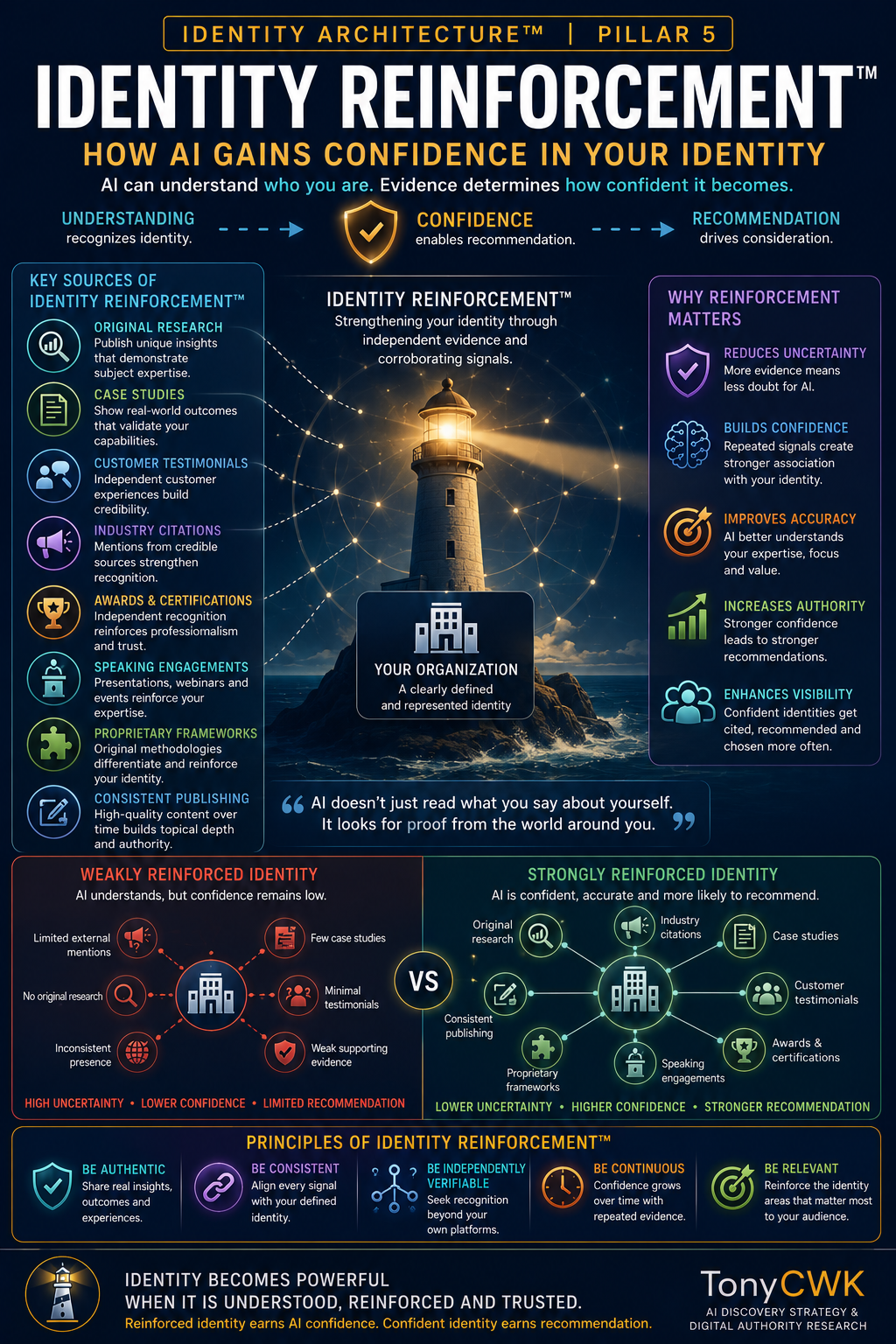
Identity Reinforcement™ explains how repeated validation, independent evidence, and consistent signals increase AI’s confidence in understanding an organization.
Identity may establish recognition.
Reinforcement strengthens confidence.
What Is Identity Reinforcement™?
Identity Reinforcement™ is the continuous process of validating and strengthening a business’s identity through independent evidence, corroborating signals, and consistent demonstrations of expertise across the digital ecosystem.
Unlike Identity Representation™, which focuses on expressing identity clearly, Identity Reinforcement™ focuses on confirming that identity repeatedly.
Every independent signal answers the same question:
“Does the available evidence support what this organization claims about itself?”
The more consistently the answer is yes, the stronger AI’s confidence becomes.
AI Seeks Corroboration, Not Just Claims
Organizations naturally describe themselves in positive terms.
Every company can claim to be:
- Experienced.
- Trusted.
- Innovative.
- Industry-leading.
AI cannot rely solely on self-description.
Instead, it compares those claims with evidence found elsewhere.
For example:
- Do independent publications mention the organization?
- Do case studies support its expertise?
- Do customer outcomes reinforce its capabilities?
- Are proprietary frameworks consistently referenced?
- Is the organization cited by credible sources?
- Does its published research align with its claimed specialization?
Identity becomes stronger when multiple independent sources reinforce the same conclusion.
Confidence Grows Through Repetition
AI confidence rarely develops from a single signal.
Instead, it accumulates over time.
Imagine repeatedly encountering the same organization associated with:
- AI discovery strategy
- Identity Architecture™
- AI Authority™
- Original research
- Industry presentations
- Customer success stories
- Expert interviews
- Professional recognition
Each occurrence strengthens AI’s confidence that these associations genuinely define the organization.
One signal may introduce identity.
Many signals reinforce it.
Sources Of Identity Reinforcement™
Identity can be reinforced through many different forms of evidence.
Original Research
Publishing unique findings demonstrates subject matter expertise.
Case Studies
Showing measurable outcomes connects expertise with real-world results.
Customer Testimonials
Independent customer experiences reinforce credibility.
Industry Citations
Mentions from reputable organizations strengthen recognition.
Speaking Engagements
Conference presentations and webinars reinforce subject expertise.
Awards And Certifications
Professional recognition provides additional validation.
Proprietary Frameworks
Original methodologies demonstrate distinctive thinking.
Consistent Publishing
Regular, high-quality content reinforces expertise over time.
No single signal is sufficient.
Together, they create a reinforcing pattern.
Reinforcement Reduces Uncertainty
AI operates under uncertainty.
When evidence is limited, recommendation confidence remains lower.
As reinforcing signals accumulate, uncertainty decreases.
Instead of asking:
“Is this organization genuinely known for AI Authority™?”
AI increasingly concludes:
“Multiple independent sources consistently associate this organization with AI Authority™.”
That shift—from uncertainty to confidence—is the purpose of Identity Reinforcement™.
Reinforcement Is Stronger Than Repetition
Repeating the same claim on your own website does not necessarily strengthen identity.
Independent corroboration carries greater weight.
For example:
Publishing a framework is valuable.
Having industry publications discuss that framework reinforces it further.
Writing a case study is useful.
Customers validating the outcomes strengthens confidence even more.
Identity grows stronger when evidence extends beyond self-published content.
Identity Reinforcement™ Within Identity Architecture™
The first five pillars now form a complete progression:
- Identity Definition™ establishes who you are.
- Identity Consistency™ reinforces the same identity everywhere.
- Identity Relationships™ connects every important element.
- Identity Representation™ expresses those relationships in machine-readable formats.
- Identity Reinforcement™ validates those representations through evidence and corroboration.
Together, these pillars help AI move from recognition to confidence.
The final pillar, Identity Persistence™, ensures that confidence remains stable across platforms, AI models, and time.
Real-World Example
Imagine two organizations with similar expertise in AI strategy.
Both publish quality content.
Both clearly describe their services.
However, only one consistently reinforces its identity through external evidence.
Organization A
- Publishes articles on its own website.
- Describes itself as an industry expert.
- Has limited external references.
- Few customer case studies.
- Minimal independent mentions.
AI understands the identity, but confidence remains moderate.
Organization B
- Publishes original research.
- Presents at industry conferences.
- Earns citations from respected publications.
- Shares verified customer case studies.
- Receives reviews and testimonials.
- Develops proprietary frameworks that are referenced by others.
AI encounters the same identity repeatedly from multiple independent sources.
The expertise may be similar.
The difference lies in the amount of reinforcing evidence.
Identity is understood.
Confidence is earned.
Practical Questions To Evaluate Identity Reinforcement™
Consider the following questions:
- Does independent evidence support your expertise?
- Have others cited or referenced your work?
- Are your customer outcomes publicly demonstrated?
- Do your case studies reinforce your claimed capabilities?
- Are your proprietary frameworks consistently associated with your organization?
- Would AI encounter your expertise beyond your own website?
If the answer is “no” to several of these questions, your identity may be understood but not yet strongly reinforced.
Looking Ahead
A well-reinforced identity enables AI to build confidence.
The next challenge is ensuring that confidence remains stable despite changing platforms, evolving technologies, and new AI models.
The final article in the Identity Architecture™ series explores:
Identity Persistence™: Becoming Recognizable Across Every AI System.
Conclusion
Identity is not strengthened by self-description alone.
It is strengthened by evidence.
Every citation.
Every case study.
Every customer outcome.
Every independent mention.
Every piece of original research.
Together, these signals reinforce what AI already understands.
Identity Reinforcement™ transforms recognition into confidence.
And confidence is what ultimately enables stronger AI recommendations, long-term AI Authority™, and durable digital recognition.
FAQ
1. What is Identity Reinforcement™?
Identity Reinforcement™ is the fifth pillar of Identity Architecture™. It is the process of strengthening a business identity through independent evidence, corroborating signals, citations, case studies, reviews, and consistent demonstrations of expertise.
2. Why does AI need reinforcement after understanding identity?
AI may understand what a business claims to be, but it needs supporting evidence before becoming confident in that identity. Reinforcement helps AI validate whether the identity is accurate, credible, and consistently supported.
3. How does Identity Reinforcement™ support AI confidence?
Identity Reinforcement™ increases AI confidence by repeatedly confirming the same identity through multiple credible signals, such as original research, customer outcomes, external mentions, testimonials, and industry citations.
4. What are examples of identity reinforcement signals?
Examples include original research, case studies, customer testimonials, reviews, industry citations, awards, certifications, speaking engagements, proprietary frameworks, expert interviews, and consistent high-quality publishing.
5. Is repeating the same claim on my website enough?
No. Repetition on your own website may improve clarity, but independent corroboration is stronger. AI gains more confidence when external sources, customers, publications, and real-world outcomes support the same identity.
6. How is Identity Reinforcement™ different from Identity Representation™?
Identity Representation™ helps AI interpret your identity in structured, machine-readable form. Identity Reinforcement™ validates that identity through evidence, credibility signals, and external confirmation.
7. How does Identity Reinforcement™ support AI Authority™?
AI Authority™ becomes stronger when AI repeatedly encounters evidence that supports your expertise. Reinforcement helps move your identity from being recognized to being considered credible and recommendable.
8. Can small businesses use Identity Reinforcement™?
Yes. Small businesses can reinforce identity through customer reviews, case studies, local citations, testimonials, original insights, consistent publishing, and clearly documented outcomes.
9. Is Identity Reinforcement™ a one-time activity?
No. Reinforcement is cumulative. AI confidence grows as credible signals accumulate over time across websites, platforms, publications, reviews, and external references.
10. What is the main goal of Identity Reinforcement™?
The main goal is to help AI move from simply recognizing who you are to becoming more confident that your identity, expertise, and authority are supported by real evidence.
Leave a Reply