
Why Trust May Be The Outcome Of Repeated Validation
Trust is one of the most discussed concepts in business, marketing, psychology, and increasingly, artificial intelligence.
We trust banks with our money.
We trust airlines with our safety.
We trust doctors with our health.
And as AI systems become more involved in recommendations, decisions, and eventually delegated actions, trust is becoming an increasingly important topic in the future of digital marketing.
But trust itself raises an important question:
How is trust actually formed?
The answer may be simpler than we think.
Trust rarely appears instantly.
Instead, trust may emerge from accumulated confidence.
Trust Is Often Misunderstood
Many people treat trust as if it were a signal.
Something that can be created, earned, or optimized directly.
But trust is often the result of something deeper.
Consider how trust develops between people.
We rarely trust someone immediately after meeting them.
Instead, we observe.
We evaluate.
We gather evidence.
We look for patterns.
Over time, confidence begins to form.
Eventually, if that confidence survives repeated validation, trust emerges.
This principle may apply not only to humans but also to brands, recommendation systems, and future AI agents.
Confidence Comes Before Trust
Before trust can exist, confidence usually comes first.
Confidence is the belief that an outcome is likely to occur as expected.
Trust is the willingness to accept risk based on that belief.
The distinction is important.
Confidence answers:
“Do I believe this is reliable?”
Trust answers:
“Am I willing to rely on it?”
Trust is not the beginning of the process.
Trust is often the result of confidence reaching a sufficient threshold.
How Confidence Accumulates
Confidence rarely comes from a single interaction.
Instead, it accumulates through repeated evidence.
Imagine booking a hotel for the first time.
You may develop confidence through:
- Reviews
- Recommendations
- Ratings
- Reputation
- Past customer experiences
The more signals align, the greater the confidence.
If the experience meets expectations, confidence increases.
If positive outcomes continue over time, trust begins to form.
This process repeats across nearly every area of life.
The same pattern can be observed in:
- Brands
- Products
- Services
- Organizations
- People
Trust emerges because confidence survives repeated validation.
The Confidence Accumulation Cycle
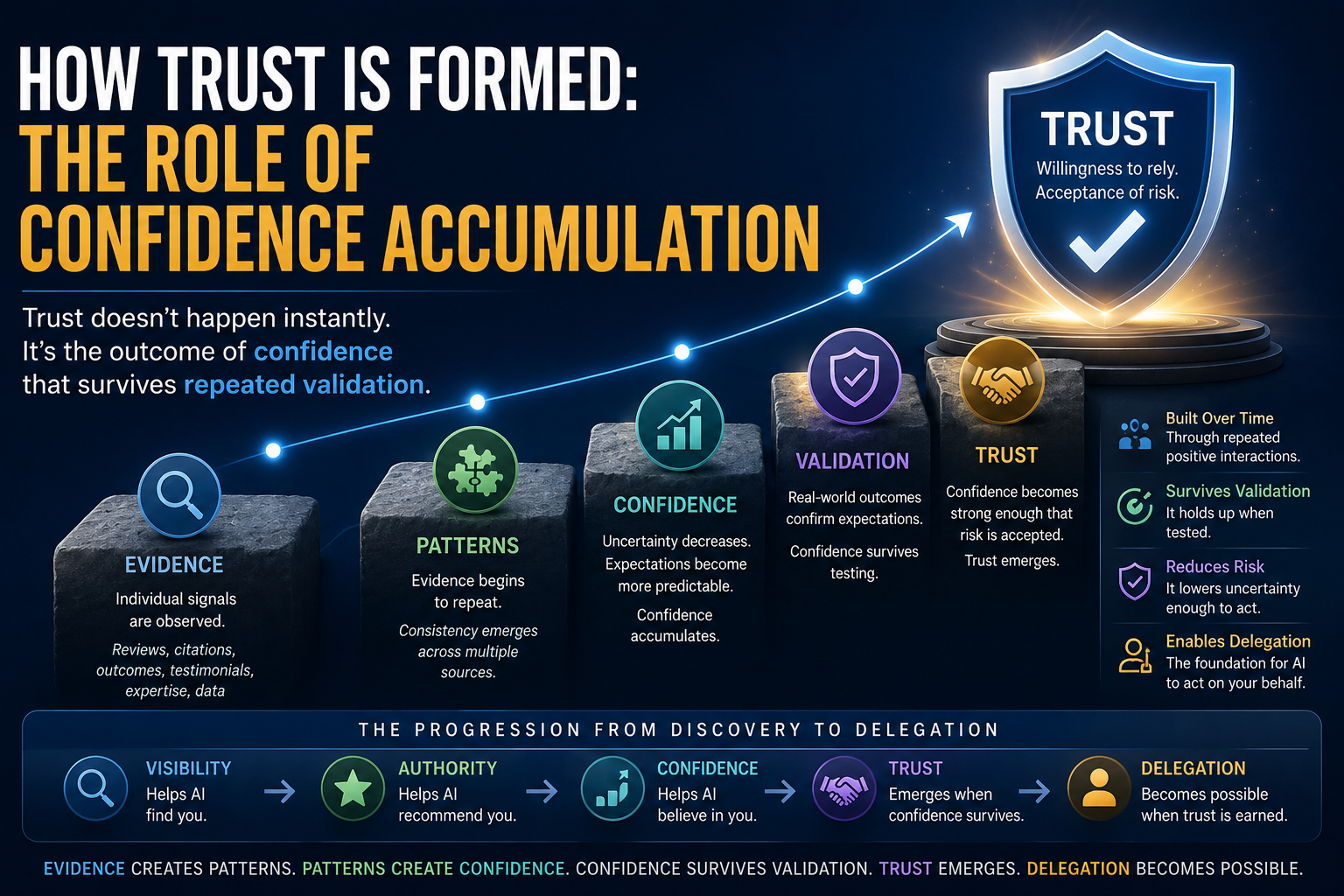
One way to think about trust formation is through a simple progression:
Evidence
Individual signals are observed.
Examples:
- Reviews
- Citations
- Outcomes
- Testimonials
- Expertise
↓
Patterns
Evidence begins to repeat.
Similar signals appear across multiple sources.
Consistency becomes visible.
↓
Confidence
Uncertainty decreases.
Expectations become more predictable.
Confidence begins to accumulate.
↓
Validation
Real-world outcomes confirm expectations.
Confidence survives testing.
↓
Trust
Confidence becomes strong enough that risk is accepted.
Trust emerges.
Why This Matters For AI
This discussion becomes increasingly important as AI systems evolve.
Today’s AI systems primarily recommend.
Tomorrow’s AI systems may:
- Book appointments
- Select vendors
- Purchase products
- Coordinate services
- Execute transactions
These delegated actions require more than visibility.
They require more than authority.
They may require trust.
But if trust is the outcome, what creates it?
Confidence.
AI systems may not directly evaluate trust.
They may instead evaluate signals that contribute to confidence.
Repeated evidence.
Repeated validation.
Repeated successful outcomes.
Over time, confidence accumulates.
Trust becomes possible.
Trust And The Future Of Delegation
This distinction may become one of the most important ideas in agentic commerce.
A recommendation requires one level of certainty.
Delegation requires another.
An AI system may recommend a hotel.
That does not automatically mean it will book the hotel.
An AI system may recommend a service provider.
That does not automatically mean it will hire the provider.
Delegation introduces risk.
Trust reduces that risk.
Confidence may be the mechanism through which trust is formed.
This is why confidence accumulation matters.
It helps explain how recommendation evolves into action.
Trust Is Earned Through Repeated Validation
Trust is not created through a single citation.
Trust is not created through a single review.
Trust is not created through a single recommendation.
Trust emerges when confidence repeatedly survives validation.
Over time:
Evidence creates patterns.
Patterns create confidence.
Confidence survives validation.
Trust emerges.
This process may apply equally to people, brands, and future AI systems.
The Future Of AI Visibility
For years, marketers focused on visibility.
Can customers find us?
As AI became more influential, the conversation shifted toward authority.
Will AI recommend us?
The next stage may involve confidence.
How certain is AI about recommending us?
And eventually, trust.
Has confidence survived enough validation to support action?
This progression may look like:
Visibility → Authority → Confidence → Trust → Delegation
Visibility helps AI find you.
Authority helps AI recommend you.
Confidence helps AI believe in you.
Trust emerges when confidence survives repeated validation.
Delegation becomes possible when trust reaches a sufficient threshold for action.
Final Thoughts
Trust rarely appears overnight.
It accumulates.
It develops.
It survives testing.
Whether between people, brands, or future AI systems, trust may not be something that can be built directly.
Instead, trust may be the outcome of confidence accumulated over time.
As AI moves from recommendation toward delegation, understanding how confidence becomes trust may become one of the most important challenges in digital marketing.
Because the future may not belong to the brands AI merely knows.
Or even the brands AI occasionally recommends.
It may belong to the brands that consistently accumulate enough confidence to become trusted.
FAQ
1. How is trust formed?
Trust is formed when confidence accumulates over time and survives repeated validation. It usually does not appear instantly; it develops through evidence, consistency, and proven outcomes.
2. What is confidence accumulation?
Confidence accumulation is the process where repeated evidence reduces uncertainty. Over time, individual signals become patterns, patterns create confidence, and confidence can eventually become trust.
3. Is confidence the same as trust?
No. Confidence is the belief that something is likely to be reliable. Trust is the willingness to rely on it or accept risk based on that confidence.
4. Why does trust matter for AI recommendations?
Trust matters because AI systems may eventually move from recommending options to acting on behalf of users. Delegated actions require a higher level of certainty than simple recommendations.
5. How does confidence help AI systems form trust?
AI systems may evaluate repeated evidence, validation, consistency, and outcomes. When these signals align over time, confidence increases and trust may become possible.
6. What is the relationship between visibility, authority, confidence, trust, and delegation?
Visibility helps AI find a brand. Authority helps AI recommend it. Confidence helps AI believe in it. Trust emerges when confidence survives validation. Delegation becomes possible when trust reaches a sufficient threshold for action.
Leave a Reply