
Why Some Brands Get Recommended Repeatedly While Others Don’t
Artificial intelligence knows far more than it recommends.
This idea sits at the heart of a growing question within AI visibility and agentic commerce:
Why do some brands get recommended repeatedly while others only appear occasionally?
Visibility explains discovery.
Authority explains selection.
But neither fully explains repeated selection.
This is where confidence may become increasingly important.
In a previous article, I explored the possibility that confidence represents a missing layer between authority and trust.
The next question naturally follows:
What creates confidence?
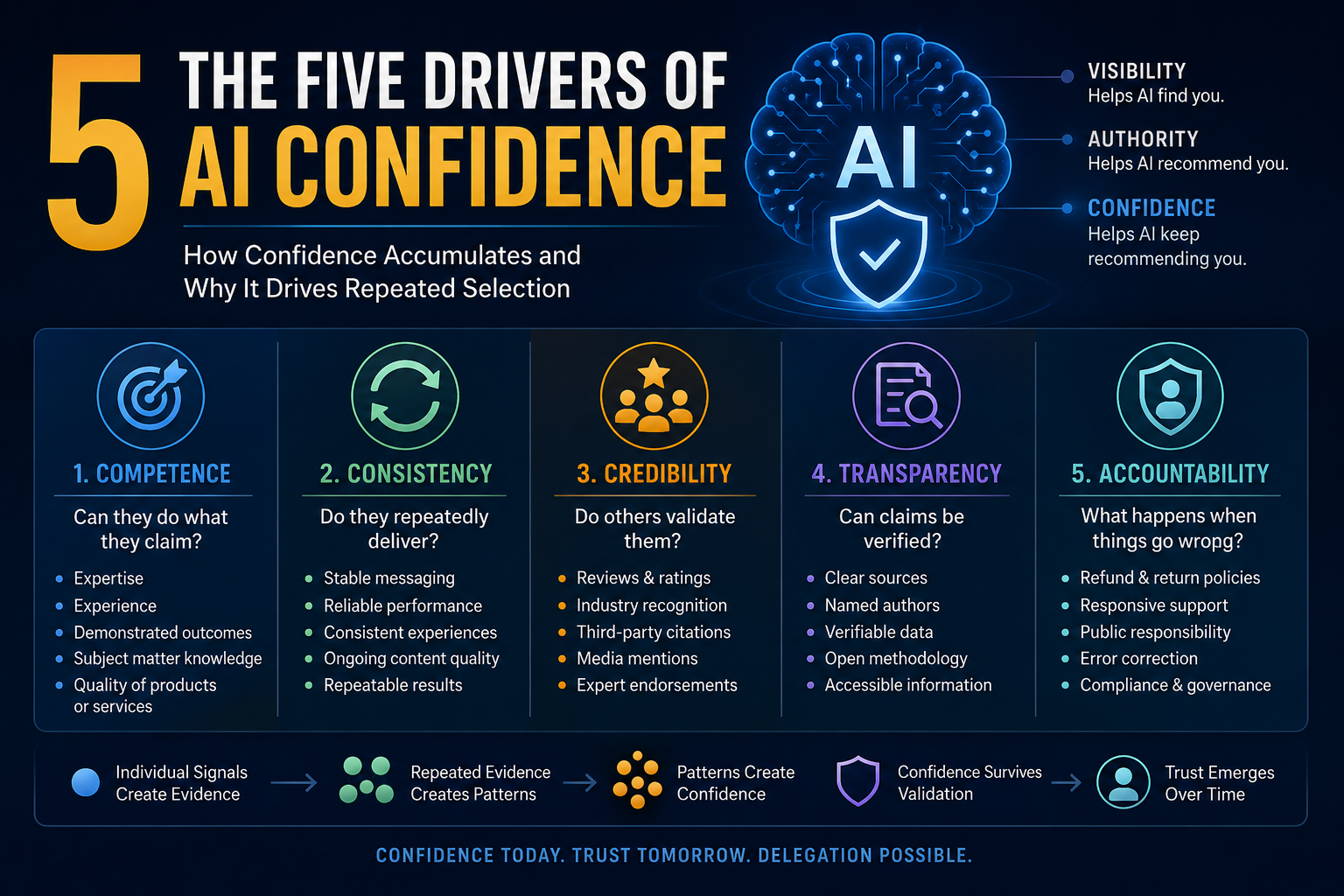
While the answer is still evolving, five drivers appear to contribute to how confidence accumulates over time.
Confidence Is Not A Single Signal
One common mistake is to think confidence comes from a single factor.
It doesn’t.
A citation alone does not create confidence.
A review alone does not create confidence.
A case study alone does not create confidence.
Instead, confidence appears to emerge from multiple forms of evidence reinforcing one another over time.
Individual signals create evidence.
Repeated evidence creates patterns.
Patterns create confidence.
Driver #1: Competence
Can They Do What They Claim?
The first driver of confidence is competence.
Competence answers a fundamental question:
Can this organization actually deliver what it promises?
For humans, competence is demonstrated through:
- Expertise
- Experience
- Knowledge
- Results
For brands, competence may be reflected through:
- Case studies
- Demonstrated outcomes
- Subject matter expertise
- Technical capability
- Product quality
AI systems increasingly evaluate signals that indicate whether expertise is genuine rather than merely claimed.
Claims create awareness.
Demonstrated competence creates confidence.
Driver #2: Consistency
Do They Repeatedly Deliver?
A single success can attract attention.
Repeated success builds confidence.
Consistency is often the difference between a brand that gets selected once and a brand that gets selected repeatedly.
Consistency may appear through:
- Stable messaging
- Repeated outcomes
- Reliable customer experiences
- Consistent expertise across channels
- Ongoing publication quality
Over time, consistency reduces uncertainty.
And confidence grows when uncertainty decreases.
This may be one reason repeated selection becomes possible.
Driver #3: Credibility
Do Others Validate Them?
Confidence becomes stronger when evidence is reinforced by independent validation.
Credibility comes from signals outside the organization itself.
Examples include:
Anyone can make claims.
Credibility emerges when others confirm them.
The more independent validation exists, the easier it becomes for AI systems and humans to develop confidence.
Driver #4: Transparency
Can Claims Be Verified?
Transparency reduces ambiguity.
The easier it is to verify information, the easier it becomes to build confidence.
Transparency may include:
- Named authors
- Clear methodologies
- Source attribution
- Public case studies
- Verifiable statistics
- Accessible company information
Transparency does not guarantee trust.
But it reduces uncertainty.
And reducing uncertainty is one of the primary mechanisms through which confidence grows.
Driver #5: Accountability
What Happens When Things Go Wrong?
This may be the least discussed driver of confidence.
Yet it could become one of the most important.
Accountability answers a difficult question:
What happens when outcomes are imperfect?
Examples include:
- Refund policies
- Customer support
- Public responses
- Error correction
- Service guarantees
- Regulatory compliance
A brand that accepts responsibility often inspires greater confidence than a brand that simply avoids criticism.
Confidence is not built because mistakes never happen.
Confidence is often built because organizations demonstrate how they respond when they do.
How Confidence Accumulates
The five drivers do not operate independently.
They reinforce one another.
Competence without consistency creates doubt.
Consistency without credibility creates skepticism.
Credibility without transparency creates uncertainty.
Transparency without accountability creates hesitation.
The strongest confidence emerges when all five drivers work together.
Over time:
Evidence becomes patterns.
Patterns become confidence.
Confidence survives validation.
Trust begins to emerge.
Why This Matters For AI Visibility
Historically, digital marketing focused on visibility.
More recently, AI visibility discussions have focused on authority.
Both remain essential.
But future AI systems may evaluate more than whether a brand is visible or authoritative.
They may increasingly evaluate confidence.
Not:
Can I find this brand?
Not:
Can I recommend this brand?
But:
How confident am I in recommending this brand repeatedly?
This distinction becomes particularly important as AI systems move closer to delegated decision-making.
Repeated recommendation requires more certainty than initial discovery.
Delegation requires more certainty than recommendation.
Confidence may become the bridge between them.
The Future Of AI Visibility
Visibility helps AI find you.
Authority helps AI recommend you.
Confidence helps AI continue recommending you.
Trust emerges when confidence survives repeated validation.
Delegation becomes possible when trust reaches a sufficient threshold for action.
This may explain why some brands are merely discovered while others become repeatedly recommended.
The future question may not be whether AI knows your brand.
It may be whether AI has accumulated enough confidence to keep choosing it.
And that confidence may be built through five simple but powerful drivers:
Competence.
Consistency.
Credibility.
Transparency.
Accountability.
Together, they may help explain why some brands become trusted recommendations while others remain merely visible.
FAQ
1. What are the five drivers of AI confidence?
The five drivers are competence, consistency, credibility, transparency, and accountability. Together, they help explain how confidence may accumulate over time.
2. Why does AI confidence matter?
AI confidence matters because AI systems may know many brands but repeatedly recommend only a smaller set. Confidence may help explain why some brands are selected again and again.
3. Is AI confidence the same as AI authority?
No. Authority helps explain why AI selects or recommends a brand. Confidence helps explain why AI may continue recommending that brand repeatedly.
4. How does confidence become trust?
Confidence becomes trust when evidence is repeatedly validated over time. Trust is not instant; it is the outcome of accumulated and tested confidence.
5. Why is accountability important for AI confidence?
Accountability matters because confidence is not only built when things go right. It is also strengthened by how a brand responds when problems, errors, or failed outcomes occur.
6. How can brands build AI confidence?
Brands can build confidence by demonstrating real expertise, delivering consistently, earning third-party validation, making claims easy to verify, and showing accountability when things go wrong.
Leave a Reply