
By TonyCWK
Introduction
Over the past six articles, we’ve explored Identity Architecture™—a framework for designing business identities that artificial intelligence can consistently understand, connect, and recognize.
But an important question remains.
How does Identity Architecture™ relate to AI Authority™?
Some may assume they are competing ideas.
They are not.
They solve different problems.
Identity Architecture™ explains how AI understands your business.
AI Authority™ explains why AI recommends your business.
Recommendation comes later.
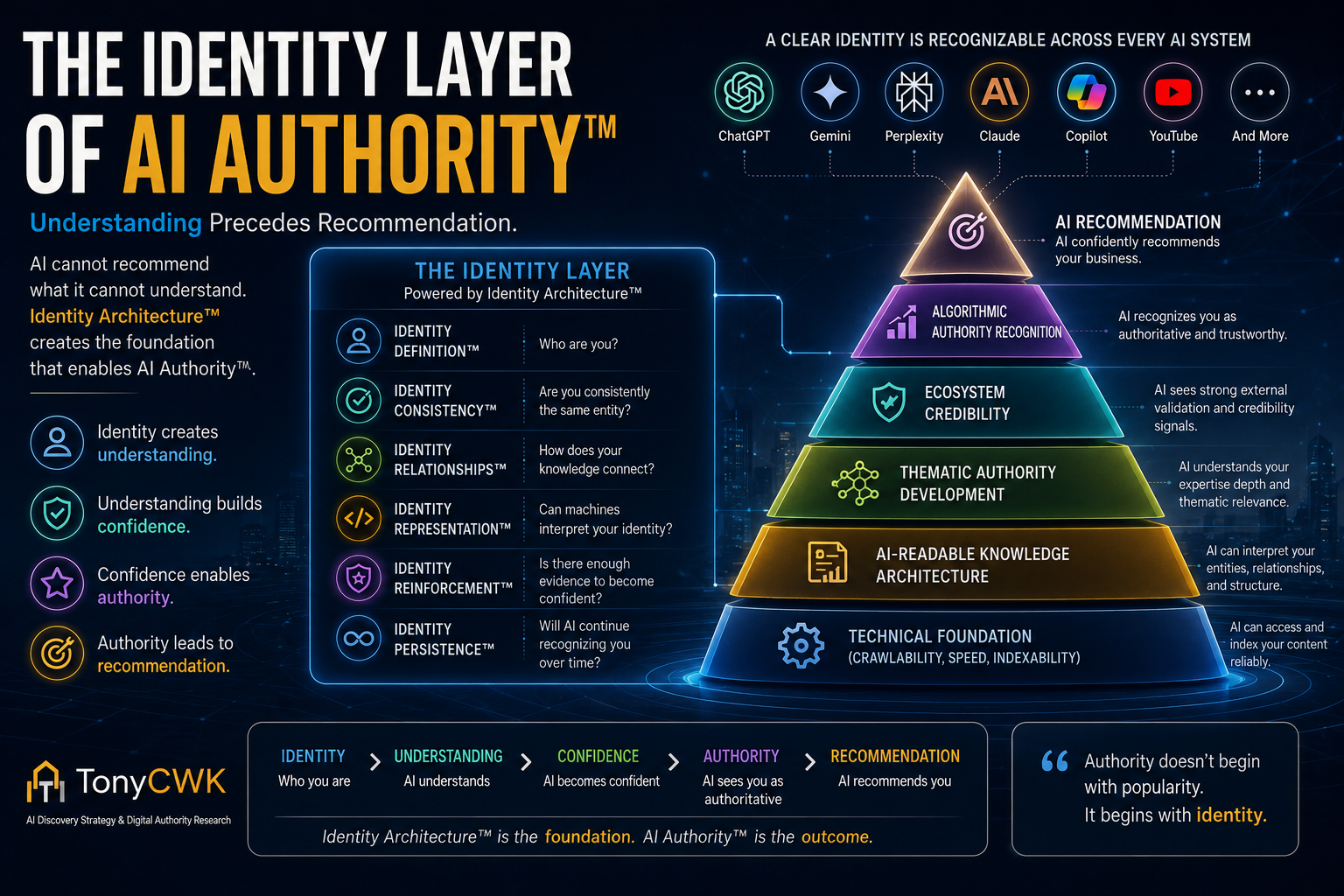
The bridge between the two is what I call The Identity Layer of AI Authority™.
AI Cannot Recommend What It Cannot Understand
Many businesses focus immediately on authority.
They invest in:
- More content.
- More backlinks.
- More citations.
- More reviews.
- More visibility.
These activities are valuable.
But they assume AI already knows who the organization is.
That assumption is often incorrect.
Before AI evaluates authority, it first needs to establish identity.
Who owns this content?
What expertise does this organization represent?
Which services belong to which company?
Which author represents this methodology?
Which research belongs to which framework?
Without clear answers, authority becomes difficult to establish.
Identity Is The First Layer Of AI Authority™
The original AI Authority™ Pyramid begins with technical foundations before progressing toward recommendation.
Identity Architecture™ explains what happens inside those foundational layers.
Rather than viewing AI-Readable Knowledge Architecture as a collection of technical tasks, Identity Architecture™ provides the strategic discipline behind it.
The relationship looks like this:
Identity Architecture™
↓
AI-Readable Knowledge Architecture
↓
Thematic Authority
↓
Ecosystem Credibility
↓
Algorithmic Authority Recognition
↓
AI Recommendation
Identity Architecture™ gives AI a coherent identity to interpret before authority signals begin accumulating.
Identity Answers Different Questions
Every stage of AI evaluation answers a different question.
| Layer | AI Question |
|---|---|
| Identity Definition™ | Who are you? |
| Identity Consistency™ | Are you consistently the same entity? |
| Identity Relationships™ | How does your knowledge connect? |
| Identity Representation™ | Can machines interpret your identity? |
| Identity Reinforcement™ | Is there enough evidence to become confident? |
| Identity Persistence™ | Will AI continue recognizing you over time? |
Only after these questions are answered can AI begin evaluating authority with greater confidence.
Authority Requires Confidence
Authority is often misunderstood.
Many people define authority as popularity.
Or visibility.
Or content volume.
AI evaluates something more nuanced.
Confidence develops when identity becomes:
- clearly defined,
- consistently represented,
- meaningfully connected,
- machine-readable,
- independently reinforced,
- continuously maintained.
Identity creates understanding.
Understanding enables confidence.
Confidence supports authority.
Authority enables recommendation.
Identity Architecture™ And AI Authority™ Are Complementary
Neither framework replaces the other.
Identity Architecture™ focuses on recognition.
AI Authority™ focuses on recommendation.
Identity asks:
“Who is this organization?”
AI Authority™ asks:
“Should this organization be recommended?”
These are different questions requiring different disciplines.
Businesses that skip identity often struggle to build sustainable authority because AI must first resolve ambiguity before it can evaluate expertise.
Real-World Example
Imagine two consulting firms.
Both publish excellent AI strategy content.
Both earn backlinks.
Both receive positive reviews.
However, one firm has:
- inconsistent author identities,
- fragmented service descriptions,
- disconnected knowledge,
- conflicting positioning,
- inconsistent organization information.
The second firm has:
- clearly defined expertise,
- connected knowledge ecosystems,
- machine-readable identity,
- reinforced evidence,
- persistent recognition across platforms.
Both firms possess expertise.
One is significantly easier for AI to understand.
The difference is not content quality.
It is Identity Architecture™.
That understanding creates stronger confidence.
Confidence creates stronger AI Authority™.
Identity Is Not A Shortcut To Authority
Identity alone does not create authority.
A clearly defined identity without expertise is still a weak recommendation candidate.
Likewise, strong expertise with fragmented identity creates uncertainty.
Both are necessary.
Identity enables AI to interpret expertise.
Authority enables AI to recommend it.
This distinction prevents one of the most common misconceptions about AI optimization.
The Complete Progression
The relationship between the two frameworks can be summarized as:
Identity
↓
Understanding
↓
Confidence
↓
Authority
↓
Recommendation
Every stage builds on the previous one.
Removing identity weakens every layer above it.
Looking Ahead
Identity Architecture™ provides the foundation.
AI Authority™ explains how recommendation confidence develops.
The next phase explores what happens after recommendation.
How does confidence evolve into trust?
How does trust enable delegation?
These questions introduce the next stage of AI strategy:
AI Trust™ and Delegation Confidence™.
Conclusion
AI cannot recommend what it does not understand.
Identity Architecture™ ensures AI can consistently recognize who your business is.
AI Authority™ determines whether that understanding is strong enough to justify recommendation.
They are not competing frameworks.
They are complementary layers of the same architecture.
In the age of AI, authority does not begin with popularity.
It begins with identity.
Key Takeaway
Identity Architecture™ answers:
“Can AI understand who you are?”
AI Authority™ answers:
“Should AI recommend you?”
Together, they explain how businesses become understood before they become recommended.
FAQ
1. What is the Identity Layer of AI Authority™?
The Identity Layer of AI Authority™ explains how Identity Architecture™ provides the foundation that allows AI systems to understand a business before evaluating whether it should be recommended.
2. How does Identity Architecture™ relate to AI Authority™?
Identity Architecture™ helps AI understand who a business is. AI Authority™ builds on that understanding to determine whether the business is credible, relevant, and recommendable.
3. Why must identity come before authority?
AI cannot confidently evaluate authority if it is unclear who the business is, what it does, who owns the expertise, or how its knowledge connects.
4. Does identity alone create AI Authority™?
No. Identity creates understanding. AI Authority™ emerges when that identity is reinforced by expertise, evidence, credibility signals, and recommendation confidence.
5. What does Identity Architecture™ help AI understand?
It helps AI understand who the organization is, what expertise it represents, how its knowledge connects, how it is represented, what evidence supports it, and whether it remains recognizable over time.
6. What is the difference between identity and authority?
Identity answers, “Who are you?” Authority answers, “Why should you be recommended?” Both are necessary, but identity must be resolved before authority can be evaluated.
7. How does the Identity Layer support AI recommendations?
The Identity Layer reduces ambiguity, strengthens AI understanding, supports confidence, and gives authority signals a clearer foundation for recommendation.
8. How does this connect to the AI Authority™ Pyramid?
Identity Architecture™ sits beneath and supports AI-Readable Knowledge Architecture, Thematic Authority, Ecosystem Credibility, Algorithmic Authority Recognition, and AI Recommendation.
9. Can businesses build AI Authority™ without Identity Architecture™?
They may gain visibility, but sustainable AI Authority™ becomes harder when identity signals are fragmented, inconsistent, or difficult for AI systems to interpret.
10. What is the main takeaway of the Identity Layer of AI Authority™?
AI Authority™ does not begin with popularity or content volume. It begins with a clear, consistent, machine-readable, and reinforced identity.
Leave a Reply