
By TonyCWK
Introduction
Many businesses focus on making their digital presence consistent.
Their website uses the same messaging.
Their social profiles share the same positioning.
Their services are described similarly across platforms.
Consistency is important.
But consistency alone is not enough.
Artificial intelligence evaluates more than consistency.
It evaluates whether everything fits together into one logical system.
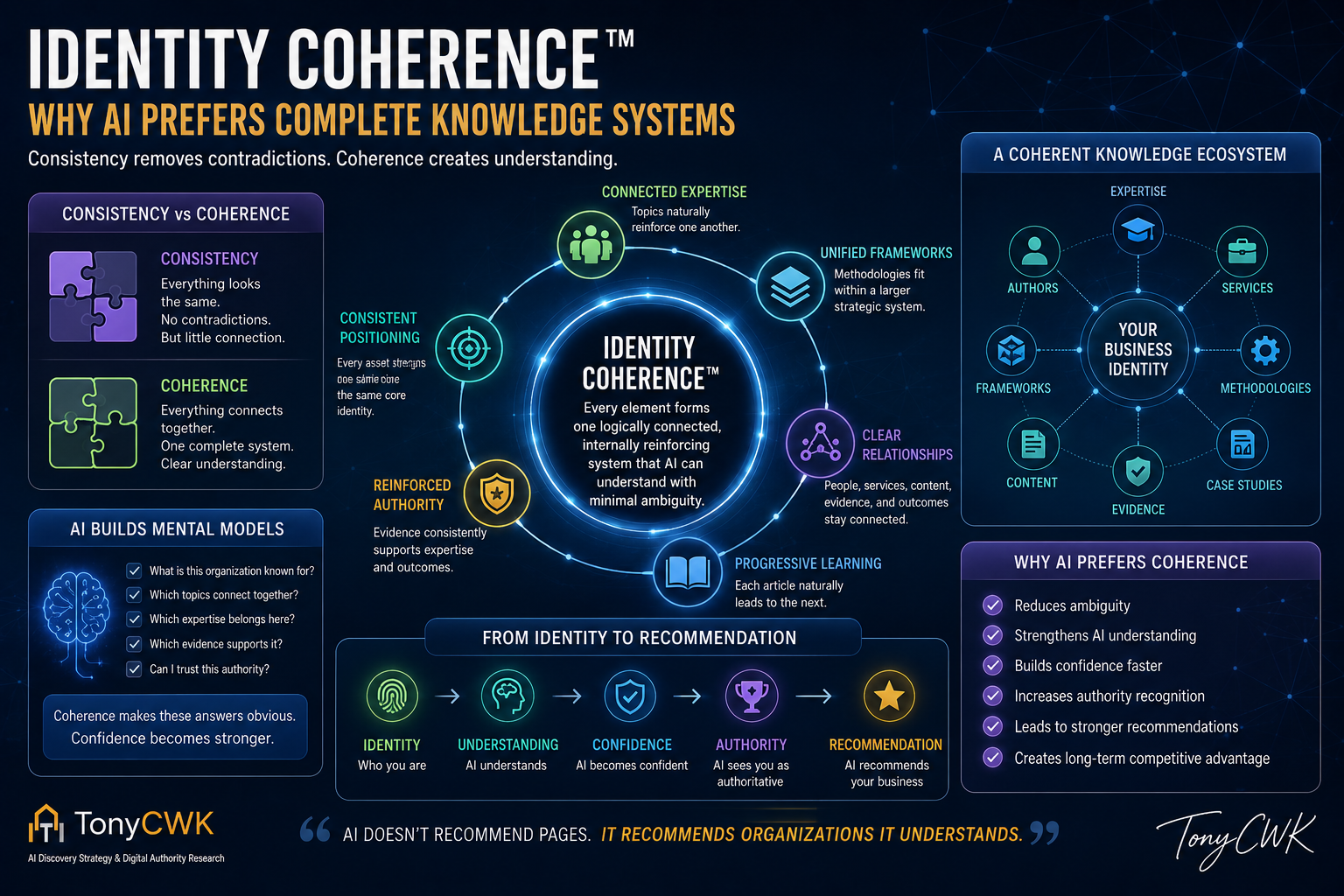
This is what I call Identity Coherence™.
Identity Coherence™ explains why AI is more confident in businesses whose people, expertise, services, content, evidence, and relationships reinforce one another rather than existing as isolated pieces of information.
Consistency reduces contradictions.
Coherence creates understanding.
What Is Identity Coherence™?
Identity Coherence™ is the degree to which every element of an organization’s identity forms one logically connected, internally reinforcing system that AI can interpret with minimal ambiguity.
A coherent identity is more than being consistent.
It is complete.
Every article supports the expertise.
Every service supports the positioning.
Every case study supports the methodology.
Every framework supports the business identity.
Everything works together.
Consistency Is Not Coherence
These concepts are often confused.
Imagine a company that says the same thing everywhere:
“We provide AI solutions.”
Its messaging is consistent.
But AI still knows very little.
Now imagine another company.
It consistently explains that it specializes in:
- AI Authority™
- Identity Architecture™
- Knowledge Architecture™
- AI Confidence™
- Conversation Engineering™
Its articles reference one another.
Its services align with its research.
Its case studies reinforce its frameworks.
Its author profiles reflect its expertise.
Its published knowledge forms one connected ecosystem.
Both companies are consistent.
Only one is coherent.
AI Builds Mental Models
Modern AI systems do not simply evaluate isolated webpages.
They build internal models of organizations.
They ask questions such as:
- What is this organization known for?
- Which topics consistently appear together?
- Which expertise belongs to this business?
- Which methodologies support its services?
- Do the published ideas reinforce one another?
The easier these questions become to answer, the stronger AI’s understanding becomes.
Coherence makes understanding easier.
Coherence Strengthens AI Confidence
AI confidence develops when multiple signals support the same conclusion.
For example:
An article introduces Identity Architecture™.
Another article explains Identity Representation™.
A third explores Identity Reinforcement™.
A framework diagram illustrates the entire system.
A case study demonstrates the concepts.
A LinkedIn post summarizes the practical application.
Individually, each asset provides value.
Together, they reinforce one coherent identity.
AI becomes increasingly confident that these ideas belong to the same expertise.
The Characteristics Of A Coherent Knowledge System
Highly coherent organizations typically demonstrate:
Connected Expertise
Topics naturally reinforce one another.
Unified Frameworks
Methodologies fit within a larger strategic system.
Consistent Relationships
People, products, services, research, and evidence remain connected.
Progressive Learning
Each article naturally leads to the next.
Reinforced Authority
Evidence consistently supports expertise.
Clear Positioning
Every asset strengthens the same core identity.
Coherence is not repetition.
It is structured reinforcement.
Real-World Example
Consider two AI consulting firms.
Firm A
Publishes:
- SEO articles
- AI articles
- Leadership articles
- Productivity articles
- Marketing articles
Each article is well written.
However, there is little connection between them.
The website resembles a library.
Not a system.
Firm B
Publishes around one integrated architecture:
- Identity Architecture™
- Knowledge Architecture™
- AI Authority™
- AI Confidence™
- AI Trust™
- Delegation Confidence™
Every article references related concepts.
Each framework explains another.
Every publication extends previous work.
The website behaves like a university curriculum.
Not a collection of blog posts.
AI encounters one coherent body of knowledge rather than isolated information.
Why Knowledge Architecture™ Depends On Identity Coherence™
Knowledge Architecture™ organizes information.
Identity Architecture™ defines organizational identity.
Identity Coherence™ ensures they reinforce each other.
Without coherence:
Knowledge becomes fragmented.
Without knowledge architecture:
Identity lacks supporting context.
Together they create one integrated system.
Practical Questions To Evaluate Identity Coherence™
Ask yourself:
- Do my articles naturally reinforce one another?
- Are my services supported by published expertise?
- Does every framework fit into a larger system?
- Would AI describe my expertise consistently after reading all my content?
- Do my case studies validate my methodologies?
- Does my website feel like one connected knowledge ecosystem?
If the answer is “yes,” AI is more likely to build a coherent understanding of your organization.
Identity Coherence™ Within The TonyCWK Framework
Identity Coherence™ extends Identity Architecture™.
It also strengthens AI Authority™.
The progression becomes:
Identity
↓
Consistency
↓
Relationships
↓
Representation
↓
Reinforcement
↓
Persistence
↓
Coherence
↓
Understanding
↓
Confidence
↓
Authority
↓
Recommendation
Coherence transforms individual identity signals into one integrated understanding.
Looking Ahead
Identity Coherence™ explains how AI interprets complete knowledge systems.
The next challenge is ensuring every part of the organization points in the same strategic direction.
The next advanced principle explores:
Identity Alignment™: When Strategy, Content, and Expertise Tell One Story.
Conclusion
AI does not recommend isolated webpages.
It recommends organizations it understands.
Understanding becomes stronger when identity forms one complete, internally reinforcing system.
Consistency removes contradictions.
Coherence creates meaning.
Businesses that publish disconnected content compete article by article.
Businesses that build coherent knowledge systems become easier for AI to understand, more confident to recommend, and more resilient as AI continues to evolve.
Because in the age of AI, understanding doesn’t come from individual pages.
It comes from the coherence of the entire system.
Key Takeaways
- Consistency ensures your identity doesn’t contradict itself.
- Coherence ensures every asset contributes to one connected understanding.
- AI builds internal knowledge models—not lists of webpages.
- A coherent knowledge ecosystem reduces ambiguity and strengthens AI confidence.
- Identity Architecture™ establishes the foundation. Identity Coherence™ ensures the entire system works together.
FAQ
1. What is Identity Coherence™?
Identity Coherence™ is an advanced principle of Identity Architecture™ that describes how well an organization’s people, expertise, services, content, frameworks, evidence, and relationships form one logically connected and internally reinforcing system.
2. How is Identity Coherence™ different from Identity Consistency™?
Identity Consistency™ ensures that an organization does not contradict itself across platforms. Identity Coherence™ goes further by ensuring that every part of the identity fits together logically and contributes to one complete understanding.
3. Why does Identity Coherence™ matter for AI systems?
AI systems build understanding by connecting information. When an organization’s content, services, expertise, authors, evidence, and frameworks reinforce one another, AI can interpret the organization with less ambiguity and greater confidence.
4. Does a business need more content to build Identity Coherence™?
Not necessarily. Identity Coherence™ depends more on how well existing content and knowledge assets connect than on content volume. A smaller, well-structured knowledge system can be more coherent than a large collection of disconnected articles.
5. What are the characteristics of a coherent knowledge system?
A coherent knowledge system includes connected expertise, unified frameworks, clear relationships, progressive learning paths, supporting evidence, and consistent positioning across the organization’s digital ecosystem.
6. How does Identity Coherence™ support AI Authority™?
Identity Coherence™ helps AI connect an organization’s expertise, methodologies, services, evidence, and outcomes into one complete model. This stronger understanding can increase confidence in the organization’s authority and recommendation relevance.
7. Is Identity Coherence™ the same as internal linking?
No. Internal linking can support coherence, but Identity Coherence™ is broader. It includes semantic relationships between content, authors, services, proprietary frameworks, research, case studies, audiences, and business outcomes.
8. How does Identity Coherence™ relate to Knowledge Architecture™?
Knowledge Architecture™ organizes information and relationships. Identity Coherence™ evaluates whether that organized knowledge reinforces one clear organizational identity and forms a complete, understandable system.
9. How can a business improve Identity Coherence™?
A business can improve coherence by connecting related articles, aligning services with demonstrated expertise, linking frameworks to evidence, maintaining clear author relationships, and ensuring every digital asset supports the same strategic identity.
10. What is the main goal of Identity Coherence™?
The main goal is to help AI understand an organization as one connected knowledge system rather than as a collection of isolated webpages, services, profiles, or claims.
Leave a Reply