
Introduction
For decades, digital visibility was largely constrained by language.
A website that ranked well in English often needed entirely separate SEO strategies for Chinese, Japanese, Spanish, French, German, and dozens of other languages.
Authority was fragmented.
Trust was localized.
Visibility was language-dependent.
Artificial intelligence is beginning to change that.
Modern AI systems no longer rely solely on keywords, pages, and language-specific rankings. Instead, they increasingly rely on entities, relationships, citations, knowledge graphs, and semantic understanding.
As a result, a new phenomenon is emerging:
Trust earned in one language can increasingly influence recommendations in another.
This shift creates a new strategic opportunity for brands.
The future may not belong to organizations that simply translate content into multiple languages.
It may belong to organizations that build authority capable of surviving translation.
This is the foundation of what I call:
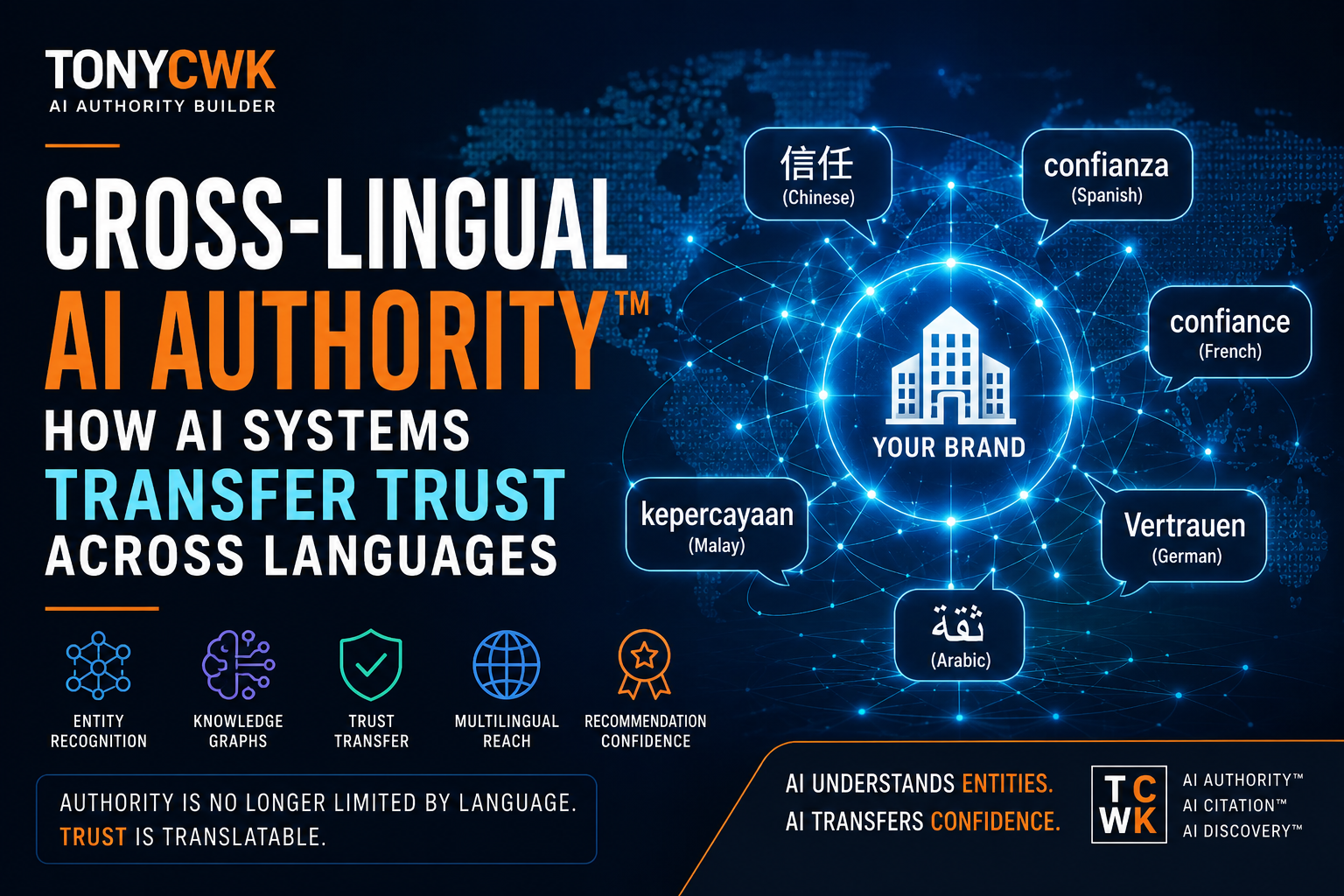
Cross-Lingual AI Authority™
The Traditional SEO Model: Authority Was Language-Bound
Traditional search engines primarily operated through language-specific indexes.
An English page competed against English pages.
A Spanish page competed against Spanish pages.
A Chinese page competed against Chinese pages.
Even when the same brand existed globally, authority signals often remained isolated within each language ecosystem.
This created several challenges:
- Duplicate content production across languages
- Separate backlink acquisition strategies
- Localized content maintenance
- Fragmented authority development
In this environment, authority rarely transferred automatically.
A company could dominate English search results while remaining virtually invisible elsewhere.
Trust had to be rebuilt repeatedly across markets.
The AI Shift: From Keywords to Entities
Modern AI systems increasingly think in terms of entities rather than documents.
Instead of asking:
“What page contains this keyword?”
AI systems increasingly ask:
“Which entities are most relevant to this question?”
An entity may represent:
- A company
- A brand
- A product
- A person
- A concept
- A location
- An organization
Entities exist independently of language.
For example:
The concept of Apple remains Apple whether discussed in English, Chinese, Spanish, Japanese, or French.
The words may change.
The entity remains the same.
This distinction is critical.
Once an AI system understands the entity, it can begin transferring confidence across linguistic boundaries.
Trust Transfer vs Content Translation
Many marketers assume global visibility requires global translation.
Translation certainly helps.
However, translation and trust transfer are not the same thing.
Translation moves content.
Trust transfer moves confidence.
A translated article may communicate information in another language.
But a trusted entity can influence recommendations even when content volume in that language remains relatively limited.
This is because AI systems increasingly connect information through:
- Knowledge graphs
- Citation networks
- Entity relationships
- Semantic similarity
- Multilingual embeddings
The AI is not simply translating words.
It is connecting confidence signals.
How AI Systems Transfer Trust Across Languages
The process generally occurs through several interconnected layers.
Layer 1: Entity Recognition
The AI identifies a specific entity.
For example:
- Brand
- Organization
- Individual
- Product
This establishes a stable reference point across languages.
Layer 2: Knowledge Consolidation
The system aggregates information from multiple sources.
These sources may include:
- Websites
- Research papers
- News publications
- Directories
- Social platforms
- Government databases
The entity becomes associated with topics, expertise, and credibility signals.
Layer 3: Citation Reinforcement
Repeated references strengthen confidence.
Consistent citations help AI systems determine:
- What the entity represents
- Which topics it owns
- Which expertise it demonstrates
Layer 4: Cross-Lingual Mapping
Modern AI systems map concepts across languages.
This allows confidence earned in one language to influence understanding in another.
Layer 5: Recommendation Confidence
When users ask questions in different languages, AI systems can leverage accumulated entity confidence to generate recommendations.
Trust begins to travel.
The Rise of Authority Portability
Historically, authority was localized.
Increasingly, authority is becoming portable.
Authority Portability™ refers to the ability of a trusted entity to maintain recommendation confidence across multiple languages, platforms, and retrieval environments.
Portable authority produces several advantages:
- Faster international visibility
- Reduced dependence on localized content volume
- Greater recommendation consistency
- Stronger AI citation potential
- Improved discoverability across markets
In an AI-driven ecosystem, portability may become one of the most valuable characteristics of digital authority.
Why This Matters for Businesses
Most businesses still optimize primarily for retrieval.
Their objective is:
“Can users find us?”
AI introduces a new objective:
“Will AI recommend us?”
As recommendation systems expand globally, businesses that build strong entity-level authority may gain visibility beyond their primary language market.
This creates opportunities for:
- SMEs seeking international customers
- SaaS companies expanding globally
- Professional services firms
- Personal brands
- E-commerce businesses
- Content publishers
The competitive advantage may increasingly come from authority systems rather than language-specific optimization alone.
The Role of AI Authority™
This is where AI Authority becomes particularly important.
AI Authority is not merely about rankings.
It is not merely about backlinks.
It is not merely about publishing content.
AI Authority is the accumulation of signals that increase the probability that AI systems will:
When those signals become strong enough, they can begin influencing recommendations across multiple languages and retrieval environments.
Cross-Lingual AI Authority represents one of the natural extensions of this process.
Building Cross-Lingual AI Authority
Organizations seeking stronger international visibility should focus on:
1. Entity Consistency
Maintain consistent information across all digital properties.
2. Structured Knowledge Architecture
Use schema and structured data where appropriate.
3. Citation Development
Earn references from authoritative and trustworthy sources.
4. Thematic Depth
Develop comprehensive expertise around core topics.
5. Ecosystem Reinforcement
Strengthen signals across websites, publications, social platforms, and industry references.
6. Global Discoverability
Ensure that AI systems can connect your entity across languages and regions.
The Future of AI Recommendations
As AI systems become increasingly multilingual, recommendation engines will rely less on isolated documents and more on interconnected knowledge networks.
The organizations that thrive may not be those producing the most content.
They may be those building the strongest authority systems.
Visibility can be translated.
And once earned, trust may increasingly travel across languages.
The future of global discoverability may not be content localization alone.
It may be the ability to build authority that survives translation.
That is the promise of Cross-Lingual AI Authority™.
Conclusion
Search engines historically organized information by language.
AI systems increasingly organize information by meaning.
This seemingly subtle shift changes everything.
When authority becomes attached to entities rather than pages, trust becomes more portable.
When trust becomes more portable, recommendations become more scalable.
And when recommendations become more scalable, businesses gain an entirely new pathway to global visibility.
The future of AI discovery may not simply be multilingual content.
It may be multilingual confidence.
FAQ
1. What is Cross-Lingual AI Authority™?
Cross-Lingual AI Authority™ refers to the ability of a brand, business, person, or entity to maintain AI trust and recommendation confidence across different languages.
2. How do AI systems transfer trust across languages?
AI systems may transfer trust through entity recognition, semantic mapping, citation patterns, knowledge graphs, structured data, and repeated references across trusted sources.
3. Is this the same as translating content?
No. Translation moves content from one language to another. Cross-lingual trust transfer moves confidence in an entity across languages.
4. Does this mean businesses no longer need multilingual SEO?
No. Multilingual SEO is still useful. However, AI Authority adds another layer by helping AI systems understand and trust the entity behind the content.
5. Why is entity consistency important?
Entity consistency helps AI systems recognize that the same brand, company, person, or product is being referenced across different platforms, languages, and sources.
6. Can small businesses benefit from Cross-Lingual AI Authority™?
Yes. Small businesses can benefit if they build consistent, credible, and structured authority signals that AI systems can understand and connect.
7. What signals support Cross-Lingual AI Authority™?
Important signals include structured data, citations, topical depth, brand consistency, authoritative mentions, multilingual references, and trusted third-party validation.
8. Why does this matter for AI search?
AI search is moving from keyword retrieval toward recommendation confidence. This means brands need to be not only findable, but also trusted enough to be recommended.
Suggested Reading
- The AI Citation Layer™
- AI Authority Pyramid™
- AI Discovery Flywheel™
- Why AI Doesn’t Trust Content — It Trusts Systems
- AI-Readable Knowledge Architecture
- The Unified Visibility Model™
- AI Authority Metrics™
- Entity Persistence In The Age of LLMs
Written by Tony Chan(TonyCWK)
AI Authority & Digital Strategy Researcher
Leave a Reply