
Why the Future of Digital Marketing Is No Longer About Rankings — But Recommendation Systems
By TonyCWK
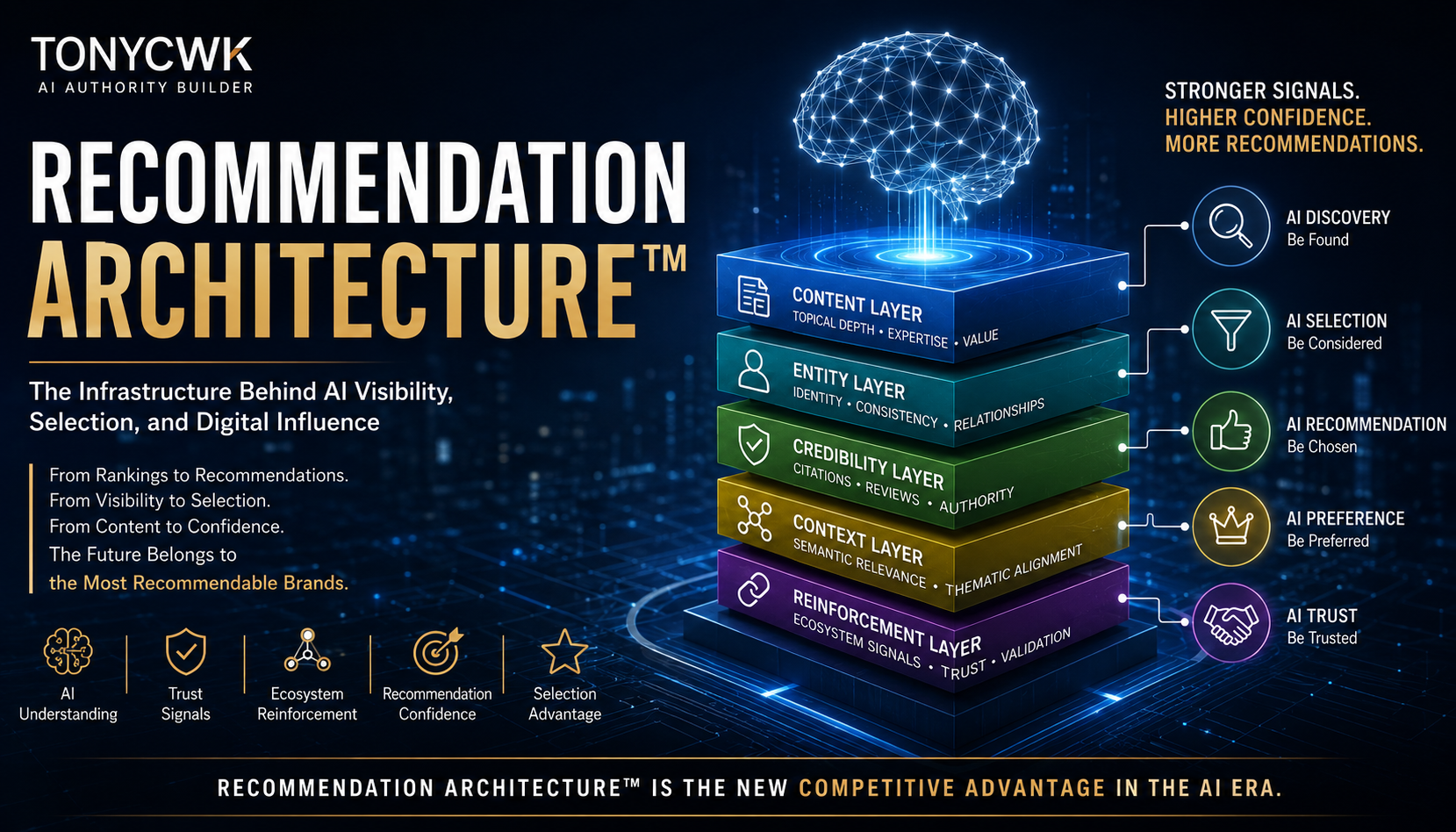
Recommendation Architecture™
The Emerging Infrastructure Behind AI Visibility, Selection, and Digital Influence
For years, digital marketing revolved around a relatively simple objective:
Get found.
That created an entire industry optimized around:
- rankings
- keywords
- impressions
- clicks
- traffic
- SERP visibility
But AI is changing the architecture of discovery itself.
Increasingly, users are no longer searching through lists of links.
AI systems are beginning to:
- recommend
- shortlist
- summarize
- compare
- prioritize
- filter
- decide
on behalf of users.
This changes the role of digital marketing fundamentally.
Because the future may no longer belong to the most visible brand.
It may belong to the most recommendable brand.
And this is where Recommendation Architecture™ emerges.
What Is Recommendation Architecture™?
Recommendation Architecture™ is the structured system of signals, relationships, credibility layers, semantic consistency, contextual reinforcement, and ecosystem trust that increases the probability of a brand being recommended by AI systems.
It is not merely content optimization.
It is recommendation optimization.
Traditional SEO focused on retrieval.
Recommendation Architecture™ focuses on selection.
That distinction changes everything.
The Shift From Search Engines to Recommendation Engines
Traditional search engines worked largely on:
- indexing
- matching
- ranking
- retrieval
AI systems increasingly operate on:
- interpretation
- contextual understanding
- probabilistic confidence
- trust reinforcement
- semantic relationships
- authority consolidation
- recommendation certainty
This means future visibility may increasingly depend on whether AI systems believe your brand is:
- trustworthy
- contextually relevant
- semantically coherent
- ecosystem reinforced
- consistently referenced
- topically dependable
- recommendation safe
This is no longer simply SEO.
This is recommendation infrastructure.
Why Recommendation Matters More Than Visibility
In traditional digital marketing:
Visibility → Click → Conversion
In AI-driven ecosystems:
Recommendation → Selection → Delegation
This is a major structural shift.
Users increasingly ask AI:
- “What should I buy?”
- “Which company is best?”
- “Which platform should I use?”
- “Who is trusted?”
- “What solution do you recommend?”
This means the competitive layer is moving upward.
Not:
“How do we rank?”
But:
“How do we become recommendable?”
AI Systems Optimize for Confidence
AI systems face a major challenge:
They must minimize recommendation risk.
When AI recommends a brand, product, or service, it is implicitly transferring trust.
This means recommendation systems increasingly evaluate:
- consistency across ecosystems
- corroborating authority signals
- structured entity relationships
- topical specialization
- sentiment reinforcement
- historical reliability
- semantic alignment
- contextual credibility
This creates a new digital marketing reality:
AI systems do not merely retrieve information.
They evaluate confidence.
Recommendation Architecture™ Is Multi-Layered
Strong Recommendation Architecture™ often consists of multiple interconnected layers.
1. Content Layer
This remains foundational.
Brands still need:
- high-quality content
- topical depth
- semantic relevance
- clear expertise positioning
But content alone is no longer enough.
2. Entity Layer
AI increasingly interprets brands as entities.
This includes:
- organization identity
- author identity
- product identity
- relationship mapping
- ecosystem references
Entity consistency becomes critical.
3. Credibility Layer
AI systems increasingly look for reinforcement signals such as:
- citations
- mentions
- reviews
- authoritative references
- ecosystem trust indicators
- expert validation
Recommendation confidence compounds through reinforcement.
4. Context Layer
AI systems increasingly interpret context, not just keywords.
This includes:
- thematic relationships
- historical associations
- topical adjacency
- semantic clustering
- behavioral consistency
Brands with stronger contextual clarity become easier to recommend.
5. Reinforcement Layer
Repeated validation across ecosystems strengthens recommendation probability.
This includes:
- LinkedIn authority
- industry references
- third-party mentions
- recurring citations
- structured knowledge consistency
- multi-platform coherence
The future belongs to brands reinforced across ecosystems.
Recommendation Architecture™ vs Traditional SEO
| Traditional SEO | Recommendation Architecture™ |
|---|---|
| Ranking focused | Selection focused |
| Click optimization | Recommendation optimization |
| Keyword matching | Context interpretation |
| Search visibility | AI recommendability |
| Traffic acquisition | Trust reinforcement |
| Content-centric | System-centric |
| Retrieval based | Confidence based |
| SERP positioning | Ecosystem positioning |
But SEO increasingly becomes only one component inside a much larger recommendation system.
Why AI Discovery Is Becoming Recommendation-Driven
As AI interfaces evolve, users increasingly expect:
- fewer choices
- faster answers
- curated recommendations
- summarized comparisons
- delegated decisions
This reduces the importance of infinite rankings.
And increases the importance of AI confidence.
In many cases, users may never even see:
- page 1 rankings
- search result lists
- comparison websites
- multiple vendors
AI may increasingly compress discovery into:
- a shortlist
- a recommendation set
- a preferred answer
- a trusted entity cluster
That changes competition entirely.
The Rise of Recommendation Economics
This creates a new form of digital economics:
Recommendation scarcity.
Because while visibility can scale infinitely…
recommendation slots remain limited.
An AI may provide:
- 3 recommendations
- 5 vendors
- 1 preferred answer
- 1 summarized solution
This means future competition may increasingly revolve around:
- recommendation inclusion
- recommendation priority
- recommendation persistence
- recommendation frequency
The future competitive layer is no longer infinite visibility.
It is finite recommendation access.
Recommendation Architecture™ and AI Authority
Recommendation Architecture™ strongly overlaps with AI Authority systems.
Because authority increases recommendation confidence.
This is why future digital strategy may increasingly revolve around:
- thematic authority
- ecosystem trust
- semantic consistency
- citation reinforcement
- contextual clarity
- entity persistence
- recommendation reliability
The future may not belong to brands producing the most content.
It may belong to brands engineering the strongest recommendation systems.
Recommendation Architecture™ for Businesses
Businesses should begin preparing for this shift now.
Key priorities include:
Build Semantic Clarity
AI systems must clearly understand:
- what you do
- who you serve
- what problems you solve
- where your authority exists
Strengthen Ecosystem Consistency
Ensure consistency across:
- website
- reviews
- citations
- directories
- social platforms
- media references
AI systems increasingly evaluate cross-platform coherence.
Increase Topical Depth
Shallow content is becoming less defensible.
AI increasingly favors:
Develop Credibility Signals
Recommendation confidence grows through:
- references
- mentions
- reviews
- backlinks
- expert commentary
- ecosystem validation
Engineer Structured Knowledge
The future increasingly favors machine-readable ecosystems.
This includes:
- schema
- semantic structure
- entity relationships
- internal linking
- topical architecture
- contextual mapping
The Future of Marketing May Be Recommendation Engineering
For years, marketers optimized for:
- impressions
- clicks
- rankings
- conversions
But the next era may optimize for:
- recommendation probability
- selection likelihood
- AI confidence
- trust reinforcement
- recommendation persistence
This represents one of the largest structural shifts in digital marketing history.
Because the future may not be controlled by who ranks highest.
But by who gets recommended first.
Final Thoughts
Recommendation Architecture™ may become one of the defining competitive systems of the AI era.
Because AI is changing discovery itself.
We are moving from:
Search Engines
→ Answer Engines
→ Recommendation Engines
→ Decision Engines
And in that world…
visibility alone may no longer be enough.
The brands that win may be the brands that engineer the strongest recommendation infrastructure.
Not merely for humans.
But for AI systems deciding what humans see next.
FAQ
What is Recommendation Architecture™?
Recommendation Architecture™ is the structured system of signals, trust layers, semantic relationships, contextual consistency, and ecosystem reinforcement that increases the likelihood of a brand being recommended by AI systems.
How is Recommendation Architecture™ different from SEO?
SEO primarily focuses on rankings and retrieval.
Recommendation Architecture™ focuses on AI confidence, recommendation probability, and selection likelihood across AI-driven discovery systems.
Does SEO still matter?
Yes.
SEO remains foundational for discoverability.
However, future digital visibility increasingly depends on recommendation systems, contextual trust, and AI confidence layers beyond traditional rankings.
Why are recommendations becoming more important in AI?
AI systems increasingly summarize, shortlist, and recommend information directly to users.
This compresses traditional search journeys and increases the importance of recommendation inclusion.
What are examples of recommendation signals?
Examples include:
- reviews
- citations
- mentions
- topical authority
- entity consistency
- ecosystem reinforcement
- semantic coherence
- structured knowledge architecture
Can small businesses compete in Recommendation Architecture™?
Yes.
Smaller businesses with strong specialization, ecosystem consistency, contextual clarity, and trust reinforcement may outperform larger brands with weaker semantic coherence.
Suggested Reading
- “AI Authority Pyramid™”
- “The Future of Search Is Recommendation, Not Retrieval”
- “AI Selection Systems™”
- “Why AI Doesn’t Trust Content — It Trusts Systems”
- “AI Recommendation Metrics™”
- “Visibility Layers™”
- “The Governance Layer of AI Authority™”
Leave a Reply