
By TonyCWK
Introduction
For years, multi-location SEO has focused on improving local rankings. Businesses created location pages, claimed Google Business Profiles, maintained NAP consistency, and encouraged customer reviews to increase their visibility in local search results.
Those practices remain important.
But AI-powered search has changed what happens after visibility.
Modern AI systems do not simply ask:
“Can I find this business?”
They increasingly ask:
“How confident am I that this organisation consistently delivers what it claims?”
That shift introduces a new way of thinking about multi-location businesses.
Every verified location is no longer just another opportunity to rank.
It becomes another piece of evidence.
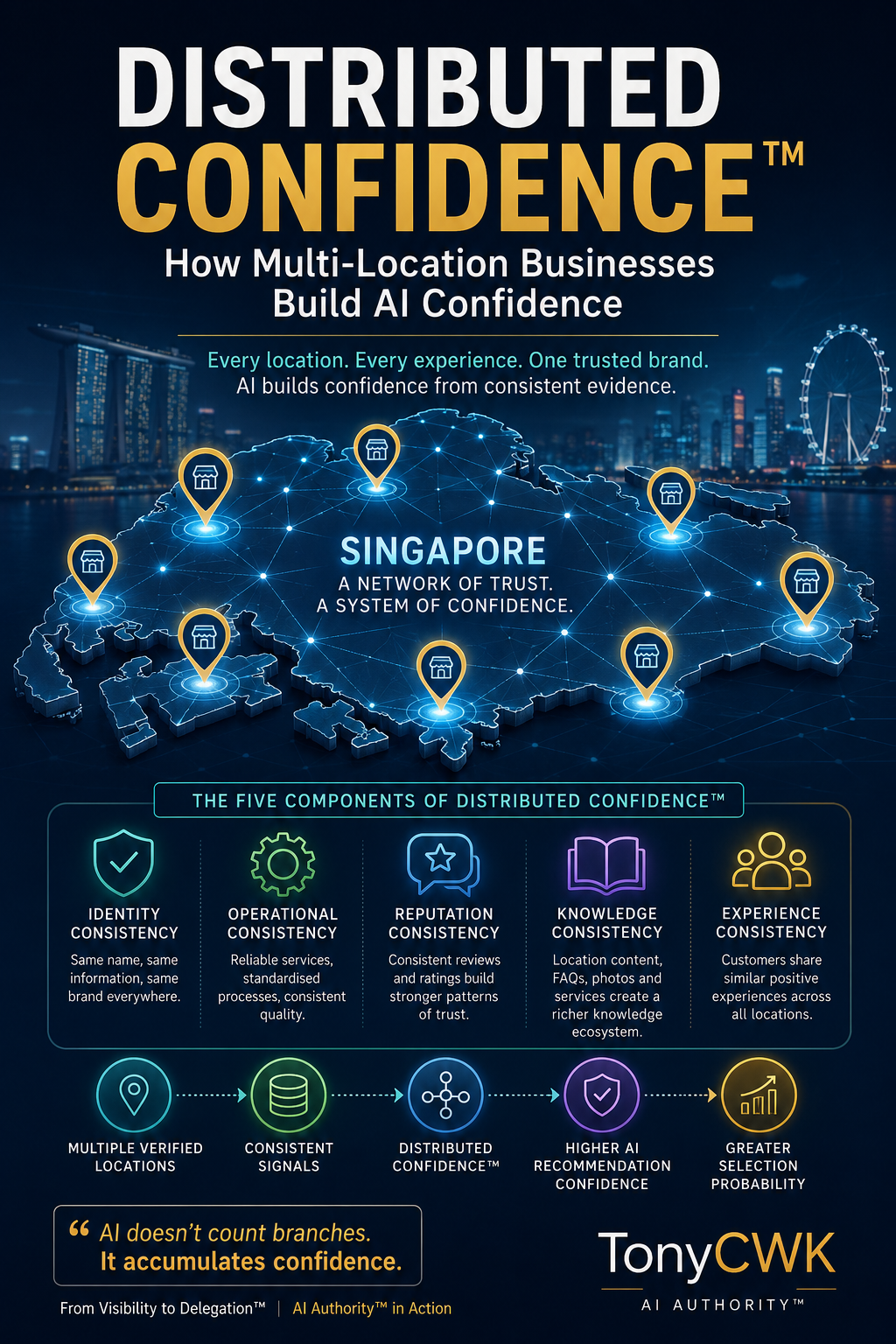
This is what I call Distributed Confidence™.
AI Doesn’t Count Locations. It Evaluates Networks.
Traditional search engines largely evaluated pages independently.
A location page competed with other location pages.
An individual Google Business Profile competed with nearby businesses.
AI systems increasingly evaluate relationships.
They observe how an organisation behaves across an entire ecosystem.
Rather than seeing:
Company
↓

Website
AI increasingly sees:
Organisation

↓

Head Office

↓

Regional Offices

↓

Retail Stores

↓

Google Business Profiles

↓

Reviews

↓

Local Citations

↓

Customer Experiences

↓

Structured Knowledge
Every verified connection strengthens the overall entity.
Confidence grows because independent signals consistently reinforce one another.
What Is Distributed Confidence™?
Distributed Confidence™ is the increase in AI recommendation confidence created by consistent evidence across multiple business locations, entities, customer experiences, and trusted information sources.
Unlike traditional authority signals, Distributed Confidence™ is not built from one exceptional webpage.
It is built from many independent signals telling the same story.
Each location contributes evidence.
Each review contributes evidence.
Each customer interaction contributes evidence.
Together they create a stronger confidence profile than any single location could achieve alone.
The Distributed Confidence™ Model
Multiple Verified Locations

↓

Consistent Business Identity

↓

Consistent Customer Experiences

↓

Consistent Reputation Signals

↓

Distributed Confidence™

↓

Higher AI Recommendation Confidence

↓

Greater Selection Probability
Notice what changes.
Confidence is not generated by quantity.
It is generated by consistency across distributed evidence.
The Five Components of Distributed Confidence™
1. Identity Consistency
Every location should reinforce the same organisation.
AI looks for consistency across:
- Business name
- Website
- Google Business Profile
- Contact information
- Services
- Categories
- Brand identity
When these remain consistent, AI develops stronger confidence that every location belongs to the same trusted organisation.
2. Operational Consistency
Customers expect similar experiences regardless of which branch they visit.
AI increasingly learns from recurring patterns.
For example:
- similar service quality
- consistent operating hours
- reliable product availability
- standardised customer support
Consistency reduces uncertainty.
Lower uncertainty increases confidence.
3. Reputation Consistency
One outstanding branch is encouraging.
Fifty consistently well-reviewed branches are far more convincing.
AI evaluates patterns rather than isolated success.
Consistent positive experiences across multiple locations demonstrate organisational reliability rather than individual excellence.
4. Knowledge Consistency
Every location contributes unique knowledge.
Examples include:
- local FAQs
- location-specific services
- staff expertise
- photographs
- accessibility information
- customer updates
Together these create a richer knowledge ecosystem that AI can better understand and reference.
5. Experience Consistency
Ultimately, customers validate confidence.
When customers consistently report similar positive experiences across multiple branches, AI accumulates stronger evidence that the organisation delivers predictable outcomes.
Confidence becomes reinforced through repetition.
A Singapore Perspective
Singapore may be geographically small, but it provides an excellent example of Distributed Confidence™ in practice.
Consumers rarely search simply for a company name.
Instead, they ask location-specific questions such as:
- “Laptop repair near Tampines”
- “Printer shop in Jurong”
- “Dental clinic near Bishan”
- “IT support in Paya Lebar”
- “Tuition centre near Woodlands”
Businesses with multiple verified locations are able to provide AI with richer contextual evidence for each area they serve.
For example, a retail chain with outlets in Orchard, Tampines, Jurong East, and Woodlands does not merely expand its physical presence. Each branch contributes local reviews, photographs, operating hours, service information, and customer experiences. Together, these signals strengthen AI’s confidence in the organisation as a whole.
For Singapore SMEs expanding into multiple neighbourhoods—or even across Singapore and Johor Bahru—this means every new, well-managed location can become another trusted node in the company’s digital ecosystem.
Why This Matters For AI Authority™
Distributed Confidence™ naturally extends the AI Authority™ progression.
Visibility

↓

Authority

↓

Confidence

↓

Trust

↓

Delegation
Within the Confidence stage, AI evaluates whether evidence is isolated or distributed.
An organisation supported by consistent evidence across many verified locations develops stronger recommendation confidence than one relying on a single digital presence.
Confidence compounds.
The Future Of Multi-Location AI Visibility
The future is not about creating hundreds of location pages.
It is about creating hundreds of consistent trust signals.
Every verified branch.
Every satisfied customer.
Every accurate business profile.
Every consistent review.
Every structured location page.
Each contributes another piece of evidence that reinforces organisational confidence.
As AI systems increasingly recommend businesses rather than simply retrieve webpages, distributed confidence may become one of the most valuable competitive advantages multi-location organisations can build.
Conclusion
Traditional local SEO taught businesses to optimise every location for better rankings.
The AI era requires something more.
Every location is now part of a larger confidence network.
The organisations that succeed will not necessarily be those with the most locations.
They will be those whose locations consistently reinforce the same identity, reputation, expertise, and customer experience.
Because AI doesn’t simply count branches.
It accumulates confidence from distributed evidence.
That is the essence of Distributed Confidence™.
FAQ
1. What is Distributed Confidence™?
Distributed Confidence™ is the increase in AI recommendation confidence created when multiple business locations, reviews, citations, profiles, and customer experiences consistently reinforce the same organisation.
2. How is Distributed Confidence™ different from local SEO?
Local SEO focuses on improving visibility for specific locations. Distributed Confidence™ focuses on how AI systems build confidence from consistent evidence across an entire location network.
3. Why do multi-location businesses have an advantage in AI search?
Multi-location businesses can create more verified evidence points, including location pages, Google Business Profiles, reviews, photos, citations, and customer experiences. When these signals are consistent, AI can develop stronger confidence in the organisation.
4. Does having more locations automatically improve AI confidence?
No. More locations only help when the information, reputation, service quality, and customer experience are consistent. Poorly managed locations can weaken AI confidence instead of strengthening it.
5. Why is this important for Singapore businesses?
Singapore customers often search with neighbourhood or district intent, such as “near Tampines,” “in Jurong,” or “near Paya Lebar.” Businesses with well-managed location signals can give AI clearer evidence of where they operate and how reliably they serve customers.
6. What signals help build Distributed Confidence™?
Important signals include consistent business identity, accurate location information, strong reviews, reliable operating hours, localised service pages, structured data, customer photos, citations, and consistent customer experiences.
7. Can single-location businesses build Distributed Confidence™?
Single-location businesses have fewer physical nodes, but they can still build distributed evidence through reviews, citations, partnerships, media mentions, case studies, social profiles, and consistent structured knowledge across platforms.
8. How does Distributed Confidence™ support AI Authority™?
AI Authority™ helps explain why AI systems select and recommend certain businesses. Distributed Confidence™ supports this by showing how consistent evidence across multiple locations can strengthen AI recommendation confidence.
Leave a Reply