
Introduction
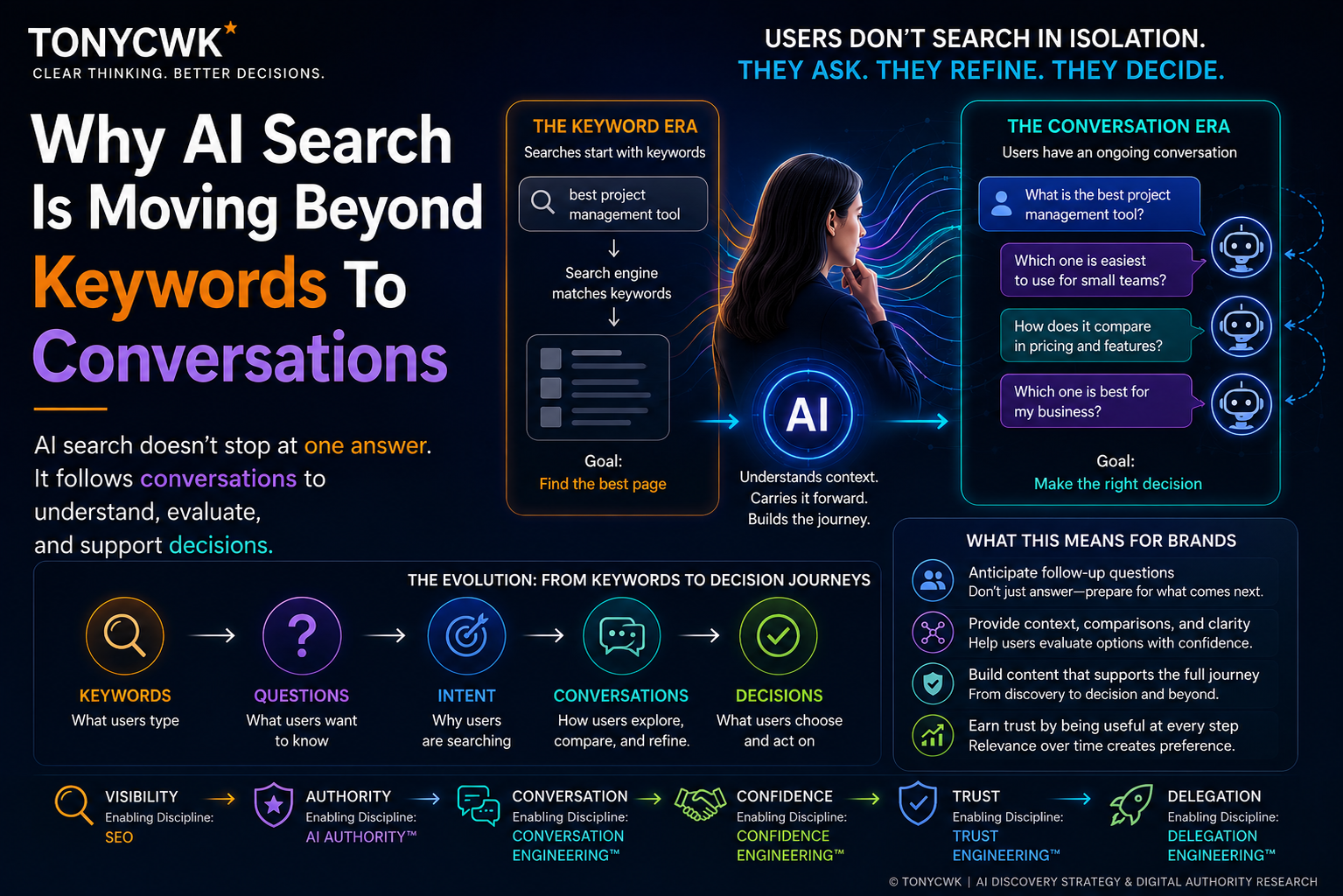
For more than two decades, digital marketing revolved around keywords.
Users typed short phrases into search engines.
Search engines matched those keywords to relevant webpages.
Success depended on ranking for the right terms.
Today, AI-powered search experiences are changing that model.
Users increasingly ask follow-up questions, refine their requests, compare options, and seek guidance throughout an ongoing interaction.
The focus is shifting from isolated keywords to connected conversations.
This change has significant implications for how brands create content and how they support users throughout the decision journey.
The Keyword Era
Explain:
- Exact match
- Keyword optimization
- Ranking
- SERPs
Goal:
Find the best page.
The Intent Era
Discuss the evolution to:
- Informational
- Commercial
- Transactional
- Navigational intent
Search became better at understanding why people searched.
The Conversation Era
Today’s AI search experiences increasingly support multi-turn interactions.
Users rarely stop after one answer.
Instead, they ask:
- Why?
- How?
- Which option?
- What happens next?
- Is this suitable for my business?
Rather than restarting the search process, AI systems often continue the interaction, carrying forward the context established earlier in the conversation.
Why Conversations Matter
Conversations naturally reduce uncertainty.
Each new question:
- clarifies intent
- provides context
- narrows options
- builds confidence
This is why conversations are closely connected to decision-making.
From Keywords To Decision Journeys
Illustrate with a table:
Keyword
↓
Question
↓
Intent
↓
Conversation
↓
Decision
Show how each stage adds context rather than replacing the previous one.
What This Means For Brands
Instead of asking:
“What keywords should we rank for?”
Brands should also ask:
“What questions will users ask after this?”
This encourages content that supports the full decision journey.
The Role Of Conversation Engineering™
Conversation Engineering™ provides a structured approach to designing content that supports these evolving interactions.
Rather than treating every page as an isolated destination, it connects information across related questions and stages of decision-making.
It complements SEO by extending content beyond discovery into ongoing engagement.
Conclusion
Keywords remain important because they often begin the discovery process.
However, discovery is increasingly only the beginning.
As AI-powered search experiences become more conversational, the brands that provide useful context, answer follow-up questions, and support decisions are likely to remain valuable throughout the user journey.
Conversation Engineering™ helps organizations prepare for this shift by designing content that advances conversations—not simply individual queries.
Frequently Asked Questions (FAQ)
1. Why is AI search moving beyond keywords?
Keywords remain important for helping AI systems and search engines understand the topic of a query. However, modern AI-powered search experiences increasingly support multi-turn interactions, allowing users to refine questions, compare options, and explore topics through an ongoing conversation. As a result, content that supports the broader decision journey becomes increasingly valuable.
2. Do keywords still matter in AI search?
Yes. Keywords continue to play an important role in content discovery and topic relevance. Conversation Engineering™ does not replace keyword optimization—it builds upon it by helping brands anticipate follow-up questions, provide additional context, and support users throughout the conversation.
3. What is the difference between keywords, search intent, and conversations?
Keywords describe what users type or say.
Search intent explains why they are searching.
Conversations describe how users progressively explore, evaluate, and refine information across multiple related questions before making a decision.
Each layer adds more context rather than replacing the previous one.
4. Why are conversations becoming more important in AI-powered search?
AI-powered search experiences often maintain context across multiple questions instead of treating every query independently. This enables users to ask follow-up questions naturally, compare alternatives, and receive responses that build upon previous interactions.
For content creators, this means designing information that remains useful beyond the first answer.
5. What is Conversation Engineering™?
Conversation Engineering™ is the practice of designing content, knowledge structures, and digital experiences that help users progress through a sequence of questions, evaluations, and decisions rather than answering only a single query.
Its goal is to support the complete decision journey.
6. How does Conversation Engineering™ relate to AI Authority™?
AI Authority™ focuses on becoming a trusted recommendation source.
Conversation Engineering™ complements AI Authority™ by helping brands provide useful information throughout the user’s decision journey.
Together, they help move from discovery to recommendation, confidence, trust, and ultimately informed action.
7. How can businesses prepare for conversational AI search?
Businesses can prepare by creating comprehensive, well-structured content that addresses not only the initial question but also likely follow-up questions, comparisons, implementation considerations, and decision factors.
Rather than publishing isolated articles, organizations should build interconnected knowledge that supports users from discovery through decision-making.
8. Will Conversation Engineering™ replace SEO?
No.
SEO remains essential for helping users and AI systems discover your content.
Conversation Engineering™ extends SEO by focusing on what happens after discovery—supporting users through ongoing conversations that build understanding, confidence, and informed decisions.
Leave a Reply