
By TonyCWK
Evergreen Content Isn’t Dead. Its Role Has Changed.
For years, marketers were taught to create evergreen content—articles that remain useful months or even years after publication. The goal was simple: rank consistently, generate organic traffic, and answer recurring questions.
That strategy is still valuable.
But the rise of AI-powered search, conversational assistants, and autonomous AI agents has changed what evergreen content is expected to accomplish.
Today, evergreen content alone is no longer the competitive advantage.
The competitive advantage is evergreen authority.
The future isn’t just about publishing content that stays relevant. It’s about building expertise that AI systems continuously recognize, trust, and recommend.
The Traditional Role of Evergreen Content
In the SEO era, evergreen content was designed to achieve three objectives:
- Rank consistently in search engines
- Generate long-term organic traffic
- Answer timeless user questions
Typical examples include:
- What is SEO?
- How does Google Ads work?
- Beginner’s Guide to Cybersecurity
- What is Structured Data?
These articles continue attracting visitors because the questions rarely change.
Success was often measured by:
- Rankings
- Clicks
- Traffic
- Pageviews
- Time on page
The content itself was the primary asset.
Why AI Is Changing the Equation
Large Language Models don’t search the web the same way traditional search engines do.
Instead of simply retrieving pages, AI systems increasingly:
- Understand entities
- Connect concepts
- Evaluate expertise
- Compare multiple sources
- Assess credibility
- Recommend the most trustworthy information
This changes the purpose of content.
Rather than asking:
“Can this article rank?”
AI increasingly asks:
“Can this source be trusted?”
The emphasis shifts from retrieval to recommendation.
Evergreen Content Is Becoming Commodity Knowledge
Generic informational content has become easier than ever to produce.
Anyone can now generate:
- Definitions
- Basic tutorials
- Checklists
- Introductory guides
- FAQs
As a result, AI systems can often summarize this information without requiring users to visit the original webpage.
This doesn’t make evergreen content obsolete.
It simply means that generic knowledge alone is no longer sufficient to establish authority.
The Rise of Evergreen Authority
Evergreen Authority is not about creating more content.
It is about creating knowledge that continues strengthening your credibility over time.
Instead of asking:
“Will this article still rank in two years?”
Ask:
“Will this article still reinforce my expertise in two years?”
That subtle difference changes everything.
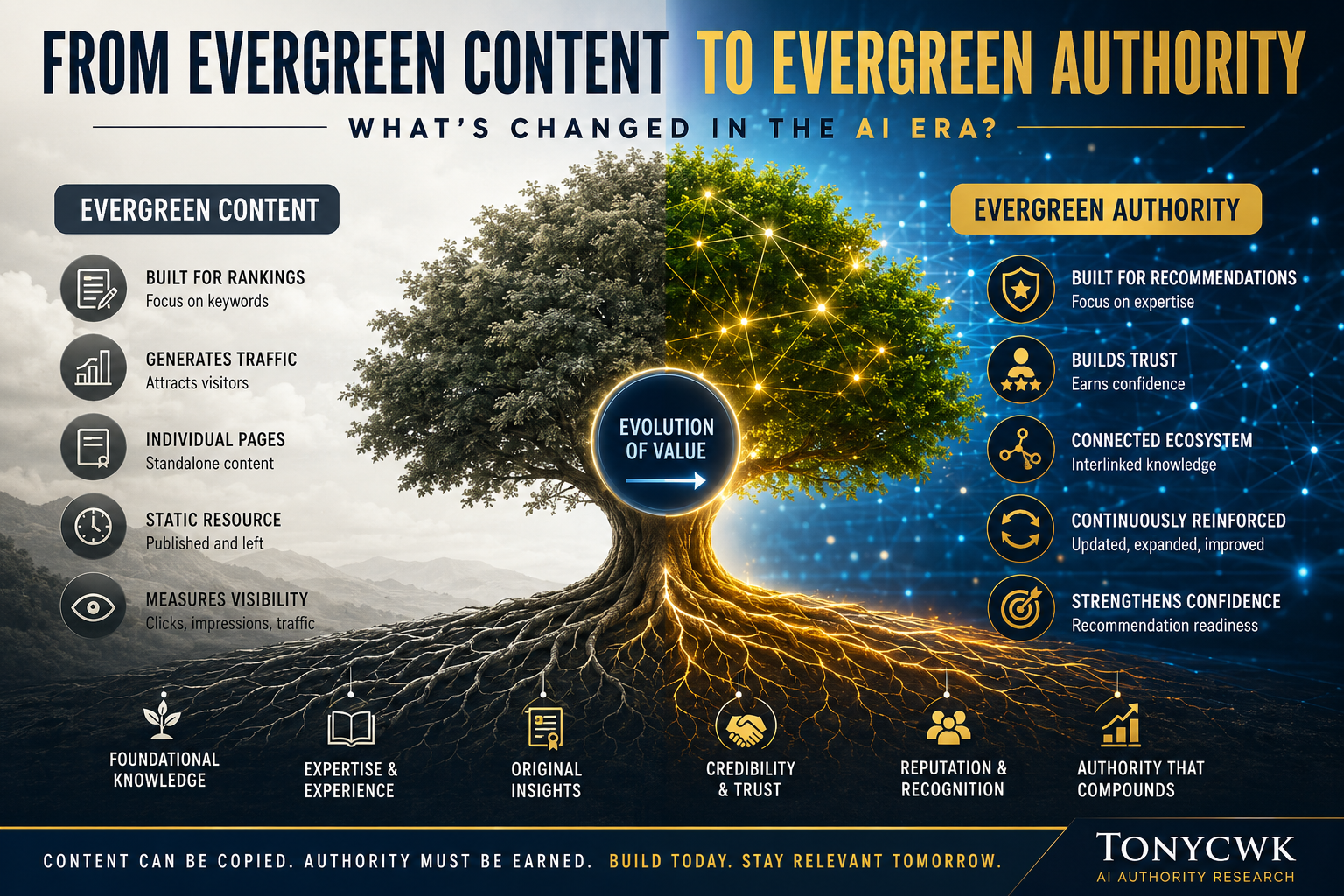
Evergreen Content vs Evergreen Authority
| Evergreen Content | Evergreen Authority |
|---|---|
| Built for rankings | Built for recommendations |
| Focuses on keywords | Focuses on expertise |
| Generates traffic | Builds trust |
| Individual articles | Connected knowledge ecosystem |
| Static resource | Continuously reinforced authority |
| Measures visibility | Strengthens recommendation confidence |
Evergreen content remains useful.
Evergreen authority compounds.
What Actually Becomes Evergreen?
Many marketers assume pages become evergreen.
In reality, AI systems increasingly recognize much larger patterns.
The most valuable long-term assets include:
Evergreen Knowledge
Foundational concepts that remain accurate over time.
Examples include:
- Marketing principles
- Cybersecurity fundamentals
- Consumer psychology
- Business strategy
Evergreen Expertise
Demonstrating consistent depth across an entire subject.
This includes:
- Original insights
- Proprietary methodologies
- Case studies
- Research
- Practical experience
Evergreen Identity
Maintaining a consistent point of view across:
- Website
- Articles
- Videos
- Podcasts
- Interviews
Consistency helps both humans and AI understand who you are and what you represent.
Evergreen Credibility
Authority is reinforced by external validation.
Examples include:
- Citations
- Mentions
- Reviews
- Awards
- Speaking engagements
- Research references
- Industry recognition
Credibility compounds when others continue referencing your work.
The Shift From Traffic Assets to Authority Assets
Traditional SEO encouraged creating content that generated traffic.
AI encourages creating assets that strengthen authority.
Examples include:
- Original frameworks
- Research reports
- Industry studies
- Proprietary models
- Unique datasets
- Expert commentary
- First-party experience
These become reference points that AI systems can repeatedly associate with your expertise.
AI Doesn’t Evaluate One Article
One important misconception is believing that AI evaluates individual pages independently.
Increasingly, AI evaluates an entire knowledge ecosystem.
That ecosystem includes:
- Website content
- Topic depth
- Structured knowledge
- External citations
- Entity relationships
- Consistency across platforms
- Reputation signals
- Original contributions
Authority is not built by one excellent article.
It emerges from repeated evidence across your entire digital presence.
Evergreen Authority Requires Continuous Reinforcement
Authority is not permanent.
Industries evolve.
Technology changes.
Customer expectations shift.
New research emerges.
Therefore, evergreen authority requires ongoing reinforcement through:
- Updating foundational articles
- Publishing new supporting insights
- Adding fresh examples
- Expanding knowledge clusters
- Refining frameworks
- Responding to industry developments
Evergreen does not mean static.
It means continuously relevant.
A New Way to Think About Evergreen
Instead of viewing evergreen content as something that never changes, consider it as knowledge that continually evolves while preserving its core principles.
Think of it like a tree.
Its roots remain stable.
Its branches continue growing.
Its leaves are renewed every season.
The stronger the roots become, the stronger the entire ecosystem becomes.
Authority grows the same way.
What This Means for Content Strategy
Instead of asking:
- What keywords should I target?
- What articles should I publish?
Consider asking:
- What expertise do I want to become known for?
- What knowledge should AI consistently associate with my brand?
- Which articles reinforce that expertise?
- What original insights only I can contribute?
- How does each new article strengthen my authority ecosystem?
These questions lead to a more sustainable content strategy.
The Future Belongs to Evergreen Authority
Search is evolving from retrieving information to recommending expertise.
As AI assistants become decision-support systems—and increasingly autonomous agents—the value of enduring authority will continue to rise.
Evergreen content will always have a place.
But its greatest purpose is no longer simply attracting visitors.
Its purpose is to build an authority that AI systems can confidently understand, trust, and recommend over time.
That is the evolution from Evergreen Content to Evergreen Authority.
Key Takeaways
- Evergreen content remains important, but its purpose has evolved.
- Generic informational content is increasingly commoditized by AI.
- Long-term success depends on building evergreen expertise, credibility, and knowledge.
- AI evaluates authority across an entire knowledge ecosystem rather than a single page.
- The most valuable content is content that continually reinforces recommendation confidence.
Evergreen content survives because it stays useful. Evergreen authority grows because it stays trusted.
Final Thoughts
The AI era doesn’t replace the principles of evergreen content—it elevates them.
In a world where AI can generate answers instantly, lasting differentiation comes from expertise, consistency, credibility, and original knowledge. Those qualities are difficult to automate, easy to recognize over time, and increasingly valuable to both people and AI systems.
The goal is no longer just to publish content that remains relevant. The goal is to build authority that remains indispensable.
“In the SEO era, evergreen content generated traffic. In the AI Authority era, evergreen authority generates recommendations.”
Frequently Asked Questions
1. Is evergreen content still relevant in the AI era?
Yes. Evergreen content remains valuable because people and AI systems still need reliable explanations of enduring topics. What has changed is that generic evergreen content is easier to reproduce and summarize. To create lasting value, evergreen content now needs to demonstrate expertise, originality, credibility, and clear connections to a wider knowledge ecosystem.
2. What is evergreen authority?
Evergreen authority is the long-term recognition of a person, brand, or organisation as a credible source within a particular subject area. It is built through consistently useful content, original insights, subject-matter depth, external validation, and a clear identity that remains recognisable over time.
3. How is evergreen authority different from evergreen content?
Evergreen content is an individual resource that remains useful for a long period. Evergreen authority is the broader reputation and expertise created when many useful resources, credibility signals, and original contributions reinforce one another over time.
4. Is evergreen content becoming less valuable because of AI-generated answers?
Generic evergreen content may receive less visibility when AI systems can answer basic informational questions directly. However, content containing first-hand experience, original research, proprietary frameworks, expert interpretation, and verifiable evidence can become more valuable because it gives AI systems a stronger reason to cite, reference, or recommend the source.
5. What types of evergreen content are most valuable in the AI era?
The most valuable evergreen content usually includes original frameworks, research, detailed case studies, practical experience, authoritative reference material, expert analysis, and regularly maintained foundational resources. These assets provide more differentiation than basic definitions or introductory summaries.
6. Does evergreen content need to be updated?
Yes. Evergreen does not mean permanently unchanged. Foundational ideas may remain stable, but examples, statistics, technologies, regulations, links, and industry practices can become outdated. Periodic updates help preserve accuracy, relevance, credibility, and usefulness.
7. How can a business build evergreen authority?
A business can build evergreen authority by developing a clear area of expertise, publishing connected and authoritative content, contributing original knowledge, maintaining consistency across platforms, earning credible third-party recognition, and regularly updating important resources.
8. How does evergreen authority support AI visibility?
Evergreen authority helps AI systems understand what a source is known for, how consistently it covers a topic, and whether its claims are supported by credible evidence. This may strengthen the source’s likelihood of being considered during AI-generated explanations and recommendations, although no framework can guarantee citation or selection.
9. Is personal branding necessary for evergreen authority?
Personal branding can strengthen evergreen authority, particularly when expertise is closely associated with an individual. However, organisations can also build authority through their research, products, documentation, specialists, customer outcomes, reputation, and wider knowledge ecosystem.
10. What is the main shift from traditional evergreen content to evergreen authority?
The main shift is from creating isolated pages that generate traffic to building a connected body of knowledge that reinforces expertise, credibility, and recommendation confidence over time.
Leave a Reply