
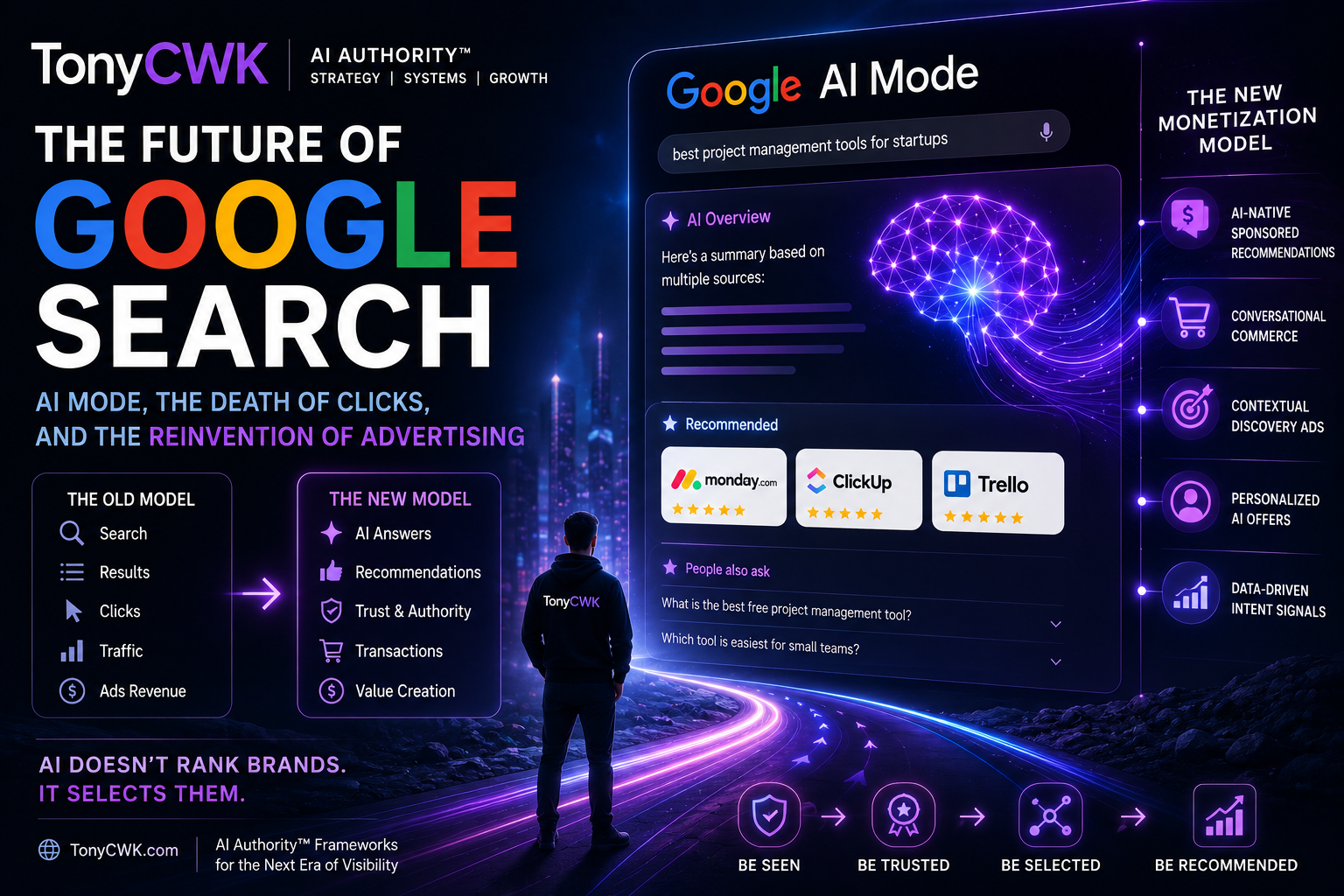
Google is no longer just evolving Search.
It is rebuilding the economics of the internet.
For over two decades, the web operated on a relatively stable model:
- Users searched
- Google ranked pages
- Websites received clicks
- Publishers monetized traffic
- Google monetized ads
But AI search changes everything.
With the rise of:
- AI Overviews,
- AI Mode,
- conversational search,
- synthesized answers,
- multimodal reasoning,
- and agentic discovery,
Google is transitioning from:
a search engine
to:
an AI discovery and decision platform.
And this shift could fundamentally redefine:
- SEO,
- digital advertising,
- publisher economics,
- and how brands achieve visibility online.
The Old Search Economy Was Built on Clicks
Traditional Google Search depended heavily on the “click economy.”
A simplified version looked like this:
| User Action | Business Outcome |
|---|---|
| Search query | Ad auction triggered |
| Organic results displayed | Publishers receive traffic |
| User clicks link | Google earns ad revenue |
| Website converts visitor | Businesses profit |
The system worked because:
- users needed websites,
- websites needed Google,
- advertisers needed traffic.
This created one of the most profitable business models in history.
But AI search compresses this journey.
AI Search Reduces the Need to Click
Google’s AI Mode increasingly delivers:
- synthesized answers,
- summarized recommendations,
- contextual guidance,
- comparison reasoning,
- direct shopping suggestions,
- and conversational exploration.
Instead of:
- 10 blue links,
users now increasingly receive:
- one AI-generated answer.
Google itself is rapidly expanding:
- AI Overviews,
- conversational search flows,
- AI Mode experiences,
- contextual exploration features,
- and recommendation-style interfaces.
This creates a major disruption:
If users stop clicking websites,
the traditional web monetization model weakens.
The Rise of the Zero-Click Internet
The internet is entering what many analysts call:
the “zero-click era.”
Search Engine Land reports that:
- zero-click searches now dominate many mobile experiences,
- AI Overviews increasingly intercept informational searches,
- and publishers are seeing significant CTR declines.
This creates a structural problem for:
- publishers,
- bloggers,
- affiliate sites,
- informational websites,
- and SEO-driven businesses.
Because traffic was previously the core economic asset.
Now:
AI systems can extract value from content
without sending proportional traffic back.
Google’s Core Dilemma
Google faces a dangerous balancing act.
AI search improves user experience because:
- answers become faster,
- research becomes easier,
- discovery becomes conversational,
- and information becomes synthesized.
But simultaneously:
- fewer clicks may reduce ad inventory,
- fewer website visits may weaken the web ecosystem,
- and publishers may lose incentives to create high-quality content.
This creates the biggest strategic question in Google’s history:
How do you monetize AI answers
without destroying the ecosystem that powers them?
Google Is Already Testing the Answer
The answer appears to be:
AI-native advertising.
Google has already confirmed testing sponsored formats inside AI Mode.
Rather than showing:
- traditional sponsored links,
Google is experimenting with:
- contextual recommendations,
- sponsored retailer placements,
- conversational product suggestions,
- personalized offers,
- AI-integrated commerce experiences.
Google recently described new AI Mode ad formats that:
- surface sponsored retailers,
- integrate contextual shopping suggestions,
- and appear during “moments of consideration.”
This is an enormous shift.
Advertising Is Becoming Conversational
Traditional ads were:
- interruptive,
- keyword-triggered,
- placement-based.
AI search advertising is becoming:
- contextual,
- intent-aware,
- recommendation-oriented,
- embedded inside conversations.
Instead of:
“Sponsored Result”
future AI search may increasingly say:
“Based on your needs, these are recommended providers.”
That changes advertising fundamentally.
The future is not:
- ranking competition.
The future is:
- recommendation competition.
The Evolution from SEO to AI Authority
This is why traditional SEO alone is becoming insufficient.
Classic SEO optimized for:
- visibility,
- rankings,
- keywords,
- and click-through rates.
But AI systems optimize for:
- trust,
- contextual relevance,
- synthesis-worthiness,
- entity clarity,
- and recommendation confidence.
The optimization target changes from:
“Can Google find you?”
to:
“Will AI systems trust and select you?”
This is the emergence of:
AI Authority
AI Doesn’t Rank Brands. It Selects Them.
Modern AI search increasingly behaves like:
- a researcher,
- a recommender,
- a synthesizer,
- and a decision engine.
This means brands must evolve from:
- traffic acquisition,
to: - authority acquisition.
From:
- ranking signals,
to: - trust systems.
From:
- content volume,
to: - ecosystem credibility.
Why Google Still Needs the Open Web
Despite AI synthesis,
Google still depends heavily on:
- publishers,
- creators,
- forums,
- communities,
- blogs,
- and expert content.
Recent AI updates increasingly emphasize:
- authentic voices,
- real-world experiences,
- expert perspectives,
- Reddit/community discussions,
- and contextual source exploration.
This suggests Google understands:
AI alone cannot replace the human web.
Instead:
Google is attempting to become
the orchestrator of web intelligence.
The New Advertising Model: AI Discovery Commerce
Google’s likely future monetization model includes:
1. Sponsored AI Recommendations
AI-generated answers with integrated sponsored placements.
2. Conversational Commerce
Users purchasing products directly inside AI interactions.
3. Contextual Discovery Ads
Ads triggered by inferred intent rather than exact keywords.
4. Personalized AI Offers
Real-time contextual promotions during AI conversations.
5. AI-Native Shopping Ecosystems
Google integrating:
- recommendations,
- checkout,
- shopping agents,
- and transaction flows
inside AI interfaces.
Why This Matters for Brands
The future competitive advantage may no longer belong to:
- the brand with the best SEO tricks,
- the biggest ad spend,
- or the most content.
Instead, AI-era visibility may increasingly favor:
- trusted entities,
- recognized expertise,
- ecosystem reinforcement,
- semantic consistency,
- structured knowledge,
- and credibility signals.
In other words:
brands must become
AI-selectable.
The Future of Digital Visibility
The old internet was built on:
- clicks,
- rankings,
- impressions,
- and traffic.
The new AI internet is increasingly built on:
- selection,
- recommendation,
- synthesis,
- trust,
- and contextual authority.
This is why:
SEO is not disappearing.
But it is evolving upward.
Traditional SEO becomes:
- the discoverability infrastructure.
AI Authority becomes:
- the recommendation advantage layer.
Final Thought
Google’s AI transition is not simply a feature update.
It is the beginning of a new economic model for the internet.
The companies that win in the next era may not be:
- the most visible brands,
but: - the most trusted,
- most structured,
- most contextually authoritative,
- and most consistently selected by AI systems.
Because in the age of AI search:
Visibility alone is no longer enough.
The future belongs to brands
that AI systems choose to recommend.
FAQs
1. What is Google AI Mode?
Google AI Mode is Google’s AI-powered search experience that gives users synthesized answers, deeper exploration, and conversational follow-up instead of only showing traditional search results.
2. How is AI Mode different from traditional Google Search?
Traditional Search mainly ranks links. AI Mode summarizes, compares, recommends, and guides users through answers using multiple sources.
3. Will Google AI Search reduce website traffic?
Yes, for some queries. AI-generated answers may reduce clicks, especially for informational searches where users get the answer directly inside Google.
4. Does this mean SEO is dead?
No. SEO is not dead, but its role is changing. SEO helps content become discoverable; AI Authority helps content become selected, cited, and recommended.
5. How will Google make money from AI Search?
Google can monetize AI Search through sponsored recommendations, contextual ads, AI-native shopping results, conversational commerce, and personalized commercial suggestions.
6. Will paid ads still work in AI Search?
Yes, but paid ads may become less dependent on traditional keyword placements and more focused on context, intent, recommendations, and moments of decision.
7. What is AI-native advertising?
AI-native advertising refers to sponsored placements or recommendations embedded naturally inside AI search experiences, rather than appearing only as separate text ads.
8. Why is this shift important for brands?
Brands may no longer compete only for rankings. They will increasingly compete to be selected by AI systems as trusted, relevant, and recommendation-worthy sources.
9. What is the “death of clicks”?
The “death of clicks” refers to the decline of traditional website traffic as AI systems answer more questions directly without requiring users to visit websites.
10. Will Google lose advertising revenue because of AI Search?
Google may face pressure on traditional ad revenue, but it is also creating new monetization models around AI recommendations, shopping, and contextual discovery.
11. What is AI Authority?
AI Authority is the ability of a brand, expert, or website to be recognized, trusted, selected, and recommended by AI systems.
12. How can websites prepare for Google’s AI Search future?
Websites should improve entity clarity, topical authority, structured content, schema markup, expert credibility, internal linking, and ecosystem trust signals.
13. Is structured data still useful?
Yes. Structured data helps search engines and AI systems better understand entities, topics, relationships, and page purpose.
14. What types of content are more likely to succeed in AI Search?
Original insights, expert explanations, comparison content, first-hand experience, clear definitions, structured guides, and authority-building thought leadership are more likely to perform well.
15. What is the new goal of digital visibility?
The new goal is not only to rank or get clicks, but to be selected, cited, recommended, and trusted inside AI-powered discovery systems.
Suggested Further Reading
Why Paid Ads Become Less Efficient in AI Interfaces
👉https://tonycwk.com/why-paid-ads-become-less-efficient-in-ai-interfaces/
Why AI Doesn’t Trust Content — It Trusts Systems
👉 https://tonycwk.com/why-ai-doesnt-trust-content-it-trusts-systems/
Selection Rate vs Click-Through Rate
👉https://tonycwk.com/selection-rate-vs-click-through-rate/
AI Discovery Flywheel™ — How authority compounds over time
👉 https://tonycwk.com/ai-discovery-flywheel/
AI Authority Pyramid™ — How AI evaluates structured authority
👉 https://tonycwk.com/ai-authority-pyramid/
Written by Tony Chan (TonyCWK)
AI Authority & Digital Strategy Researcher
Leave a Reply