
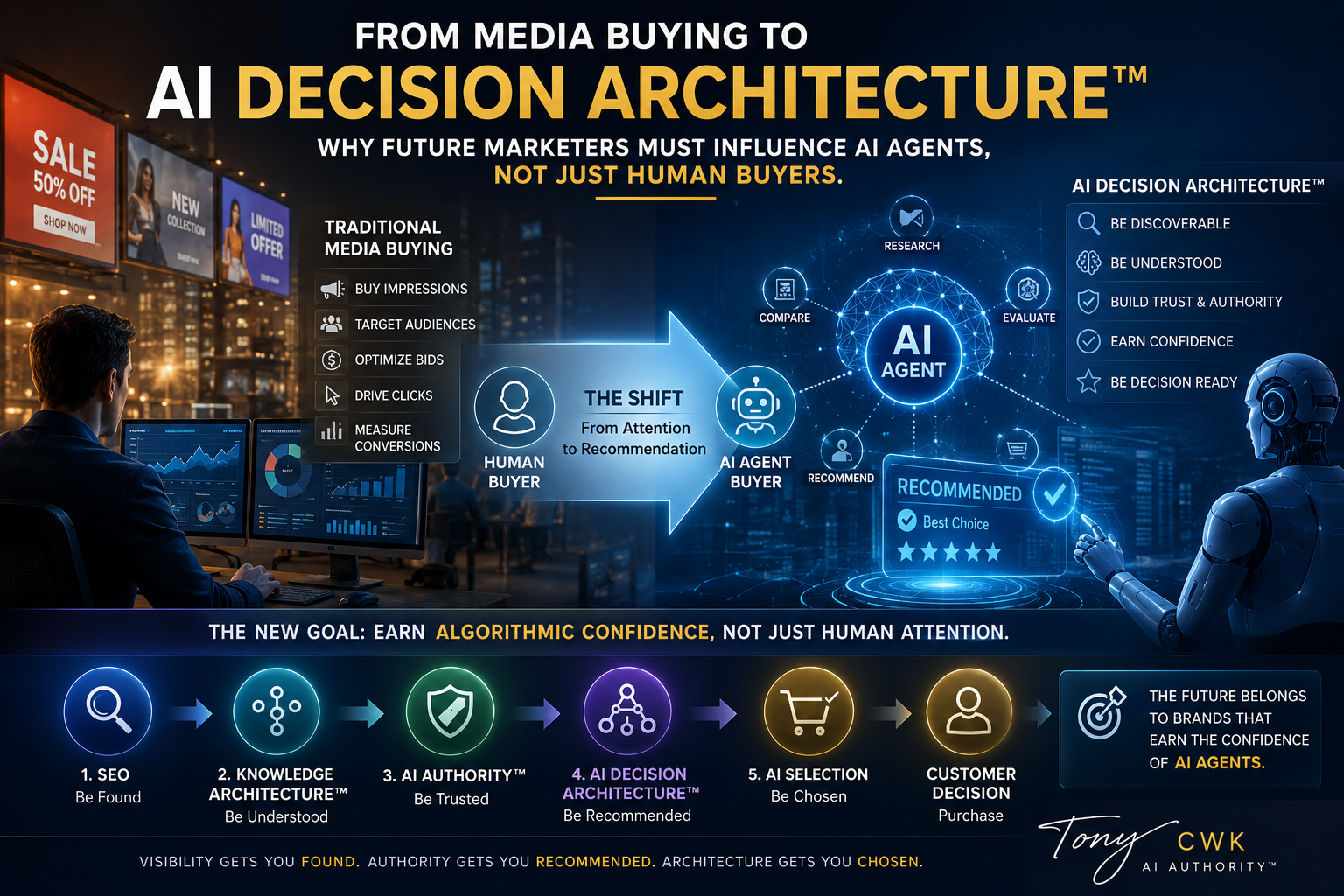
Executive Summary
For decades, digital advertising has focused on influencing human attention. Media buyers optimized campaigns to generate impressions, clicks, and conversions.
That model is beginning to change.
As AI agents become capable of researching products, comparing vendors, negotiating purchases, and recommending solutions, marketers will increasingly need to influence not only people—but also the AI systems acting on their behalf.
The future of marketing is not simply about buying media.
It is about designing decision environments that intelligent agents trust.
This is where AI Decision Architecture™ emerges as a natural evolution of modern digital marketing.
The Next Customer May Not Be Human
Today’s customer journey often looks like this:
Advertisement → Website → Comparison → Purchase
Tomorrow’s journey may look very different.
AI Agent → Vendor Evaluation → Recommendation → Human Approval → Purchase
Instead of visiting ten websites, a customer may simply ask:
“Find me the best cybersecurity consultant in Singapore.”
or
“Recommend the best CRM for my business.”
The AI agent performs the research.
The human reviews the shortlist.
The purchase decision becomes increasingly delegated.
This changes the role of marketers fundamentally.
Traditional Media Buying Is Built for Human Attention
Traditional media buying focuses on:
- Audience targeting
- Bid optimisation
- Creative testing
- Cost per acquisition
- Return on ad spend
- Conversion optimisation
These remain important.
However, they assume the buyer is the person viewing the advertisement.
In an AI-mediated world, advertisements become only one of many signals considered by intelligent agents.
AI Agents Evaluate More Than Advertisements
Unlike humans, AI agents can simultaneously evaluate dozens of trust signals before recommending a business.
These include:
- Product specifications
- Pricing consistency
- Structured product data
- Customer reviews
- Delivery performance
- Refund policies
- Knowledge consistency
- Third-party citations
- Industry recognition
- Brand reputation
- Expert publications
- Authority signals
The advertisement may attract attention.
The recommendation depends on confidence.
Introducing AI Decision Architecture™
AI Decision Architecture™ is the strategic discipline of designing digital ecosystems that maximize the likelihood of being selected by AI-assisted decision-making systems.
While traditional media buying optimizes exposure, AI Decision Architecture™ optimizes recommendation confidence.
It answers a different question.
Instead of:
“How do we get seen?”
it asks:
“How do we become the most trustworthy recommendation?”
The Five Pillars of AI Decision Architecture™
1. Discoverability
AI cannot recommend what it cannot find.
This includes:
- Technical SEO
- AI-readable content
- Structured data
- Entity optimisation
- Indexability
Visibility remains the foundation.
2. Understanding
After discovery comes comprehension.
AI systems need to understand:
- What your company does
- Who you serve
- Your expertise
- Your products
- Your competitive advantages
This is where Identity Architecture™ and Knowledge Architecture™ become essential.
3. Trust
AI agents increasingly evaluate credibility before recommending businesses.
Signals include:
- Reviews
- Citations
- Media mentions
- Industry recognition
- Customer success
- Consistent branding
This aligns directly with the AI Authority Pyramid™, particularly the Ecosystem Credibility Signals layer.
4. Confidence
Recommendation requires confidence.
Confidence develops through repeated reinforcement across multiple sources.
The more independent systems consistently describe your organisation in similar ways, the more confident AI becomes in recommending you.
This is why AI Authority™ compounds over time.
5. Decision Readiness
Ultimately, AI agents ask:
“Can I confidently recommend this business?”
Decision readiness combines:
- Visibility
- Understanding
- Trust
- Confidence
- User suitability
Only when these elements align does recommendation become highly probable.
Media Buying Becomes Decision Engineering
The future media buyer evolves into something much broader.
| Traditional Media Buying | AI Decision Architecture™ |
|---|---|
| Purchase impressions | Build recommendation systems |
| Optimise bids | Optimise confidence |
| Target audiences | Target decision pathways |
| Improve CTR | Improve recommendation probability |
| Measure conversions | Measure AI selection frequency |
| Campaign management | Ecosystem orchestration |
Media buying does not disappear.
It becomes one component within a much larger decision ecosystem.
AI Authority™ Remains the Foundation
This shift does not replace your existing AI Authority™ framework.
Instead, it reinforces it.
The relationship can be understood as:
- SEO helps AI find you.
- Knowledge Architecture™ helps AI understand you.
- AI Authority™ helps AI trust you.
- AI Decision Architecture™ helps AI recommend you.
Each layer builds upon the previous one.
Recommendation is the outcome—not the starting point.
Why This Matters for Businesses
Many organisations continue to optimise primarily for human visitors:
- Better advertisements
- Better landing pages
- Better creatives
These remain valuable.
However, businesses that also optimise for AI-mediated decision-making will gain an increasingly important competitive advantage.
Future marketing success may depend less on generating the highest volume of traffic and more on becoming the preferred recommendation across multiple AI systems.
The Future of Marketing
The role of marketers is expanding.
Tomorrow’s marketing leaders will need to understand:
- AI recommendation systems
- Knowledge engineering
- Semantic relationships
- Structured information
- Entity management
- Digital trust
- AI Authority™
- Decision architecture
Marketing is evolving from communication to computational influence.
The objective is no longer simply to persuade people.
It is to earn the confidence of the intelligent systems that increasingly guide their decisions.
Final Thoughts
The history of digital marketing has been a progression of optimisation.
First, marketers optimised for search engines.
Then they optimised for social media algorithms.
Today, they optimise for AI discovery.
Tomorrow, they will optimise for AI recommendation.
The next frontier goes even further.
It is not simply about being visible.
It is about becoming the most trusted option when AI agents make decisions on behalf of customers.
That is why the future belongs not only to businesses that master media buying, but to those that master AI Decision Architecture™.
Because in the age of intelligent agents, the most valuable marketing asset is no longer attention.
It is algorithmic confidence.
Key Takeaways
- Traditional media buying is evolving from impression optimisation to recommendation optimisation.
- AI agents evaluate trust, structured knowledge, reputation, and confidence—not just advertisements.
- AI Decision Architecture™ extends AI Authority™ by focusing on influencing AI-assisted purchasing decisions.
- Future marketers must design ecosystems that AI agents can discover, understand, trust, and confidently recommend.
- The next competitive advantage is not merely attracting attention, but becoming the preferred choice in AI-mediated decision journeys.
FAQ
1. What is AI Decision Architecture™?
AI Decision Architecture™ is the strategic practice of designing digital ecosystems that increase the likelihood of being recommended by AI-powered assistants and autonomous agents. It extends beyond traditional marketing by optimizing for AI-assisted decision-making rather than just human attention.
2. How is AI Decision Architecture™ different from media buying?
Traditional media buying focuses on purchasing advertising placements to influence human audiences. AI Decision Architecture™ focuses on building trust, structured knowledge, authority, and credibility so AI agents can confidently recommend your business during purchasing decisions.
3. Will AI agents replace human buyers?
Not entirely. AI agents are expected to handle research, comparison, shortlisting, and recommendations, while humans remain responsible for approving significant purchases. The balance will vary depending on the industry, transaction value, and organizational policies.
4. Why will marketers need to influence AI agents?
As AI assistants increasingly help consumers and businesses evaluate products and services, marketers must ensure their brands are discoverable, understandable, trustworthy, and recommended by AI systems—not just visible to human audiences.
5. How does AI Authority™ support AI Decision Architecture™?
AI Authority™ provides the credibility and trust signals that AI systems rely on when evaluating brands. AI Decision Architecture™ builds on this foundation by organizing those signals into a decision environment that increases recommendation confidence.
6. Is SEO still important in the era of AI agents?
Yes. SEO remains essential because AI systems often rely on searchable, crawlable, and structured content. However, SEO alone is no longer sufficient. Businesses also need knowledge architecture, entity optimization, reputation, and authority signals to improve AI recommendations.
7. What are the core pillars of AI Decision Architecture™?
The five pillars are:
- Discoverability
- Understanding
- Trust
- Confidence
- Decision Readiness
Together, these help AI systems identify, evaluate, and recommend businesses with greater confidence.
8. Which industries will benefit most from AI Decision Architecture™?
Industries with complex purchasing decisions are likely to benefit first, including:
- Professional services
- B2B technology
- Healthcare
- Financial services
- Education
- Cybersecurity
- Enterprise software
- E-commerce
- Consulting
As AI assistants become more widely adopted, virtually every industry may benefit.
9. How does structured data support AI Decision Architecture™?
Structured data helps AI systems accurately interpret products, services, organizations, reviews, and relationships. This improves machine understanding and strengthens recommendation confidence.
10. What is the relationship between SEO, AI Authority™, and AI Decision Architecture™?
They represent different stages of AI influence:
- SEO improves discoverability.
- Knowledge Architecture™ improves understanding.
- AI Authority™ builds trust and credibility.
- AI Decision Architecture™ increases the likelihood of AI recommendation.
Together, they form a complete strategy for AI-era digital marketing.
Leave a Reply