
By TonyCWK
Introduction
Most businesses assume AI understands them after reading a webpage.
It doesn’t work that way.
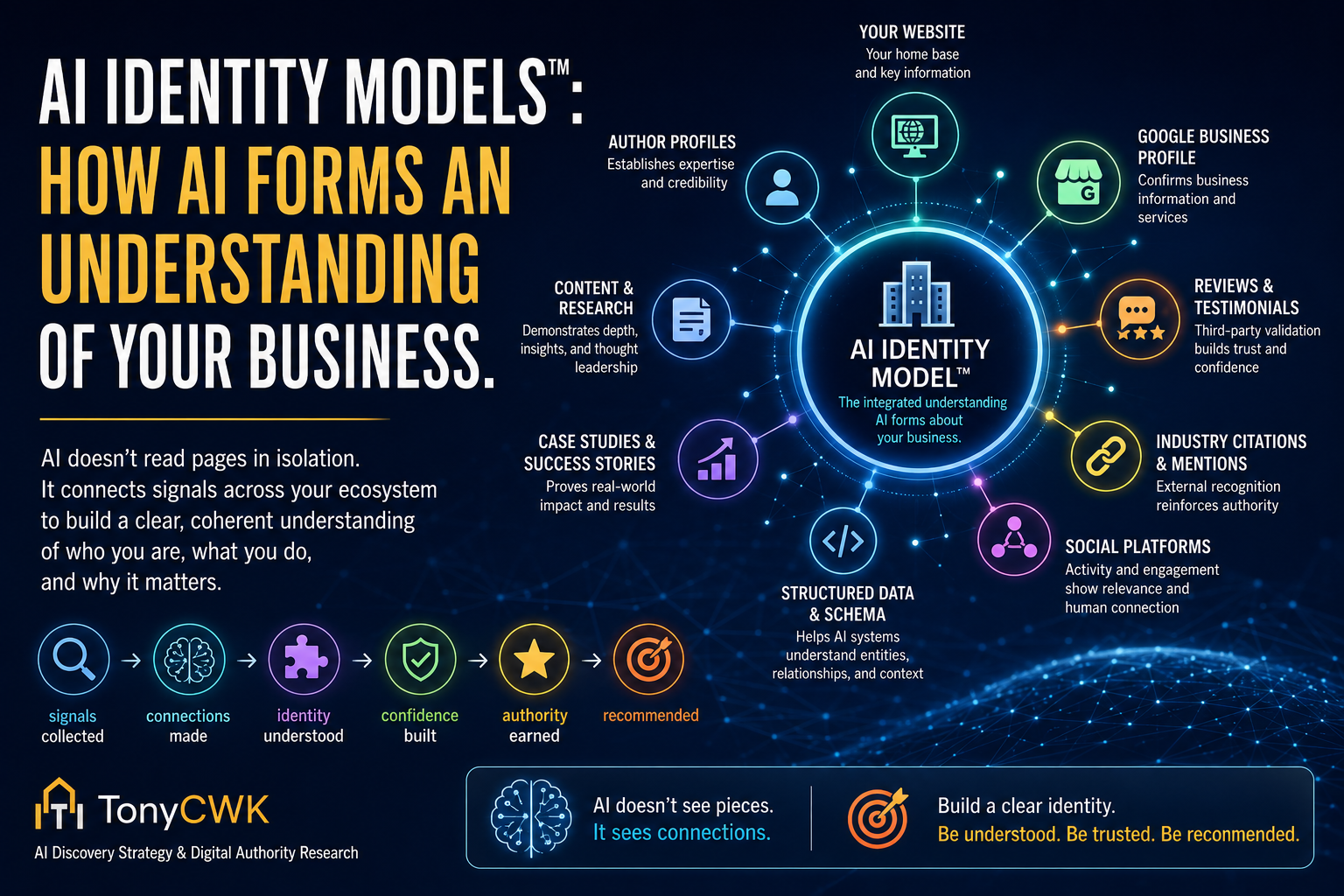
AI systems rarely rely on a single page, profile, or document to understand an organization. Instead, they connect signals from across the digital ecosystem to build a progressively richer understanding of who a business is, what it knows, and how confidently it can be associated with particular areas of expertise.
I describe this evolving understanding as an AI Identity Model™.
It is not a single database or a hidden profile stored inside an AI model.
Rather, it is a conceptual framework for understanding how AI connects information to recognize organizations, resolve ambiguity, and build confidence before making recommendations.
In the age of AI-powered discovery, the businesses that are easiest to understand are often the easiest to recommend.
What Is An AI Identity Model™?
AI Identity Models™ describe the integrated understanding AI forms by connecting identity signals, knowledge, relationships, evidence, and context across an organization’s digital ecosystem.
Rather than viewing every webpage independently, AI seeks to answer a larger question:
“What organization do all these signals describe?”
Every interaction contributes another piece of that understanding.
No single page defines the identity.
The identity emerges from the whole system.
AI Doesn’t Start With Conclusions
Before AI can recommend an organization, it must progressively reduce uncertainty.
That process involves connecting many different types of signals.
For example:
- Organization information
- Author profiles
- Products and services
- Published expertise
- Structured data
- Customer reviews
- Case studies
- Industry citations
- Research
- Digital relationships
- External references
Each signal contributes context.
Together, they help AI form a coherent picture of the organization.
Identity Is More Than Content
Many businesses focus almost entirely on publishing articles.
Articles matter.
But articles are only one signal.
AI also evaluates:
- Who wrote them.
- Which organization they belong to.
- What services the organization provides.
- Whether published expertise matches business positioning.
- Whether independent evidence supports those claims.
- Whether the same expertise appears consistently elsewhere.
Identity emerges from relationships.
AI Builds Understanding Through Connections
Imagine trying to identify a person.
One photograph tells you very little.
Multiple photographs.
Their profession.
Their colleagues.
Their publications.
Their achievements.
Their interviews.
Their certifications.
Their projects.
Suddenly, a much clearer picture emerges.
Organizations work the same way.
Every connected signal strengthens understanding.
Disconnected signals increase ambiguity.
The Components Of An AI Identity Model™
A mature identity model typically includes several interconnected layers.
Identity
Who is the organization?
Expertise
What is it known for?
Relationships
How are its people, products, services, and knowledge connected?
Evidence
What independently supports its expertise?
Consistency
Does every digital touchpoint reinforce the same identity?
Coherence
Do all these elements form one complete understanding?
Together, these components reduce ambiguity and strengthen AI confidence.
Identity Architecture™ Builds Better Identity Models™
The six pillars of Identity Architecture™ each contribute to AI understanding.
- Identity Definition™ establishes who you are.
- Identity Consistency™ removes contradictions.
- Identity Relationships™ connects your knowledge ecosystem.
- Identity Representation™ makes identity machine-readable.
- Identity Reinforcement™ builds confidence through evidence.
- Identity Persistence™ ensures recognition continues over time.
Identity Coherence™ then integrates these elements into one connected system.
The result is a stronger AI Identity Model™.
Real-World Example
Imagine two cybersecurity consultancies.
Consultancy A
Publishes excellent technical articles.
However:
- author identities are inconsistent,
- services are disconnected from published expertise,
- case studies are difficult to find,
- certifications are rarely referenced,
- reviews exist on unrelated platforms.
Each asset has value.
Together, they tell an incomplete story.
Consultancy B
Defines a clear identity.
Links expertise to services.
Connects authors to research.
Publishes case studies.
Maintains consistent positioning.
Reinforces proprietary frameworks.
Updates cornerstone content.
Every digital asset strengthens the same understanding.
AI forms a richer identity model.
That stronger understanding supports greater confidence.
AI Identity Models™ And AI Authority™
Identity Models™ do not replace AI Authority™.
They enable it.
Identity Architecture™ creates the signals.
Identity Coherence™ organizes them into one system.
AI Identity Models™ explain how those signals become understanding.
AI Authority™ explains how that understanding becomes recommendation.
The progression becomes:
Identity Signals
↓
Identity Architecture™
↓
Identity Coherence™
↓
AI Identity Model™
↓
AI Confidence
↓
AI Authority™
↓
AI Recommendation
Every layer builds upon the one before it.
Practical Questions To Evaluate Your AI Identity Model™
Ask yourself:
- Would AI consistently describe my business the same way across multiple platforms?
- Do my services align with my published expertise?
- Are my authors connected to my research?
- Do my case studies reinforce my positioning?
- Does independent evidence support my claims?
- Would a new AI system quickly recognize what my organization is known for?
If these answers are consistently “yes,” your AI Identity Model™ is becoming clearer and more complete.
Looking Ahead
AI systems continue to evolve.
Some rely more heavily on retrieval.
Others rely more on knowledge graphs.
Future systems may integrate additional reasoning and verification mechanisms.
Regardless of implementation, one principle is likely to remain constant:
Organizations that present a clear, connected, and evidence-backed identity are easier to understand than those with fragmented digital footprints.
That understanding creates the conditions for confidence.
Confidence creates the conditions for recommendation.
Conclusion
Businesses often optimize individual pages.
AI increasingly evaluates organizations.
Understanding emerges from connected signals rather than isolated content.
That is the idea behind AI Identity Models™.
It is a conceptual framework for understanding how AI progressively recognizes, connects, and interprets an organization’s identity across its digital ecosystem.
Because before AI can recommend your business…
It first needs to understand who you are.
Key Takeaway
AI doesn’t build confidence from one page.
It builds understanding from an ecosystem of connected identity signals.
FAQ
1. What is an AI Identity Model™?
An AI Identity Model™ is a conceptual framework describing the integrated understanding AI systems may form by connecting an organization’s identity signals, expertise, relationships, evidence, content, and context across its digital ecosystem.
2. Is an AI Identity Model™ a literal profile stored inside every AI system?
No. AI Identity Models™ should not be understood as a single hidden profile or database record used by every AI platform. The term describes the broader understanding that can emerge when AI systems connect multiple signals about an organization.
3. How does AI form an understanding of a business?
AI may combine signals from websites, author profiles, structured data, services, research, reviews, case studies, citations, social profiles, and external references to infer who the organization is and what it is known for.
4. Why is one webpage not enough to define a business identity?
A single webpage provides only one perspective. AI gains a clearer understanding when multiple independent and connected sources consistently reinforce the same organization, expertise, relationships, and evidence.
5. What are the main components of an AI Identity Model™?
The main components include organizational identity, expertise, relationships, consistency, machine-readable representation, supporting evidence, contextual relevance, coherence, and persistence over time.
6. How does Identity Architecture™ support AI Identity Models™?
Identity Architecture™ helps organizations define, align, connect, represent, reinforce, and maintain their identity signals. These signals give AI systems clearer material from which to form an integrated understanding.
7. How does Identity Coherence™ relate to AI Identity Models™?
Identity Coherence™ ensures that content, services, people, frameworks, evidence, and relationships form one logically connected system. Greater coherence can make an organization’s overall identity easier for AI to interpret.
8. How do AI Identity Models™ support AI Authority™?
A clearer identity model can reduce ambiguity about who the organization is and what expertise it represents. That understanding provides a stronger foundation for confidence, authority recognition, and recommendation.
9. Can conflicting digital signals weaken an AI Identity Model™?
Yes. Inconsistent names, disconnected author profiles, conflicting positioning, outdated descriptions, and unsupported claims can create competing interpretations and reduce confidence in the organization’s identity.
10. How can a business strengthen its AI Identity Model™?
A business can strengthen it by maintaining a clear identity, connecting expertise to services and evidence, using consistent entity information, publishing coherent content, earning independent validation, and keeping important information current.
Leave a Reply