
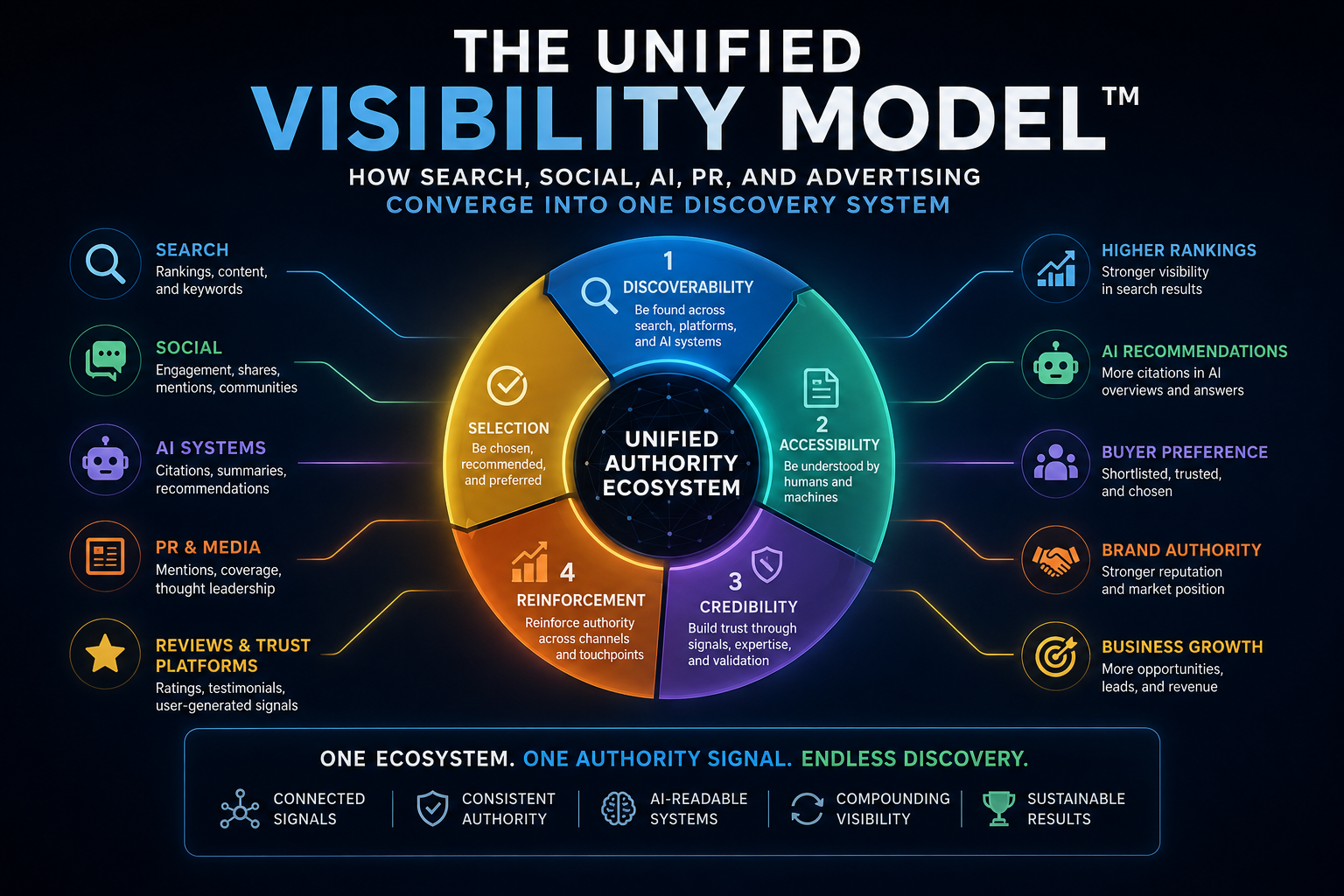
Why Search, Social, AI, PR, and Advertising Are Converging Into One Discovery System
Introduction
For decades, marketers treated visibility as a collection of separate channels.
SEO was one discipline.
Social media was another.
Public relations operated independently.
Advertising had its own objectives.
Brand building lived somewhere in between.
Each channel had its own metrics, teams, budgets, and strategies.
But AI is changing the structure of digital visibility itself.
The walls between channels are beginning to disappear.
Search engines now incorporate AI-generated responses.
Social platforms function as search engines.
AI assistants retrieve information from websites, news sources, social content, videos, reviews, and knowledge graphs simultaneously.
Advertising platforms increasingly influence organic discovery signals.
Consumers move fluidly between search, social, AI assistants, reviews, videos, and recommendations without recognizing them as separate systems.
The future of visibility is no longer channel-based.
It is ecosystem-based.
This is where The Unified Visibility Model™ emerges.
The Great Convergence
Historically, visibility followed a fragmented model.
A business might:
- Optimize for Google Search
- Run Facebook Ads
- Publish LinkedIn content
- Generate media coverage
- Build backlinks
- Produce videos
Each activity appeared disconnected.
Today, AI systems increasingly interpret these activities as parts of a single authority ecosystem.
A news mention can influence search visibility.
A LinkedIn post can influence AI citations.
A podcast appearance can strengthen entity understanding.
Customer reviews can impact recommendation systems.
Structured data can improve machine interpretation.
Digital signals no longer operate independently.
They reinforce each other.
Visibility is becoming networked.
The Visibility Layers
The Unified Visibility Model™ consists of five interconnected layers.
Layer 1: Discoverability
The ability to be found.
This includes:
- Search rankings
- Indexation
- Entity recognition
- Knowledge graph inclusion
- Structured data
- Crawlability
Without discoverability, nothing else can occur.
Visibility begins with existence.
Layer 2: Accessibility
The ability for both humans and machines to consume information.
This includes:
- Content clarity
- Semantic structure
- AI-readable architecture
- Schema markup
- Content organization
- Information extraction
A brand that is discoverable but difficult to interpret creates friction.
Accessibility reduces interpretation costs.
Layer 3: Credibility
The ability to generate trust signals.
This includes:
- Expert content
- Third-party mentions
- Reviews
- Case studies
- Citations
- Author authority
- Consistent entity relationships
Credibility determines whether visibility becomes influence.
Layer 4: Reinforcement
The ability to repeatedly validate authority across channels.
This includes:
- Search visibility
- Social visibility
- Media mentions
- Podcast appearances
- Video content
- Industry references
- Community participation
Reinforcement creates consistency.
Consistency creates confidence.
Confidence creates recommendation potential.
Layer 5: Selection
The ultimate outcome.
Selection occurs when:
- Search engines rank you
- AI systems recommend you
- Buyers shortlist you
- Consumers choose you
- Partners reference you
Visibility alone does not create business outcomes.
Selection does.
The highest form of visibility is not exposure.
It is preference.
Why Traditional Channel Thinking Is Failing
Many organizations still manage visibility using isolated strategies.
The SEO team focuses on rankings.
The social team focuses on engagement.
The PR team focuses on media coverage.
The advertising team focuses on conversions.
Each team measures success independently.
AI systems do not.
They evaluate relationships.
They interpret patterns.
They recognize consistency.
The more fragmented an organization’s visibility strategy becomes, the harder it becomes for AI systems to build confidence.
Visibility fragmentation creates authority fragmentation.
From Channel Optimization to Ecosystem Optimization
The next evolution of digital strategy is not improving individual channels.
It is aligning them.
Organizations must begin asking:
- Are our messages consistent?
- Are our entities connected?
- Are our authority signals reinforcing each other?
- Are machines interpreting us correctly?
- Are we creating recommendation confidence?
These questions represent a shift from channel optimization to ecosystem optimization.
This shift is fundamental.
Because AI systems increasingly evaluate ecosystems rather than webpages.
The Rise of Unified Visibility
The future of visibility will not belong to brands with the largest advertising budgets.
Nor will it belong solely to brands with the highest rankings.
It will belong to organizations that create consistent authority signals across the entire digital ecosystem.
Search.
Social.
Content.
PR.
Reviews.
Video.
Communities.
Knowledge graphs.
AI systems.
These are no longer separate visibility channels.
They are becoming components of one unified discovery system.
The organizations that understand this convergence earliest will gain disproportionate advantages in recommendation systems, AI discovery environments, and future search ecosystems.
The Unified Visibility Model™
Visibility is no longer a channel problem.
It is a system problem.
The brands that win tomorrow will not necessarily be the most visible.
They will be the most consistently understood, reinforced, trusted, and selected across the entire digital ecosystem.
Because the future of visibility is not fragmented.
It is unified.
And the future belongs to organizations that learn how to build authority across the entire discovery network rather than optimize isolated channels.
That is the essence of The Unified Visibility Model™.
FAQ: The Unified Visibility Model™
What is The Unified Visibility Model™?
The Unified Visibility Model™ is a digital strategy framework that explains how search, social media, AI systems, PR, reviews, content, and advertising are converging into one connected discovery ecosystem.
Instead of treating each channel separately, the model shows how visibility signals reinforce one another to increase authority, trust, and selection.
Why is visibility becoming unified?
Visibility is becoming unified because users and AI systems no longer discover brands through one channel alone.
A person may discover a business through Google, LinkedIn, YouTube, ChatGPT, reviews, media mentions, or AI summaries. AI systems may also evaluate signals from multiple sources before deciding which brands to reference, rank, cite, or recommend.
How is The Unified Visibility Model™ different from traditional SEO?
Traditional SEO focuses mainly on improving search engine visibility.
The Unified Visibility Model™ is broader. It includes SEO, but also considers social proof, content authority, PR mentions, reviews, entity clarity, structured data, and AI-readable credibility signals.
SEO helps a brand become findable. Unified visibility helps a brand become consistently understood, trusted, and selected.
Why does AI make unified visibility more important?
AI systems do not only retrieve webpages. They interpret patterns across the digital ecosystem.
They may consider whether a brand is consistently mentioned, clearly described, semantically connected, cited by trusted sources, and reinforced across multiple platforms.
This means fragmented visibility can weaken AI confidence, while unified visibility can strengthen recommendation potential.
What are the five layers of The Unified Visibility Model™?
The five layers are:
- Discoverability — the ability to be found.
- Accessibility — the ability to be understood by humans and machines.
- Credibility — the ability to demonstrate trust.
- Reinforcement — the ability to validate authority across channels.
- Selection — the ability to become recommended, chosen, or preferred.
Together, these layers explain how visibility evolves into authority and selection.
Does The Unified Visibility Model™ replace SEO?
No. The Unified Visibility Model™ does not replace SEO.
SEO remains an important foundation for discoverability, crawlability, content structure, and search visibility. However, SEO alone is no longer enough in an AI-influenced discovery environment.
Unified visibility expands SEO into a broader authority system.
How can businesses apply The Unified Visibility Model™?
Businesses can apply the model by aligning their website, content, social media, reviews, PR, structured data, and brand messaging around a consistent authority narrative.
The goal is not just to appear across more channels, but to make every channel reinforce the same trusted identity.
Why is selection more important than visibility?
Visibility means a brand can be seen.
Selection means a brand is chosen.
In the AI era, being found is only the first step. The bigger question is whether search engines, AI assistants, buyers, and recommendation systems trust the brand enough to rank it, cite it, recommend it, or shortlist it.
What types of signals support unified visibility?
Unified visibility can be supported by:
- Clear website architecture
- Strong topical content
- Structured data
- Consistent brand messaging
- Third-party mentions
- Customer reviews
- Social media authority
- Expert commentary
- Case studies
- AI-readable entity information
These signals work best when they are connected and consistent.
Why should marketers care about unified visibility?
Marketers should care because digital discovery is no longer linear.
Customers do not move through one channel at a time. AI systems do not evaluate one signal in isolation. Visibility now depends on how well a brand is understood and reinforced across the entire discovery ecosystem.
The marketers who understand this shift early will be better positioned for AI search, recommendation systems, and future digital authority.
Suggested Reading
1. The Evolution of SEO in the Age of AI Authority™
Discover why traditional SEO is evolving beyond rankings into a broader system of recommendation, credibility, and AI-driven discovery.
Read Next: How Search Has Evolved from Retrieval to Recommendation
2. The AI Authority Pyramid™
Explore the five foundational layers that influence how AI systems interpret, trust, and recommend brands.
Read Next: Understanding the Architecture of AI Trust
3. Why AI Doesn’t Trust Content. It Trusts Systems.
Learn why isolated content assets are becoming less important than interconnected authority ecosystems.
Read Next: How Authority Signals Compound Across Digital Channels
4. AI-Readable Knowledge Architecture™
Understand how websites, entities, structured data, and content relationships help machines interpret organizations more accurately.
Read Next: Building a Machine-Readable Business
5. Citation Engineering™
Discover how citations, references, mentions, and semantic reinforcement contribute to AI recommendation confidence.
6. The AI Discovery Flywheel™
Learn how visibility, credibility, citations, and reinforcement create self-compounding authority growth over time.
7. The Future of Search Is Recommendation, Not Retrieval
Explore why search engines and AI systems are increasingly helping users evaluate options rather than simply retrieve information.
Read Next: The Shift from Information Access to Decision Support
Leave a Reply