
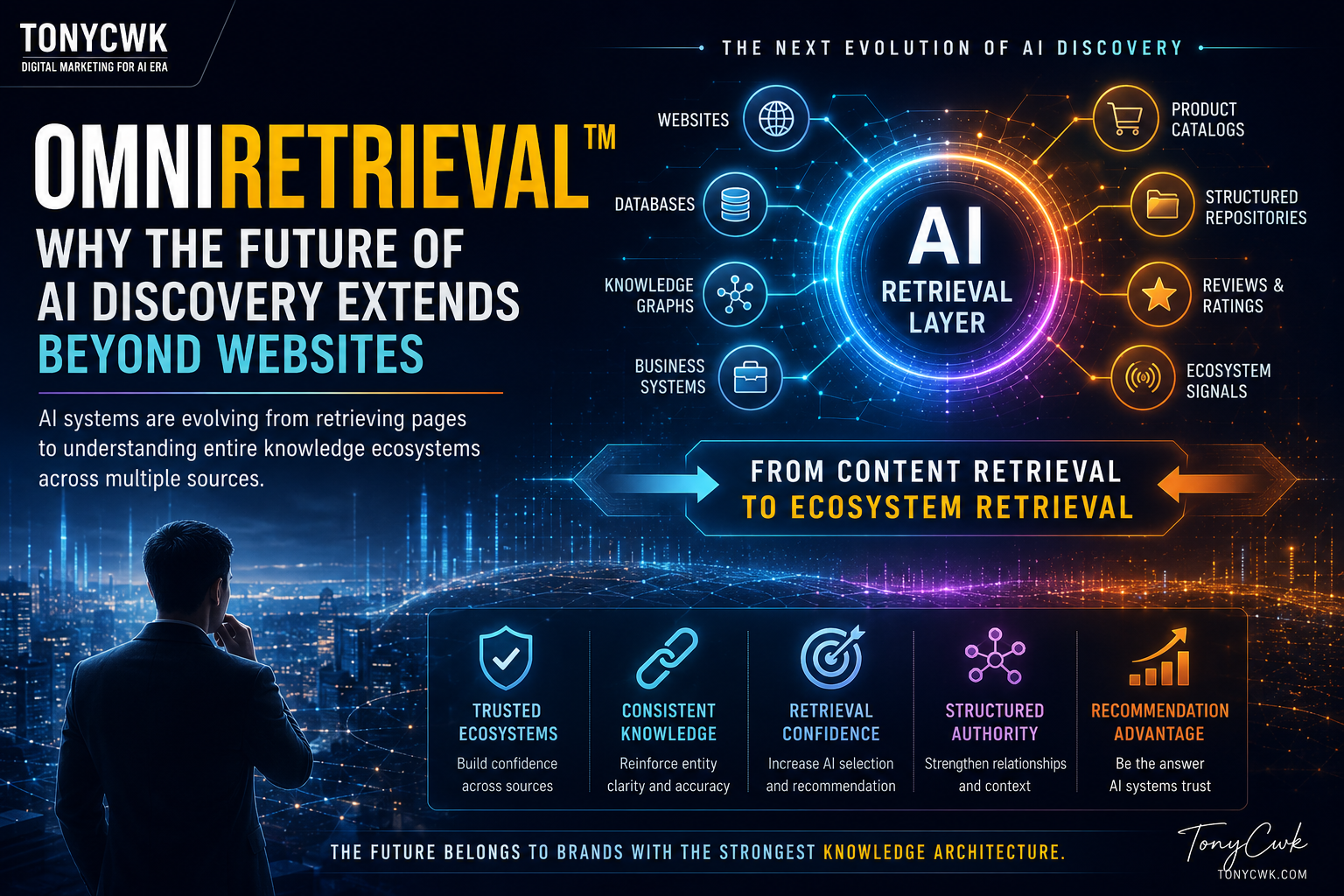
The Next Evolution of AI Visibility
For decades, digital marketing has revolved around a central assumption:
Visibility comes from webpages.
Websites became the core assets of the internet economy.
SEO became the process of optimizing those pages for retrieval.
Search engines became gateways between information and users.
But AI discovery systems are beginning to change that architecture entirely.
A new research direction known as:
OmniRetrieval
suggests that future AI systems may no longer retrieve information primarily from webpages alone.
Instead, they may retrieve knowledge simultaneously from:
- websites
- databases
- business systems
- product catalogs
- knowledge graphs
- structured repositories
- review ecosystems
- organizational data layers
This is a profound shift.
Because it changes the competitive question from:
“Who ranks highest?”
to:
“Whose entire knowledge ecosystem is most trusted?”
That changes the future of digital marketing itself.
The Traditional Search Model
For most of the search era, digital visibility followed a relatively linear model:
Website → Search Engine → User
Brands focused on:
- keywords
- rankings
- backlinks
- webpages
- metadata
- content publishing
The webpage became the primary unit of discoverability.
This system worked because traditional search engines primarily indexed documents.
The better your webpage performed, the higher your visibility.
But AI systems are beginning to evolve beyond document retrieval.
What Is OmniRetrieval?
OmniRetrieval is an emerging AI retrieval architecture that enables AI systems to retrieve information across heterogeneous knowledge sources simultaneously.
Rather than flattening everything into plain text documents, OmniRetrieval systems preserve:
- structure
- relationships
- schemas
- ontologies
- graph connections
- entity hierarchies
across multiple knowledge ecosystems.
This means future AI systems may increasingly retrieve and evaluate:
- structured business data
- product inventories
- organizational repositories
- ecosystem relationships
- external verification signals
- cross-platform consistency
alongside traditional webpages.
In other words:
AI retrieval is evolving from:
document retrieval
toward:
Why This Matters for Digital Marketing
This shift could fundamentally reshape how digital visibility is earned.
Because in the AI era:
websites may become only one signal layer among many.
That means future AI recommendation systems may increasingly evaluate:
- ecosystem consistency
- cross-source reinforcement
- structured knowledge integrity
- entity persistence
- recommendation reliability
- machine-readable relationships
before deciding which brands to recommend.
This creates a new competitive layer:
AI Systems Are Becoming Trust Compression Engines
Traditional search engines largely ranked documents.
AI systems increasingly perform a different role.
They compress trust.
When a user asks an AI assistant:
“What is the best solution?”
the AI system must determine:
- which source is credible
- which brand is consistent
- which information is verified
- which ecosystem appears trustworthy
This means AI systems may increasingly cross-check multiple sources before recommending a brand.
For example:
A future AI system may simultaneously analyze:
- your website
- Google Business Profile
- review ecosystems
- local citations
- business databases
- appointment systems
- knowledge graphs
- structured schemas
- external references
before making a recommendation.
That changes the nature of digital authority.
The Shift From Content Optimization to Knowledge Optimization
Most businesses still operate using a content-centric model:
Publish more → Rank more → Gain traffic
But OmniRetrieval points toward a future where:
knowledge architecture
becomes more important than content volume alone.
This means brands may increasingly compete through:
- structured entity ecosystems
- schema integrity
- semantic relationships
- ecosystem consistency
- verified business attributes
- cross-platform alignment
rather than merely publishing articles at scale.
The future competitive layer may become:
Structured Knowledge Is Becoming a Strategic Asset
In traditional SEO, structured data was often treated as a technical enhancement.
In AI retrieval systems, structured knowledge may become foundational.
Why?
Because AI systems increasingly depend on:
- machine-readable entities
- semantic relationships
- contextual verification
- structured retrieval pathways
to determine confidence.
This increases the importance of:
- schema markup
- knowledge graphs
- entity relationships
- semantic consistency
- AI-readable architectures
for future visibility.
The brands with stronger structured ecosystems may become easier for AI systems to trust, retrieve, and recommend.
OmniRetrieval and Local Business Marketing
The impact may become especially significant for local businesses.
Imagine a user asking:
“Find the best chiropractor near me for busy professionals.”
A traditional search system might primarily analyze webpages and rankings.
A future OmniRetrieval system may simultaneously analyze:
- Google Business Profile
- review sentiment
- local directories
- business citations
- appointment availability
- business categories
- customer reinforcement signals
- website expertise
- ecosystem consistency
before generating a recommendation.
This means future local visibility may increasingly depend on:
ecosystem reinforcement,
not just SEO rankings.
The Rise of AI Authority™
This evolution aligns closely with the emergence of:
because future AI systems may increasingly evaluate:
- trust persistence
- retrieval confidence
- ecosystem credibility
- recommendation consistency
- cross-source validation
rather than isolated webpages.
In this environment, authority is no longer merely about visibility.
It becomes about:
The future winners may not be brands that generate the most content.
But brands that become:
- consistently retrievable
- structurally trustworthy
- contextually reinforced
- semantically persistent
- ecosystem validated
across multiple AI-accessible systems.
Why SEO Still Matters
This does not mean SEO disappears.
SEO remains foundational.
Websites still matter.
Content still matters.
Search visibility still matters.
But the competitive environment is expanding beyond webpages alone.
SEO may increasingly become:
one layer
inside a much larger AI discovery ecosystem.
The future belongs to businesses that combine:
- SEO
- structured knowledge
- ecosystem consistency
- entity persistence
- AI-readable architecture
- recommendation reinforcement
into one unified visibility system.
The Future of Digital Marketing
OmniRetrieval represents something much larger than a retrieval model.
It represents a directional signal for the future of AI discovery.
The internet is evolving from:
a document web
toward:
a knowledge ecosystem web.
That changes digital marketing fundamentally.
The future visibility question may no longer be:
“Can AI retrieve my content?”
But instead:
“Can AI trust my ecosystem?”
And that may become one of the defining competitive advantages of the AI era.
Final Thoughts
The future of digital marketing may increasingly revolve around:
- retrieval confidence
- ecosystem authority
- structured knowledge
- semantic persistence
- recommendation reliability
because AI systems are evolving beyond webpages.
They are evolving toward ecosystem-level intelligence.
And in that future:
the brands with the strongest knowledge architecture may become the brands AI systems recommend most confidently.
The future of visibility may not belong to the most optimized webpages.
It may belong to the most trusted ecosystems.
FAQ
1. What is OmniRetrieval?
OmniRetrieval refers to an AI retrieval approach where systems can retrieve knowledge from multiple types of sources, including websites, databases, knowledge graphs, structured repositories, business systems, reviews, and product catalogs.
2. Why does OmniRetrieval matter for digital marketing?
It matters because AI discovery may no longer depend only on webpages or rankings. Brands may need strong, consistent, machine-readable knowledge ecosystems across multiple platforms to be retrieved and recommended by AI systems.
3. Does OmniRetrieval mean SEO is no longer important?
No. SEO remains important, but it may become one layer within a broader AI discovery system. Websites, content, schema, reviews, citations, business profiles, and structured data may all work together to influence AI visibility.
4. How is OmniRetrieval different from traditional search?
Traditional search often focuses on indexing and ranking webpages. OmniRetrieval points toward AI systems retrieving and evaluating knowledge across many connected sources, including structured and unstructured data.
5. What is knowledge optimization in the AI era?
Knowledge optimization is the process of making a brand’s information clear, structured, consistent, verifiable, and machine-readable across websites, profiles, databases, feeds, and digital ecosystems.
6. How can businesses prepare for OmniRetrieval?
Businesses can prepare by improving website content, implementing schema markup, maintaining consistent business information, strengthening reviews, developing entity clarity, organizing product or service data, and building cross-platform credibility.
7. How does OmniRetrieval affect local businesses?
Local businesses may be evaluated across Google Business Profile, reviews, local citations, directories, websites, appointment systems, and other signals. The more consistent and trusted the ecosystem, the higher the chance of AI recommendation.
8. What is the connection between OmniRetrieval and AI Authority™?
OmniRetrieval supports the idea that AI systems may evaluate entire knowledge ecosystems, not just isolated webpages. This connects directly to AI Authority™, where brands build structured trust, retrieval confidence, and recommendation readiness.
Suggested Reading
- AI-Readable Knowledge Architecture™
How structured knowledge ecosystems help AI systems retrieve, interpret, and trust brands more effectively. - The Future of Search Is Recommendation, Not Retrieval
Why AI systems are shifting from document retrieval toward trusted recommendation systems. - AI Doesn’t Trust Content. It Trusts Systems.
How ecosystem consistency, verification, and reinforcement influence AI recommendation confidence. - The Evolution of SEO in the Age of AI Authority™
Why SEO is evolving from webpage optimization toward AI discovery ecosystem optimization. - The AI Citation Layer™
Why future digital visibility may increasingly depend on AI citation recognition and cross-source reinforcement. - Selection Intelligence™: Why Visibility Alone Is No Longer Enough
Why future AI systems may prioritize recommendation confidence over simple retrievability. - Hyperlocal AI Authority™
How local businesses can strengthen AI recommendation potential through ecosystem-level consistency. - Decision Delegation Flow™
Why future users may increasingly delegate choices directly to AI systems instead of manually researching options.
Written by Tony Chan (TonyCWK)
AI Authority & Digital Strategy Researcher
Leave a Reply