
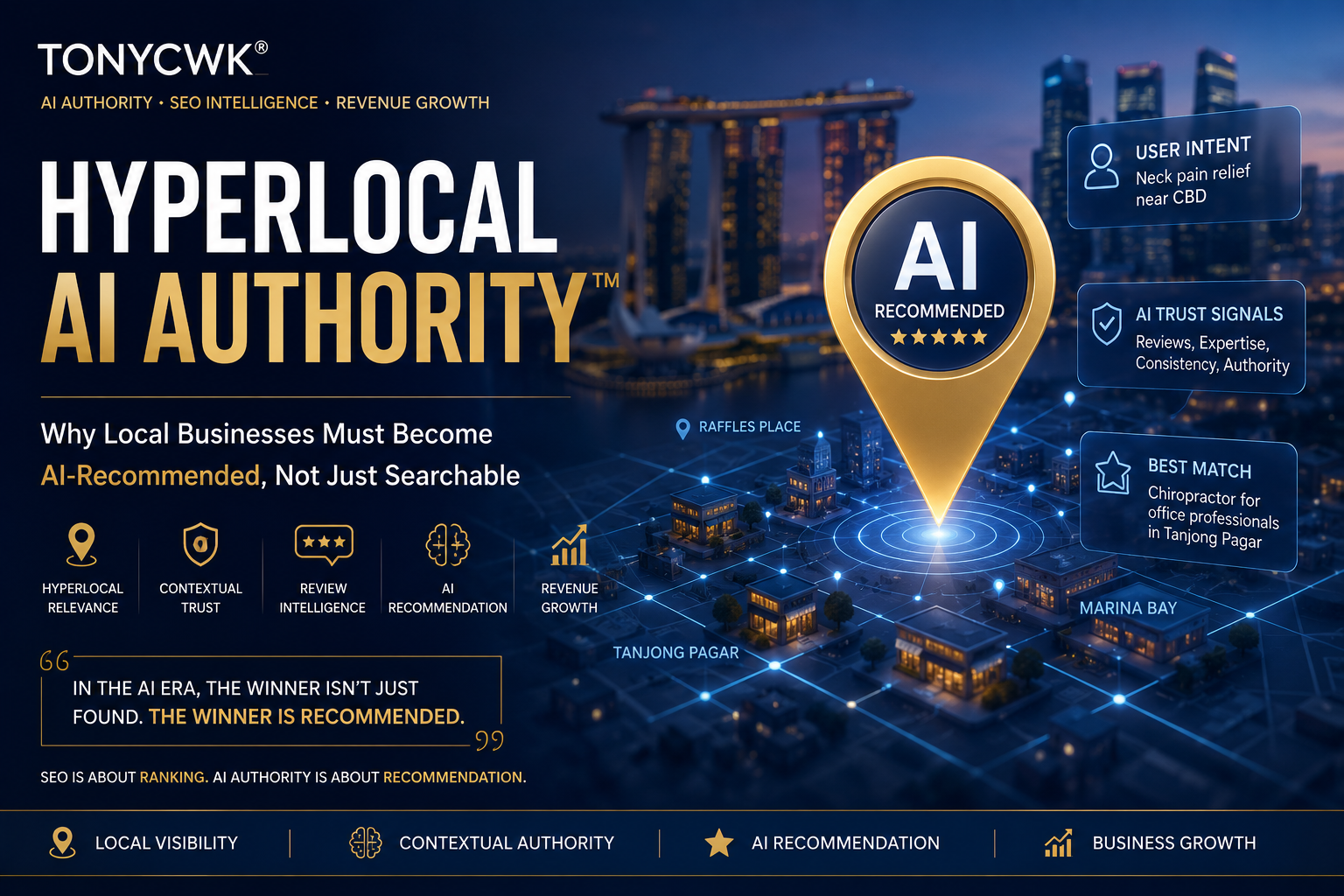
Why Local Businesses Must Become AI-Recommended, Not Just Searchable
For years, local digital marketing was largely built around one objective:
ranking.
Businesses competed to appear higher for terms like:
- “best dentist Singapore”
- “Italian restaurant near me”
- “chiropractor Orchard Road”
- “digital marketing agency Singapore”
And for a long time, that strategy worked.
Because traditional search engines primarily functioned as:
retrieval systems.
Users searched.
Search engines returned lists.
Humans manually evaluated options.
Clicks became the gateway to discovery.
But that model is beginning to change.
Rapidly.
Today, AI systems increasingly act as:
recommendation engines,
decision assistants,
trust filters,
and contextual selectors.
This changes the future of local discovery entirely.
The next era of local visibility may no longer depend primarily on whether your business is merely searchable.
Instead, success may increasingly depend on whether AI systems confidently recommend your business for specific local situations, problems, and contexts.
This is the emerging layer of:
Hyperlocal AI Authority™
A framework describing how businesses build contextual trust, localized relevance, and recommendation readiness inside AI-driven discovery systems.
The Evolution of Local Discovery
Traditional local SEO focused heavily on:
- map rankings
- directory listings
- location keywords
- backlinks
- citations
- NAP consistency
- review volume
These elements still matter.
But AI systems are beginning to evaluate businesses differently.
Increasingly, AI attempts to answer questions such as:
- Which business best fits this user’s exact situation?
- Which provider appears most contextually trustworthy?
- Which business demonstrates expertise for this specific problem?
- Which recommendation aligns with this user’s location, intent, urgency, and preferences?
This moves discovery away from:
generic local visibility
toward:
contextual recommendation selection.
That distinction is critical.
Because ranking visibility and recommendation confidence are no longer identical.
From “Near Me” To “Best For Me”
Traditional search often emphasized proximity.
AI-assisted discovery increasingly emphasizes contextual suitability.
That means businesses may increasingly be evaluated based on:
- problem specialization
- contextual expertise
- local trust signals
- review specificity
- semantic consistency
- ecosystem reinforcement
- topical relevance
- recommendation confidence
For example:
Traditional Local SEO:
“Chiropractor Singapore”
Emerging Hyperlocal AI Discovery:
- Chiropractor for office workers with neck pain
- Chiropractic clinic near CBD professionals
- Best posture treatment near Tanjong Pagar
- Back pain specialist for remote workers
This creates a major shift in local marketing strategy.
The future advantage may belong to businesses that become:
Why This Matters Especially In Dense Urban Markets
Highly competitive urban environments such as Singapore may become one of the strongest examples of Hyperlocal AI Authority™ in action.
Because consumer intent is often:
- immediate
- mobile-first
- location-sensitive
- problem-specific
- convenience-driven
AI systems increasingly attempt to compress the decision-making process.
Instead of forcing users to browse through multiple websites, AI increasingly tries to provide:
recommended answers.
This creates an entirely new competitive layer.
Businesses are no longer competing only for:
attention.
They are increasingly competing for:
The Five Layers Of Hyperlocal AI Authority™
1. Local Entity Clarity
AI systems must clearly understand:
- who you are
- where you operate
- what services you provide
- which audiences you serve
- what problems you solve
This requires consistency across:
- Google Business Profile
- website schema
- social profiles
- local directories
- review platforms
- business descriptions
- service pages
Inconsistent ecosystems weaken AI confidence.
Consistency strengthens recommendation reliability.
2. Contextual Expertise Signals
Generic service descriptions are becoming less effective.
AI systems increasingly favor businesses demonstrating:
contextual specialization.
For example:
Instead of:
“We provide chiropractic services.”
Stronger contextual positioning becomes:
- posture correction for office workers
- neck pain relief for desk professionals
- spinal care for remote workers
- sports recovery chiropractic treatment
The more contextually reinforced your expertise becomes, the stronger your recommendation profile may become.
3. Hyperlocal Semantic Relevance
Location keywords alone are no longer enough.
AI systems increasingly connect:
location + intent + problem + trust.
Businesses may benefit from building content around:
- neighborhoods
- districts
- local landmarks
- local audience segments
- region-specific pain points
- local industry verticals
Examples:
- accounting services for F&B businesses in Bugis
- physiotherapy for runners near East Coast
- tuition centre for PSLE students in Tampines
- interior design for HDB resale flats
This creates stronger contextual matching signals.
4. Review Intelligence Signals
In the AI era, reviews may evolve beyond social proof.
They increasingly become:
semantic trust data.
Generic reviews such as:
“Great service.”
carry limited contextual intelligence.
But reviews like:
“Helped relieve severe neck pain caused by long office hours in Raffles Place.”
provide significantly richer recommendation signals.
AI systems can increasingly interpret:
- problems solved
- audience relevance
- contextual outcomes
- location associations
- specialization indicators
The future of reviews may become:
contextual reinforcement systems.
5. Recommendation Ecosystem Consistency
AI systems rarely rely on a single source.
They increasingly synthesize information across ecosystems.
This means businesses benefit from reinforcing consistent authority across:
- website content
- reviews
- directories
- social media
- local mentions
- digital PR
- local partnerships
- citations
- video platforms
The future may belong to businesses that create:
multi-platform recommendation consistency.
Not isolated visibility.
Why Hyperlocal AI Authority™ Changes SME Marketing
Many SMEs still operate using outdated assumptions:
- more traffic equals success
- ranking alone guarantees growth
- visibility automatically creates trust
- local SEO is only about maps
But AI-driven discovery may fundamentally reshape those assumptions.
The future local marketing equation may become:
Visibility → Trust → Selection → Recommendation → Reinforcement
This means SMEs increasingly need to optimize for:
Not merely discoverability.
The Rise Of AI-Mediated Local Decisions
As AI assistants become more integrated into search, commerce, and mobile ecosystems, local business selection may increasingly become delegated.
Users may ask AI systems:
- “Find the best nearby clinic for posture problems.”
- “Recommend a trusted accountant for a small café.”
- “Which tuition centre near me has the strongest math results?”
- “Suggest a reliable marketing consultant for SMEs.”
This changes the nature of competition entirely.
Businesses are no longer competing solely for clicks.
They are competing for:
AI-mediated trust selection.
Hyperlocal AI Authority™ And The Future Of SEO
SEO is not disappearing.
But its role is evolving.
Traditional SEO helped businesses become:
findable.
Hyperlocal AI Authority™ helps businesses become:
recommendable.
That distinction may define the next generation of local marketing strategy.
Because in the AI era:
the businesses most likely to grow may not simply be the businesses that appear.
But the businesses AI systems repeatedly choose.
The Future Belongs To Contextually Trusted Businesses
The future of local discovery may no longer revolve around:
who ranks highest.
But increasingly around:
who AI systems trust most confidently for a specific local need.
That is the deeper transition unfolding beneath modern search.
And it may become one of the defining competitive shifts of the AI era.
Because the next evolution of local visibility is no longer only about being nearby.
It is about becoming:
contextually authoritative,
semantically trusted,
and repeatedly recommendable.
That is the foundation of:
Hyperlocal AI Authority™.
FAQ
1. What is Hyperlocal AI Authority™?
Hyperlocal AI Authority™ is the ability of a local business to become clearly understood, trusted, and recommended by AI systems for specific local customer needs.
2. How is Hyperlocal AI Authority™ different from local SEO?
Local SEO helps a business become searchable in maps and search results. Hyperlocal AI Authority™ goes further by helping the business become recommendable in AI-assisted discovery.
3. Why does this matter for Singapore SMEs?
Singapore is dense, competitive, and mobile-first. Customers often search by location, urgency, and specific problems, making contextual local authority highly important.
4. What businesses can benefit from Hyperlocal AI Authority™?
Clinics, tuition centres, restaurants, salons, gyms, consultants, agencies, accountants, property agents, and most local SME service providers can benefit.
5. Do Google Business Profile reviews matter for AI discovery?
Yes. Reviews may act as trust and context signals, especially when they describe the customer problem, location, service quality, and outcome clearly.
6. What type of content supports Hyperlocal AI Authority™?
Useful content includes service pages, location pages, problem-specific articles, local case studies, FAQs, review-rich pages, and structured business information.
7. Is traditional SEO still necessary?
Yes. SEO remains the foundation for being found, indexed, and understood. Hyperlocal AI Authority™ builds on SEO by adding contextual trust and recommendation readiness.
8. How can SMEs start building Hyperlocal AI Authority™?
Start by improving Google Business Profile, creating clear service pages, collecting specific reviews, adding local FAQs, using schema markup, and keeping business information consistent across platforms.
Suggested Further Reading
To strengthen topical authority and internal linking around this article, these TonyCWK articles would be highly relevant as “Further Reading” recommendations:
Foundational AI Authority Articles
- What Is AI Authority™?
A foundational overview explaining why digital visibility is evolving beyond traditional rankings into recommendation-driven ecosystems. - SEO Alone Is No Longer Enough
Explains why discoverability remains important but increasingly insufficient in AI-mediated visibility environments. - The Evolution of SEO in the Age of AI Authority
Provides a balanced explanation of how SEO continues evolving rather than disappearing in the AI era. - AI Authority Framework
Introduces the strategic systems businesses need to build long-term recommendation resilience. - AI Authority Systems
Explores how interconnected authority ecosystems outperform isolated optimization tactics.
AI Discovery & Recommendation Articles
- The Future of Search Is Recommendation, Not Retrieval
A deeper strategic exploration of why AI systems are shifting from link retrieval toward answer and decision recommendation. - AI Discovery Flywheel™
Explains how reinforcement loops increase long-term AI visibility momentum. - AI Authority Pyramid™
Explains how AI evaluates structured authority. - Entity Persistence in the Age of LLMs
Explains why consistent semantic identity across platforms matters for AI visibility. - Local Entity SEO in the Age of AI
Explores how local businesses must adapt entity optimization strategies for AI-driven discovery.
Written by Tony Chan (TonyCWK)
AI Authority & Digital Strategy Researcher
Leave a Reply