
Introduction
For over two decades, digital visibility was built around one dominant paradigm:
Search engines retrieved information.
Users selected results.
The competitive advantage belonged to brands that ranked higher, generated more clicks, and optimized more keywords.
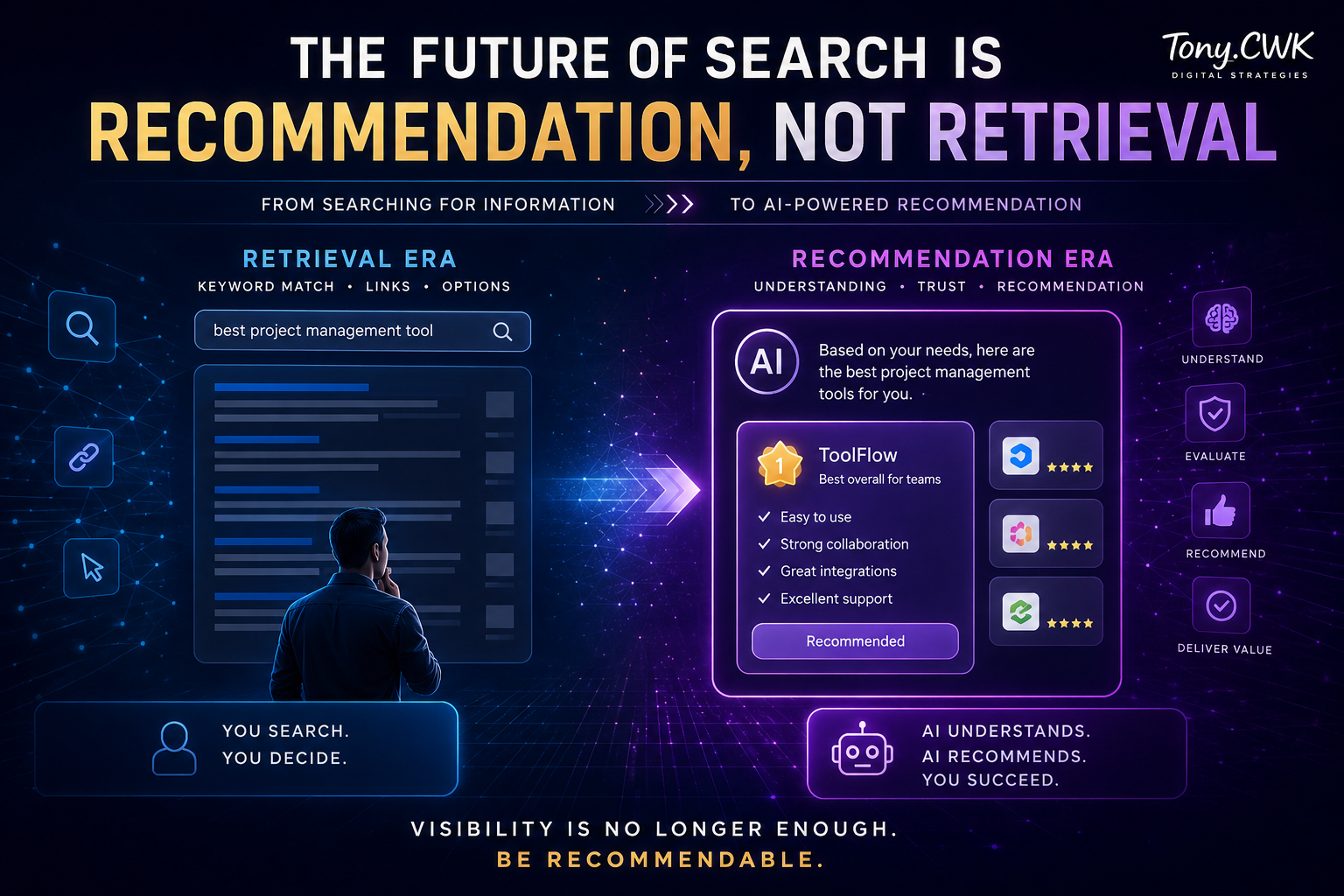
But the architecture of digital discovery is now fundamentally changing.
Modern AI systems are no longer functioning primarily as retrieval engines.
They are evolving into recommendation engines.
This shift changes everything.
The future of search is no longer about:
- returning the most relevant webpages,
- displaying the best keyword match,
- or ranking ten blue links.
Instead, AI systems are increasingly deciding:
- which brands to recommend,
- which products to surface,
- which services to trust,
- and which entities deserve delegated confidence.
The transition from retrieval to recommendation may become one of the largest structural transformations in the history of digital marketing.
And most businesses are still optimizing for the old internet.
From Retrieval Engines to Recommendation Systems
Traditional search engines operated on a relatively straightforward model:
- Crawl content
- Index webpages
- Match queries
- Rank results
- Let users decide
This was fundamentally a retrieval architecture.
Google’s original dominance was built on helping users retrieve the best information from the web.
But AI-powered systems are introducing a completely different layer of intelligence.
Large Language Models (LLMs), AI assistants, AI Overviews, agentic search systems, delegated commerce interfaces, and recommendation engines do not merely retrieve information.
They interpret.
They synthesize.
They evaluate.
They recommend.
This creates a massive shift in digital visibility.
The winning brand is no longer simply the most searchable.
It becomes the most recommendable.
Why Retrieval Is Becoming Less Important
Retrieval assumes:
- users want options,
- users want multiple links,
- users want to compare manually,
- users want to evaluate information themselves.
AI systems increasingly reduce this friction.
Instead of giving users ten possible answers, AI aims to provide:
- one trusted recommendation,
- one summarized conclusion,
- one delegated decision pathway.
This is the rise of delegated discovery.
The interface itself becomes the selector.
In many AI experiences:
- users may never visit a website,
- may never compare multiple brands,
- and may never perform traditional search behavior at all.
The AI system becomes the intermediary layer between businesses and consumers.
This fundamentally changes how digital authority is earned.
The Rise of AI Recommendation Architectures
Modern AI systems increasingly operate through recommendation logic rather than retrieval logic.
Recommendation systems evaluate:
- authority,
- semantic clarity,
- consistency,
- trust signals,
- ecosystem reinforcement,
- citation reliability,
- contextual relevance,
- entity confidence,
- retrieval confidence,
- and predictive usefulness.
This means AI systems are not merely asking:
“Does this page contain the keyword?”
They are increasingly asking:
“Is this entity trustworthy enough to recommend?”
That is an entirely different competitive framework.
Search Is Becoming Selection
The next evolution of search is not ranking.
It is selection.
Traditional SEO optimized for discoverability.
AI-era visibility optimizes for selectability.
This creates a major strategic transition:
| Traditional Search Era | AI Recommendation Era |
|---|---|
| Ranking competition | Recommendation competition |
| Keyword relevance | Entity trustworthiness |
| Link retrieval | Decision delegation |
| Click-through optimization | Selection optimization |
| Search visibility | AI recommendation visibility |
| Traffic acquisition | Recommendation inclusion |
| Content volume | Retrieval confidence |
| SERP position | Recommendation probability |
This is why many legacy SEO strategies may become increasingly insufficient.
Being found is no longer enough.
Brands must become recommendable.
Why AI Systems Prefer Trusted Entities
AI systems operate under uncertainty.
To reduce hallucination risks and improve answer quality, AI increasingly favors:
- recognizable entities,
- structured knowledge,
- repeated validation signals,
- authoritative ecosystems,
- semantic consistency,
- and cross-platform reinforcement.
This creates a trust-weighted internet.
Brands with:
- stronger authority systems,
- clearer entity relationships,
- better ecosystem consistency,
- and higher retrieval confidence
become more likely to be surfaced repeatedly across AI interfaces.
The future competitive advantage shifts from:
“Who ranks first?”
to:
“Who gets selected repeatedly?”
The Collapse of Click-Centric Visibility
The retrieval era was built around clicks.
Success metrics included:
- CTR,
- impressions,
- pageviews,
- organic traffic,
- bounce rates,
- session duration.
But recommendation-driven AI interfaces may dramatically reduce direct clicks.
In recommendation environments:
- AI may summarize content,
- compare vendors,
- recommend products,
- answer questions directly,
- and guide decisions without sending traffic outward.
This creates a post-click visibility economy.
Visibility no longer depends solely on website visits.
Instead, authority increasingly depends on:
- recommendation frequency,
- citation probability,
- ecosystem recognition,
- semantic presence,
- and delegated trust.
This is one of the most important strategic changes businesses must understand.
The Emergence of AI Authority™
In the retrieval era:
SEO determined visibility.
In the recommendation era:
AI Authority™ may determine recommendation eligibility.
AI systems increasingly favor entities that demonstrate:
- consistent expertise,
- semantic depth,
- ecosystem authority,
- structured knowledge,
- cross-platform reinforcement,
- citation reliability,
- and retrieval confidence.
This is why the future of digital strategy may revolve around:
- AI-readable authority systems,
- entity persistence,
- recommendation architecture,
- ecosystem credibility,
- and selection intelligence.
The future internet may increasingly reward:
not the loudest brands,
but the most trusted systems.
Why SMEs May Still Win
One of the most important implications of recommendation-driven search is this:
Large budgets may no longer guarantee visibility dominance.
In traditional search:
large brands often dominated through:
- domain authority,
- backlinks,
- advertising budgets,
- and content scale.
But AI recommendation systems may prioritize:
- semantic clarity,
- topical specialization,
- ecosystem consistency,
- and contextual trustworthiness.
This creates opportunities for SMEs.
Smaller businesses that build:
- highly coherent authority ecosystems,
- specialized expertise,
- structured knowledge architecture,
- and consistent semantic positioning
may outperform larger organizations in recommendation environments.
The future may reward precision over scale.
The New Visibility Model
The internet is entering a new visibility paradigm.
Old Model
Search → Click → Website → Decision
Emerging Model
Intent → AI Evaluation → Recommendation → Delegated Decision
This changes:
- SEO,
- digital marketing,
- content strategy,
- branding,
- commerce,
- and competitive positioning.
The businesses that understand this shift early may gain disproportionate advantages in the AI era.
Because the future of visibility may no longer belong to the most searchable brands.
It may belong to the most recommendable entities.
Final Thoughts
The future of search is no longer retrieval.
It is recommendation.
AI systems are increasingly becoming:
- evaluators,
- selectors,
- recommenders,
- and delegated decision engines.
This transforms digital competition from:
- ranking optimization
to: - recommendation optimization.
The strategic question businesses must now ask is no longer:
“How do we rank higher?”
But instead:
“Why would AI systems recommend us over everyone else?”
That may become the defining visibility question of the AI era.
And the brands that solve it earliest may shape the next generation of digital authority.
Frequently Asked Questions (FAQ)
1. What does “The Future of Search Is Recommendation, Not Retrieval” mean?
It means AI systems are evolving beyond simply retrieving webpages. Modern AI increasingly evaluates, filters, and recommends trusted entities directly to users instead of presenting multiple links for manual comparison.
2. How is AI recommendation different from traditional search?
Traditional search retrieves indexed webpages based on keyword relevance. AI recommendation systems evaluate authority, trustworthiness, semantic clarity, ecosystem credibility, and contextual usefulness before recommending brands or information.
3. Why is retrieval becoming less important?
AI interfaces aim to reduce user friction by delivering direct answers, recommendations, and delegated decisions instead of requiring users to evaluate multiple search results themselves.
4. What is delegated discovery?
Delegated discovery occurs when users allow AI systems to evaluate options and make recommendations on their behalf instead of manually researching and comparing information.
5. What is recommendation-driven visibility?
Recommendation-driven visibility refers to a brand’s ability to be selected, cited, surfaced, and recommended by AI systems rather than merely being searchable through traditional search engines.
6. How do AI systems decide which brands to recommend?
AI systems increasingly evaluate:
- semantic consistency,
- entity recognition,
- ecosystem authority,
- structured knowledge,
- citation reliability,
- retrieval confidence,
- and cross-platform trust signals.
7. What is AI Authority™?
AI Authority™ refers to a brand’s ability to establish trust, consistency, credibility, and semantic relevance across digital ecosystems in ways that increase recommendation probability within AI systems.
8. Why are AI recommendation systems important for digital marketing?
Because future digital visibility may depend less on clicks and rankings, and more on recommendation inclusion, citation probability, and AI trustworthiness.
9. Will SEO become obsolete?
No. SEO still matters. However, SEO alone may become insufficient as AI systems increasingly prioritize recommendation eligibility rather than simple webpage retrieval.
10. What is the difference between discoverability and selectability?
Discoverability focuses on being found.
Selectability focuses on being chosen and recommended by AI systems.
11. What role do entities play in AI recommendation systems?
AI systems rely heavily on entities to establish contextual understanding, semantic relationships, trust evaluation, and recommendation confidence.
12. Why do AI systems favor trusted entities?
Trusted entities reduce uncertainty, improve answer reliability, strengthen retrieval confidence, and lower hallucination risks for AI systems.
13. What is retrieval confidence?
Retrieval confidence refers to the level of certainty AI systems have when identifying, understanding, validating, and surfacing an entity or information source.
14. How can businesses improve AI recommendation visibility?
Businesses can improve recommendation visibility through:
- structured knowledge architecture,
- topical authority,
- ecosystem consistency,
- entity reinforcement,
- semantic clarity,
- and cross-platform credibility signals.
15. Why may SMEs benefit from recommendation-driven search?
AI recommendation systems may prioritize specialization, contextual authority, and semantic coherence over sheer scale or advertising budgets, giving SMEs opportunities to compete more effectively.
16. How will AI recommendation systems affect website traffic?
AI systems may reduce direct website visits because users increasingly receive summarized answers, recommendations, and delegated decisions directly within AI interfaces.
17. What is a post-click visibility economy?
A post-click visibility economy is an environment where visibility and influence are measured by recommendation frequency, AI citations, and delegated trust rather than solely by clicks and traffic.
18. What is recommendation optimization?
Recommendation optimization involves improving a brand’s likelihood of being selected and recommended by AI systems through authority, consistency, and ecosystem trust signals.
19. How does AI recommendation affect online commerce?
AI systems may increasingly guide product comparisons, vendor selection, and purchasing decisions directly, reducing traditional click-based commerce pathways.
20. What is the biggest strategic shift businesses must understand?
The biggest shift is that future digital competition may increasingly depend on recommendation eligibility rather than search rankings alone.
Suggested Further Reading
- “AI Authority Systems” 👉 https://tonycwk.com/ai-authority-systems/
- “Selection Intelligence™” 👉 https://tonycwk.com/selection-intelligence/
- “AI Selection Systems™” 👉 https://tonycwk.com/ai-selection-systems/
- “Retrieval Confidence™” 👉 https://tonycwk.com/retrieval-confidence/
- “Entity Persistence in the Age of LLMs” 👉 https://tonycwk.com/entity-persistence-in-the-age-of-llms/
- “The New Visibility Model: Why Being Found Is No Longer Enough” 👉 https://tonycwk.com/the-new-visibility-model
- “Why AI Doesn’t Trust Content — It Trusts Systems” 👉 https://tonycwk.com/why-ai-doesnt-trust-content-it-trusts-systems/
- “Algorithmic Authority Recognition” 👉 https://tonycwk.com/algorithmic-authority-recognition/
- “AI Discovery Flywheel™” 👉 https://tonycwk.com/ai-discovery-flywheel/
Written by Tony Chan (TonyCWK)
AI Authority & Digital Strategy Researcher
Leave a Reply