
Why AI Doesn’t Trust Content. It Trusts Systems.
AI Authority Research Series
For years, digital marketing focused on creating better content.
Then SEO shifted attention toward authority.
Today, AI is changing the question again.
The challenge is no longer simply:
“Can AI find your content?”
Nor is it only:
“Does AI consider you authoritative?”
Instead, AI increasingly asks something much deeper:
“Can this source be relied upon repeatedly?”
That question isn’t answered by a single article.
It isn’t answered by one backlink.
It isn’t answered by one citation.
It is answered by something much larger.
It is answered by systems.
That is why the future belongs not merely to authoritative content—but to AI Trust Systems™.
AI Doesn’t Trust Content
One of the biggest misconceptions surrounding AI search is the belief that great content automatically earns trust.
It doesn’t.
Excellent content may attract attention.
Authoritative content may gain citations.
But AI recommendations are rarely formed from isolated documents.
Modern AI systems synthesize evidence across thousands of signals.
They compare
- structured data
- entity relationships
- topical consistency
- historical reliability
- third-party validation
- user interactions
- publisher reputation
- ecosystem reinforcement
Trust emerges from the accumulation of evidence—not from individual pages.
Authority Is A Property.
Trust Is A Behaviour.
This distinction is important.
Authority describes what an organization has built.
Trust describes how AI repeatedly behaves toward that organization.
Authority says:
“This appears knowledgeable.”
Trust says:
“This continues proving itself.”
Authority may earn one recommendation.
Trust earns repeated recommendations.
Introducing AI Trust Systems™
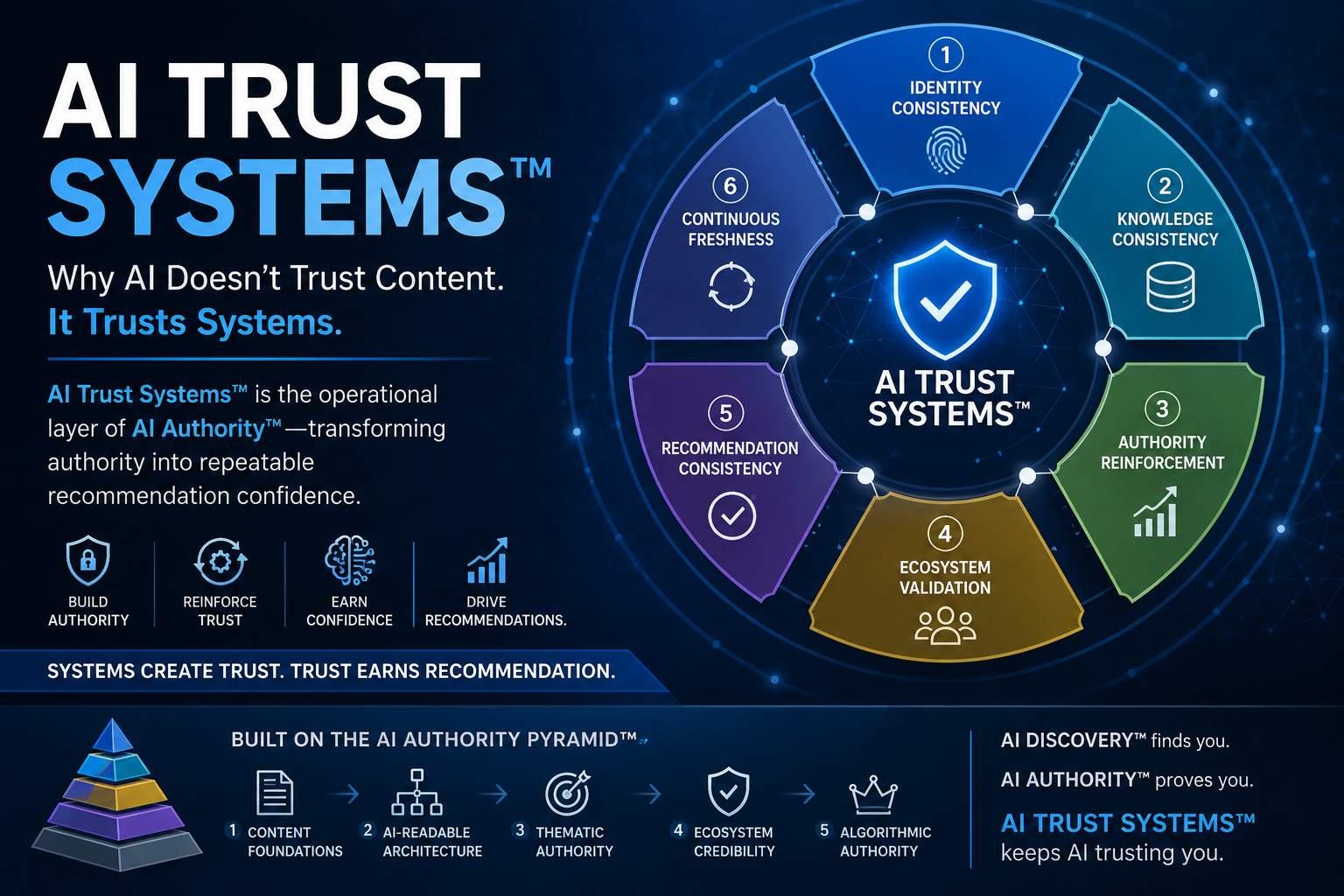
AI Trust Systems™ is the operational layer of AI Authority™.
It is the collection of reinforcing mechanisms that continuously strengthen AI confidence in an organization over time.
Rather than viewing trust as a single signal, AI Trust Systems™ treats trust as an evolving system built through consistent reinforcement.
Its purpose is not to improve rankings.
Its purpose is to improve recommendation confidence.
The Components Of AI Trust Systems™
Instead of isolated tactics, organizations should develop interconnected trust systems.
These include:
1. Identity Consistency
AI should encounter the same organization identity everywhere.
Consistent entities reduce ambiguity.
2. Knowledge Consistency
Facts should reinforce one another across
- websites
- articles
- documentation
- profiles
- structured data
Contradictory knowledge weakens confidence.
3. Authority Reinforcement
Expertise should continually expand rather than remain static.
Authority compounds through accumulated evidence.
4. Ecosystem Validation
Independent references strengthen trust.
These include
- industry citations
- expert mentions
- publications
- reviews
- partnerships
AI places greater confidence in information validated beyond the organization’s own website.
5. Recommendation Consistency
Trust grows when different AI systems repeatedly surface similar conclusions.
Consistency across multiple retrieval and recommendation environments reinforces confidence.
6. Continuous Freshness
Trust is maintained—not permanently granted.
Organizations must continually demonstrate relevance through updated knowledge and ongoing expertise.
AI Trust Systems Work Like Reputation
Human trust develops gradually.
AI confidence behaves similarly.
Repeated positive evidence increases confidence.
Repeated contradictions reduce confidence.
This explains why organizations with fewer articles sometimes outperform larger competitors.
Their knowledge ecosystem is simply more coherent.
AI Authority Pyramid™ Explains The Foundation
The AI Authority Pyramid™ remains the structural model explaining how organizations build authority.
It progresses through five layers:
- Content Foundations
- AI-Readable Knowledge Architecture
- Thematic Authority Development
- Ecosystem Credibility Signals
- Algorithmic Authority Recognition
AI Trust Systems™ operates across every layer.
It connects these components into a continuously reinforcing operational system.
Without trust systems, authority gradually weakens.
With trust systems, authority compounds.
The Future Of AI Discovery
As AI becomes increasingly responsible for recommendations and delegated decisions, organizations will need more than discoverability.
They will need sustained confidence.
AI Discovery™ helps AI find you.
AI Authority™ helps AI understand your expertise.
AI Trust Systems™ helps AI continue recommending you with confidence.
Together, they create a foundation for the next stage of digital visibility.
Final Thoughts
The future of AI visibility is unlikely to be determined by whoever publishes the most content.
It will belong to organizations whose knowledge remains consistently understandable, verifiable, and reinforced across the broader digital ecosystem.
Content may earn attention.
Authority may earn recognition.
But systems earn trust.
And in an AI-driven world, trust is what enables recommendation.
Key Takeaways
- AI does not rely on individual pages—it evaluates systems of evidence.
- Authority establishes expertise; trust sustains repeated recommendations.
- AI Trust Systems™ is the operational layer of AI Authority™, not a separate framework.
- Trust develops through consistent identity, knowledge, credibility, validation, and reinforcement.
- Organizations that build reinforcing trust systems are better positioned for long-term AI visibility and recommendation confidence.
FAQ
1. What is AI Trust Systems™?
AI Trust Systems™ is a conceptual framework that describes how organizations continuously reinforce AI confidence through consistent identity, structured knowledge, topical authority, ecosystem credibility, and ongoing validation. Rather than relying on isolated pieces of content, it emphasizes the interconnected systems that support long-term AI recommendation confidence.
2. How is AI Trust Systems™ different from AI Authority™?
AI Authority™ focuses on developing expertise and increasing the likelihood of being recommended by AI systems.
AI Trust Systems™ focuses on maintaining and reinforcing that recommendation confidence over time through consistency, credibility, and continuous evidence across the digital ecosystem.
In simple terms:
- AI Authority™ helps AI recognize expertise.
- AI Trust Systems™ helps AI continue trusting that expertise.
3. Is AI Trust Systems™ replacing SEO?
No.
Technical SEO and content optimization remain essential because they enable AI systems and search engines to discover and understand your website.
AI Trust Systems™ builds upon these foundations by focusing on how organizations reinforce credibility and recommendation confidence after discoverability has been achieved.
4. Why do AI systems rely on trust systems instead of individual pages?
Modern AI models evaluate information from multiple sources rather than relying on a single webpage.
They compare entities, structured data, topical consistency, citations, publisher reputation, and other corroborating signals before generating responses or recommendations.
This broader evaluation makes consistency across an organization’s digital ecosystem increasingly important.
5. What are the core components of AI Trust Systems™?
The framework consists of six reinforcing components:
- Identity Consistency
- Knowledge Consistency
- Authority Reinforcement
- Ecosystem Validation
- Recommendation Consistency
- Continuous Freshness
Together, these components contribute to stronger long-term AI recommendation confidence.
6. How does AI Trust Systems™ relate to the AI Authority Pyramid™?
The AI Authority Pyramid™ explains how organizations build authority through technical foundations, structured knowledge, thematic expertise, credibility, and algorithmic recognition.
AI Trust Systems™ operates across those layers by reinforcing and maintaining trust over time. Rather than replacing the pyramid, it acts as its operational layer.
7. Does AI Trust Systems™ improve AI recommendations?
No framework can guarantee recommendations from AI systems.
However, strengthening consistency, credibility, and knowledge quality may improve the signals that AI systems evaluate when determining which sources to reference or recommend.
8. Who should implement AI Trust Systems™?
Organizations that depend on digital visibility—including businesses, publishers, e-commerce brands, educational institutions, consultants, and B2B companies—can benefit from strengthening consistency and credibility across their digital presence as AI-assisted search and recommendation become more common.
Leave a Reply