
From Rankings to Recommendations
Introduction — Visibility Has Fundamentally Changed
For years, digital visibility was defined by one objective:
Rank higher. Get more clicks.
This was the foundation of Search Engine Optimisation (SEO).
But today, search has evolved.
Users are no longer just:
- Clicking links
- Browsing multiple websites
They are receiving:
- Direct answers
- AI-generated summaries
- Curated recommendations
This shift changes everything.
Visibility is no longer about being found —
it is about being selected.
And that requires a new model.
Why Traditional SEO Frameworks Are No Longer Enough
Most SEO strategies still operate on a familiar pyramid:
- Technical SEO
- Structured Data
- Keywords & Content
- Authority & Backlinks
This model was designed for:
Ranking web pages in search engines
But AI systems do not rank pages.
They evaluate:
- Clarity
- Structure
- Context
- Credibility
And most importantly:
They decide which answer to present.
The Shift: From Findable to Recommended
| Traditional SEO | AI Visibility |
|---|---|
| Rank pages | Select answers |
| Keywords | Context & entities |
| Traffic | Citations & mentions |
| Click-driven | Zero-click outcomes |
| Page-level optimisation | Knowledge-level architecture |
👉 This is the defining shift:
SEO = Findable
AI Authority = Recommended
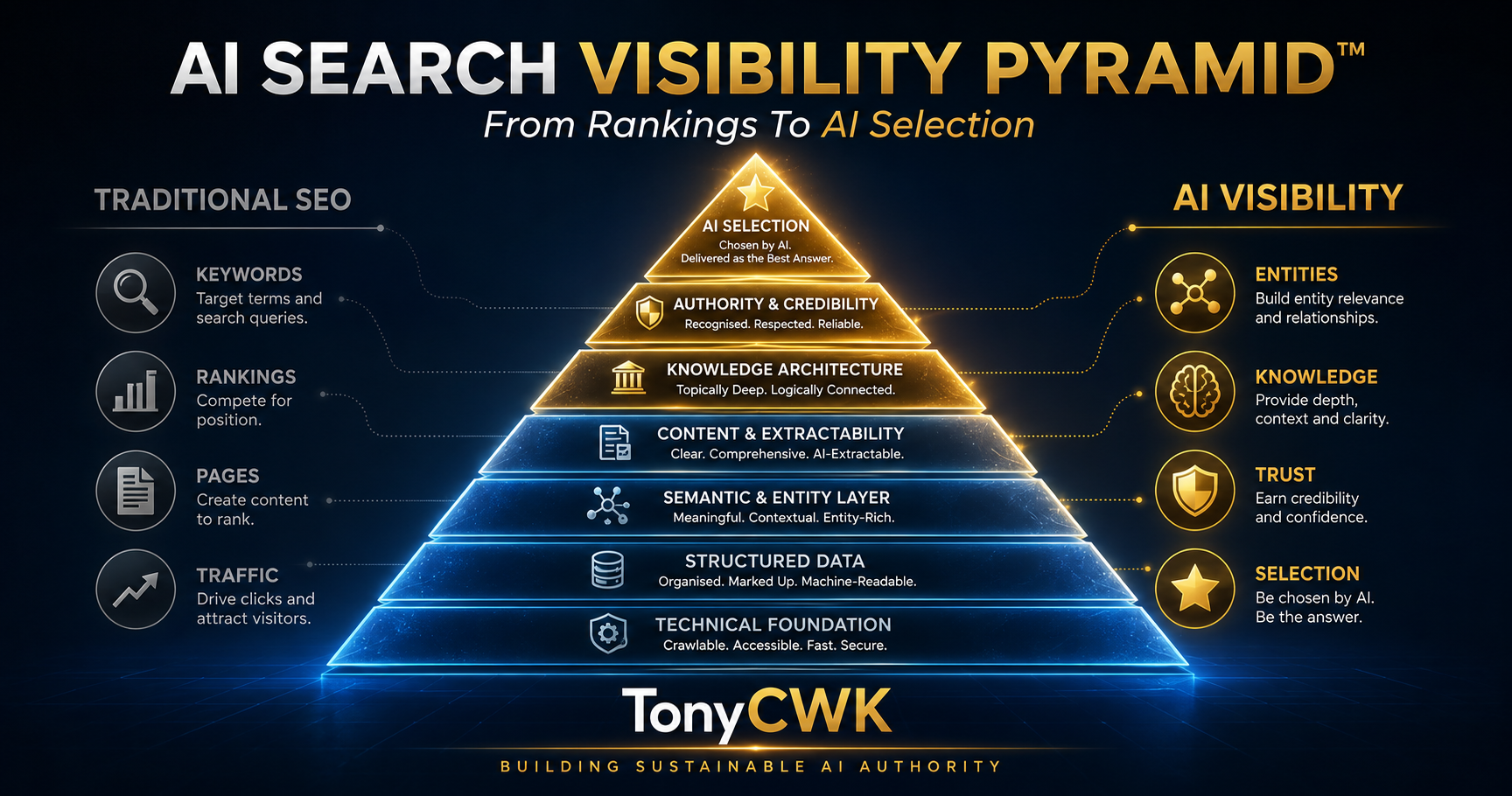
Introducing the AI Search Visibility Pyramid™
To compete in this new landscape, we need a more evolved framework.
Not just SEO.
But AI-ready visibility architecture.
Below is the upgraded model:
🔴 Layer 1 — Technical Foundation
What it does: Ensures your content can be accessed
- Site speed
- Mobile responsiveness
- Indexing & crawlability
- Clean architecture
👉 Without this, nothing else works.
🟣 Layer 2 — Structured Data Layer
What it does: Makes your content machine-readable
- Schema markup
- Metadata clarity
- Rich snippets
👉 This helps systems interpret your content correctly.
🔵 Layer 3 — Semantic & Entity Layer
What it does: Builds contextual understanding
- Entity optimisation (brand, person, topic)
- Semantic relationships
- NLP alignment
👉 AI does not read keywords — it understands meaning.
🟢 Layer 4 — Content & Extractability Layer
What it does: Makes your content usable by AI
- Clear answers
- Q&A structures
- Bullet points & summaries
- Defined sections
👉 If AI cannot extract it, it cannot use it.
🟡 Layer 5 — Knowledge Architecture
What it does: Connects your expertise
- Topic clusters
- Internal linking
- Thematic depth
- Content ecosystems
👉 AI evaluates not just content — but how knowledge is organised.
🟠 Layer 6 — Authority & Credibility
What it does: Builds trust signals
- Backlinks
- Mentions
- Expertise signals
- Consistency across platforms
👉 Authority is no longer just links — it is recognition.
🔺 Layer 7 — AI Selection Layer
What it does: Determines if you get chosen
👉 This is the ultimate outcome:
Will AI select you as the answer?
How This Plays Out in the Real World (Singapore SME Example)
Consider a chiropractic clinic in Singapore.
Traditional SEO approach:
- Target keywords like “back pain treatment Singapore”
- Publish blog articles
- Build backlinks
AI Visibility approach:
- Create structured Q&A content:
- “What causes lower back pain?”
- “When should you see a chiropractor?”
- Build a knowledge cluster:
- Pain types → Treatments → Prevention
- Establish entity authority:
- Doctor profile
- Clinic expertise
- Consistent mentions
👉 Result:
Instead of just ranking…
The clinic becomes a trusted source AI systems reference.
Common Mistake: Creating Content Without Structure
Many businesses are still:
- Writing long articles
- Targeting keywords
- Hoping to rank
But AI systems are asking:
“Can I extract a clear answer from this?”
If the answer is no:
- You may rank
- But you won’t be selected
Strategic Insight — Visibility Is Now Engineered
The biggest misconception today is this:
“More content = more visibility”
This is no longer true.
In the AI era:
Visibility is engineered through structured authority.
This means:
- Designing content for extraction
- Building interconnected knowledge
- Reinforcing credibility across platforms
Conclusion — The New Visibility Playbook
The AI Authority Pyramid™ is not just a framework.
It represents a shift in thinking:
Final Takeaway
SEO helps you get discovered.
AI Authority helps you get chosen.
Businesses that understand this will not just compete in search.
They will lead in AI-driven discovery.
AI Search Visibility Pyramid — FAQ
1. What is the AI Search Visibility Pyramid?
The AI Search Visibility Pyramid is a framework that explains how digital visibility has evolved from traditional SEO rankings to AI-driven answer selection, focusing on structured knowledge, credibility, and extractable content.
2. How is AI visibility different from SEO?
SEO focuses on ranking web pages, while AI visibility focuses on being selected as the best answer in AI-generated responses.
3. Why is SEO no longer enough?
SEO alone is not enough because AI systems now deliver direct answers, reducing clicks and prioritising content that is clear, structured, and trustworthy.
4. What does “AI selection” mean?
AI selection refers to the process where AI systems choose specific content as the most relevant and reliable answer to present to users.
5. What is the most important layer in the pyramid?
The most important layer is AI Selection, as it determines whether your content is chosen and surfaced in AI-generated answers.
6. What is the role of technical SEO in AI visibility?
Technical SEO ensures that your website is accessible, fast, and crawlable, forming the foundation for all higher-level optimisation.
7. Why is structured data important for AI?
Structured data helps AI systems understand content through machine-readable signals, improving interpretation and extraction.
8. What is semantic and entity SEO?
Semantic and entity SEO focuses on defining meaning by linking topics, entities, and relationships so AI can understand context rather than just keywords.
9. What is content extractability?
Content extractability refers to how easily AI systems can identify, extract, and reuse your content as direct answers.
10. How can I make content more extractable?
You can improve extractability by using clear headings, concise answers, bullet points, summaries, and Q&A formats.
11. What is knowledge architecture?
Knowledge architecture is the way content is structured and interconnected through topic clusters, internal links, and thematic coverage.
12. Why are topic clusters important for AI?
Topic clusters help AI systems understand depth and authority by showing comprehensive coverage of a subject area.
13. What builds authority in AI search?
Authority is built through expertise, consistent publishing, backlinks, mentions, and strong entity recognition across platforms.
14. Do backlinks still matter in the AI era?
Yes, but they are no longer the only factor. AI also evaluates credibility, consistency, and contextual relevance.
15. What are AI confidence signals?
AI confidence signals include clarity, accuracy, consistency, and validation from multiple trusted sources.
16. What is zero-click search?
Zero-click search refers to search experiences where users receive answers directly without clicking on a website.
17. How do AI systems choose content?
AI systems choose content based on clarity, structure, expertise, relevance, and trustworthiness.
18. What industries benefit most from AI visibility?
All industries benefit, especially service-based businesses, healthcare, finance, and education where trusted answers are critical.
19. How can SMEs in Singapore improve AI visibility?
SMEs can improve AI visibility by creating structured content, building topical authority, using schema markup, and establishing credibility signals.
20. What is the future of search visibility?
The future of search visibility lies in AI-driven discovery, where businesses are selected and recommended based on authority, structure, and trust.
AI Search Visibility Pyramid Summary
The AI Search Visibility Pyramid is a framework that explains how digital visibility has evolved from traditional SEO rankings to AI-driven answer selection.
It consists of seven layers:
- Technical Foundation — Ensures site performance, indexing, and crawlability
- Structured Data — Provides machine-readable signals through schema markup
- Semantic & Entity Layer — Defines meaning through entities and contextual relationships
- Content & Extractability — Structures content into clear, AI-readable answers
- Knowledge Architecture — Connects content through topic clusters and internal linking
- Authority & Credibility — Builds trust through expertise, mentions, and consistency
- AI Selection — Determines whether content is chosen as the best answer
👉 In the AI era, visibility is no longer about ranking pages —
it is about being selected as the answer.
This framework represents the foundational visibility layer that supports the broader AI Authority Pyramid™ and AI Discovery Flywheel™ frameworks.
Leave a Reply