
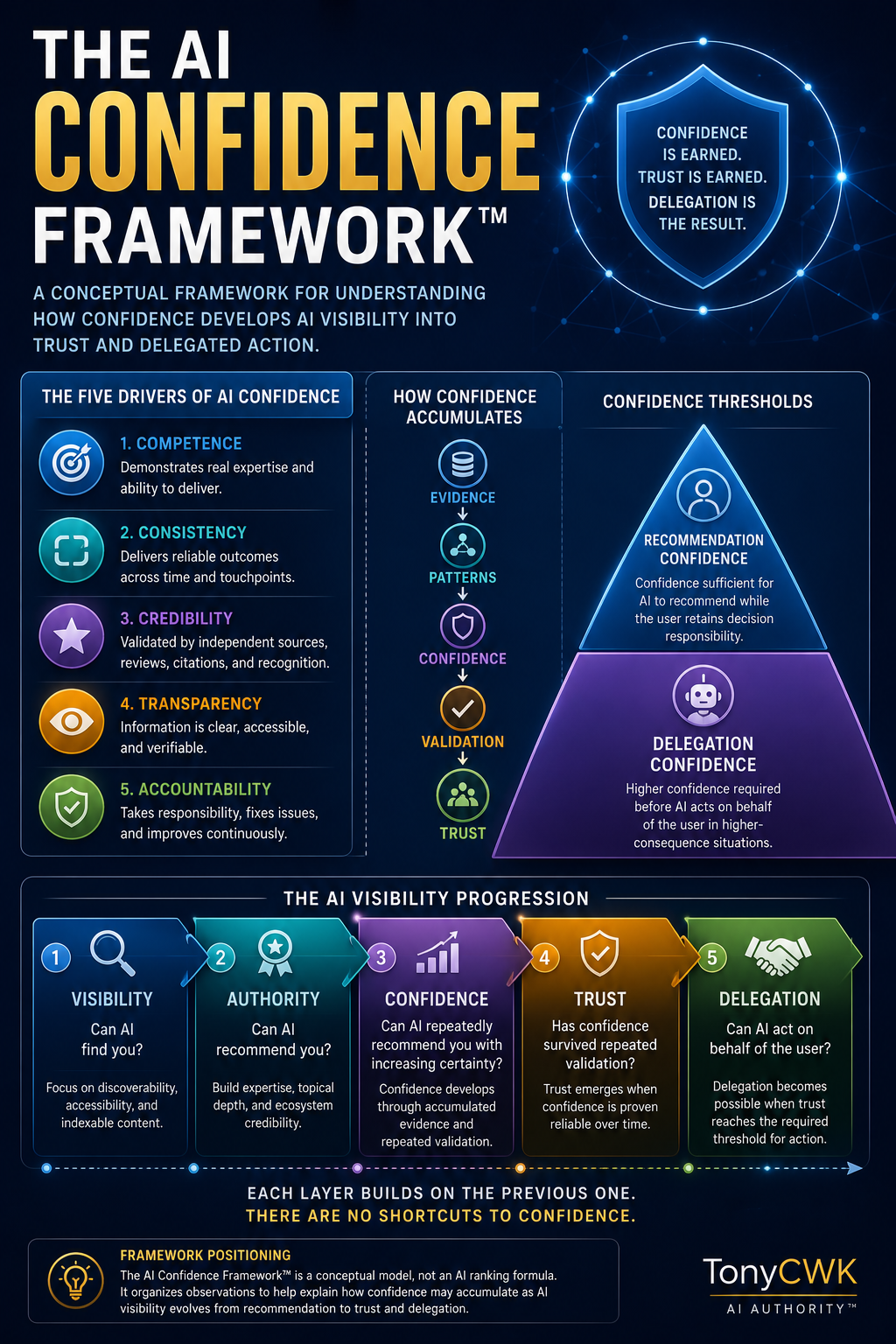
A Conceptual Framework For Understanding How Confidence May Develop In AI Visibility
Over the past several months, my research has explored the evolution of AI visibility beyond discovery and recommendation.
That journey began with Visibility.
It progressed to Authority.
More recently, it explored Confidence, Trust, and Delegation.
Each article asked a simple question that the previous layer could not fully answer.
Visibility explained how AI discovers a brand.
Authority explained why AI may recommend a brand.
Confidence explored why AI may continue recommending that brand with increasing certainty.
Trust explained how confidence survives repeated validation.
Delegation examined the confidence required before AI can act on behalf of users.
Together, these observations lead to what I call The AI Confidence Framework™.
This framework is not proposed as an AI ranking formula.
Nor does it claim to describe how current AI systems internally compute confidence.
Instead, it provides a conceptual model for understanding how confidence may accumulate as AI systems evolve from retrieval toward recommendation, trust, and delegated action.
Why A Confidence Framework?
Traditional SEO focused on visibility.
Modern AI optimization increasingly focuses on recommendation.
But recommendation alone may not explain why certain brands are surfaced repeatedly while others are only occasionally selected.
Confidence helps explore that missing layer.
Rather than asking:
Can AI recommend this brand?
The framework introduces another question:
How confident is AI becoming in recommending this brand repeatedly?
The Five Drivers Of AI Confidence
The framework begins with five observable drivers that may contribute to confidence accumulation.
1. Competence
Can the organization consistently demonstrate the expertise it claims?
Competence provides evidence that capability is genuine rather than merely stated.
2. Consistency
Does the organization repeatedly deliver similar outcomes across time, channels, and customer experiences?
Consistency reduces uncertainty.
Repeated evidence strengthens confidence.
3. Credibility
Do independent sources reinforce the organization’s claims?
Reviews, citations, references, industry recognition, and expert validation all contribute to credibility.
Confidence grows stronger when evidence extends beyond self-published content.
4. Transparency
Can important claims be understood and verified?
Transparency makes evidence easier to evaluate.
The more verifiable the information, the easier it becomes to reduce uncertainty.
5. Accountability
How does the organization respond when outcomes fall short of expectations?
Confidence is often strengthened not because mistakes never occur, but because organizations demonstrate responsibility, correction, and continuous improvement.
How Confidence Accumulates
The framework proposes that confidence develops progressively.
Individual signals create evidence.
Repeated evidence creates patterns.
Patterns reduce uncertainty.
Reduced uncertainty strengthens confidence.
Confidence that repeatedly survives validation begins to support trust.
This progression can be summarized as:
Evidence → Patterns → Confidence → Validation → Trust
Rather than relying on any single signal, confidence develops through the interaction of many forms of evidence over time.
Confidence Thresholds
Not every decision requires the same level of confidence.
The framework distinguishes between two confidence thresholds.
Recommendation Confidence
Sufficient confidence for AI to recommend an option while the user retains responsibility for the decision.
Delegation Confidence
A higher level of confidence that may be required before AI acts on behalf of the user in higher-consequence situations.
This distinction reflects the increasing certainty required as AI moves from suggestion to execution.
The AI Visibility Progression
The AI Confidence Framework™ is not independent of the AI Authority™ framework.
It builds upon it.
The progression can be understood as:
Visibility
Can AI find you?
↓
Authority
Can AI recommend you?
↓
Confidence
Can AI repeatedly recommend you with increasing certainty?
↓
Trust
Has confidence survived repeated validation?
↓
Delegation
Can AI act on behalf of the user?
Each stage depends on the integrity of the stages before it.
Confidence cannot be separated from visibility and authority.
Trust cannot be separated from confidence.
Delegation cannot be separated from trust.
An Integrated Framework, Not A Shortcut
Perhaps the most important principle behind this framework is that confidence is not an optimisation tactic.
It is not something that can simply be added to a marketing strategy.
Confidence emerges from the accumulated strength of everything beneath it.
Visibility creates discoverability.
Authority establishes recommendation potential.
Confidence develops through repeated evidence.
Trust emerges through repeated validation.
Delegation becomes possible when confidence reaches an appropriate threshold for action.
The framework therefore represents an integrated progression rather than a collection of isolated techniques.
Looking Ahead
As AI systems continue evolving toward recommendation engines, personal assistants, and autonomous agents, confidence may become an increasingly important concept for understanding digital visibility.
Whether future AI systems explicitly calculate confidence in this way remains to be seen.
What this framework offers is a structured way of thinking about the progression from visibility to recommendation, from recommendation to trust, and from trust to delegated action.
Rather than searching for shortcuts, organizations may benefit from building stronger foundations.
Because confidence is unlikely to be created overnight.
It is more likely to emerge from accumulated evidence, repeated validation, and consistent performance over time.
Ultimately, The AI Confidence Framework™ proposes a simple principle:
Confidence is not a destination.
It is the progressive outcome of strong foundations consistently reinforced over time.
FAQ
1. What is the AI Confidence Framework™?
The AI Confidence Framework™ is a conceptual model for understanding how confidence may develop as AI systems move from visibility and recommendation toward trust and delegated action.
2. Is the AI Confidence Framework™ an AI ranking formula?
No. It is not presented as an AI ranking formula or a description of how any specific AI system calculates recommendations. It is an architectural framework for understanding how confidence may accumulate over time.
3. What are the five drivers of AI confidence?
The five drivers are competence, consistency, credibility, transparency, and accountability. These factors may help explain how evidence accumulates and confidence develops.
4. How does confidence relate to trust?
Confidence reduces uncertainty. Trust emerges when confidence survives repeated validation over time and becomes strong enough to support reliance or action.
5. What is the difference between recommendation confidence and delegation confidence?
Recommendation confidence is the confidence needed for AI to suggest an option. Delegation confidence is the higher confidence threshold needed before AI can act on behalf of a user.
6. Why does AI confidence matter for brands?
AI confidence matters because future AI visibility may not only depend on being found or recommended, but also on being repeatedly recommended, trusted, and eventually selected for delegated action.
Leave a Reply