
Why Confidence Is Not A New Tactic, But The Next Layer In An Integrated AI Visibility Framework
Over the past several months, my research has explored how AI systems discover, evaluate, recommend, and increasingly support decisions about brands.
That exploration began with a simple question:
What makes a brand visible to AI?
The answer led to the development of the AI Authority™ framework, which examined how visibility, structured knowledge, topical authority, and ecosystem credibility help brands become recommendation candidates within AI-powered search.
But as AI systems continue to evolve, another question has emerged:
Why are some brands recommended repeatedly while others are only recommended occasionally?
Authority explains why AI may recommend a brand.
It does not fully explain why AI continues recommending that brand over time.
This observation led me to explore another layer:
Confidence.
Importantly, confidence should not be viewed as a replacement for authority.
Nor should it be treated as a new optimisation tactic.
Instead, I believe confidence represents the next layer in an integrated AI visibility progression.
AI Visibility Is A Progressive System
One of the biggest misconceptions in digital marketing is the search for shortcuts.
Every few years, a new technique is presented as the answer to everything.
SEO.
Content marketing.
Entities.
Schema.
AI optimisation.
In reality, sustainable visibility rarely comes from isolated tactics.
It comes from systems.
Each capability builds upon another.
Each layer depends on the strength of the layers beneath it.
That same thinking applies to AI visibility.
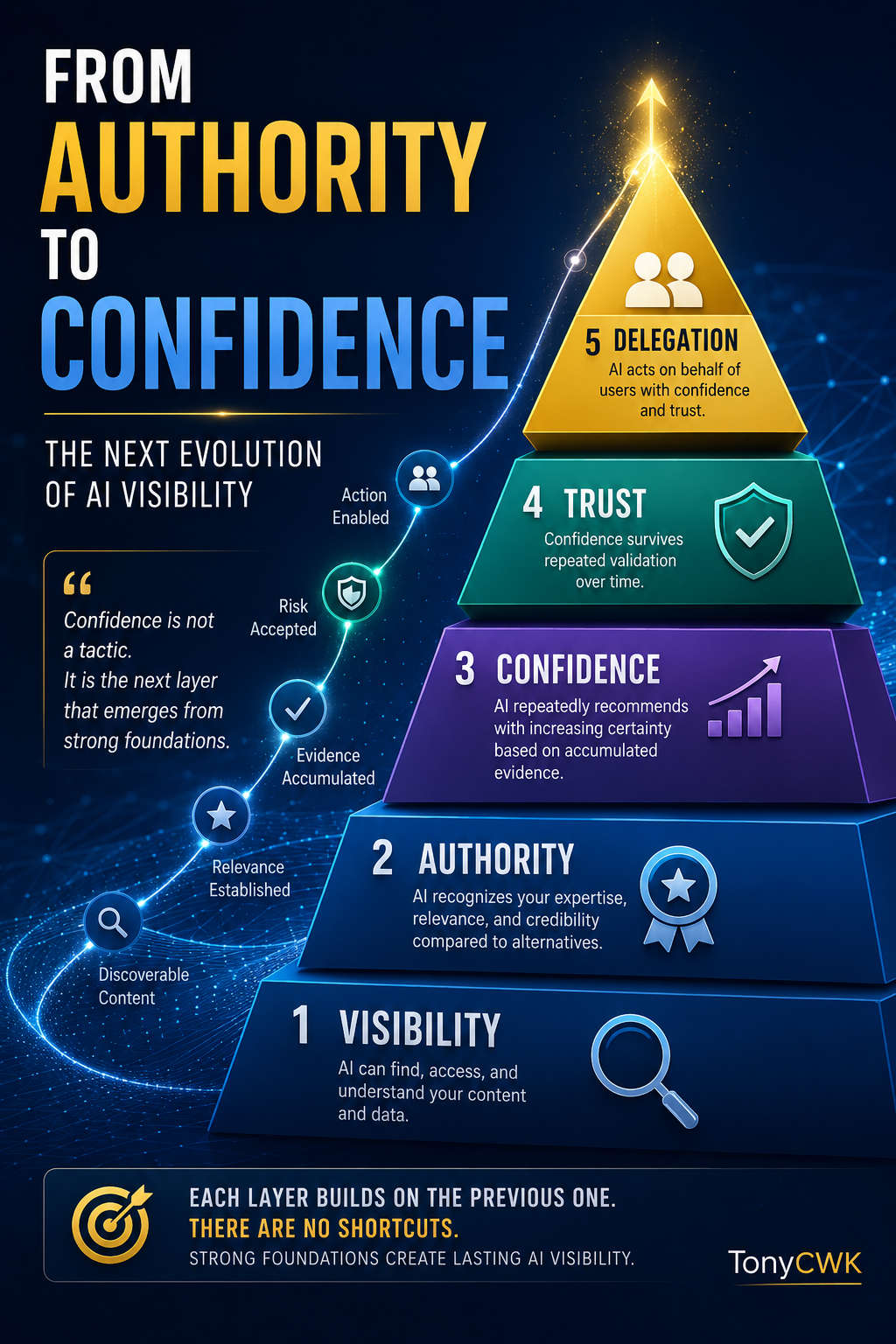
Rather than viewing visibility, authority, confidence, trust, and delegation as separate ideas, I see them as successive stages within a broader progression.
The AI Visibility Progression
Stage 1: Visibility
The first requirement is simple:
Can AI find you?
Without technical accessibility, structured content, discoverability, and indexable information, AI has nothing meaningful to evaluate.
Visibility creates opportunity.
It does not create preference.
Stage 2: Authority
Once AI can find a brand, another question follows:
Should this brand be recommended?
Authority develops through accumulated expertise, topical depth, semantic relationships, citations, and credibility.
Authority explains selection.
It helps AI identify brands that appear capable of answering a user’s needs.
Yet recommendation alone is not the end of the journey.
Stage 3: Confidence
Recommendation introduces another question:
How certain is AI about recommending this brand repeatedly?
This is where confidence may become increasingly important.
Confidence is not something that can be added directly.
It develops when evidence consistently reinforces itself over time.
Confidence is an outcome of accumulated evidence rather than a standalone optimisation.
Confidence Is Not Independent
This distinction is essential.
Confidence should never be interpreted as a shortcut.
It cannot exist without the layers beneath it.
Without visibility, AI cannot discover a brand.
Without authority, AI has little reason to recommend it.
Without repeated evidence, confidence has little foundation on which to grow.
Confidence depends on the integrity of everything that comes before it.
This is why I describe confidence as an emergent property rather than an optimisation tactic.
From Confidence To Trust
Confidence and trust are closely related, but they are not identical.
Confidence reduces uncertainty.
Trust accepts risk.
Confidence accumulates through repeated evidence.
Trust emerges when confidence survives repeated validation over time.
This distinction helps explain why trust cannot simply be declared.
Like confidence, it develops progressively.
Trust Enables Delegation
As AI systems evolve beyond recommendation toward delegated actions, the importance of trust becomes even greater.
Recommending a hotel requires one level of confidence.
Booking the hotel requires another.
Suggesting a supplier is different from selecting one.
Delegated actions carry greater consequences.
They therefore require stronger foundations.
This is why delegation sits at the top of the progression.
It depends on every preceding layer.
Building The Framework, Not Chasing Shortcuts
Throughout this research, one principle has remained consistent.
Each article builds on the one before it.
The framework has not been developed by introducing isolated tactics.
Instead, each concept has emerged from analysing the limitations of the previous layer and asking what question remains unanswered.
Visibility explains discovery.
Authority explains recommendation.
Confidence explores repeated recommendation.
Trust explains confidence that has survived validation.
Delegation explores confidence strong enough to support action.
The progression is intentional.
Each stage extends the previous one.
An Architectural Model, Not A Ranking Formula
It is important to clarify what this framework is—and what it is not.
This progression is not proposed as a set of AI ranking factors.
Nor does it claim to describe how any current AI system explicitly calculates recommendations.
Instead, it offers an architectural model for thinking about how AI visibility may evolve as AI systems move from retrieval to recommendation and, increasingly, toward delegated action.
The framework is intended to provide a structured way of understanding this progression rather than a shortcut for influencing AI systems.
The Future Of AI Visibility
The future of AI visibility may not be defined by one breakthrough technique.
It may be defined by how well organizations build layer upon layer of evidence over time.
Visibility helps AI find you.
Authority helps AI recommend you.
Confidence helps explain why recommendations become more consistent.
Trust emerges when confidence survives repeated validation.
Delegation becomes possible when confidence and trust reach a sufficient threshold for action.
Each layer depends on the integrity of the one before it.
The goal is not to skip steps.
The goal is to build them.
Because sustainable AI visibility is unlikely to come from isolated tactics.
It is far more likely to emerge from an integrated system developed progressively over time.
FAQ
1. What is the next evolution of AI visibility?
The next evolution of AI visibility may be the shift from authority to confidence. Authority helps AI recommend a brand, while confidence helps explain why AI may recommend that brand repeatedly.
2. Is confidence a standalone AI optimization tactic?
No. Confidence should not be viewed as a standalone tactic or shortcut. It is a higher layer that depends on visibility, authority, repeated evidence, and consistent validation over time.
3. How is authority different from confidence?
Authority explains why AI may select or recommend a brand. Confidence explains why AI may continue recommending that brand with greater consistency and certainty.
4. Why does confidence depend on previous layers?
Confidence depends on previous layers because AI must first discover a brand, understand its relevance, and recognize its authority before repeated evidence can accumulate into confidence.
5. How does confidence lead to trust?
Confidence reduces uncertainty. Trust emerges when confidence survives repeated validation over time and becomes strong enough for people or AI systems to rely on it.
6. Why does this matter for delegation and agentic commerce?
Delegation requires a higher threshold than recommendation. As AI systems move from suggesting options to acting on behalf of users, confidence and trust may become increasingly important.
Leave a Reply