
Introduction
For more than two decades, digital visibility was largely governed by one dominant principle:
Rank higher.
Get more clicks.
Win more traffic.
Traditional search engines rewarded discoverability through rankings. Businesses competed for page-one visibility through keyword optimization, backlinks, technical SEO, and content relevance.
But the rise of AI-generated answers, conversational search, recommendation systems, and delegated decision-making is fundamentally changing how visibility works.
We are entering an era where:
- users increasingly consume answers without clicking,
- AI systems synthesize information instead of merely indexing it,
- recommendation engines determine exposure,
- and digital authority influences whether brands are selected, cited, trusted, or ignored.
Search is no longer evolving around retrieval alone.
It is evolving around recommendation.
The future of visibility is not simply about being found.
It is about being chosen.
The Traditional Search Era — Rankings as the Primary Visibility Mechanism
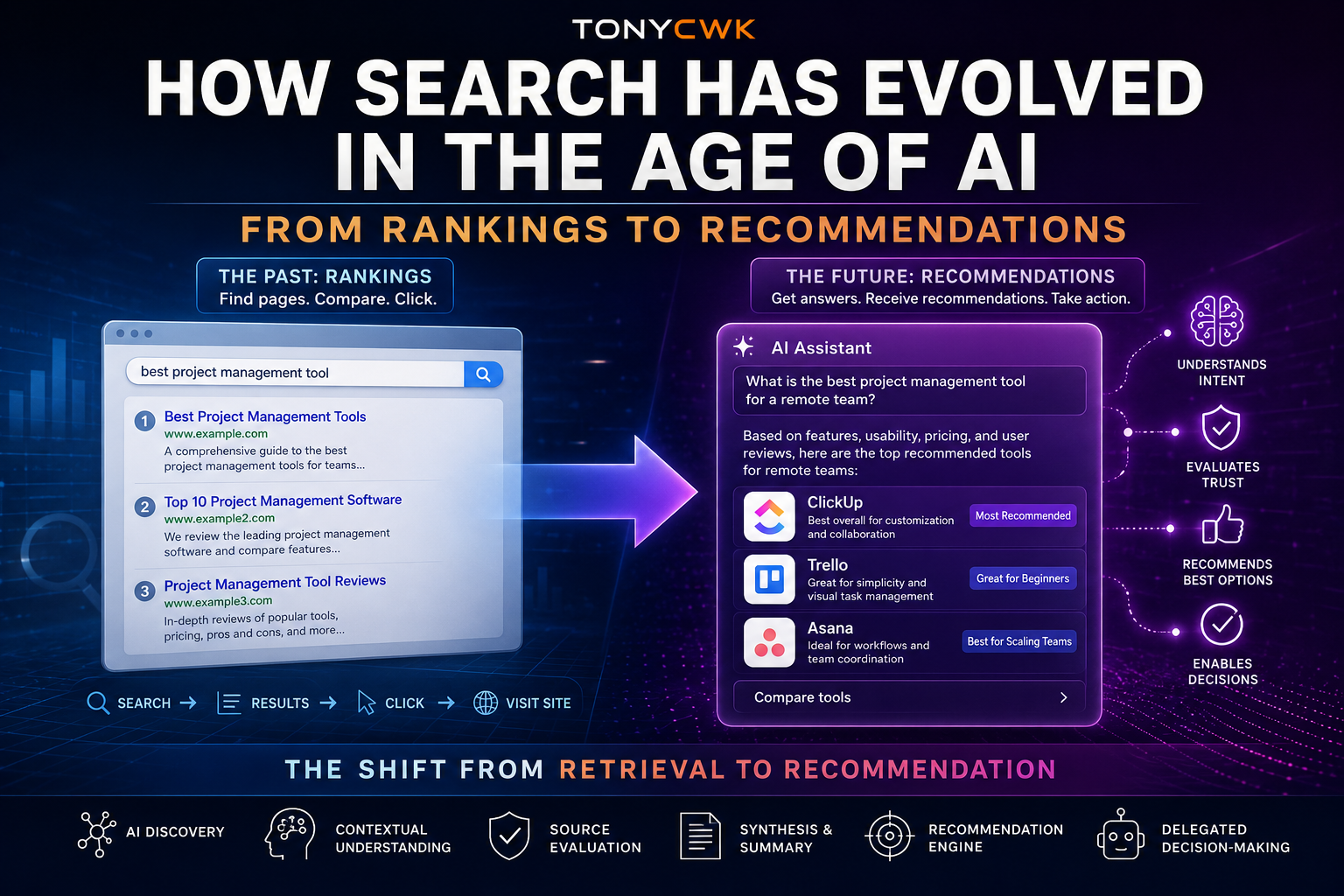
In the traditional search ecosystem, search engines primarily operated as retrieval systems.
Their role was to:
- crawl the web,
- index content,
- rank pages,
- and return results based on relevance signals.
Success was largely determined by:
- keyword targeting,
- backlinks,
- page authority,
- metadata optimization,
- technical SEO,
- click-through rates,
- and user engagement signals.
The dominant user journey looked like this:
Traditional Search Flow
User Query → Search Results Page → Click → Website Visit → Conversion
Visibility was therefore highly click-dependent.
The objective of SEO was straightforward:
Increase ranking positions to increase traffic opportunities.
In this model:
- discoverability mattered most,
- rankings represented visibility,
- and traffic became the primary currency of digital marketing.
This system shaped the modern internet economy.
But AI is beginning to reshape that foundation.
The Shift Toward AI-Mediated Discovery
Modern AI systems do not behave like traditional search engines.
Instead of merely retrieving links, AI systems increasingly:
- synthesize information,
- summarize content,
- infer intent,
- evaluate contextual relevance,
- compare entities,
- and generate recommendations directly.
This creates a fundamentally different visibility environment.
Instead of asking:
“Which page ranks highest?”
AI systems increasingly ask:
“Which source appears most trustworthy, contextually useful, semantically coherent, and recommendation-worthy?”
This changes the competitive landscape dramatically.
From Retrieval Systems to Recommendation Systems
Traditional search engines optimized for retrieval efficiency.
AI systems optimize for answer utility.
This distinction is critical.
Traditional Retrieval Logic
- Match keywords
- Rank indexed pages
- Present options
- Let users decide
AI Recommendation Logic
- Understand intent
- Evaluate sources
- Synthesize information
- Recommend likely best answers
- Reduce user decision friction
This means the user increasingly interacts with:
- AI-generated summaries,
- conversational interfaces,
- AI shopping assistants,
- delegated commerce systems,
- multimodal recommendation engines,
- and predictive discovery environments.
The result is a major transition:
Search is evolving from:
“Here are the best links.”
To:
“Here is the best answer.”
And eventually:
“Here is the best decision.”
Why Rankings Alone Are No Longer Enough
Traditional rankings still matter.
SEO remains important.
Technical discoverability still forms the foundation of digital visibility.
However, rankings alone no longer guarantee influence.
A page may rank highly yet:
- never be cited by AI systems,
- fail semantic trust evaluation,
- lack ecosystem reinforcement,
- have weak entity consistency,
- or provide low synthesis utility for AI-generated answers.
This creates a growing gap between:
Being Visible
and
Being Selected
In the AI era, recommendation probability becomes increasingly important.
The Rise of AI Authority
As AI systems mediate more discovery experiences, a new competitive layer emerges:
AI Authority™
AI Authority refers to the likelihood that AI systems:
- trust,
- retrieve,
- synthesize,
- recommend,
- cite,
- and repeatedly surface a brand or entity across interactions.
Unlike traditional SEO, AI Authority is not built from rankings alone.
It emerges from a combination of:
- semantic consistency,
- entity clarity,
- topical depth,
- ecosystem credibility,
- cross-platform reinforcement,
- citation recurrence,
- knowledge architecture,
- and retrieval confidence.
This is why businesses increasingly need systems rather than isolated optimization tactics.
The Evolution of Search Behavior
User behavior itself is also evolving rapidly.
Past Search Behavior
Users previously:
- compared multiple websites,
- evaluated search results manually,
- consumed long browsing sessions,
- and made independent decisions.
Emerging AI Search Behavior
Users now increasingly:
- ask conversational questions,
- rely on AI summaries,
- accept synthesized recommendations,
- interact through AI assistants,
- and delegate evaluation processes to algorithms.
This reduces:
- browsing depth,
- click dependency,
- and traditional website interaction patterns.
The new visibility challenge becomes:
How do brands remain influential when users interact less directly with websites?
The answer lies in becoming recommendation-worthy inside AI systems themselves.
The New Visibility Model
The emerging visibility stack can be understood as three major evolutionary phases.
1. Search Era
Visibility Through Rankings
Primary objective:
- maximize discoverability
Core metric:
- rankings and clicks
Competitive advantage:
- SEO execution
2. AI Discovery Era
Visibility Through Recommendations
Primary objective:
- maximize AI citation and recommendation likelihood
Core metric:
- recommendation visibility
Competitive advantage:
- AI Authority systems
3. AI Delegation Era
Visibility Through Selection
Primary objective:
- become the preferred AI-selected option
Core metric:
- selection probability
Competitive advantage:
- ecosystem trust and decision confidence
Why AI Systems Prefer Systems Over Isolated Content
One major misconception is that AI visibility can be achieved through isolated “optimized articles.”
In reality, AI systems increasingly evaluate:
- thematic consistency,
- ecosystem coherence,
- repeated reinforcement signals,
- author authority,
- organizational trust,
- and cross-platform semantic alignment.
This means:
AI systems trust systems more than standalone pages.
A fragmented content strategy may still rank.
But cohesive authority ecosystems are more likely to be recommended.
This is one reason why entity persistence and ecosystem reinforcement are becoming increasingly important in AI-mediated discovery.
The Future of Search Is Recommendation Architecture
As AI systems become more agentic, predictive, and decision-oriented, visibility increasingly shifts toward what can be called:
Recommendation Architecture
Recommendation Architecture refers to how effectively a brand positions itself to be:
- retrieved,
- trusted,
- synthesized,
- recommended,
- and selected by AI systems.
This extends beyond SEO into areas such as:
- semantic knowledge architecture,
- entity optimization,
- AI-readable ecosystems,
- citation reinforcement,
- retrieval confidence engineering,
- digital credibility signals,
- and recommendation consistency.
In this environment:
The brands that win will not necessarily be the loudest.
They will be the most recommendation-compatible.
Does SEO Still Matter?
Absolutely.
SEO still provides critical foundations for:
- crawlability,
- indexability,
- discoverability,
- site structure,
- technical accessibility,
- and content relevance.
Without discoverability, AI systems may never encounter or retrieve content effectively.
However, SEO is increasingly becoming:
The foundation layer — not the final layer.
In the AI era:
SEO helps content become findable.
AI Authority helps brands become recommendable.
The future is not SEO versus AI Authority.
The future is SEO evolving into a broader intelligent visibility framework.
The Strategic Implications for Businesses
Businesses that continue optimizing purely for rankings may eventually face diminishing influence in AI-mediated environments.
Future-ready organizations will increasingly need to build:
- structured knowledge ecosystems,
- thematic authority systems,
- semantic consistency,
- entity reinforcement,
- ecosystem credibility,
- AI-readable architecture,
- and recommendation resilience.
The competitive question is shifting from:
“How do we rank higher?”
to:
“How do we become the source AI systems consistently trust and recommend?”
That is a fundamentally different strategic challenge.
Conclusion
Search has not disappeared.
SEO has not died.
But the mechanics of visibility are evolving.
The internet is moving from:
- retrieval → recommendation,
- clicks → selections,
- rankings → trust systems,
- discoverability → recommendation compatibility.
The future of digital visibility will increasingly belong to organizations that understand how AI systems evaluate authority, coherence, confidence, and recommendation-worthiness.
Because in the age of AI:
Visibility alone is no longer enough.
The future belongs to brands that are consistently recommended.
FAQ — How Search Has Evolved in the Age of AI — From Rankings to Recommendations
1. What does “search evolving from rankings to recommendations” mean?
It means digital visibility is shifting from traditional search engine rankings toward AI-driven recommendation systems. Instead of only displaying links, AI systems increasingly synthesize answers, evaluate sources, and recommend brands, products, or information directly to users.
2. Is traditional SEO still important in the AI era?
Yes. SEO remains essential for crawlability, discoverability, technical accessibility, and content indexing. However, SEO alone is no longer sufficient for sustained visibility in AI-mediated environments.
3. What is the difference between SEO and AI Authority?
SEO focuses primarily on helping content become discoverable through search engines.
AI Authority focuses on increasing the likelihood that AI systems trust, retrieve, synthesize, cite, recommend, and repeatedly surface a brand or entity across digital ecosystems.
4. Why are AI-generated answers changing digital visibility?
AI-generated answers reduce the need for users to browse multiple websites manually. Instead, AI systems summarize and synthesize information directly, meaning brands must now compete to become recommendation-worthy rather than merely rank-worthy.
5. What are AI recommendation systems?
AI recommendation systems are algorithms and AI models that evaluate relevance, trustworthiness, contextual utility, and semantic relationships to determine which information, brands, or products should be surfaced to users.
6. What is AI-mediated discovery?
AI-mediated discovery refers to digital experiences where AI systems influence or control what users discover, consume, compare, or select through generated answers, recommendations, summaries, or delegated decision-making.
7. What is recommendation architecture?
Recommendation Architecture refers to the systems, structures, and ecosystem signals that increase a brand’s likelihood of being retrieved, trusted, synthesized, and recommended by AI systems.
8. Why are rankings alone no longer enough?
A webpage may rank highly but still fail to be recommended by AI systems if it lacks semantic consistency, topical authority, ecosystem reinforcement, or contextual trust signals.
9. What is the AI Discovery Era?
The AI Discovery Era is the transition phase where visibility increasingly depends on AI recommendations, citations, synthesis, and contextual trust rather than traditional ranking positions alone.
10. What is the AI Delegation Era?
The AI Delegation Era refers to an emerging future where AI systems increasingly make decisions, recommendations, comparisons, and transactions on behalf of users with minimal manual browsing involvement.
11. How do AI systems determine trustworthiness?
AI systems may evaluate factors such as:
- semantic consistency,
- topical authority,
- entity clarity,
- ecosystem credibility,
- citation recurrence,
- contextual coherence,
- author expertise,
- and cross-platform reinforcement signals.
12. What is entity optimization in AI visibility?
Entity optimization involves making brands, people, organizations, and topics clearly understandable, consistently represented, and semantically connected across digital ecosystems to improve AI recognition and recommendation likelihood.
13. What role does content still play in AI search?
Content remains foundational. However, isolated content is less effective than interconnected knowledge ecosystems that reinforce thematic authority and contextual trust over time.
14. How does AI reduce click dependency?
AI-generated summaries and direct recommendations often answer user queries without requiring users to click through multiple websites, reducing traditional traffic-driven discovery behavior.
15. What is recommendation compatibility?
Recommendation compatibility refers to how likely a brand, product, or entity is to be selected, cited, trusted, or surfaced repeatedly by AI systems across different contexts and user interactions.
16. What industries will be most affected by AI-driven search evolution?
Industries heavily dependent on digital discoverability such as:
- ecommerce,
- publishing,
- SaaS,
- education,
- healthcare,
- finance,
- travel,
- consulting,
- and digital marketing
may experience significant transformation as AI recommendation systems evolve.
17. How can businesses prepare for AI-driven visibility?
Businesses should focus on:
- structured knowledge architecture,
- thematic authority,
- semantic consistency,
- AI-readable ecosystems,
- entity reinforcement,
- ecosystem credibility,
- and cross-platform authority development.
18. Will clicks disappear completely in the future?
No. Clicks will still exist, especially for deeper research, validation, transactions, and niche exploration. However, clicks may become less dominant as AI-mediated recommendations increasingly shape user decision-making.
19. What is the future of digital visibility?
The future of digital visibility is likely to revolve around recommendation systems, AI trust evaluation, ecosystem credibility, and selection probability rather than rankings alone.
20. What is the biggest strategic shift businesses must understand?
The biggest shift is that future competitive advantage may increasingly depend not only on being discoverable — but on being consistently recommendable by AI systems.
Suggested Further Reading
What Is AI Authority™?
A foundational overview explaining why digital visibility is evolving beyond traditional rankings into recommendation-driven ecosystems.
SEO Alone Is No Longer Enough
Explains why discoverability remains important but increasingly insufficient in AI-mediated visibility environments.
The Evolution of SEO in the Age of AI Authority
Provides a balanced explanation of how SEO continues evolving rather than disappearing in the AI era.
AI Authority Framework
Introduces the strategic systems businesses need to build long-term recommendation resilience.
AI Authority Systems
Explores how interconnected authority ecosystems outperform isolated optimization tactics.
The Future of Search Is Recommendation, Not Retrieval
A deeper strategic exploration of why AI systems are shifting from link retrieval toward answer and decision recommendation.
AI Discovery Flywheel™
Explains how reinforcement loops increase long-term AI visibility momentum.
AI Selection Systems™
Explains how AI systems increasingly determine which brands, products, and entities are surfaced or ignored.
Selection Intelligence™
Explores the competitive advantage of becoming structurally easier for AI systems to recommend.
Selectability™
Focuses on why future visibility depends on being AI-selectable rather than merely searchable.
Retrieval Confidence™
Explains how AI systems evaluate confidence before retrieving or recommending information.
The AI Citation Layer™
Explores how citation visibility becomes increasingly important in AI-generated answers.
Algorithmic Authority Recognition
Focuses on how AI systems identify and reinforce trustworthy entities across ecosystems.
How AI Systems Build Trust
Examines the structural signals AI models may use to infer authority and reliability.
Why AI Doesn’t Trust Content — It Trusts Systems
A strategic continuation of this article’s central argument about ecosystem-level authority.
Entity Persistence in the Age of LLMs
Explains why consistent semantic identity across platforms matters for AI visibility.
Local Entity SEO in the Age of AI
Explores how local businesses must adapt entity optimization strategies for AI-driven discovery.
The New Visibility Model: Why Being Found Is No Longer Enough in the Age of AI
Explains the new AI-driven visibility model , where visibility comes from being selected and recommended by AI systems rather than just being found in search results.
Written by Tony Chan (TonyCWK)
AI Authority & Digital Strategy Researcher
Leave a Reply