
By TonyCWK
Introduction
For years, organizations have viewed their website as the centre of their digital presence.
In the age of AI, that assumption is no longer sufficient.
Large Language Models (LLMs), AI-powered search engines, and intelligent assistants rarely rely on a single webpage to understand an organization. Instead, they connect information from multiple digital properties to form a more complete understanding of who you are, what you do, and how consistently your expertise is represented.
Your website remains essential—but it is no longer the whole story.
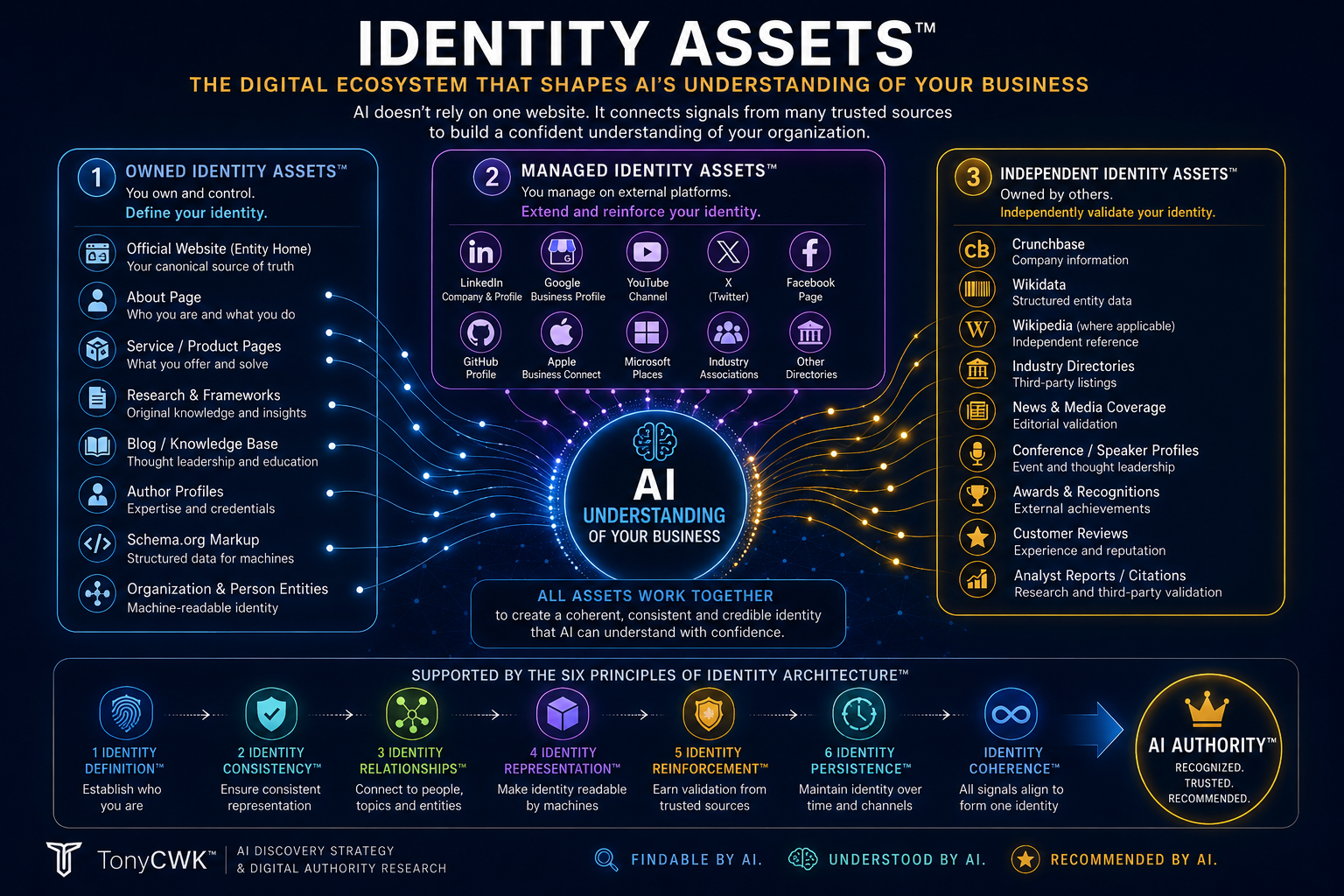
Your LinkedIn profile, Google Business Profile, structured data, research, author pages, reviews, industry directories, media mentions, and business listings all contribute to the identity AI constructs about your organization.
Collectively, these become your Identity Assets™.
Organizations that intentionally design and maintain these assets are better positioned to improve machine understanding, strengthen AI confidence, and support long-term digital authority.
What Are Identity Assets™?
Identity Assets™ are the digital properties that collectively establish, represent, and reinforce an organization’s identity across AI systems.
Unlike traditional digital assets that primarily serve human visitors, Identity Assets™ help machines answer questions such as:
- Who is this organization?
- What expertise do they consistently demonstrate?
- Are they represented consistently across different platforms?
- How are they connected to other trusted entities?
- Is this the same organization appearing across multiple sources?
AI increasingly answers these questions by synthesizing information across an entire digital ecosystem rather than relying on a single source.
The Three Categories of Identity Assets™
Identity Assets™ can be grouped into three categories based on ownership and function.
1. Owned Identity Assets™
Owned Identity Assets™ are digital properties that your organization directly owns and controls.
These assets serve as the primary source of truth for your identity.
Examples include:
- Official website (Entity Home)
- About page
- Service pages
- Product pages
- Framework pages
- Research publications
- Knowledge base
- Blog articles
- Author profiles
- Case studies
- White papers
- Schema.org markup
- Organization and Person entities
Their primary purpose is to define your identity.
They answer fundamental questions such as:
- Who are you?
- What does your organization do?
- What expertise do you possess?
- What problems do you solve?
Without strong owned assets, AI has no reliable foundation upon which to build an understanding of your organization.
2. Managed Identity Assets™
Managed Identity Assets™ are profiles that you maintain on external platforms.
Although hosted by third parties, your organization controls the information published on them.
Examples include:
- LinkedIn Company Page
- LinkedIn Personal Profile
- Google Business Profile
- X
- YouTube
- GitHub
- Apple Business Connect
- Microsoft Places
- Industry association profiles
These assets extend your identity beyond your own website.
They allow AI to verify that the same organization exists consistently across multiple digital ecosystems.
Consistency across these assets helps reduce ambiguity.
When your business name, descriptions, expertise, branding, and contact information remain aligned, AI can more confidently connect these properties into a single entity.
3. Independent Identity Assets™
Independent Identity Assets™ are maintained by external organizations rather than by your business.
Because they exist outside your direct control, they often provide stronger corroborating evidence.
Examples include:
- Crunchbase
- Wikidata
- Wikipedia (where applicable)
- Industry directories
- News articles
- Conference speaker profiles
- Awards
- Analyst reports
- Academic citations
- Customer review platforms
- Partner websites
Independent assets help answer a different question:
Do other trusted sources recognise this organization in the same way it represents itself?
This external corroboration contributes to stronger identity confidence.
Identity Assets™ Across Identity Architecture™
Identity Assets™ are not another pillar of Identity Architecture™.
Instead, they provide the implementation layer that supports every principle.
| Identity Architecture™ Principle | Supporting Identity Assets™ |
|---|---|
| Identity Definition™ | Website, Entity Home, About page, Organization profile |
| Identity Consistency™ | Consistent branding, descriptions, logos, contact information |
| Identity Relationships™ | Authors, founders, partners, products, affiliations |
| Identity Representation™ | Schema.org, Knowledge Graph, sameAs, canonical URLs, Wikidata |
| Identity Reinforcement™ | Reviews, Crunchbase, awards, citations, media coverage |
| Identity Persistence™ | Long-term profile maintenance, historical publications, archived content |
Rather than existing independently, Identity Assets™ operationalise Identity Architecture™.
Why AI Uses Multiple Identity Assets™
Every asset contributes different information.
Your website explains your business.
LinkedIn reinforces professional identity.
Google Business Profile validates business information.
Schema.org provides structured machine-readable relationships.
Crunchbase describes company details.
Reviews demonstrate customer experiences.
Media coverage offers independent recognition.
AI combines these signals to reduce uncertainty.
The more consistently these assets reinforce one another, the easier it becomes for AI to recognise a coherent identity.
Identity Assets™ Form An Ecosystem
Identity Assets™ should never be viewed as isolated platforms.
They function as an interconnected ecosystem.
                 Independent Assets
         (Crunchbase • Reviews • Media)

                    ▲           ▲
                    │           │

Managed Assets ◄──────────────► Owned Assets

LinkedIn                 Official Website
GBP                      Entity Home
YouTube                  About Page
Facebook                 Schema.org
X                        Research
When information flows consistently across this ecosystem, AI develops a clearer understanding of the organization.
Identity Assets™ Are Not Equal
Different assets perform different roles.
| Asset | Primary Role |
|---|---|
| Official Website | Defines identity |
| Entity Home | Canonical source |
| About Page | Explains identity |
| Schema.org | Represents identity to machines |
| Extends professional identity | |
| Google Business Profile | Validates business information |
| Crunchbase | Reinforces company identity |
| Reviews | Reinforce reputation |
| Media Coverage | Provides independent recognition |
| Wikidata | Supports machine-readable entity resolution |
Understanding these different roles helps organizations prioritise where to invest.
Building A Strong Identity Asset Ecosystem
A mature Identity Asset ecosystem should:
- Establish one clear Entity Home.
- Publish original knowledge on owned assets.
- Maintain consistent branding across managed platforms.
- Connect digital properties using structured data and
sameAsrelationships. - Earn independent validation through trusted third-party sources.
- Keep all identity information accurate and current.
- Regularly review identity consistency across every digital property.
The goal is not simply to appear on more platforms.
The goal is to create a connected identity ecosystem that AI can understand with confidence.
Identity Assets™ And AI Confidence
AI systems increasingly rely on corroboration rather than isolated claims.
One webpage describing your expertise is helpful.
The same expertise consistently reinforced across your website, LinkedIn, research publications, business profiles, conference biographies, media coverage, and industry directories creates much stronger identity confidence.
Confidence emerges from consistency.
Consistency emerges from connected Identity Assets™.
Conclusion
The future of digital visibility extends beyond websites and keywords.
As AI becomes responsible for discovering, summarising, comparing, and recommending organisations, identity is increasingly shaped by an ecosystem of interconnected digital assets.
Owned assets define your identity.
Managed assets extend it.
Independent assets reinforce it.
Together, they create a coherent identity that AI can recognise, understand, and evaluate with greater confidence.
Identity is no longer represented by one website.
It is represented by the collective strength of your Identity Assets™.
Key Takeaways
- Identity Assets™ are the digital properties that collectively shape AI’s understanding of an organization.
- They fall into three categories: Owned, Managed, and Independent Identity Assets™.
- Different assets serve different purposes, including defining, representing, extending, and reinforcing identity.
- Identity Assets™ support every pillar of Identity Architecture™ and help AI build confidence through corroborating evidence rather than isolated claims.
- The objective is not simply to increase online presence, but to build a coherent, connected identity ecosystem.
Frequently Asked Questions (FAQ)
What are Identity Assets™?
Identity Assets™ are the digital properties that collectively establish, represent, extend, and reinforce an organization’s identity across AI systems.
Why are Identity Assets™ important?
AI increasingly forms an understanding of organizations by combining information from multiple digital sources. A well-managed Identity Asset ecosystem reduces ambiguity and strengthens machine confidence.
What is the difference between Owned, Managed, and Independent Identity Assets™?
- Owned Identity Assets™ are controlled directly by your organization (website, research, schema, author pages).
- Managed Identity Assets™ are profiles you maintain on external platforms (LinkedIn, Google Business Profile, YouTube).
- Independent Identity Assets™ are maintained by third parties and provide external validation (Crunchbase, Wikidata, reviews, media coverage).
Is an official website still important?
Yes. Your official website serves as your Entity Home and remains the primary source of truth for your identity. However, AI increasingly corroborates information using additional Identity Assets™ across the web.
How do Identity Assets™ relate to Identity Architecture™?
Identity Assets™ are not a separate pillar. They are the implementation layer that supports the six principles of Identity Architecture™ by providing the digital properties through which identity is defined, represented, reinforced, and maintained.
Leave a Reply